

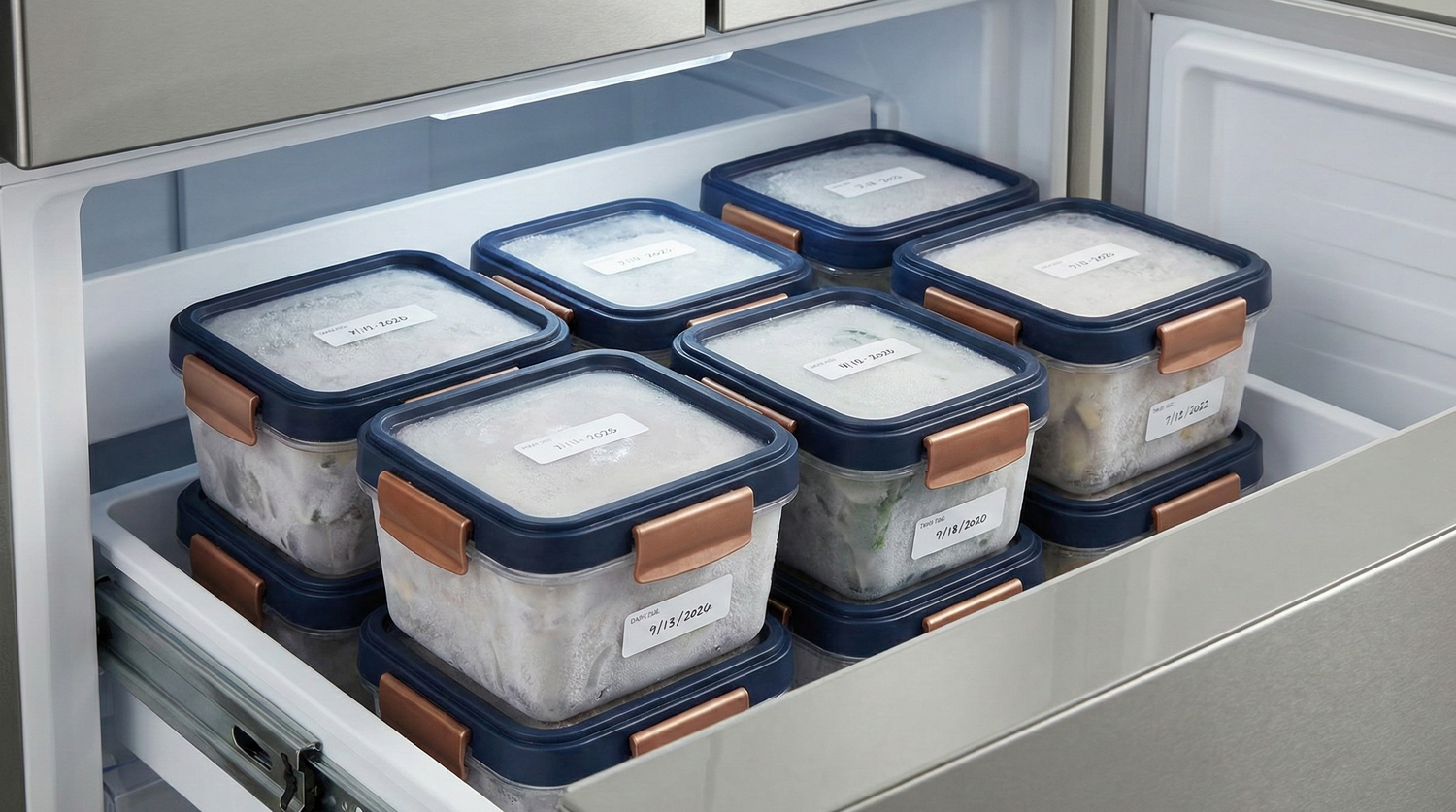
Freezing food is one of the easiest ways to save money and reduce waste—until your freezer turns into a stack of mystery containers and half-dried leftovers.
The right freezer food storage containers help you stack efficiently, label clearly, and keep air out (which is the main cause of freezer burn). This guide covers the best shapes, headspace rules for liquids, and a simple system for freezing meals that actually works.
What causes freezer burn (and how containers help)
Freezer burn happens when food loses moisture and gets exposed to air in the freezer. It shows up as dry, pale, or tough spots and usually comes from poor sealing, too much empty space, or frequent temperature changes.
Good freezer containers help by reducing air contact, protecting food from freezer odors, and keeping portions organized so you open the freezer less.
The best container shapes for the freezer
1) Rectangular or square (best for stacking)
Rectangular and square containers typically make the best use of freezer space. They stack neatly, don’t roll around, and help you build an organized “brick” system.
2) Flat, shallow containers (best for fast freezing and quick defrost)
Shallow containers freeze faster and thaw more evenly. They’re great for cooked grains, shredded meats, chopped veggies, and sauce bases.
3) Round containers (best for soups, but less efficient for space)
Round containers can be convenient for soups and stews, but they usually waste space if you stack many of them. If you use rounds, try to keep the same diameter so stacks stay stable.
Headspace rules: how full should freezer containers be?
Liquids expand as they freeze. If you fill a container to the top, you risk cracked containers, popped lids, or messy seals.
A simple headspace guide
- Soups, broths, sauces: leave noticeable headroom (don’t fill to the rim)
- Stews, chili, curry: leave some headroom—especially if very saucy
- Cooked rice/grains: pack gently (avoid tight compression) and leave a little space
- Baked goods or dry items: headspace matters less, but seal quality still matters
Airtight vs leak-resistant in the freezer
For freezer storage, airtight sealing helps prevent freezer odors and moisture loss. Leak resistance matters less in the freezer (everything sits upright), but strong closure still helps keep air out.
In real use, lids are the weak point—choose containers with lids that close consistently and don’t trap residue in corners.
What to freeze in containers (best foods)
These foods typically freeze well when sealed properly:
- Soups, stews, chili, curry
- Cooked proteins (shredded chicken, cooked ground meat, meatballs)
- Cooked grains (rice, quinoa) and beans
- Sauce bases (tomato sauce, broth concentrates)
- Prepared meals you’ll reheat (portion-sized)
- Chopped onions/peppers and prepped veggies (where appropriate)
How to prevent freezer burn: the simple system
1) Cool first, then seal
Let food cool before sealing and freezing. Sealing hot food creates steam and condensation, which can lead to ice crystals and quality loss.
2) Portion smart (freeze what you’ll actually use)
Freeze in portion sizes you’ll reheat in one go. Most households get better results freezing in small/medium containers rather than one big batch.
3) Press out extra air (where possible)
For foods with lots of air space around them (like cooked meats or chopped items), pack gently to reduce empty pockets. Less air contact = less freezer burn.
4) Label everything
Label with:
- Meal name
- Date frozen
- Portion size (single / family)
- This prevents “mystery containers” and reduces wasted food.
5) Stack by category
Create freezer zones: meals, proteins, grains, sauces. Uniform container footprints make this easy. When your freezer is organized, you open it less and your food stays higher quality.
Glass vs plastic for freezer containers
Both can work if the product is designed for freezing. Choose based on your routine.
Choose glass if you…
- Want a premium, stain/odor-resistant option
- Plan to reheat frequently (once thawed)
- Prefer long-term durability and a consistent look
Choose plastic if you…
- Want lightweight, easy stacking and transport
- Freeze lots of portions and want a larger set
- Prefer less weight when handling multiple containers
Tip: for either material, avoid sudden temperature changes—let containers thaw before exposing them to high heat.
A freezer starter kit (what most households need)
If you’re building a freezer system from scratch, this is a practical place to start:
- 6–8 medium containers (portion meals and leftovers)
- 4–6 small containers (sauces, chopped ingredients, small portions)
- 2–4 shallow/flat containers (fast freezing, easy stacking)
- Optional: 2 larger containers (family-size meals)
Common freezer mistakes (and how to avoid them)
- Freezing in huge containers (hard to thaw and leads to waste)
- Not leaving headspace for liquids (popped lids or cracks)
- Skipping labels (creates freezer clutter)
- Using mismatched shapes (wastes freezer space)
- Sealing hot food (creates condensation and ice crystals)
Next step: choose freezer containers that stack and seal
If your freezer is messy, start with uniform, stackable shapes and a lid system that seals consistently. Freeze in portions you’ll actually use, leave headspace for liquids, and label every container.
