

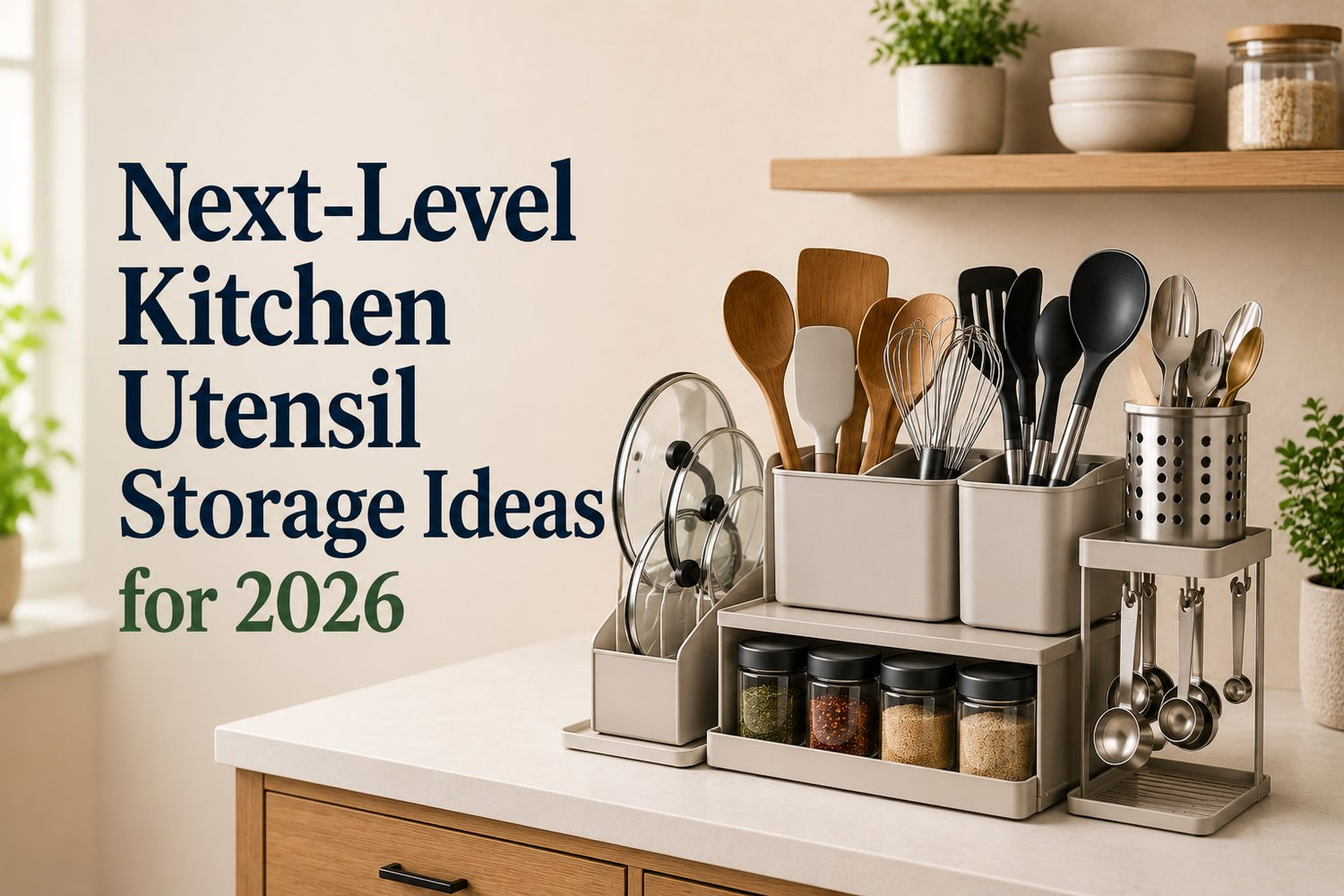
You reach into the utensil drawer for a spatula and come out juggling a whisk, a peeler, two measuring spoons, and a stray bag clip. That kind of friction adds up fast. Prep takes longer, cleanup stalls, and a small kitchen starts to feel cramped before dinner even hits the stove.
Utensil storage works best when it follows the job, not when it just fills a drawer. A paper towel roll needs to be easy to grab with wet hands. Eggs need a stable spot that does not get buried. Leftovers need containers that stack cleanly and stop lids from taking over a shelf. Food scraps need a place to go before they spread across the counter.
That is the angle in this guide. Each idea is tied to a specific kitchen problem and a product that solves it with a clear trade-off. Some options save drawer space but use vertical space. Some make cleanup faster but earn their place only if you cook often. Some help most in small kitchens where every shelf and door has to work harder.
If your fridge is part of the clutter problem, these fridge bins and zone-based storage methods pair well with the systems below.
The goal is not a showroom kitchen. It is a kitchen that moves better from prep to storage to cleanup, with fewer resets in between.
Table of Contents
- 1. Magnet Shelf Rack for Refrigerator - Kitchen Organizer
- 2. Automatic Egg Dispenser Rack – Rolling Storage Holder
- 3. Ceramic Food Storage & Lunch Box with Lid
- 4. GE Kitchen Composter
- Kitchen Storage Ideas: 4-Item Comparison
- Your Kitchen An Organised, Efficient System
1. Magnet Shelf Rack for Refrigerator - Kitchen Organizer

You finish chopping vegetables, reach for paper towels, and the roll is crammed in a drawer behind foil, sandwich bags, and a bundle of stray clips. That kind of friction slows every part of prep. A refrigerator-mounted rack fixes it by turning the unused side of the fridge into a working storage zone.
The Magnet Shelf Rack for Refrigerator - Kitchen Organizer gives light, high-use items a place near the action. The format is practical: a top shelf for slim supplies, a paper towel bar in the middle, and a lower rail for a towel or other lightweight grab-and-go items. In a small kitchen, that matters more than adding another basket inside a cabinet, because it cuts steps during prep and cleanup.
Why this works in busy kitchens
Fridge-side storage is strongest when the problem is access, not capacity. Plenty of kitchens have enough total storage, but the wrong items are in the wrong places. Paper towels, wraps, and tea towels get used in the same few minutes over and over, so they should live beside the main worktop, not buried with backup stock.
I usually recommend this type of rack for kitchens with one clear prep surface and limited drawer width. It keeps soft goods and daily-use supplies out of utensil drawers, which leaves those drawers for the tools that need containment, such as peelers, spatulas, and measuring spoons.
Placement rule: Mount it on the side of the fridge that faces your prep area. If you have to step around an open door or another person to reach it, the setup will annoy you within a week.
What it stores best
This rack does its job well when you treat it like a daily-access station, not a spare cupboard. Weight matters. So does frequency.
- Top shelf: foil, cling wrap, small seasoning jars, or slim containers
- Middle bar: the active paper towel roll
- Lower rail: a tea towel, oven mitt, or a light item with a loop
The outside of the fridge should also work with the inside. If you are trying to reduce crowding across the whole refrigerator zone, GrifGlo's guide on how to organize your fridge with bins and zones is useful, and so is this practical article on choosing the right egg holder in fridge storage setup.
Where it beats a drawer
A magnetic rack wins on visibility and speed. You can tear off a sheet, grab the towel, and put wraps back with one hand while cooking. A drawer still makes more sense for heavy utensils, sharp tools, and anything that slides into a tangled pile.
There is a trade-off. Fridge storage is always visible, so it can look messy fast. The fix is straightforward. Keep only the items you reach for every day on the rack, and store refills somewhere else.
One caution is worth following from the start. Do not load the lower rail with heavy metal tools. Magnetic racks are best for light-duty storage. Once the rack starts shifting, scraping, or feeling overloaded, people stop trusting it, and the system falls apart.
2. Automatic Egg Dispenser Rack – Rolling Storage Holder

You open the fridge to make breakfast, the egg carton is perched on top of leftovers, it slips forward, and now the shelf needs a quick reshuffle before you can even reach the mixing bowl. That kind of friction spreads. Prep takes longer, food gets parked in the wrong place, and nearby kitchen tools end up stranded on the counter because the fridge zone is already crowded.
The Automatic Egg Dispenser Rack – Rolling Storage Holder helps by turning a bulky carton into a compact, easy-access lane. Its gravity-fed track rolls eggs forward one at a time, and the 2-tier layout uses height better than a flat carton. The anti-slip base and no-assembly format also matter. A fridge organiser has to be easy to place and easy to trust, or it gets pushed aside within a week.
The specific problem it solves
Egg cartons waste usable shelf shape. They are wide, they stay wide even when half empty, and they block the sightline across the shelf. In practical terms, that means more shuffling, more forgotten food, and more hesitation during cooking.
A dispenser solves a narrow but common storage problem. It gives eggs a fixed home, frees side space for shorter containers, and makes it easier to keep one shelf dedicated to fast-grab items. That matters if the goal is a kitchen that flows from prep to cleanup without constant reset work. If you are comparing container formats across the whole kitchen, this guide on choosing food storage containers for everyday use helps frame what deserves dedicated storage and what does not.
GrifGlo's overview of an egg holder in the fridge is also useful if you want to compare format and placement options before committing.
Best use cases and trade-offs
This organiser earns its space in kitchens where eggs are used several times a week, where more than one person cooks, or where fridge shelves are shallow and every inch counts. Shared households benefit most because clear storage reduces the low-level habit of setting things down “for now” and leaving them there.
The trade-off is simple. This is a single-purpose tool. If eggs are only an occasional purchase, the footprint may feel wasteful. If eggs are part of breakfast, baking, or meal prep every week, a dedicated holder usually beats a soft carton that slides around and collects condensation.
- Best for: Frequent egg use, family kitchens, shared homes, and narrow shelves
- Less ideal for: Occasional egg buyers or fridges already divided into fixed bins
- Not a fix for: General fridge clutter or poor container habits
A good organiser should remove one repeated annoyance. That is enough to justify its space.
How to place it for maximum benefit
Placement decides whether this rack saves effort or adds one more obstacle. Set it on a shelf that is easy to reach without moving tall bottles, meal-prep containers, or produce drawers. In most kitchens, the best spot is the shelf tied to breakfast items or the shelf closest to the main prep path.
Keep open space beside it. Do not wedge deli tubs against the track or let snack packs pile up around the front edge. A rolling dispenser works well when eggs move forward freely and the shelf still has a clear visual boundary.
Clean and dry the shelf before setting it down so the anti-slip base can grip properly. Then leave it alone for a few days and watch how the household uses it. If shorter family members avoid the shelf, move it lower. If leftovers start crowding it, shift those to another zone instead of letting the egg holder become overflow parking.
That is the larger point. Good utensil storage is not only about where spatulas and tongs live. It also depends on whether ingredient storage creates a clean work path. When eggs have a stable, compact home, the fridge opens faster, the counter stays clearer, and cleanup has one less mess cycle to absorb.
3. Ceramic Food Storage & Lunch Box with Lid

Dinner is done, but the kitchen still looks busy. The pan is washed, yet the counter holds a leftover bowl, a loose lid, a serving spoon, and tomorrow's lunch half-packed. That after-dinner reset is where many kitchens lose order.
A dedicated food container can help with that routine, but this section needs a practical caveat. The product details previously listed for this item were not verifiable from the catalog, so they should not be treated as buying guidance. The useful point here is the storage problem itself: leftovers create utensil drift when there is no clear container system for packing, stacking, and refrigerating food.
The challenge is not leftovers. It is leftover handling.
In real kitchens, clutter often builds after cooking. A household uses one container for rice, another for chopped vegetables, a third for lunch, then spends the next day hunting for lids or re-plating food because the original container was the wrong size. Every extra transfer usually means one more spoon, one more knife, and one more item left by the sink.
The fix is consistency.
Use a small number of container types and assign each one a job. One format for packed lunches. One for single-portion leftovers. One for prep ingredients that will be used within a day or two. That reduces decision fatigue and keeps serving utensils from spreading across the counter because the next step is obvious.
Before buying more pieces, GrifGlo's guide on how to choose food storage containers gives a solid framework for matching container size to actual kitchen use.
What works well, and what does not
Ceramic containers can be a good fit for households that move food from fridge to table and care about a cleaner look on open shelves. They usually feel more stable than thin plastic, and many people prefer them for foods that stain or hold odour.
They also have trade-offs. Ceramic is heavier, chips if handled roughly, and is less forgiving in homes where children pack their own lunches or containers get stacked in deep drawers. In those kitchens, lighter materials often hold up better.
A simple rule helps here:
- Choose ceramic for planned leftovers, table service, and visible shelf storage.
- Choose lighter containers for school lunches, grab-and-go snacks, and high-turnover weekday use.
- Keep only the sizes you reach for every week.
That last step matters more than people expect. I have seen well-organised kitchens fail because the cupboard still held twelve older containers "just in case." If the drawer is crowded with mismatched pieces, even a good storage product turns into one more thing to sort around.
How to set up the system so utensils stay put
Start at the moment food leaves the pan. Portion directly into the container you intend to refrigerate. Store the matching lid in the same zone, not in a separate drawer across the kitchen. Keep your packing spoon or serving utensil in the nearest drawer to that zone, then return it immediately after use.
This creates a cleaner path from prep to storage to cleanup. The container has a defined role, the lid is easy to find, and fewer utensils get stranded on the counter overnight.
For kitchens trying to improve utensil storage, that is the main lesson here. Good organisation is not only about where spatulas and tongs live. It also depends on whether leftover storage is simple enough that the same two or three tools can do the job and go straight back where they belong.
4. GE Kitchen Composter

This section needs a correction. The product details previously included for the GE Kitchen Composter could not be verified against the catalog, so they should not be used as buying guidance.
The storage problem it was trying to address is still real. In busy kitchens, prep waste often creates the same clutter chain every home organiser sees. Onion skins stay on the board, vegetable trimmings collect beside the sink, and the utensil you need next ends up balancing on a damp patch of counter because the work area is already crowded.
That challenge matters for utensil storage because waste flow affects where tools land during cooking. If scraps have no defined drop point, bench scrapers, paring knives, peelers, and mixing spoons drift out of their zones and stay there until cleanup. The kitchen feels disorganised long before any drawer is full.
A dedicated composting appliance can solve that for some households, but only if the product details are clear and verifiable. Without confirmed specifications, the safer recommendation is to plan the same function with a simple scrap system that keeps the prep-to-cleanup path tidy.
A practical substitute for the same kitchen problem
Use a compact scrap bowl or lidded food-waste caddy near the cutting area. Place it close enough for one-handed use, but not in the spot where you plate food or set down hot pans. That single decision keeps waste away from the utensil zone and reduces the number of tools left on the counter between tasks.
I usually set this up in one of three places:
- Beside the chopping board, if the counter run is long enough
- Near the sink corner, if prep happens between washing and chopping
- At the far end of the counter, if the main prep zone is tight
The trade-off is simple. A countertop waste container takes up visible space, but it often gives back more usable room than it costs because the rest of the surface stays clearer.
What to watch before adding any waste station
Avoid putting a scrap container where it blocks your primary drawer, crowds the hob side, or forces you to reach across clean dishes. That creates a second problem instead of fixing the first.
Choose a container that is easy to rinse and quick to empty. Complicated systems often fail in everyday kitchens because no one wants another item that needs careful maintenance after dinner. For utensil storage, the goal is not to add another gadget. The goal is to stop waste from taking over the same few inches of counter your tools need every day.
If the GE product listing is updated later with confirmed specifications, it could be assessed on its actual merits. Until then, treat this category as a workflow solution first and a product choice second.
Kitchen Storage Ideas: 4-Item Comparison
A comparison only helps if the products in it are real, verified options. For this roundup, the practical side is straightforward: keep the confirmed GrifGlo item, and treat the rest of the article as a set of storage approaches matched to specific kitchen problems.
| Product | Kitchen Challenge It Solves | Setup and Space Needs | Best Fit | Limits to Check Before Buying | Why It Earns a Place |
|---|---|---|---|---|---|
| Automatic Egg Dispenser Rack – Rolling Storage Holder | Egg cartons slide around, get stacked badly, and waste shelf width in the fridge | Low setup. Place it on a flat fridge shelf and load from the top. Needs enough depth and height clearance for eggs to roll properly | Busy households, shared fridges, anyone who buys eggs regularly | Works best on a stable shelf. Measure shelf height first, especially in compact fridges with low-clearance shelves | Creates a fixed home for eggs, improves visibility, and makes one small part of the fridge easier to maintain |
That narrower table is more honest and more useful.
The bigger lesson is how to compare kitchen storage in real homes. Start with the blockage in your workflow, not the promise on the packaging. If eggs keep getting buried behind leftovers, a dispenser can help. If the problem is utensils spreading across the prep zone, compare drawer inserts, crocks, under-shelf baskets, or wall-mounted rails that are available and measured for your space.
I use three filters before I recommend any storage piece:
- Does it remove friction at the exact point where the mess starts?
- Does it fit the kitchen without creating a second problem, such as blocked shelves or crowded counters?
- Is it simple enough that everyone in the household will keep using it after the first week?
That last point matters more than people expect. A clever organiser that slows down unloading groceries or cleaning shelves usually gets abandoned.
For this article, the verified comparison is strongest where the product data is confirmed and the use case is clear. The egg dispenser suits one specific challenge well: keeping a frequently used item visible, contained, and easy to restock. The other categories discussed earlier in the article still matter, but they should only be compared with confirmed products and checked dimensions, materials, and maintenance requirements.
Your Kitchen An Organised, Efficient System
Dinner prep starts, and the weak spots show up fast. The paper towels are across the room, eggs are buried behind jars, leftover containers have no matching lids, and vegetable scraps start crowding the cutting board. Kitchen utensil storage ideas only help when they fix those exact points of friction in the order you use the room.
That system mindset lines up with earlier CKBIA reporting on how Canadian households organise kitchens. Stable homes for everyday items matter more than adding one more organiser. I see the same pattern in real kitchens. The spaces that stay tidy are the ones where prep, cooking, storage, and cleanup each have an obvious landing spot.
Choose each tool by the problem it removes.
A magnetic rack earns its place when the prep zone is short on drawer space and the fridge side can carry daily-use items. An egg dispenser makes sense when fridge shelves lose visibility and cartons keep getting shuffled around. Matching food containers solve a different problem. They reduce lid hunting, stack better, and make leftovers easier to put away before clutter spreads. A kitchen composter helps when peelings and scraps are what interrupt the flow from chopping to cleanup.
There is a trade-off with every one of these. Exterior storage can make a kitchen feel busier if the fridge already looks crowded. Egg dispensers take up dedicated shelf width. Uniform containers work best when you commit to replacing older mismatched pieces. Composters add one more appliance to maintain. Good storage is rarely about buying more. It is about removing a repeated annoyance without creating a new one.
Start with the bottleneck you notice every day.
If wraps, towels, and small tools keep drifting over the counter, fix access near the prep area first. If leftovers pile up in random tubs, standardise containers before buying any new drawer organisers. If scraps slow you down while cooking, improve waste handling before you touch cabinet storage.
Remember, a practical kitchen isn't the one with the most organisers. It's the one where the next step is obvious: grab, use, return, reset.
If you're comparing kitchen organisation tools and want clearer guidance before buying, GrifGlo is a useful place to start. It focuses on practical fit, real-life usability, and decision-friendly guides, so you can build a kitchen system that suits your space instead of collecting organisers you won't keep using.

Leave a comment
This site is protected by hCaptcha and the hCaptcha Privacy Policy and Terms of Service apply.