

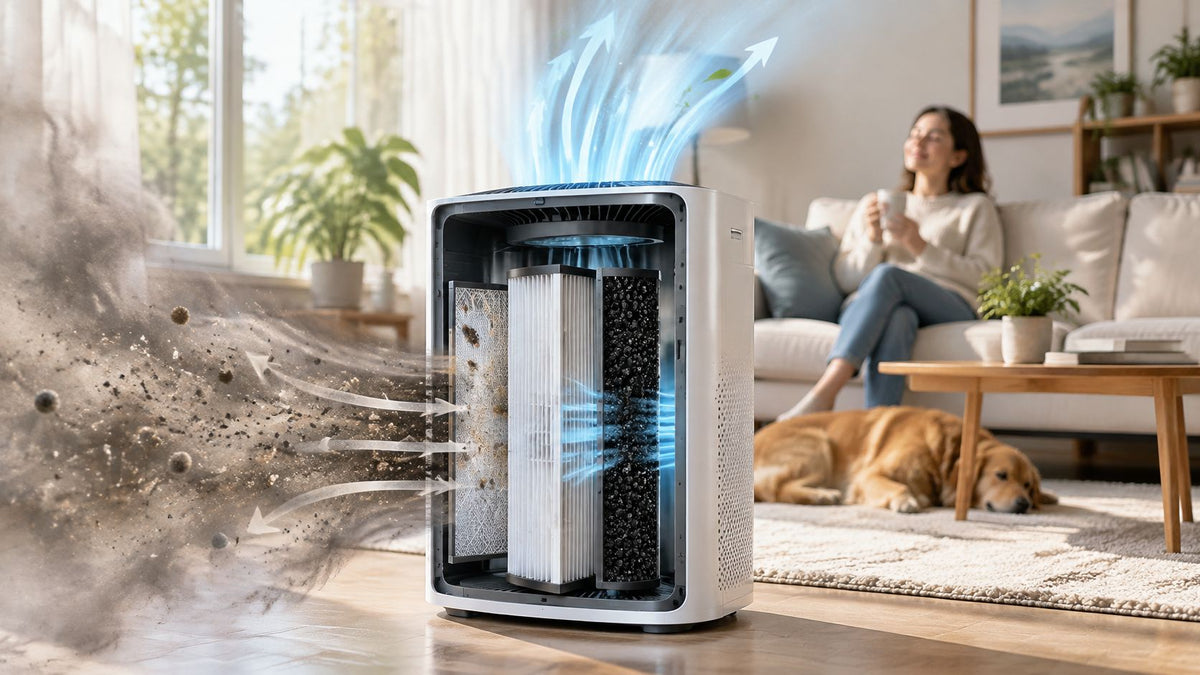
An air purifier works when its fan pulls room air through a filter that traps suspended particles and returns cleaner air, lowering the room's particle level gradually with each pass. It doesn't scrub the room in one sweep, and it only cleans air that reaches the machine.
That gradual part is where most disappointment starts. You set a unit in the corner during a hazy afternoon, the air still smells of smoke twenty minutes later, and you wonder if it's doing anything at all. In most cases, it is. The question is whether it's moving enough air, often enough, through the right kind of filter for the particles you're trying to remove.
Once you understand air purifier how it works as a loop, not a one-time treatment, the buying decisions get simpler. You stop chasing filter percentages on the box and start checking airflow, filter efficiency, and room fit. You also get clearer about limits. A purifier can lower airborne particles in the room where it runs. It can't seal a leaky window, cancel out frying smoke as fast as a pan produces it, or remove every gas with a thin carbon pad.
Table of Contents
- How an Air Purifier Cleans the Air You Breathe
- Inside the Machine from Fan to Outlet
- Filter Technologies Compared Across HEPA, Carbon, Ionizers and UV
- Matching Room Size to Clean Air Delivery Rate
- Ozone and Electronic Cleaners Are Not Always Better
- Maintenance, Airflow and Real-World Limits
How an Air Purifier Cleans the Air You Breathe
Say wildfire smoke has drifted into your living room, or you've just fried fish and the kitchen air feels thick. You close the windows, turn on a purifier, and wait. The machine pulls room air in with a fan, passes it through filter media that trap suspended particles, and pushes cleaner air back out. Then it does it again.
Think of a colander that keeps stirring a pot. Each pass catches some of what's floating in the water. The water gets clearer over time, but one pass through the colander doesn't empty the pot. A purifier works the same way in a room. It lowers the particle concentration step by step as more room air cycles through it.
That means three limits are built in from the start.
- It can't clean instantly: Most rooms need a few hours of continuous running before the difference is clear, especially after a strong source fills the air.
- It can't outrun an active source: If food is still smoking, a candle is still burning, or smoke keeps leaking in, the purifier is removing particles while new ones arrive.
- It only treats air that reaches it: A unit tucked behind a couch in one room won't do much for a closed bedroom down the hall.
A purifier doesn't create clean air from nothing. It recirculates the air you have and removes a share of particles on every pass.
That's also why a purifier isn't the same tool as ventilation or moisture control. If you're sorting out dampness, stale air, and particles at the same time, the comparison of an air purifier versus a dehumidifier helps you separate which problem each device solves.
Hold on to one simple mental model. Airflow decides how often room air reaches the filter. Filter efficiency decides how much gets captured when it gets there. Fit for the room decides whether those two add up to a noticeable result.
Inside the Machine from Fan to Outlet
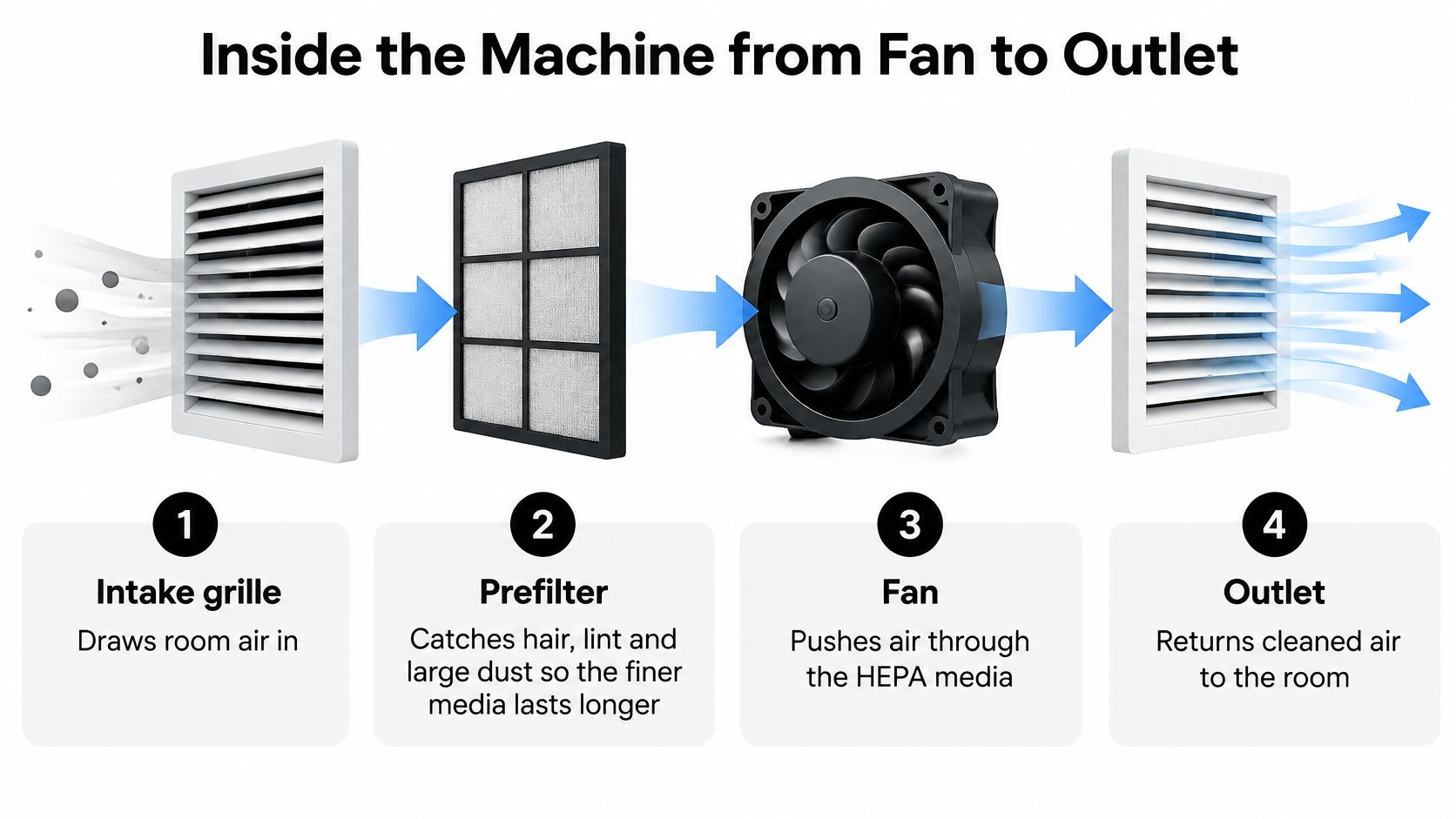
Follow one parcel of air through a typical portable unit and the design stops feeling mysterious. It enters, gets filtered in stages, and leaves cleaner than it arrived.
The flow looks like this inside most mechanical purifiers.
The air path step by step
First, the intake grille draws room air in, usually from the front, sides, or back of the housing. Next, a prefilter catches hair, lint, and large dust. That coarse stage looks unimpressive, but it protects the finer media behind it, so the expensive filter doesn't clog with pet hair in a few weeks.
Then the fan pushes or pulls air through the main filter. In a mechanical unit, that's usually HEPA media, a dense mat of fibres designed to capture very small particles. If the unit has an odour stage, air also passes through activated carbon, which adsorbs some gases and smells onto its surface. Finally, the fan pushes the cleaned air out through the outlet, often at the top, so it mixes back into the room and starts the loop again.
The California Air Resources Board fact sheet on indoor air cleaners and wildfire smoke recommends mechanical cleaners using HEPA filters because they collect very small particles effectively without intentionally producing ozone, and it reports that properly selected air cleaners can reduce indoor particle concentrations by more than 90% in some cases during wildfire smoke episodes. That result depends on the whole system working together, not on filter media alone.
How HEPA fibres actually catch particles
HEPA media don't work like a kitchen sieve with holes smaller than every particle. Capture happens three ways. With interception, a particle follows the airflow close enough to a fibre that it touches and sticks. With impaction, a heavier particle can't turn as sharply as the air around a fibre, so it travels straight and strikes the fibre. With diffusion, very small particles jiggle erratically as air molecules bump them, and that random movement makes them collide with fibres.
Why tiny particles still get caught: The smallest particles move the most erratically, so diffusion gives them more chances to hit a fibre, not fewer.
The fan matters as much as the media because it sets throughput. On high speed, room air passes through the filter far more often, so the room level drops faster. On low speed, the same excellent filter sees less air and delivers less cleaning. A weak fan or a clogged filter can make a good filter perform poorly in a real room.
A short demonstration helps you see the intake-to-outlet path rather than just picturing it.
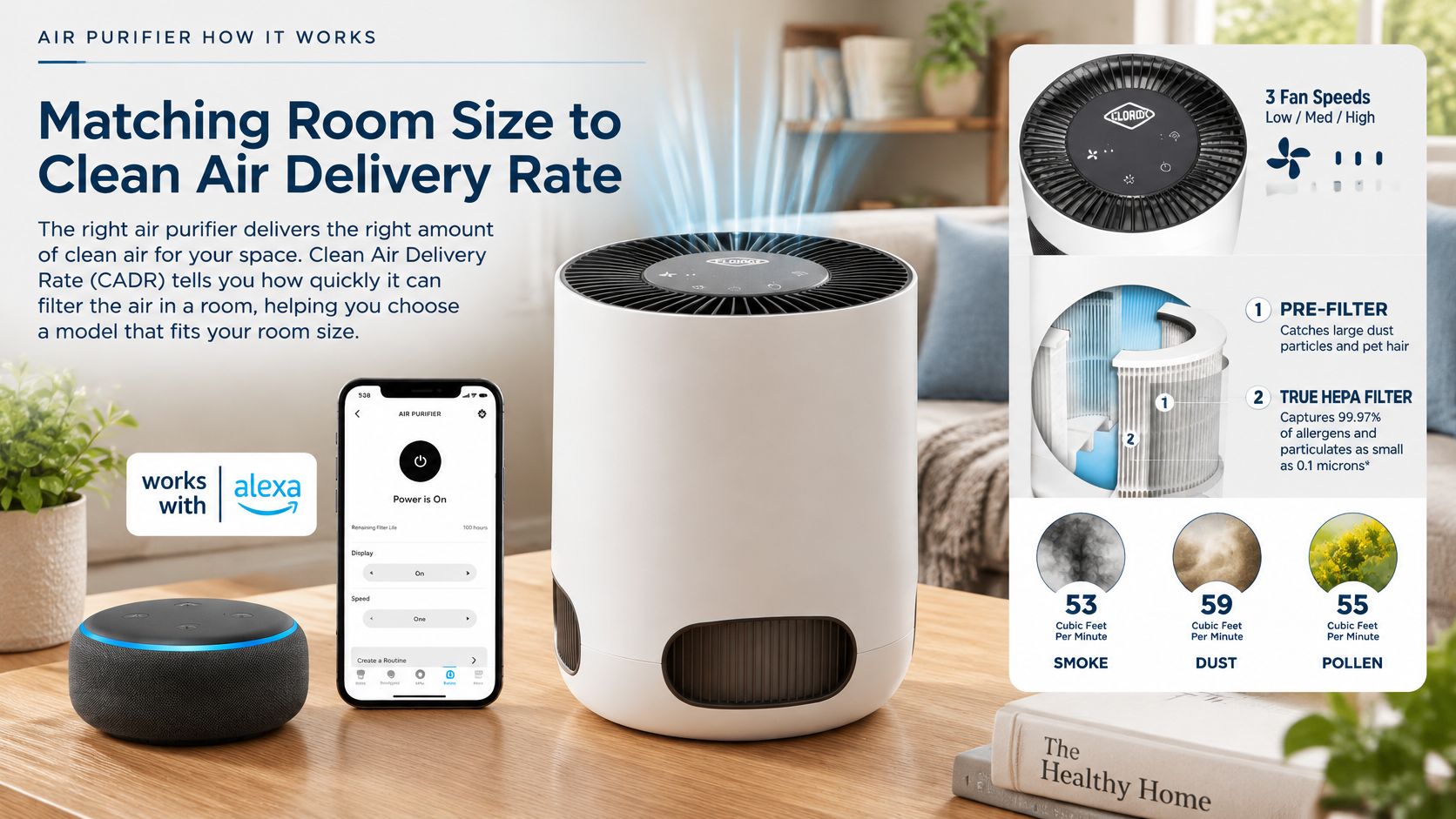
A tabletop unit such as the CLOROX 11021 Alexa Smart Tabletop True HEPA Air Purifier follows the same basic path, with voice control through an Alexa smart speaker or the Alexa app as a control feature rather than a different cleaning method. In normal use, expect steady airflow from the outlet, visible dust on the prefilter after weeks of running, and no unusual sharp smell. If the airflow feels faint on a setting that used to feel strong, check the filters first.
Filter Technologies Compared Across HEPA, Carbon, Ionizers and UV
| Technology | Captures | Gases and odours | Ozone risk | Role in a purifier |
|---|---|---|---|---|
| HEPA filter | Fine particles, smoke, dust, pollen, mould fragments, bacteria | No | None | Core particle stage |
| Activated carbon | Some gases and odours, as a limited sorbent | Yes, but capacity is finite | None | Odour and gas stage only |
| Ionizer or electrostatic precipitator | Particles charged so they collect on plates or surfaces | Not reliably | Can generate ozone | Use only with low-ozone certification |
| UV-C lamp | Microbes exposed to light, not particles | Not reliably | Low when the lamp is certified ozone-free | Supporting role, not a substitute for HEPA |
HEPA is the particle workhorse
Health Canada's advice on choosing a portable air purifier states that HEPA filters remove at least 99.97% of particles at or above 0.3 micrometres under the applicable test condition. That figure describes what the filter media does in a controlled test. Your room result also depends on air leakage around the filter frame, new particles being generated indoors, fan speed, placement, and how many equivalent air changes the unit delivers.
Particles both larger and smaller than that test size are still captured as air moves through the fibre mat, so 0.3 micrometres marks the hardest size to catch rather than a cutoff. The practical point is simpler. If your main problem is smoke, dust, pollen, or other airborne particles, HEPA media do the core work. Everything else is an accessory to that stage, not a replacement for it. If you want the filter layers explained in product terms, see the guide to how an air purifier filter is built.
Carbon, ionizers, and UV solve narrower problems
Activated carbon confuses people because it looks like a filter but behaves like a sponge with a limit. Its porous surface adsorbs some gases and odours. Once those sites fill up, it stops doing useful work and needs replacement. A thick carbon bed holds more than a thin scented pad, so two units that both say "carbon filter" can perform very differently on cooking smells or stale air.
Ionizers and electrostatic precipitators work differently. They give particles an electrical charge so particles stick to collection plates or to nearby surfaces such as walls and furniture. That can remove some particles from the air, but it may deposit them in the room rather than trapping them inside a filter you throw away. Because the cleaning happens electrically rather than mechanically, these designs raise a separate question about what they emit while running, and the ozone section examines that trade-off in detail.
A UV-C lamp doesn't pull particles out of the air at all. It exposes microbes that pass close to the lamp to ultraviolet light. If dust, pollen, and smoke are your concern, UV doesn't do that job. Treat it as a supporting feature in a unit that already has strong particle filtration, never as the reason to buy one.
Matching Room Size to Clean Air Delivery Rate
A purifier can carry the best filter label on the shelf and still leave a room hazy. The deciding factor is Clean Air Delivery Rate, or CADR, the number that connects the filter to the room. It combines how efficiently a device removes particles with how much air it moves, so it tells you more about whole-room performance than any filter claim by itself. A superb filter paired with a tiny fan delivers little clean air. A strong fan pushing air through a weak filter doesn't help much either. CADR captures both halves at once.
The U.S. Environmental Protection Agency guidance on preparing for smoke and heat recommends selecting a portable cleaner with a tobacco-smoke CADR of at least two-thirds of the room's floor area in square feet for wildfire smoke. Use the smoke CADR rather than the largest number on the box, because smoke represents the fine particles that are hardest to clean.
| Room floor area (sq ft) | Minimum smoke CADR (cu ft/min) | Practical note |
|---|---|---|
| 150 | 100 | Small bedroom or home office |
| 300 | 200 | Living room, worked example below |
| 450 | 300 | Open-plan area, check ceiling height |
The 300-square-foot example
A 300-square-foot living room needs a smoke CADR of at least 200 cubic feet per minute: multiply the floor area by two-thirds and that's the target. A unit rated well below that may still help near the machine, but it'll struggle to bring the whole room down during a smoke event.
A compact tabletop unit gives you a sense of scale for smaller spaces.
If you measured in square metres, convert first. Multiply square metres by 10.76 to get square feet, then apply the two-thirds rule. Ceiling height changes the math too, because CADR ratings are built around standard ceiling heights. A room with much higher ceilings holds more air, so you need additional capacity to get the same rate of cleaning.
Buy for the speed you'll actually tolerate. CADR is rated at the unit's high setting, so a purifier you only run on low because it's loud delivers less clean air than its label suggests.
Placement completes the sizing process. Position the unit in the room where you spend the most time during a smoke event, keep the doors closed when possible, and run it on high while particle levels are raised. Kitchens add cooking bursts on top of room size, so the unit works best close to the cooking zone without blocking the space; the guide to choosing an air purifier for kitchen use covers that layout problem in detail. Sizing also works room by room. Walls and doorways break up airflow, so a unit sized correctly for the living room won't clean two bedrooms through open doors, and one room per unit is the practical rule.
Ozone and Electronic Cleaners Are Not Always Better
A renter with asthma has two units with the same HEPA rating on the box. One moves air through a fan and filter. The other adds an electronic stage that is on by default, easy to miss in the manual, and capable of releasing ozone while it runs.
Ozone is a lung irritant. The Health Canada guidance on fine particulate matter and indoor air notes that Canada's residential guideline sets an eight-hour maximum exposure limit of 20 ppb, equivalent to 40 µg/m³, and warns that some electrostatic precipitators and other air-cleaning devices can release ozone. The same guidance describes ozone reacting with household volatile organic compounds to form by-products such as formaldehyde and ultrafine particles. At residential output levels, ozone is a poor cleaner and can irritate airways.
The label problem is subtle. A HEPA claim describes particle capture. It says nothing about whether an ionizer, electrostatic plate, or UV lamp sits downstream, whether that stage defaults to on, or whether you can shut it off. An electronic stage also does not raise CADR by itself; airflow still decides how fast the room clears. Two listings can read alike while one machine stays mechanical and the second needs a setting change before it is asthma-friendly.
Four checks before you buy
- Look for independent low-ozone certification: Check for certification to the relevant Canadian CSA ozone standard rather than trusting a marketing badge.
- Read the manual for electronic stages: Find out whether an ionizer or electrostatic stage is fitted, whether it is on by default, and whether you can turn it off.
- Avoid intentional ozone generation: Skip any device that produces ozone on purpose for home use, whatever the odour claims say.
- Treat carbon as limited: Activated carbon is a replaceable sorbent with finite capacity, so it can reduce some gases for a period and then saturate.
Those checks make the renter's choice clear. The mechanical unit removes particles without asking her to remember to disable a feature every day.
If you already own an electronic cleaner, track what the room is doing. A separate monitor helps you watch particle levels where you sleep or work, and the guide to choosing an air quality monitor for home use explains what those readings can and cannot tell you.
Maintenance, Airflow and Real-World Limits
A purifier rarely fails all at once. It fades. Dust loads onto the prefilter and HEPA media, resistance rises, and airflow falls while the fan still sounds busy. Health Canada's guide to improving indoor air quality in your home describes a Canadian government research study that found particle CADR and airflow declined as dust accumulated, and in HEPA-based units the CADR loss was traced to reduced airflow. A clogged filter works like a kinked garden hose. The pump keeps running, but the flow drops.
Filtration has a second limit no cleaning schedule fixes. Standard particle filters do not remove gases, so odours and volatile organic compounds need a separate, adequately sized activated-carbon stage plus source control. If paint, cleaning products, or a gas appliance are the source, ventilation when outdoor air is clean and removing the source do work a HEPA filter can't.
A routine that protects airflow
- Check the prefilter monthly: Vacuum or wash it only as the manual describes, and let a washable prefilter dry fully before refitting it.
- Refresh carbon when odours return: Returning smells are your saturation signal. Check charcoal filters often and replace them as needed.
- Replace HEPA on schedule: Follow the manufacturer's interval, or replace sooner when airflow drops and cleaning the prefilter doesn't restore it.
- Keep intake and outlet clear: Leave the clearance the manual specifies, and don't let curtains or furniture block the grille.
Washable and permanent are not the same thing. The step-by-step in the guide on how to clean an air purifier filter is worth reading before you wash anything, because water damages some HEPA media.
Filter-cost check: Before you buy, price the replacement HEPA and carbon filters, confirm they're easy to order, and set a reminder for each interval. A cheap unit with costly, scarce filters isn't cheap to own.
Real rooms add load no filter was rated for. Air leaks under doors and around windows. Frying, candles, wood stoves, and cleaning sprays keep feeding particles into the space the unit is trying to clean. During a wildfire event, run the unit continuously in your main room with windows closed, then inspect the prefilter and HEPA filter once the air clears, because heavy smoke can load media fast.
The ownership math comes down to airflow. A purifier delivers its rated CADR only while air moves freely through it, so monthly prefilter checks, timely carbon swaps, and clear grilles are what keep that rating real in the second year, not just the first week.
GrifGlo groups air purifiers and other home appliances into clear categories with plain sizing and comparison guidance, so you can match smoke CADR, filter type, and room fit without sorting through an overwhelming catalogue. Visit GrifGlo to compare your options, check replacement filter details before you commit, and choose a unit that fits the room where you'll run it.

Leave a comment
This site is protected by hCaptcha and the hCaptcha Privacy Policy and Terms of Service apply.