

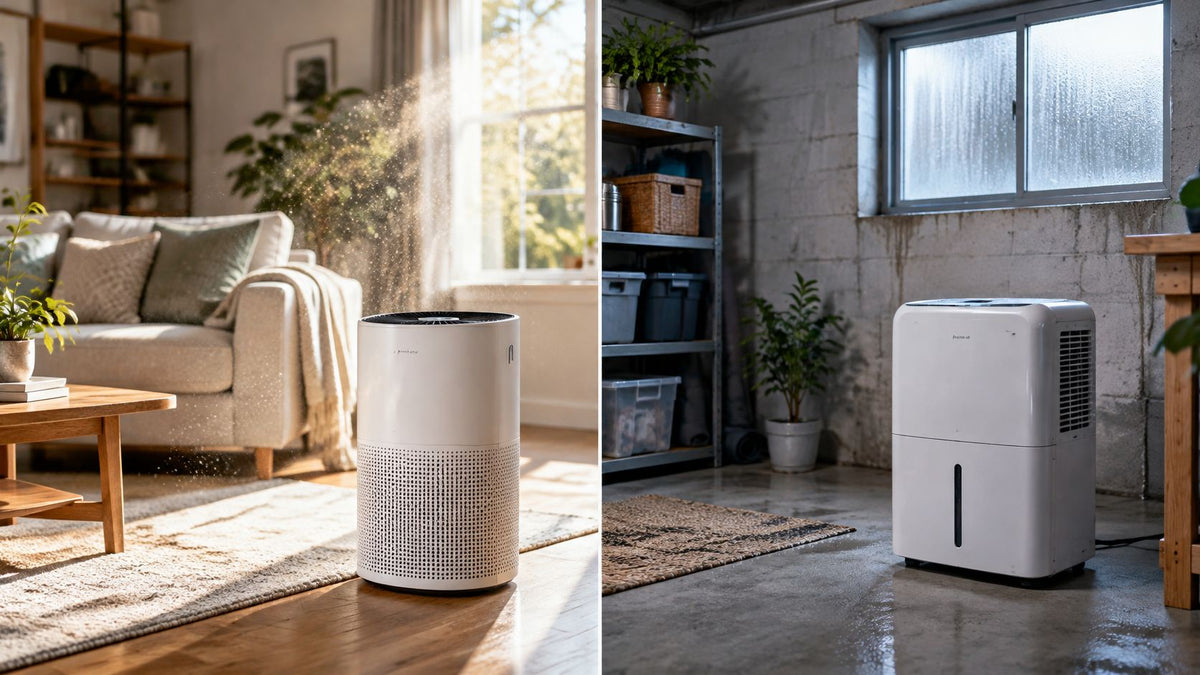
An air purifier and a dehumidifier answer different questions: are particles in the air, or is there excess moisture? Measure the problem first, then choose the device that addresses it.
The phrase air purifier vs dehumidifier can suggest a contest over which produces “better air.” That framing obscures the decision. Smoke, dust and pollen are particles; damp walls, window condensation and a musty basement point to moisture. A dehumidifier can reduce water vapour, but it does not remove smoke particles.
California's Legislative Analyst's Office found that estimated annual PM2.5 emissions from the state's wildfires were generally higher in the seven years ending in 2020 than in 2007 to 2013. The finding concerns particle pollution, not indoor humidity, and does not mean a moisture-control device can address it. California's Legislative Analyst's Office
Both devices may be sold for improving indoor conditions, but their jobs differ. The useful choice starts with identifying the hazard and checking it: smoke season calls for a particle-focused plan, while a damp basement calls for moisture control. A rental unit may require a different setup again, depending on which problem is present and what changes the occupant can make.
Table of Contents
- Air Purifier and Dehumidifier Side by Side
- Diagnose Particles or Moisture Before You Buy
- Health Stakes of Fine Particles and Damp Air
- Smoke Season, Damp Basements and Rental Units
- Small Offices, Hospitality and Bulk Buying
- Running Costs, Noise and Upkeep Over a Year
- Sizing the Device and Checking Specs Before You Buy
Air Purifier and Dehumidifier Side by Side
The two machines move air for different outcomes. An air purifier draws room air through a true HEPA filter, often paired with activated carbon to reduce odours and some gases, then returns air with fewer particles. A dehumidifier sends air over a refrigerant coil or through a desiccant wheel to remove water vapour. For a closer look at what an air purifier is used for, compare its particle-removal role with moisture control.
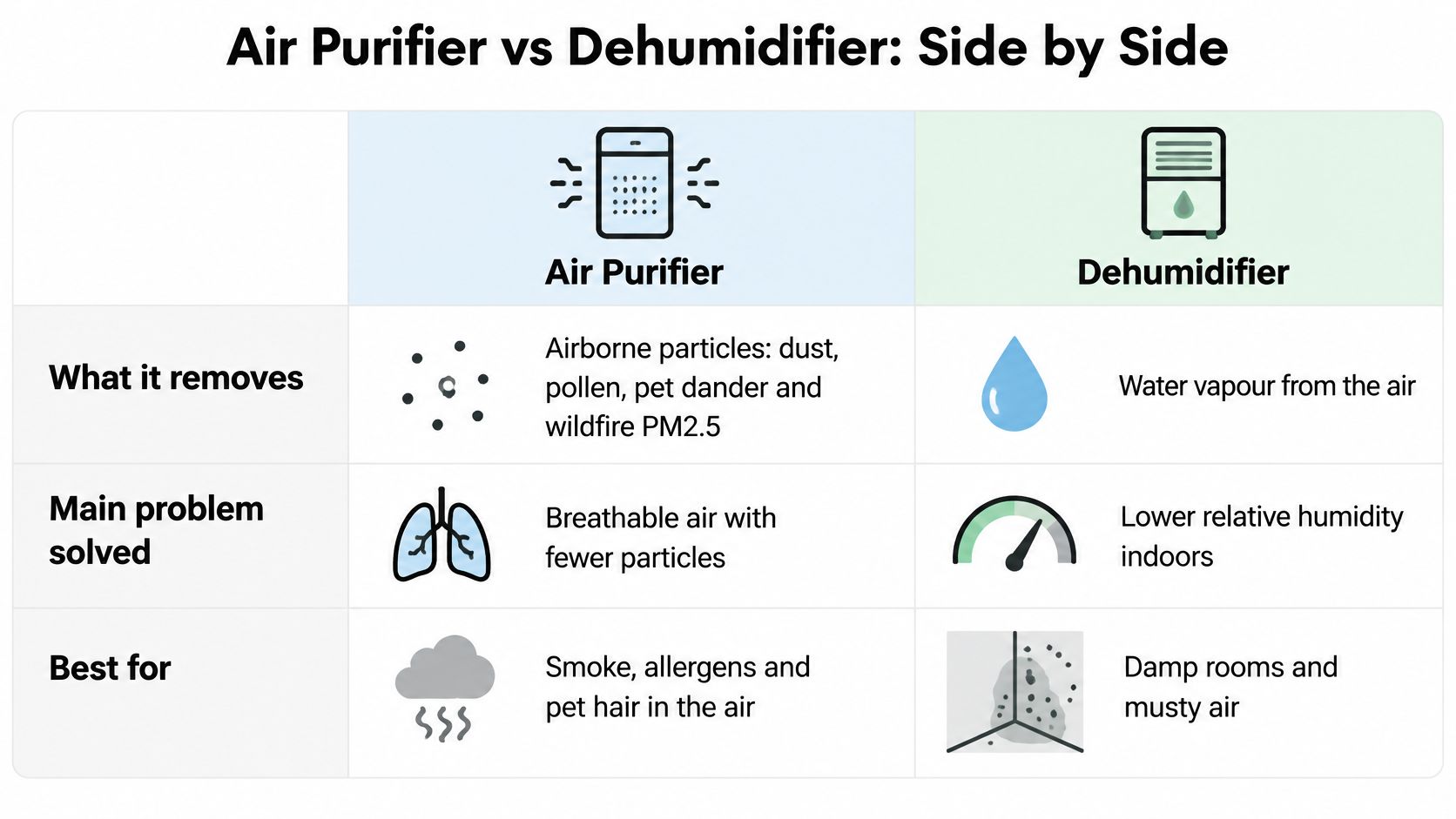
| Factor | Air Purifier | Dehumidifier |
|---|---|---|
| Main job | Removes airborne particles | Removes water vapour from the air |
| Core technology | True HEPA filter, often with activated carbon | Refrigerant coil or desiccant wheel that condenses moisture |
| What it removes | Dust, pollen, pet dander, smoke PM2.5, some odours with carbon | Water vapour, reducing dampness and condensation |
| What it cannot do | Lower humidity or stop mould at its source | Capture smoke particles, allergens or gases |
| Main rating | CADR (clean air delivery rate) for smoke, dust and pollen | Pints or litres collected per day under standard test conditions |
| Typical placement | Open airflow near where people sit or sleep | Basement, laundry or closed room with a moisture source |
Each machine has a clear boundary. A purifier does not lower relative humidity or stop mould growth on a wet sill or damp foundation. A dehumidifier does not capture smoke particles, allergens or gases. Choosing one for the other's job leaves the measured hazard untreated, even if the machine runs longer.
Practical rule: Match the rating to the problem. CADR indicates how quickly a purifier delivers clean air for smoke, dust and pollen. A dehumidifier's pints or litres per day rating describes the water it collects under stated test conditions.
The comparison is a starting point, not a diagnosis on its own. CADR measures particle-cleaning capacity; litres per day measures moisture removal. Those ratings answer different questions, so neither can stand in for the other.
Diagnose Particles or Moisture Before You Buy
Choose the device after checking what is in the room. A hygrometer measures relative humidity; during smoke, a PM2.5 monitor measures fine particles. A home air quality monitor can make particle checks routine rather than relying on smell, which cannot confirm smoke levels.
Health Canada's indoor air guidance for professionals recommends keeping indoor relative humidity generally below 50% in summer and around 30% in colder weather, subject to the building envelope. Its guidance also supports choosing a purifier by room size and clean air delivery rate, and avoiding ozone-producing units. A 2025 McGill climate-health brief reports that indoor PM2.5 during wildfires can reach 33–76% of outdoor levels even with windows and doors closed. In cited evidence, HEPA filtration reduced indoor PM2.5 by about 48–78%.
| Symptom | Likely Problem | Device to Use | How to Confirm |
|---|---|---|---|
| Hazy or smoky air during fire season | Fine particulate (PM2.5) | Air purifier with true HEPA | Read a dedicated indoor PM2.5 monitor; elevated readings confirm particles are present |
| Musty smell, damp walls, mould on window sills | Excess moisture | Dehumidifier, plus repair of the water source | Hygrometer reading above 50% in summer |
| Condensation on windows each morning | High indoor humidity | Dehumidifier | Hygrometer reading above 50% |
| Sneezing, itchy eyes, dust on surfaces | Allergens and dust | Air purifier with true HEPA | Symptoms track room use, humidity normal |
| Damp basement that also smells of smoke | Two separate hazards | Both devices, sized separately | Hygrometer and PM2.5 readings, both taken |
For smoke, use a PM2.5 monitor, not a humidity reading or smell, to check whether airborne particles are present. The reading helps identify the hazard, while a purifier's CADR and room size determine whether the unit is appropriately matched to the space. Musty walls and mould on sills point to moisture and a water source. A purifier may circulate air there, but it will not dry the surface or fix a leak. Morning condensation also warrants checking humidity with a hygrometer. Sneezing or dust in a room with normal humidity points toward particles or allergens instead.
When both readings are bad
A damp basement that also smells of smoke contains two separate problems. Check humidity with a hygrometer and particles with an indoor PM2.5 monitor. Use a dehumidifier sized for the moisture load and an air purifier sized for the particle load. Each device addresses a different measured hazard, so one machine cannot stand in for the other.
Health Stakes of Fine Particles and Damp Air
A room can be dry and still contain hazardous particles. Clear-looking air also says little about moisture. These are separate exposures, so the health risk depends on what is present and how long people breathe it.
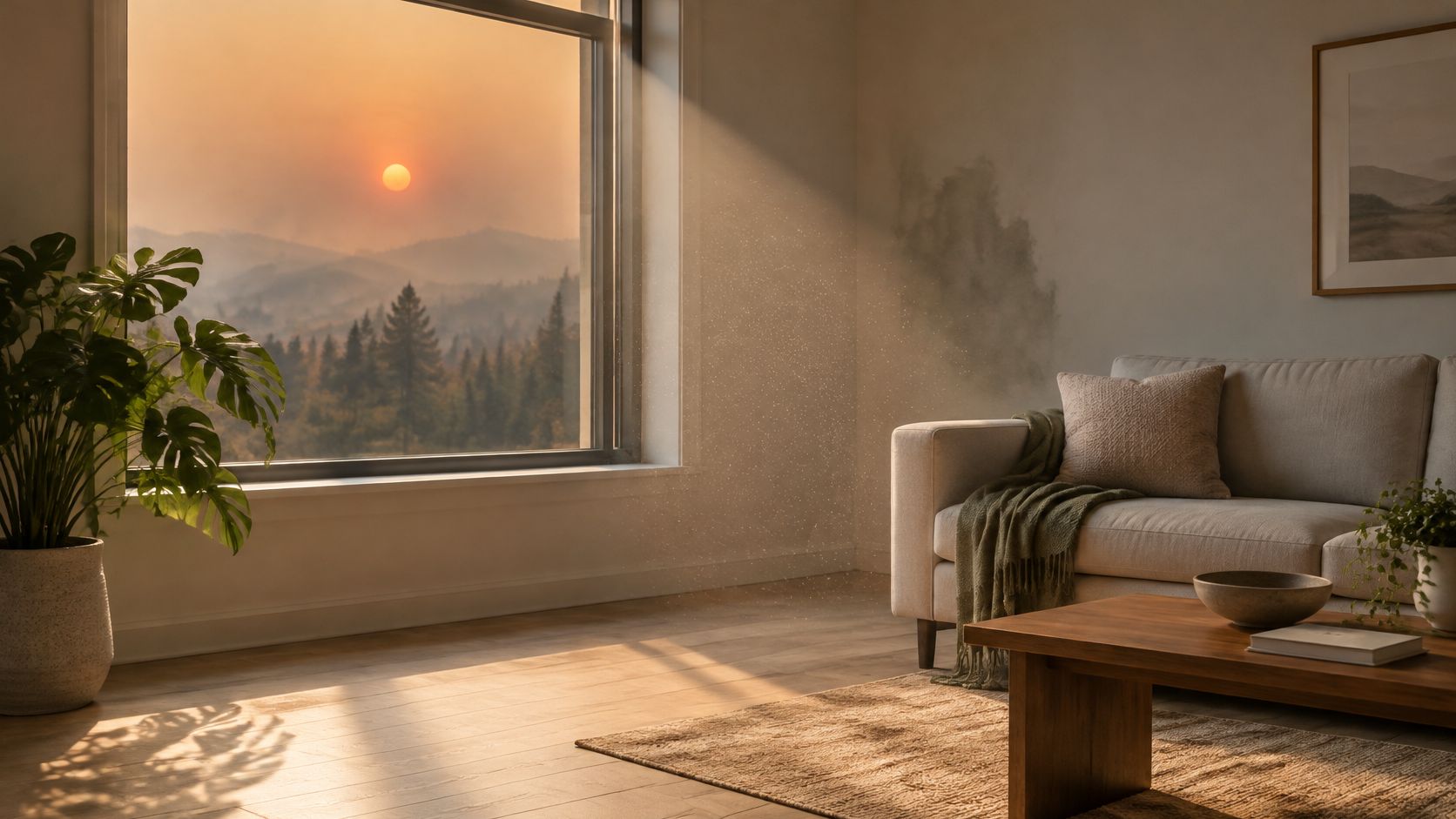
A 2021 peer-reviewed study in PNAS, using PurpleAir sensors in more than 1,400 California buildings, measured how outdoor wildfire smoke enters buildings. The geometric-mean infiltration ratio for outdoor-origin PM2.5 was about 0.4 during non-fire periods and about 0.2 during wildfires. Although buildings admitted a smaller fraction of outdoor particles during fires, indoor levels nearly tripled as outdoor smoke concentrations rose. On fire days, 10-minute outdoor PM2.5 averages exceeded 250 µg/m³ several times. Mean indoor concentrations reached about 45.4 µg/m³, compared with 11.1 µg/m³ on non-fire days.
PM2.5 can travel deep into the lungs. Exposure is a particular concern for children, older adults, and people with asthma or heart disease. A dehumidifier does not remove these particles. A purifier can reduce them in the air that passes through its filter, but its effect depends on airflow, placement and continued operation.
Damp air is a different exposure
Moisture affects surfaces and the conditions that support biological growth. Persistently high indoor humidity can favour dust mites and mould, while damp, mouldy rooms are associated with asthma symptoms and irritated airways. Humidity targets for summer and cold weather help manage this risk, but they do not replace fixing leaks or removing airborne particles.
Clean-looking air can still be too damp, and a dry room can still be full of smoke. The health priority depends on the exposure present and the time people spend in that environment.
Smoke exposure also depends on household behaviour. Closing windows and doors, limiting time outdoors and running a purifier in the occupied room can reduce exposure. The California measurements show that buildings admitting a smaller share of outdoor particles can still have higher indoor concentrations when outdoor smoke rises sharply. For people with asthma or heart disease, reducing time in smoky indoor air matters alongside choosing a filtration device.
Smoke Season, Damp Basements and Rental Units
Three buildings, three measurements, three purchases. None of them is a universal ranking of air purifier vs dehumidifier.
A condo in smoke
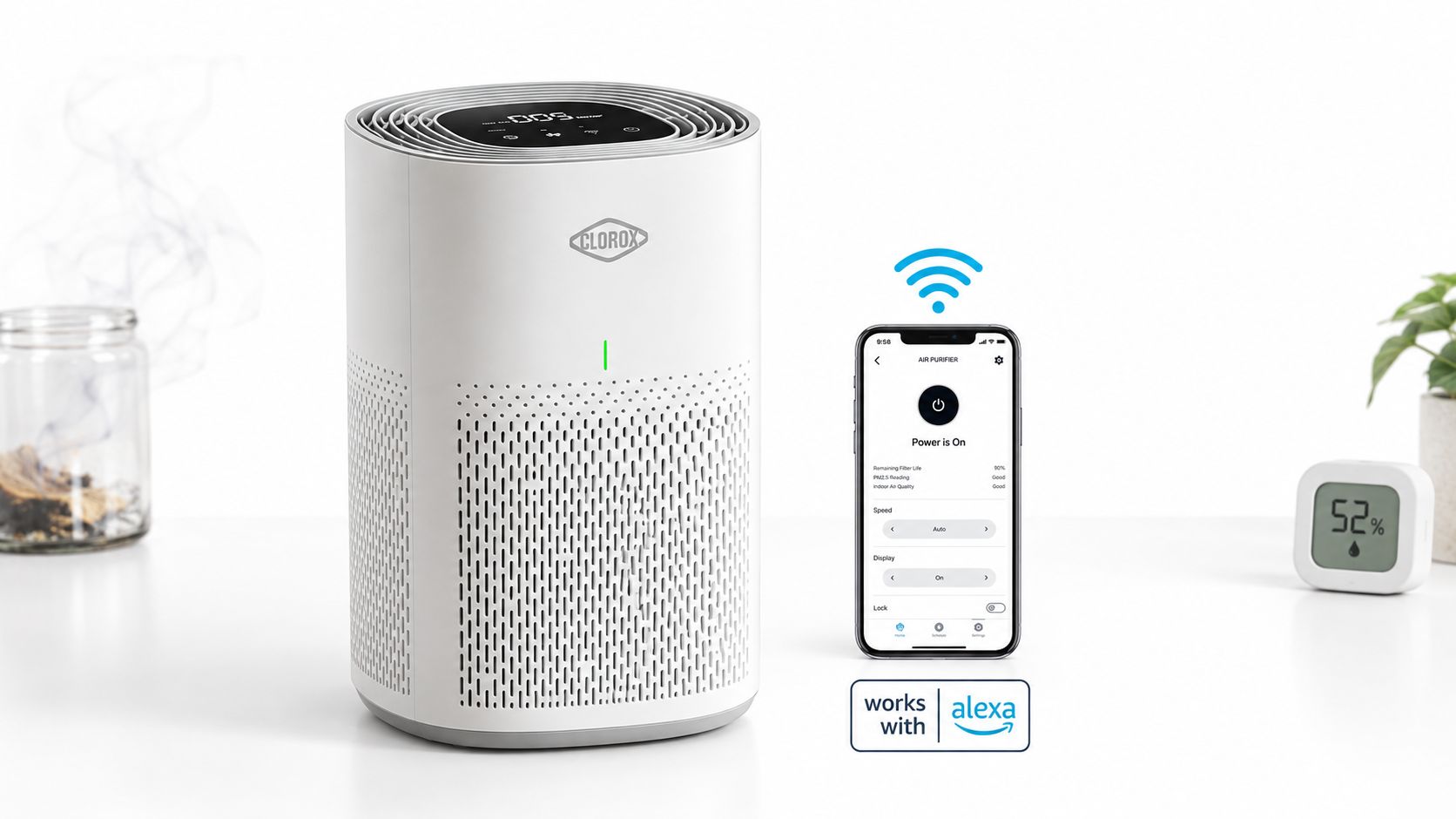
Take a 700 sq ft condo in a wildfire-prone region. During smoke, the plan is a certified portable HEPA purifier sized to the occupied room, windows and doors kept closed, and clean filters in any ventilation system that is already there. Toronto Public Health's indoor air guidance sits beside federal preparedness advice that points households toward certified, properly sized portable purifiers and clean replacement filters. Quebec public-health guidance adds a limit worth using: portable HEPA filtration can help when it is selected, run and maintained properly, but it may be unnecessary where ventilation already provides MERV 13 or higher. Check the existing filter before you buy a second machine. A medium-room example of that portable type is the CLOROX 11031 Alexa Smart Medium Room True HEPA Air Purifier, with Alexa voice control, true HEPA 3-stage filtration, a real-time air quality display and an auto mode. It does not change humidity.
A wet basement
A 1,000 sq ft basement with condensation and a musty smell needs a dehumidifier sized to the moisture load, set near the summer humidity target, plus source work. Grading, eavestrough repair and a sump check stop water that a fan cannot. A purifier in that room will not stop mould on the concrete. If cooking particles are a separate complaint in a tight rental kitchen, a purifier sized for a kitchen is still a particle tool, not a dryer.
A renter who cannot touch the HVAC
A renter who cannot change the air handler has a narrower set of moves. A portable purifier is the practical smoke upgrade because it needs an outlet and clear airflow, not a mechanical-room key. A dehumidifier needs landlord approval for where it sits, how it drains, and whether a shared space can take the noise and the hose. Measure humidity and particles first so you are not asking for permission to install the wrong machine.
The right purchase matches the measured problem and the equipment already in the building. Money goes to a portable purifier, a central-filter upgrade, or a dehumidifier, not to all three by default.
Small Offices, Hospitality and Bulk Buying
Workplaces show the same split, with a sharper audience. In a 2023 survey of 500 Canadian indoor workers published by Fellowes, 25% rated their workplace air quality as "very clean," while 93% agreed that clean indoor air helps them perform their best work. Staff already connect the air to the work. Most do not think the air is very clean.
That gap is not a reason to drop one appliance type across a whole site.
- Offices, reception and meeting rooms: Particle loads from people, dust and outdoor smoke. Size a purifier to each room, not to the floor plate.
- Storage, laundry, pool, spa and back of house: Moisture is generated there. A dehumidifier belongs with the water, not in the boardroom.
- Hospitality on a smoke day: A patio that opens onto a dining room puts particles in the dining room. Size filtration to that dining room. The kitchen hood is a different system.
Buy by room type
For bulk purchasing, pick one model per room type so filters, spare parts and service visits match across a portfolio. A compact tabletop purifier suits a single desk or a small enclosed office. A medium-room unit suits a shared office where several people sit for hours. Standardising like that beats a mix of leftover consumer units that nobody can restock.
Keep a one-page log per site: filter change dates, humidity readings in wet rooms, and who is responsible. The next order starts from that log, not from a catalogue photo.
Running Costs, Noise and Upkeep Over a Year
A machine can address the measured hazard and still be a poor fit for the room. Noise, electricity use and maintenance determine whether it can run consistently where it is needed.
Purifiers are mostly fans: on low, many are quiet enough for a bedroom, while high speed is clearly audible. Dehumidifiers use a compressor or desiccant heater, so their operating cycles are generally louder and less suited to sleeping areas. Their power use also differs. A purifier's draw rises with fan speed, while a dehumidifier typically uses more electricity while actively removing water.
A 2024 Canadian market estimate from MarketsandMarkets valued the desiccant dehumidifier market at US$60.1 million. Desiccant units are used in cooler spaces where compressor capacity can fall. They address moisture, not airborne particles.
| Factor | Air Purifier | Dehumidifier |
|---|---|---|
| Noise on low | Often quiet enough for a bedroom at a low fan setting | Louder, cycling with the compressor or heater |
| Noise on high | Clearly audible at full fan speed | Often as intrusive as a full fan, plus the drying cycle |
| Power while running | Modest, and it rises with fan speed | Much higher while actively removing moisture |
| Estimated annual energy | Depends on hours of use and fan speed | Depends on humidity, the setpoint and how much damp air enters the room |
| Routine upkeep | Clean the prefilter monthly. Follow manufacturer guidance for HEPA and carbon filter replacement; common intervals are 6 to 12 months for HEPA and 3 to 6 months for carbon. | Clean the filter monthly, empty the tank or maintain the drain hose, and clean the coil about yearly |
Annual energy cost is an estimate, not a fixed product figure. Local electricity rates and runtime shape the bill. For a purifier, runtime and fan speed are the main controls. For a dehumidifier, the humidity setpoint and the amount of damp air entering the room affect how long it runs. If it cannot reach its target, it may continue operating without resolving the moisture problem.
Maintenance affects performance as well as cost. Dust on a prefilter can restrict airflow, and a saturated carbon filter may no longer control odours effectively. For routine cleaning, follow a straightforward guide to cleaning an air purifier filter. A dehumidifier with a full tank may stop, while a dirty coil can make moisture removal less efficient.
Sizing the Device and Checking Specs Before You Buy
Choose a device after identifying the measured hazard and the room it must treat. A purifier's particle rating does not establish moisture capacity, and a dehumidifier's water-removal rating does not describe particle filtration.
For a purifier, a common floor-area rule sets minimum CADR at about two-thirds of the room's floor area in square feet, expressed in cubic feet per minute. Smoke CADR is the stricter of the usual ratings, so use it when wildfire smoke is the concern. High ceilings, open layouts and heavy foot traffic can require a larger unit or a higher fan setting than the minimum.
Dehumidifiers are sized by moisture load, not by a simple area chart. Water entering through walls or a slab, the number of people using the room and the room's temperature all affect capacity needs. As a rule of thumb, compressor-only models can lose capacity below about 15°C, so check the manufacturer's low-temperature performance for a cold basement. Visible seepage points to a higher moisture load. An undersized unit may run continuously without reaching its humidity setpoint.
| Room Area | Purifier Minimum CADR | Dehumidifier Capacity (Damp Space) |
|---|---|---|
| 100 sq ft (9 m²) | About 67 cfm (about 114 m³/h) | 20 pints (9 L) a day |
| 200 sq ft (19 m²) | About 133 cfm (about 226 m³/h) | 20 to 30 pints (9 to 14 L) a day |
| 300 sq ft (28 m²) | About 200 cfm (about 340 m³/h) | 30 pints (14 L) a day |
For example, under the two-thirds rule, a 300 sq ft bedroom calls for a purifier rated at least about 200 cfm (about 340 m³/h). A 500 sq ft finished basement with recurring condensation is a separate sizing problem. A 40 to 50 pint unit can serve as a planning starting point, but confirm the capacity against actual dampness and the model's performance at the basement temperature. These figures are planning examples, not a lab certificate.
Spec checks before you pay
- Confirm the purifier uses a true HEPA filter, not a “HEPA-type” label.
- Check for ozone-free operation. Canadian guidance advises avoiding ozone-producing units.
- Check replacement-filter availability and cost, since filters affect lifetime expense. The air purifier filter guide can help with that check.
- For a dehumidifier, look for an adjustable humidistat, a continuous-drain outlet, and a low-temperature rating or defrost cycle.
- Set a date for the first filter or maintenance check before putting the unit into service. Keep a log of readings and changes so later sizing decisions can use room-specific information.
A unit with the wrong capacity remains the wrong purchase, even if it is the right type. Match CADR to the particle problem and litres per day to the moisture load, then confirm filter fit and drainage before checkout.
GrifGlo groups home and workplace essentials with sizing notes for matching purifiers to particles and dehumidifiers to moisture. Use room readings to compare product fit and upkeep, keeping the measured hazard as the basis for the choice.

Leave a comment
This site is protected by hCaptcha and the hCaptcha Privacy Policy and Terms of Service apply.