

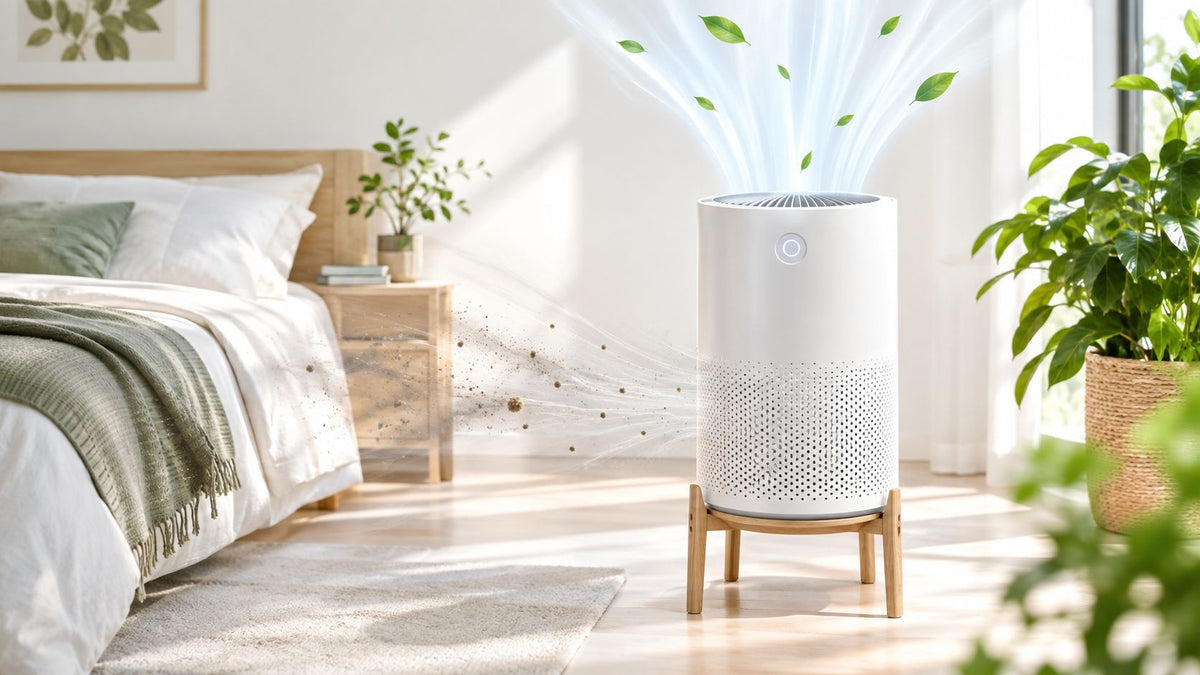
An air purifier is a single-room device that pulls air through filters to remove particles and odours. In California, a certified HEPA air cleaner can reduce indoor particle levels by more than 90 percent in some cases during smoke events (California Air Resources Board).
You notice the need most clearly when wildfire smoke turns the sky hazy, when cooking leaves a smell in the kitchen, or when a cat's dander settles through the bedroom. A purifier can create a cleaner-air zone in that room, but it won't exchange stale air throughout the home or fix the source of pollution.
The practical question isn't “what is an air purifier used for?” It's which pollutant are you trying to control, in which room, and with which filter? The answer depends on four things: the particles and gases involved, the filter technology, the unit's airflow ratings, and how consistently you maintain it.
Table of Contents
- What an Air Purifier Actually Does
- Pollutants an Air Purifier Can Remove
- How HEPA, Activated Carbon, and Ionizers Differ
- Understanding CADR and ACH Ratings
- Where and When to Use an Air Purifier
- Common Misconceptions About Air Purifiers
- Basic Maintenance to Keep It Working
What an Air Purifier Actually Does
During wildfire season, a closed bedroom can become a practical clean-air room. A portable purifier pulls that room's air through an intake grille, while a fan moves it across filters that capture particles or adsorb some gases and odours. The treated air returns to the same room, so the device repeatedly cleans the air already inside.
That makes an air purifier a targeted clean-air appliance. It can lower airborne particle concentrations in a selected space, especially when doors and windows stay closed. It does not bring in outdoor air, remove carbon dioxide, or distribute filtered air throughout the home. A single unit is therefore better suited to a sleeping area, office, or smoke refuge than to whole-home control.
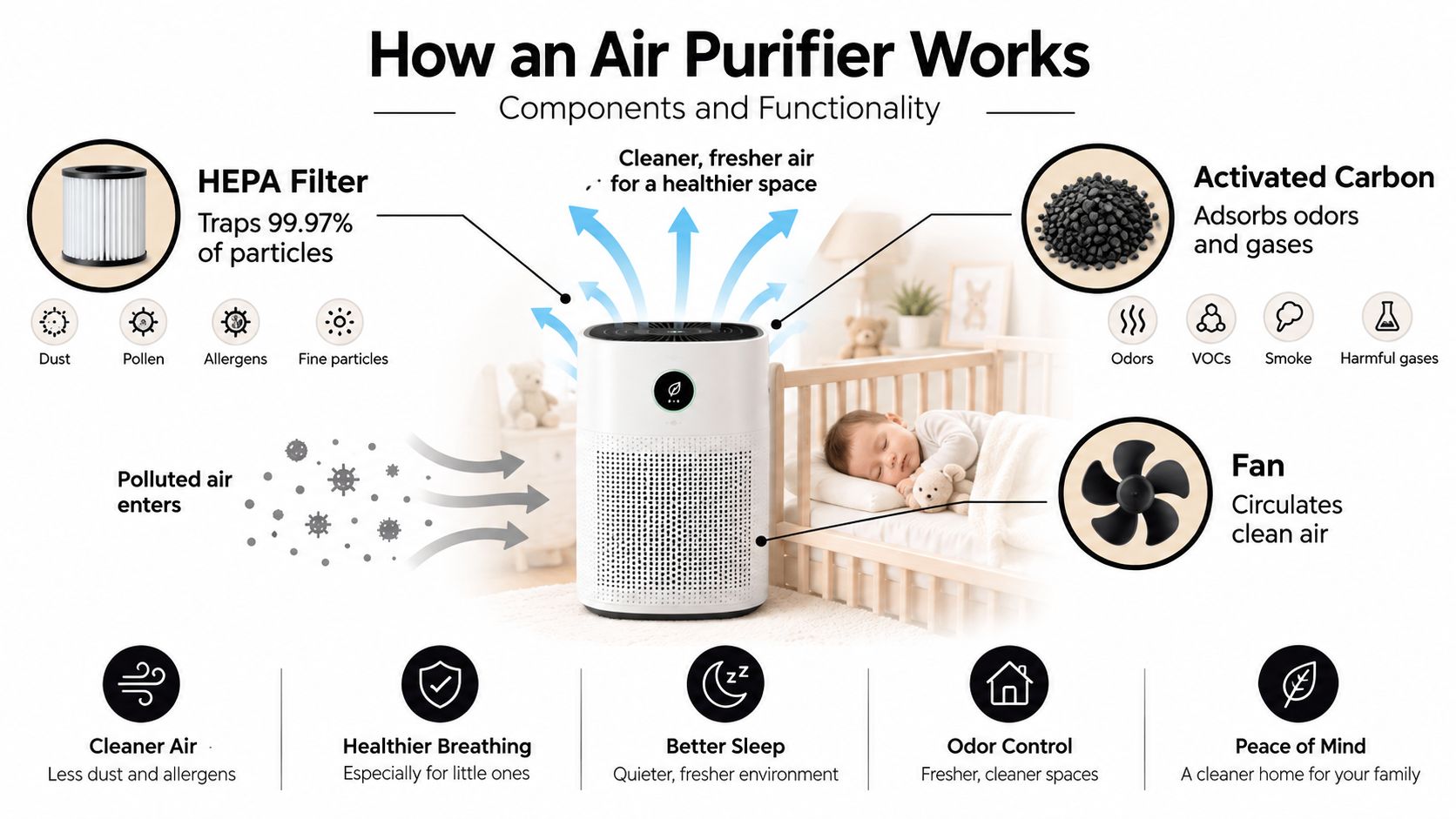
The room is the unit of control
Choose the room where people spend the most time, match the purifier to that room's size, and keep it running during the pollution event. That may mean a bedroom overnight, a home office during work hours, or a living room used as a smoke refuge. Closing the room helps limit new pollution while the purifier cycles the air.
California Air Resources Board guidance recommends using an indoor air cleaner when the AQI is unhealthy or smoke is visible or present by smell. In its certified-device guidance, CARB also describes HEPA mechanical air cleaners that reduced indoor particle levels by more than 90 percent in closed-room testing when units were appropriately sized and operated continuously (CARB's certified air-cleaning device guidance). That result describes a controlled room setup, not a guarantee for every home.
Practical rule: Use a purifier to manage air in a specific occupied room. Continue source control, kitchen exhaust, and appropriate ventilation.
The task then becomes concrete: identify whether the concern is particles, odours, or gases; select a suitable filter; check CADR and ACH for the room; and replace filters before restricted airflow reduces performance.
A smart air purifier review provides a product-specific example of questions to ask. Check how much air the unit moves, what it filters, how loud it is at the required setting, and whether replacement filters are available.
Pollutants an Air Purifier Can Remove
Start by separating particles from gases. A mechanical HEPA filter catches airborne solids and droplets as air passes through a dense filter media. Activated carbon works differently. It adsorbs some gaseous molecules and odours on a porous surface, but its performance depends on the amount and condition of carbon and on how concentrated the gas is.
For a California household, fine particulate matter from wildfire smoke is often the clearest use case. A Los Angeles-area study found that homes using HEPA purifiers had indoor PM2.5 levels about 3 µg/m³ lower, roughly a 15 percent reduction, than homes without HEPA units (the published Los Angeles-area study). The result was statistically significant but modest, which reinforces the importance of room selection, closed windows and doors, and correct sizing.
Match the pollutant to the filter
- Wildfire smoke and PM2.5: A HEPA filter can capture fine particles. It won't remove every gaseous component of smoke.
- Pollen, dust and pet dander: These are particulate pollutants that a suitable mechanical filter can capture while they're airborne.
- Cooking smells and pet odours: Activated carbon can reduce some odour molecules, although it won't eliminate the source. Use the range hood or exhaust fan while cooking.
- Mould spores: A purifier can reduce airborne spores, but it can't correct leaks, dampness, or established mould growth. Moisture control comes first.
- Carbon monoxide and radon: A typical portable purifier isn't the right control. Use appropriate detectors and professional mitigation.
- Humidity and carbon dioxide: Filtration doesn't dehumidify a room or provide fresh-air exchange. Those problems require different equipment or building measures.
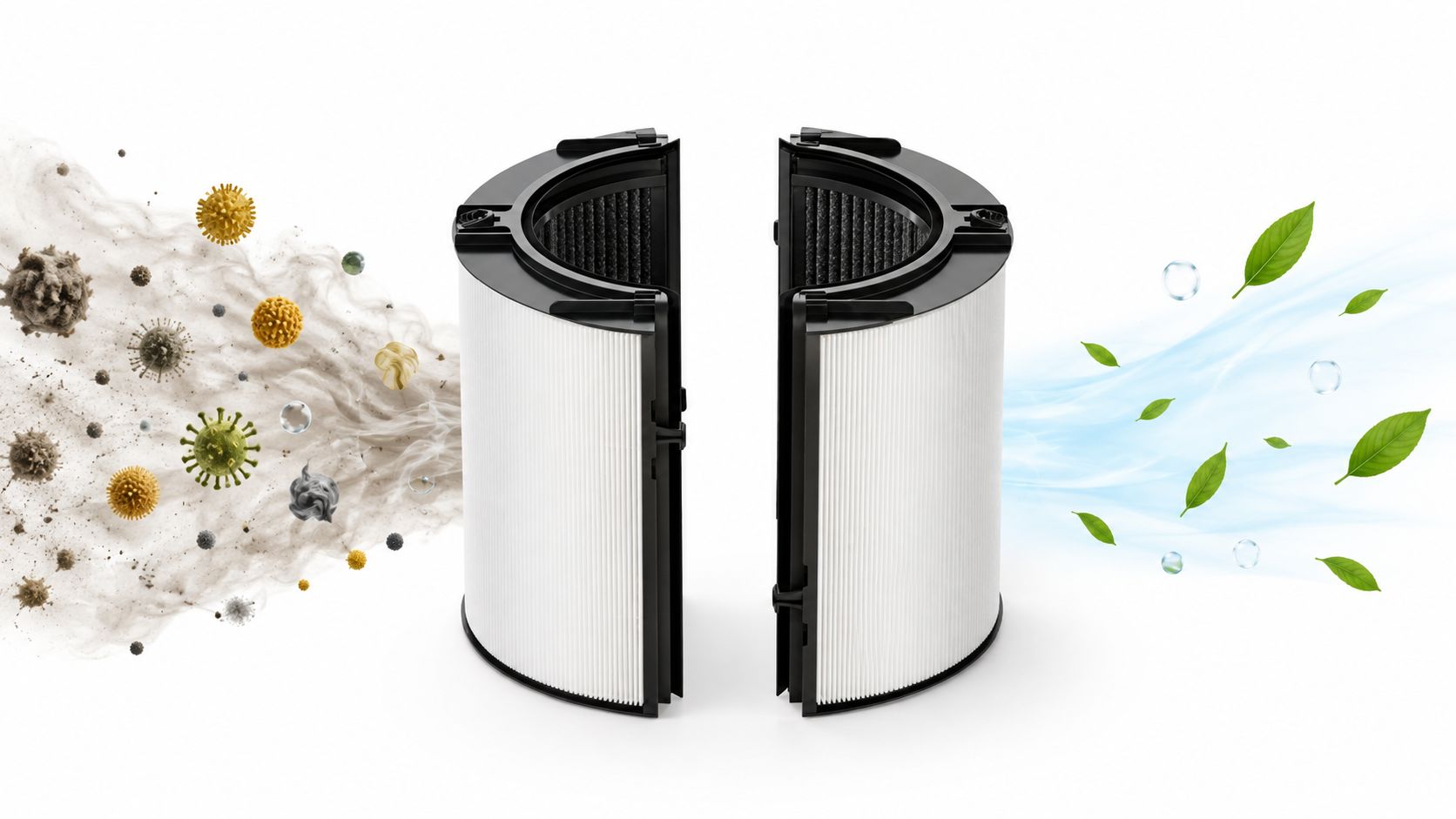
The DYSON HEPA Air Carbon Purifier Filter - 965432-01 combines a 360° HEPA filtration system with activated carbon for odours and gases, and its product snapshot describes a sealed design for clean-air output. That combination fits rooms where both particles and smells are part of the problem.
| Pollutant | Example source | Removable by purifier? | Filter that handles it |
|---|---|---|---|
| PM2.5 | Wildfire smoke | Yes, with suitable mechanical filtration | HEPA |
| Pollen | Outdoor air entering indoors | Yes, while airborne | HEPA |
| Pet dander | Cats and dogs | Yes, while airborne | HEPA |
| Cooking odours | Frying, roasting and spices | Partially | Activated carbon |
| Mould spores | Damp areas and mould growth | Partially | HEPA, alongside moisture control |
| Carbon monoxide | Fuel-burning appliances | No, not with a typical purifier | Detector and source correction |
| Radon | Soil gas entering a building | No | Testing and mitigation |
| Carbon dioxide | People and combustion | No | Ventilation |
An air quality monitor for the home can help you distinguish a particle problem from assumptions based only on smell. A purifier may make a room smell better while leaving an important invisible hazard unchanged, so monitoring and source investigation still matter.
How HEPA, Activated Carbon, and Ionizers Differ
A purifier works best as a targeted clean-air tool. During wildfire smoke, it can reduce fine particles in a closed bedroom. In a kitchen, a carbon stage may reduce lingering odours. The right technology depends on the pollutant, not on a fan, display, or “purifier” label.
A true HEPA mechanical filter captures airborne particles as room air passes through dense filter media. The commonly cited test point is 99.97 percent of particles at 0.3 microns, but that figure applies to the filter and its test conditions, not automatically to every device marketed as a purifier. In a smoke-affected bedroom or an allergen hot spot, HEPA is the main option for pollen, dust, pet dander, and fine particulate matter.
Activated carbon handles a different part of the problem. Its porous surface adsorbs some odour molecules and gases, including compounds linked to cooking and pets. Performance depends on the amount and design of carbon. A thin layer can fill sooner than a substantial carbon bed, and carbon does not replace an exhaust fan or source control when pollution is being created indoors.
Ionizers and electrostatic systems charge particles so they collect on plates or nearby surfaces. Some designs can also produce ozone. California requires electronic air cleaners sold in the state to be tested for ozone emissions and to remain at or below 0.050 ppm under CARB's certification requirements. That certification provides a useful buying check for equipment used in an occupied room.
Compare the technologies by job
| Technology | Mechanism | What it removes | Key limitation |
|---|---|---|---|
| HEPA | Physically captures airborne particles | Dust, pollen, dander, and fine particulate matter | Does not meaningfully remove most gases |
| Activated carbon | Adsorbs molecules on porous carbon | Some odours and gases | Capacity varies, and carbon can saturate |
| Ionizer or electrostatic system | Charges particles for collection | Some airborne particles | May produce ozone and may not provide the same mechanical capture |
For many homes, HEPA plus activated carbon suits a room with both particles and odours. HEPA carries the particle load, while carbon addresses some gases. If a product depends on ionization, plasma, or ozone claims, review its certification and emissions information before placing it in a bedroom or other occupied space.
Use the air purifier filter guide to compare replacement construction, filter stages, and the difference between a nominal label and a system designed to maintain airflow. Even a suitable filter has limited value if the fan cannot move enough room air through it.
Understanding CADR and ACH Ratings
CADR, or Clean Air Delivery Rate, describes how quickly a purifier supplies cleaned air for particles. Manufacturers may list separate ratings for smoke, dust and pollen. A higher CADR generally suits a larger room or a situation where you want faster particle reduction.
A commonly used sizing rule is to choose a CADR of at least two-thirds of the room's square footage. That means a 300-square-foot room points toward a CADR of about 200 cfm. Treat that as a starting point, then account for ceiling height, open doors, leakage and the pollution level you're addressing.
ACH, or air changes per hour, estimates how many times the purifier can process the room's full air volume in an hour. A bedroom with a strong CADR can reach a higher ACH quickly because the volume is small. An open living area may need more airflow to achieve the same turnover.
Sizing example: In a 300-square-foot room, a 200 cfm unit matches the two-thirds starting rule. The exact ACH depends on ceiling height and room sealing, so room volume matters, not floor area alone.
For allergen control, guidance commonly discusses 4 to 5 ACH as a baseline, while smoke events may call for 5 to 6 or more ACH. These figures are sizing targets, not promises of a particular health result. Closed doors and windows help the purifier work on the same room air instead of continuously receiving polluted outdoor air.
| Room size | Use case | Recommended CADR | Target ACH |
|---|---|---|---|
| Small bedroom | Overnight allergens | At least two-thirds of floor area in cfm | 4 to 5 |
| Medium bedroom or office | Daily occupied-room use | At least two-thirds of floor area in cfm | 4 to 5 |
| Smoke-ready bedroom | Wildfire smoke | Prefer a higher CADR where practical | 5 to 6 or more |
| Open living area | Larger clean-air zone | Higher CADR, based on total volume | Depends on doors and ceiling height |
For context, a Mini Digital Pocket Scale 200g has no role in air-cleaner sizing. Its listed function is measuring small items, so don't confuse precision in a separate household tool with CADR measurement.
A kitchen guide such as air purifier use in the kitchen should be read alongside source-control advice. A purifier can help with airborne particles after cooking, but an exhaust fan remains the first line of defence.
Where and When to Use an Air Purifier
Choose the room before choosing the machine. A bedroom often makes sense because it's occupied for long stretches, while a closed living room can become a practical clean-air room during wildfire smoke. If you work from home, the office may deserve priority during the day.
Place the unit on the floor or a low, stable table where its intake and outlet can breathe. Keep roughly 12 inches of clearance around it, and move it away from walls, curtains and upholstered furniture that can block airflow. Don't hide it behind a sofa or push it into a corner just because the appliance looks tidier there.
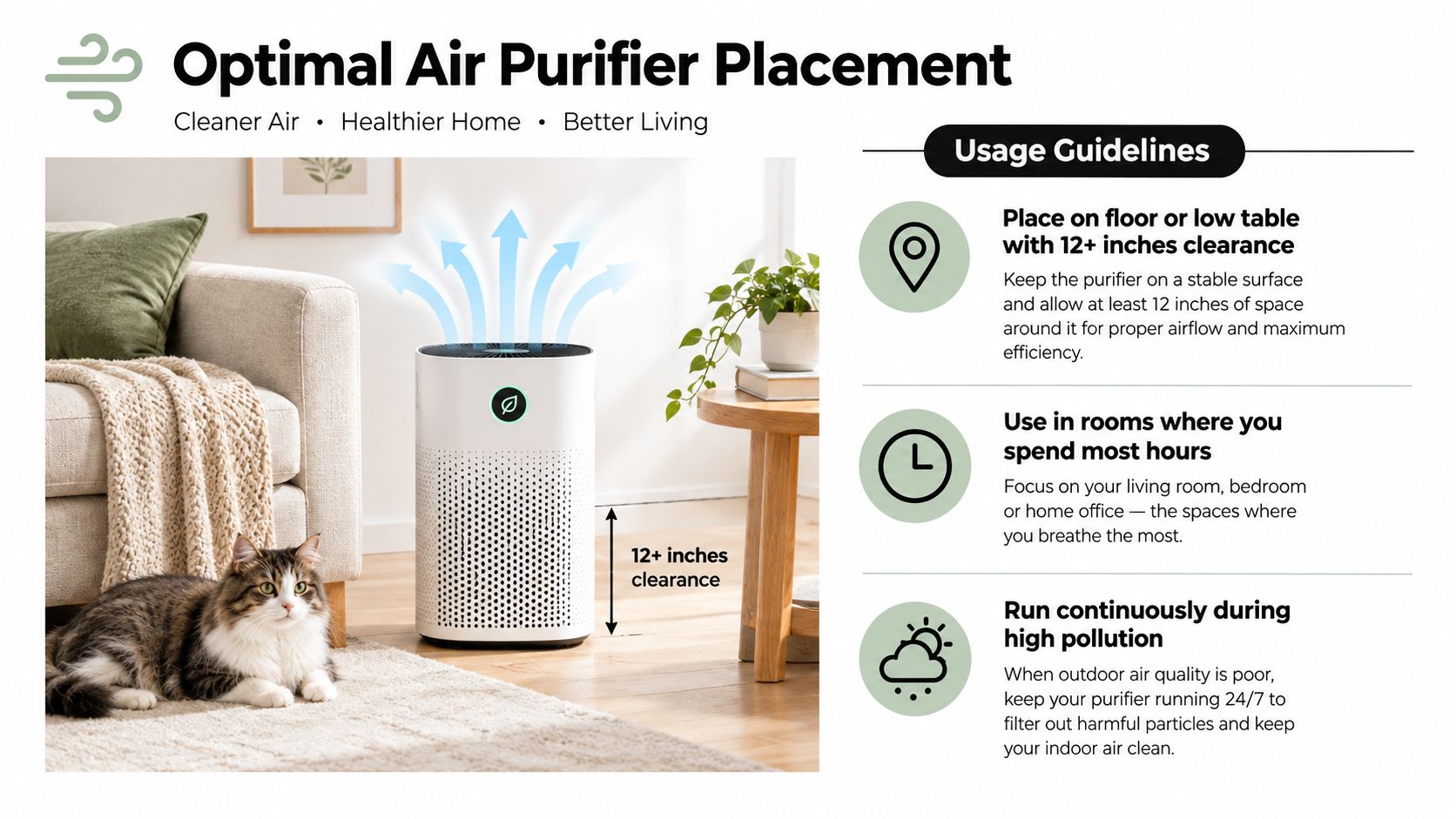
Build a clean-air room
During a smoke event, shut windows and doors in the selected room and run the purifier continuously while smoke is present. California and federal guidance recommends using a portable cleaner in the room where people spend time, sizing it correctly, and pairing it with closed doors and windows (EPA guidance on creating a clean room during wildfire smoke).
A purifier is useful after vacuuming, during and after cooking, and when pollen or pet dander becomes airborne. Use a higher setting when the room is polluted, then reduce the speed if noise interferes with sleep or work. The right setting is the highest one you'll run consistently.
- Bedroom first: Prioritise the room where someone sleeps, particularly during smoke or allergy episodes.
- Living room next: Use it as a shared clean-air zone, with doors closed where possible.
- Home office by day: Move the unit rather than expecting one appliance to cover the entire home.
- Open-plan caution: A purifier can still help, but its effective zone becomes harder to define as doors and boundaries disappear.
Avoid placing the appliance beside a smoking source, directly beside a cooker, or where water can splash onto it. Source control still matters. Use kitchen exhaust, stop indoor smoking, repair dampness, and follow local wildfire guidance rather than asking the purifier to compensate for every problem.
Common Misconceptions About Air Purifiers
During a wildfire-smoke event, a purifier can make one closed bedroom or living room cleaner. It cannot turn the entire home into a sealed, fully ventilated system. Most portable models recirculate indoor air, filtering particles that pass through the unit. They do not dilute carbon dioxide, remove cooking moisture, or replace outdoor-air ventilation when opening windows is appropriate.
A purifier's label also does not make every technology equivalent to HEPA filtration. Ionizers and plasma devices use electrical processes, while HEPA filters physically trap particles. A common misconception is that any electronic purifier is automatically safe. In practice, certification matters when marketing mentions ionizers or plasma, because some electronic designs can produce ozone. Choose a device designed to avoid ozone when the goal is a clean-air room.
What the appliance cannot solve
- Carbon monoxide: Use a working carbon-monoxide detector and correct the combustion source. A purifier cannot make this gas safe.
- Radon: Arrange testing and professional mitigation. HEPA and carbon stages do not stop soil gas entering the building.
- Excess humidity: Use ventilation, source control, or a dehumidifier. Filtration does not remove water vapour.
- Established mould: Repair the moisture source and remove contaminated materials appropriately. Capturing spores does not remove mould growth.
- Whole-house pollution: One portable unit usually serves a room-sized zone. Larger coverage may require several zones or HVAC filtration.
A purifier may capture some virus-containing aerosols, but particle capture is not sterilisation and does not guarantee that transmission will stop. Pair filtration with ventilation, appropriate isolation, cleaning, and source control.
During severe wildfire smoke, a purifier does not make open windows safe. Follow local AQI and smoke guidance, keep the clean-air room closed, and select a certified device that does not produce ozone. A purifier is a targeted tool for smoke and allergen hot spots, not a solution for every indoor-air problem.
Basic Maintenance to Keep It Working
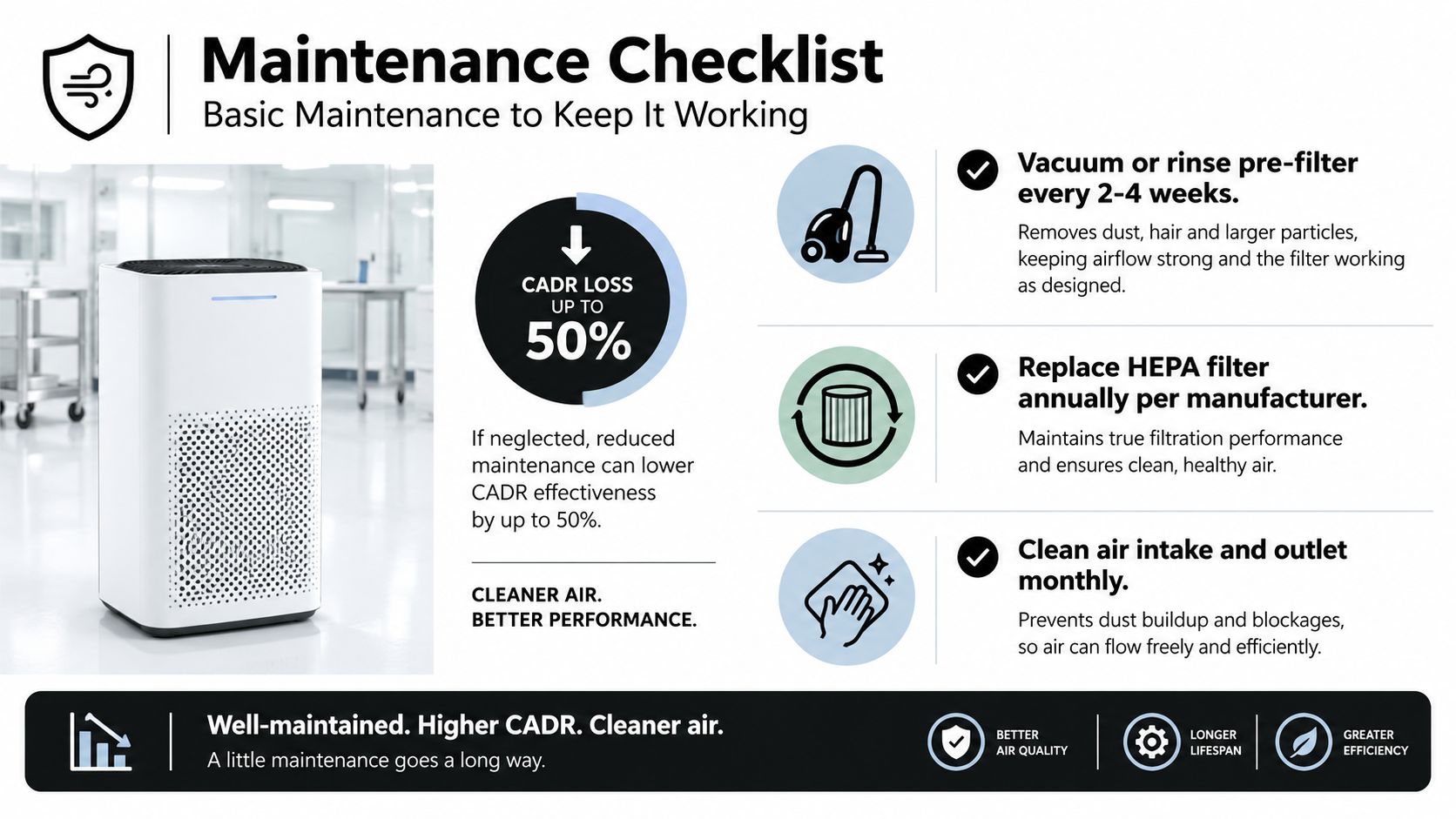
A clean-air room depends on more than the appliance's label. Dust and pet hair load the pre-filter first, then restrict the fan's ability to pull air through the main filter. A neglected unit may still sound active while moving less air, so maintenance protects the room's actual cleaning rate.
Start with the manufacturer's instructions because filter construction differs. In general, inspect the pre-filter every 2 to 4 weeks, especially if you have pets, nearby construction or recent smoke exposure. Vacuum it when appropriate, or rinse it only if the manufacturer says water is safe and the filter can dry completely before reinstallation.
A simple maintenance routine
- Inspect the intake: Remove hair, dust and lint from the grille and surrounding floor.
- Clean the pre-filter: Vacuum or rinse it according to the product instructions.
- Check the main filter: Look for heavy discolouration, damage or a filter-change warning.
- Assess odour control: Persistent smells passing through may indicate saturated carbon.
- Wipe the housing: Clean the exterior and outlet so loose dust doesn't accumulate around the airflow path.
- Replace on schedule: Use the manufacturer's interval, and replace sooner when smoke or heavy dust has loaded the filter.
A visibly grey HEPA filter, stronger fan noise, persistent odours, or a warning light can all signal that service is due. Carbon often loses odour-control capacity before the filter looks dramatically dirty, because adsorption sites fill as the material is used.
Keep the intake clear of curtains, bedding and furniture. A well-maintained filter can't compensate for blocked airflow.
The guide to cleaning an air purifier filter can help you follow a safe process without damaging filter media. Don't wash a disposable HEPA filter unless the manufacturer specifically permits it, and don't reinstall any damp component.
Maintenance is part of the purchase decision. Before choosing a unit, check how filters are accessed, which stages need replacement, whether the device provides a filter indicator, and whether the required replacements are readily available. A purifier that's easy to maintain is more likely to keep serving the room when smoke arrives.
GrifGlo provides decision-friendly guides and comparisons for practical home essentials, including air purifiers and replacement filters. Visit GrifGlo to compare options by room use, fit for purpose and everyday maintenance needs before you buy.

Leave a comment
This site is protected by hCaptcha and the hCaptcha Privacy Policy and Terms of Service apply.