

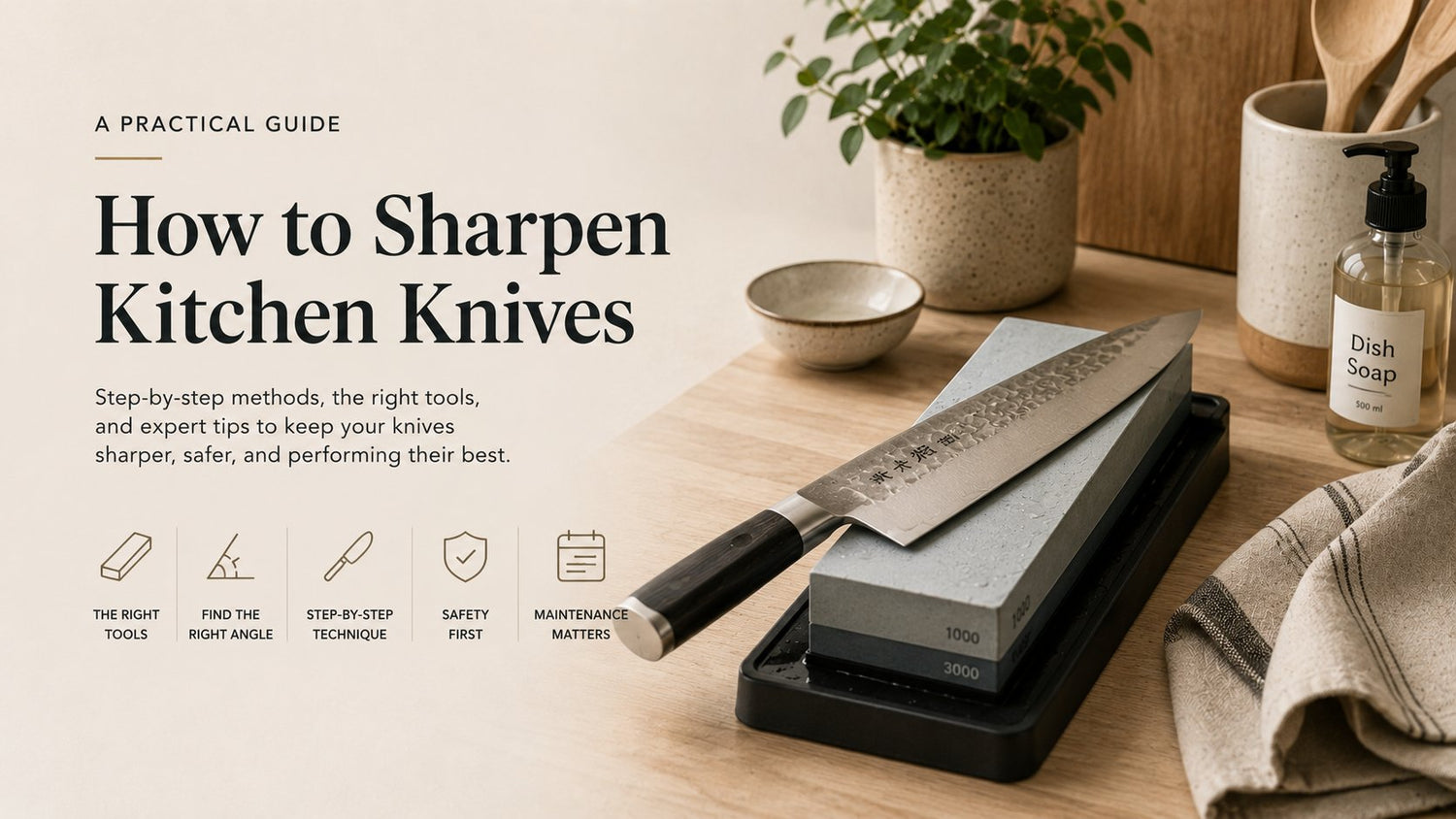
A lot of people start looking up how to sharpen kitchen knives after the same moment. You line up a tomato, press down with your chef's knife, and instead of a clean slice you get split skin, crushed flesh, and juice on the board. The knife still feels usable, but it doesn't feel right.
That's the frustrating middle ground where most home cooks live. Not blunt enough to throw out, not sharp enough to trust. The good news is that sharpening isn't reserved for butchers, sushi chefs, or people who own a wall of stones. You can learn a reliable method at home, keep your knives working properly, and stop guessing.
Table of Contents
- Why a Sharp Knife Is Your Most Important Kitchen Tool
- Choosing Your Sharpening Method and Tools
- Preparing Your Knives and Workspace for Safety
- Mastering the Whetstone Sharpening Technique
- Testing, Honing, and Maintaining a Lasting Edge
- Common Sharpening Mistakes and Simple Fixes
- Frequently Asked Knife Sharpening Questions
Why a Sharp Knife Is Your Most Important Kitchen Tool
Dinner prep falls apart fast when the knife stops cooperating. You press harder on an onion, the blade slips off the skin of a tomato, and a simple dice turns into slow, messy work. A sharp knife fixes that at the source. It cuts where you aim it, with less force and less correction mid-cut.
That matters for safety, but it also matters for control. In real kitchen use, dull knives cause more awkward motion than sharp ones. People start pushing, twisting, and sawing because the edge will not bite cleanly. Those are the moments that lead to slips.
Better cuts, less waste, less effort
A good edge changes the food on the board. Herbs stay cleaner instead of turning dark at the edges. Onion cuts separate instead of tearing. Meat carves into slices you can plate instead of rough chunks you have to tidy up later.
It also cuts fatigue. After a long prep session, the difference between a sharp knife and a dull one is not subtle. You use less pressure, your grip stays looser, and your pace stays steady.
Practical rule: If you need to lean into a tomato, pepper, or onion, the edge needs attention.
Sharpness also helps the rest of your kitchen run better. Prep moves faster when the tool in your hand works the first time. The same principle shows up in kitchen setup. Small systems, like pantry bins and zones that keep ingredients within easy reach, remove friction so you can focus on cooking instead of fighting your setup.
Sharp is not fancy
A sharp edge matters more than a high price tag. I would rather use a basic chef's knife that is maintained well than an expensive one that has gone dull. That is the practical gap this guide aims to close. You do not need to settle for a rough pull-through edge, and you do not need to turn sharpening into a metallurgy project either.
You need a method you can repeat, an angle you can hold, and enough understanding to choose the right tool for your knife and your cooking habits.
If you cook often, sharpening is not a side hobby. It is routine care for the tool you rely on most.
Choosing Your Sharpening Method and Tools
Dinner prep is when bad sharpening advice shows up. A tomato skins over under the blade, onions crush before they slice, and you end up wondering whether to buy a gadget, a stone, or just give up and send the knife out. The practical answer sits between those extremes. Home cooks do not need a drawer full of gear, but they do need a method they will use and understand.

What each tool actually does
Start with the job, not the marketing. Sharpening tools remove metal in different ways, and the right choice depends on how much control you want, how often you cook, and whether you will stick with the routine.
| Method | What it's good at | Trade-off | Best for |
|---|---|---|---|
| Whetstone | Control over angle, edge shape, and finish | Requires practice and patience | Cooks who want the most versatile method |
| Electric sharpener | Speed and angle consistency | Less control over the final edge feel | Busy households that want fast, repeatable sharpening |
| Honing rod | Regular edge maintenance | Doesn't replace real sharpening | Anyone who cooks often |
A whetstone gives the most control, which is why I recommend it to ambitious home cooks who want better results than a pull-through sharpener can give but do not want to study knife forums for a month first. You choose the angle, the pressure, and the finish. You also learn what the edge is doing instead of guessing. For a practical starter setup, the King Japanese Whetstone – #800/#6000 Dual Grit is a double-sided stone made in Japan, available for $59, with an #800 grit side for bringing back a dull edge and a #6000 grit side for refining it. That grit progression makes sense for home kitchens because it covers the two jobs most cooks need.
An electric sharpener trades some finesse for convenience. That trade-off is often worth it. If you cook a lot, share the kitchen with other people, or know you will never set up a soaking stone on a weeknight, an electric model is a sensible choice. The edge may feel a little less customized, but a knife that gets sharpened regularly will beat a neglected knife every time.
A honing rod belongs in a different lane. It helps keep an already decent edge lined up between sharpening sessions. It does not rebuild a worn edge, and it will not rescue a dull knife no matter how often you swipe the blade on it.
Choose the tool you will use every month, not the one that sounds impressive in theory.
How to choose based on your kitchen habits
Pick a whetstone if you want the best balance of performance, control, and long-term value. It takes more reps at the start, but the payoff is real. Once angle control starts to click, you can sharpen different knives, adjust the finish for different tasks, and stop depending on preset machines.
Pick an electric sharpener if speed matters more than customization. That is common in family kitchens. It is also a good fit for cooks who want a repeatable result without building hand skills first.
Keep a honing rod if your knives are already reasonably sharp and you want to stretch the time between full sharpening sessions.
I use the same buying rule here that I use for other everyday kitchen gear. Match the tool to your habits, your tolerance for setup, and the amount of maintenance you will do. The same kind of practical decision-making applies when choosing food storage containers that fit your kitchen and routine, and GrifGlo's household guides generally get that part right.
A simple decision filter
Use this quick filter if you are still on the fence:
- Choose a whetstone if you want better edges, more control, and are willing to practice.
- Choose an electric sharpener if you want speed, consistency, and low effort.
- Choose a honing rod if you need maintenance between real sharpening sessions, not a full fix.
One good tool is enough to start. The right choice is the one that fits your kitchen, your patience, and the knives you use.
Preparing Your Knives and Workspace for Safety
You feel setup mistakes fast. The stone skates a little, the blade arrives with onion residue still on it, your off hand has nowhere safe to rest, and suddenly a simple sharpening session turns sloppy.
Set the station before the knife comes out.
A stable counter at a comfortable height makes angle control easier and keeps your stroke from drifting. Put the stone in a holder if you have one. If not, set it on a folded damp towel so it stays planted. I have sharpened on both, and either works as long as the stone does not creep across the counter while you are halfway through a pass.
Handle the stone the way its maker recommends. Some water stones need a soak, while others are splash-and-go. Check that before you start instead of guessing, because the wrong prep can leave the surface dry, muddy, or slow to cut.
Then prep the knife. Wash it, dry it fully, and wipe off anything sticky near the heel and bolster. Residue hides what the edge is doing and makes the blade harder to control. Good light helps too. You want to see the water on the stone, the scratch pattern on the bevel, and any wobble in your stroke.
Keep the area clear around your working hand and your guiding hand. No loose tools, no food scraps, no bowls crowding the board. Sharpening takes a surprisingly small footprint, but it needs that space to stay predictable. The same logic behind organizing your fridge with bins and zones for a cleaner workflow applies here. Give each item a place, and the job gets calmer.
Use this quick check before the first stroke:
- Secure the stone: Holder or damp towel, with no side-to-side movement.
- Prep the stone correctly: Soak or splash with water based on the stone type.
- Clean the knife: Remove grease and food residue, then dry it well.
- Clear the workspace: Leave enough room for the full stroke and a safe off-hand position.
- Set up good lighting: Make the edge and stone surface easy to read.
- Keep a towel nearby: Wipe your hands if they get wet or slick.
A bad setup forces you to compensate. A good setup lets you focus on pressure, angle, and feel. That is the middle ground most home cooks need. Better than rushing a knife through a pull-through sharpener, and far less fussy than treating your kitchen counter like a professional knife shop.
Mastering the Whetstone Sharpening Technique
A whetstone gives you the most control without forcing you into pro-level complexity. That is why I recommend it to ambitious home cooks who have outgrown pull-through sharpeners but do not want a hobbyist lecture every time they touch up a chef's knife.

Find an angle you can repeat
For most Western kitchen knives, aim for roughly 15 to 20 degrees per side. Japanese knives often run a bit lower, but home cooks get better results by repeating one steady angle than by chasing a textbook number and wobbling through every stroke.
A simple starting point is a medium stone around 1000 grit for a dull but usable knife, then a finer stone around 3000 to 6000 grit to clean up the edge. You can go finer if you enjoy the process, but you do not need an ultra-polished finish to prep dinner well. In many kitchens, a clean 1000-to-4000 progression is the sweet spot between sharpness, time, and edge durability.
Keep the spine slightly raised and hold that height from heel to tip. Lock the wrist. Let the shoulder and elbow move the blade. If the angle changes every few inches, the stone cannot shape a clean edge.
Build the edge on the first stone
The first stone performs the heavy lifting. If the knife is very dull or has a small flat spot near the edge, start coarser. If it still cuts but slips on onion skin or tomato skin, a medium stone is usually enough.
Work one side until the edge is fully formed. Do not count strokes and assume both sides are done. Check the knife itself. I sharpen in short sections at first, especially on curved blades, because the heel, belly, and tip rarely wear the same way.
The sign you want is a burr. That is the fine wire of metal pushed to the opposite side as the abrasive reaches the apex. Feel for it carefully with your thumb moving across the edge, never along it. Once you can detect that burr from heel to tip, flip the knife and repeat on the second side.
A practical sequence looks like this:
- Set the angle and start with smooth, even strokes.
- Work in sections if that helps you keep full edge contact.
- Check for a continuous burr instead of guessing by sound or stroke count.
- Flip and match the work on the other side.
- Reduce pressure near the end so you do not leave a heavy burr behind.
Pressure matters. Start firm enough for the stone to cut, then lighten as the edge comes together. Too much force makes the bevel uneven and tires your hands faster. Too little force at the start wastes time.
A knife that still feels dull after several minutes usually does not need a fancier stone. It usually needs a fully formed edge on the first one.
Refine and finish the edge
Once the edge is set, switch to the finer stone and keep the same angle. At this stage, many home cooks blur the edge they just built. The finer stone feels smoother, so they speed up, lift the spine, or stop paying attention to the tip.
Use lighter strokes here. Alternate sides more often. The goal is to replace the deeper scratches from the first stone, shrink the burr, and leave an edge that cuts cleanly without feeling fragile.
If you want a little more durability, add a small micro-bevel at the end by raising the angle slightly for a few very light finishing strokes per side. I use this on workhorse chef's knives that see hard board contact. You give up a bit of pure razor feel, but you often get an edge that stays useful longer in everyday cooking.
Keep the stone surface clear as you work. Slurry can help cutting, but thick swarf and metal residue make feedback muddy. The same habit behind cleaning food storage containers thoroughly after heavy use applies here. Clean surfaces are easier to read and easier to control.
The result to aim for is simple. A knife that starts cuts easily, tracks straight through dense food, and stays predictable on the board.
Testing, Honing, and Maintaining a Lasting Edge

A knife can feel sharp on the stone and still disappoint on the board. The check that matters is simple. Does it start cleanly in food, or does it slide, crush, and need extra force?
How to test sharpness without overthinking it
Start with food, not party tricks. A ripe tomato, a scallion, or the skin of a bell pepper will tell you more than a dramatic paper slice. The edge should bite right away and keep tracking without wandering.
If I want a quick bench check before cutting food, I use my thumbnail carefully. The edge should catch lightly instead of skating. As noted earlier, professional guidance also treats that light thumbnail bite as a useful sharpness check and recommends regular honing between sharpening sessions to keep an edge working longer.
Use a light touch. You are checking for bite and consistency along the whole edge, not trying to dig into your nail.
Paper can help, but it is a secondary test. A knife that slices printer paper may still feel clumsy on onions if the edge is toothy in one spot and rounded in another. Food exposes that faster.
What honing does and what it does not do
Honing keeps a good edge working well. It does not rebuild a worn-out one.
That distinction saves people a lot of frustration. If the knife has lost its bite completely, a honing rod will not bring it back. If the edge still cuts but feels slightly rough, hesitant, or less precise, a few controlled passes on a rod can straighten the very fine edge and buy you more time before the next full sharpening.
Use the right tool for the steel. A smooth or fine ceramic rod suits many home kitchen knives. Aggressive grooved steels can be too harsh for harder Japanese blades and can leave a coarse, ragged edge if your pressure is sloppy.
A simple routine works well for most cooks:
- Hone when the knife starts to feel a little off, but still cuts.
- Sharpen when honing stops restoring clean performance.
- Hone less often than you think if the knife is very hard and the edge is stable.
- Hone more often if you use a softer European-style knife for heavy prep.
The trade-off is straightforward. Frequent light maintenance removes less metal overall, but only if you stop before the rod becomes a substitute for actual sharpening.
Storage and cutting habits that protect the edge
Daily use dulls knives. Bad habits dull them fast.
The board matters most. End-grain wood and softer synthetic boards are much kinder to an edge than glass, stone, or very hard bamboo. Technique matters too. Push cuts and slice cuts are easier on the edge than hard chopping straight down into the board all day.
A few habits make a noticeable difference:
- Use the spine, not the edge, to move chopped food.
- Wash knives by hand and dry them right away.
- Store them where the edge does not knock against other tools.
- Keep magnetic strips clean so grit does not scratch the blade.
That last point gets ignored. The same habit behind cleaning food storage containers thoroughly after heavy use helps here too. Clean contact surfaces are easier on your gear.
Good storage is simple. A magnetic strip, a blade guard, or a clean knife block all work if they keep the edge protected. The best choice is the one you will use every day without tossing the knife into a crowded drawer.
Common Sharpening Mistakes and Simple Fixes
Everyone makes the same few mistakes at first. The trick is knowing what the symptom means so you can correct it quickly instead of assuming you're bad at sharpening.

The knife feels dull even after sharpening
This usually means you never fully apexed the edge, or you left a burr hanging on. In plain terms, you polished the sides but didn't create a clean meeting point.
Fix: Go back to the earlier stone and work until you get a continuous burr along the full edge. Then refine again with lighter strokes.
One part of the blade cuts better than the rest
That almost always points to inconsistent angle control or uneven time spent on different sections. The heel may be sharp while the middle drags, or the tip may feel dead because you didn't follow the curve properly.
Fix: Sharpen in sections and inspect each one. Slow down at the tip. Keep your wrist fixed and let the arm move the blade.
The edge gets worse fast
This often comes from too much pressure, poor deburring, or rough use after sharpening. It can also happen if the stone surface is dished and no longer making even contact.
A simple reset helps:
- Flatten the stone if needed: An uneven stone creates an uneven edge.
- Reduce pressure: Heavy grinding can leave a fragile edge.
- Deburr more carefully: A leftover burr feels sharp briefly, then folds away.
- Check your daily use: Glass boards, twisting cuts, and drawer storage undo good sharpening fast.
There's a broader lesson here. Technique problems usually come from routine, not talent. That's true in the kitchen and in other maintenance tasks too, even with household tools like garment steamers that work best when you use them with the right setup and habits.
Frequently Asked Knife Sharpening Questions
Can I sharpen serrated knives at home
Yes, if you treat them like a different tool.
A serrated bread knife is maintained one gullet at a time, usually from the beveled side only. Primeaux's guide to maintaining serrated edges shows the basic approach: use a rounded diamond rod that matches the size of the serration, make light passes inside each scallop, and avoid grinding away the points that do the biting.
This is slow work. That is normal. For a home cook, the goal is usually to freshen the edge, not reshape every tooth from scratch.
How often should I sharpen my kitchen knives
Sharpen based on performance, not a fixed date.
A home cook making a few dinners a week might only need full sharpening a few times a year. A busy cook who uses the same chef's knife every day will need it more often. Softer German-style knives usually ask for touch-ups sooner. Harder Japanese steels tend to hold an edge longer, but they are less forgiving if your technique is sloppy.
I use a simple rule. If the knife slides on tomato skin, tears herbs, or needs extra force to start an onion cut, it is time for a stone. If the edge still cuts cleanly but feels a little tired, a few light honing passes may be enough.
When should I use a professional sharpening service
Use a pro for chips, broken tips, badly uneven bevels, or any knife you would hate to replace.
That also applies if you own thin Japanese knives, very hard powdered steels, or expensive custom pieces and you are not yet confident holding a consistent angle. A good sharpener can remove damage while keeping the blade geometry sensible, which matters more than getting the sharpest edge for one day.
For routine maintenance, home sharpening is still realistic for ambitious cooks. You do not need a workshop or years of training. You need a decent stone, a stable setup, and enough patience to keep the angle steady from heel to tip.
GrifGlo helps shoppers cut through clutter when they're choosing practical home and kitchen tools, from prep gear to storage and organisation systems. If you're building a kitchen that works better day to day, browse GrifGlo for decision-friendly guides and curated essentials that fit real routines.

Leave a comment
This site is protected by hCaptcha and the hCaptcha Privacy Policy and Terms of Service apply.