

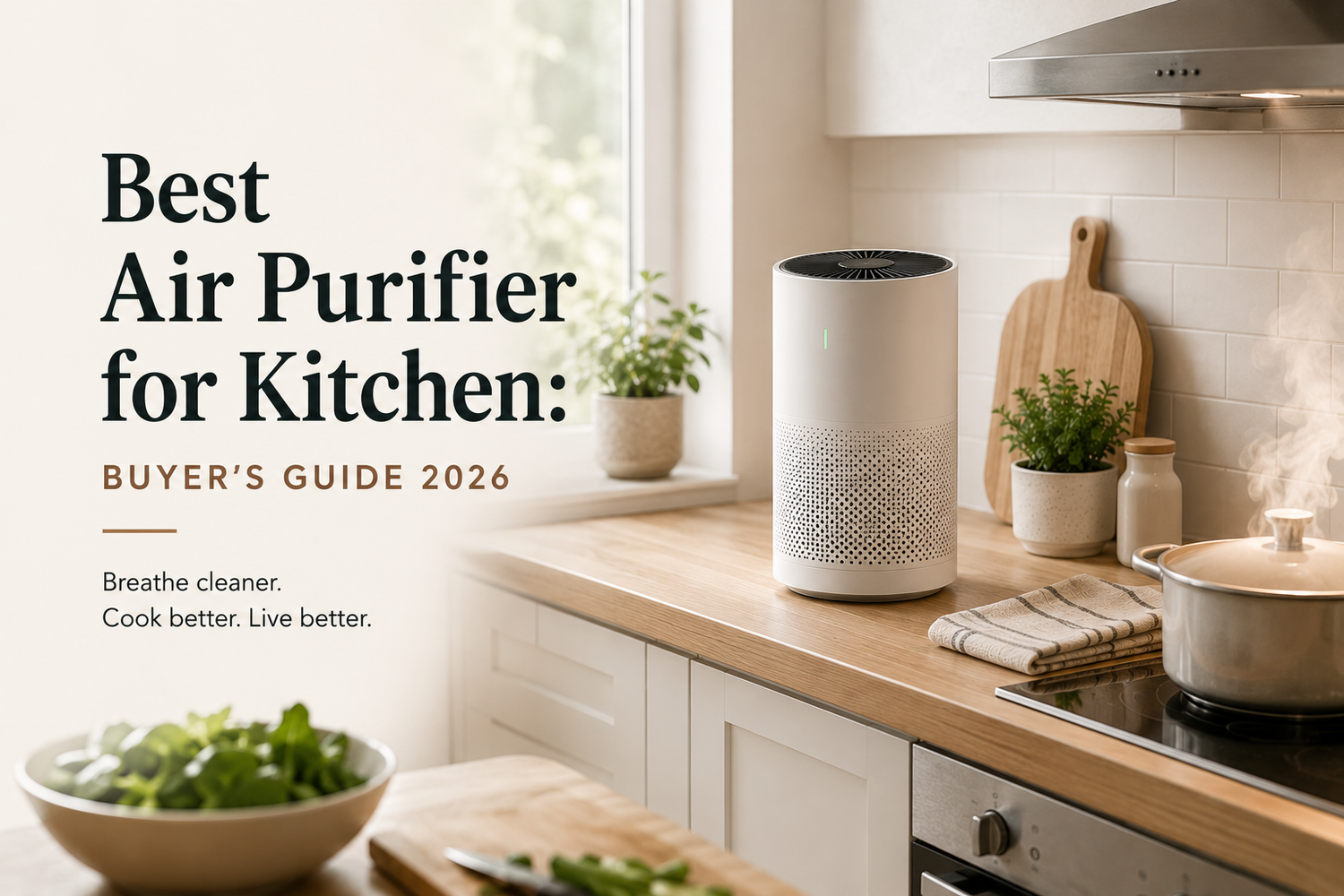
You sear salmon, the pan behaves for a minute, then the oil starts smoking. Ten minutes later the food is fine, but the kitchen smells like a fryer, the hallway has joined in, and the recirculating hood has done almost nothing except make noise. That's the moment one starts searching for an air purifier for kitchen use.
The problem is that kitchen air is messy in a way bedroom or office air isn't. Cooking throws off smoke, tiny grease aerosols, odour molecules, and other gases in short, intense bursts. A purifier that works nicely beside a bed can struggle badly beside a stove.
If you cook often, especially with garlic, onions, spices, high heat, or shallow frying, you need a machine chosen for this exact job. The right one can help clear escaped smoke and reduce lingering smells. The wrong one just circulates warm, greasy air and burns through filters.
Table of Contents
- Why Your Kitchen Needs a Different Kind of Air Purifier
- How Air Purifiers Tackle Kitchen Contaminants
- Decoding Key Specs CADR ACH and Room Size
- Choosing the Right Filters for Kitchen Pollutants
- Strategic Placement and Real World Kitchen Use
- Maintenance Costs and Long Term Reliability
- Your Kitchen Air Purifier Buying Checklist
Why Your Kitchen Needs a Different Kind of Air Purifier
Dinner can turn the air in a kitchen fast. Sear a steak in a hot skillet, char a tray of vegetables for 30 seconds too long, or let garlic catch in oil, and the room fills with smoke, sharp odours, and a greasy haze that does not behave like ordinary dust in a bedroom.
That difference matters. Kitchen pollution comes in short, intense bursts, and it is a mixed load. You are dealing with fine particles from smoke and cooking residue, plus gases from frying oil, food waste, and lingering food smells that settle into the room long after the burners are off. A purifier that works well for pollen or pet dander can struggle here because kitchen air asks more of both the fan and the filters.
I see this mistake all the time. People buy a purifier that is quiet and well reviewed for allergies, then expect it to handle stir-fry smoke or fish odours. It may catch some visible haze, but if the carbon filter is thin, the smell stays. If airflow is modest, the unit cleans eventually, not while the problem is still spreading through the house.
Practical rule: Buy a kitchen purifier for fast cleanup under cooking conditions. That means strong airflow, solid particle capture, and enough odour control to deal with grease-heavy air.
Kitchens also add wear that other rooms do not. Air near the hob or range often carries sticky residue, moisture, and heat. Those conditions load pre-filters faster and can shorten the useful life of carbon and HEPA filters if maintenance slips. That is why a kitchen-ready purifier needs more than a good spec sheet. It needs filter stages that match cooking pollutants and a design you will realistically keep clean.
Countertop appliances create the same kind of problem in a smaller zone. Air fryers, toaster ovens, and indoor grills can push hot odours and residue into tight spaces very quickly. If you use them often, good cleaning habits around the appliance help just as much as filtration. This guide to a clean air fryer setup addresses the same practical problem.
How Air Purifiers Tackle Kitchen Contaminants
A kitchen purifier works like a layered security team
The easiest way to understand a kitchen purifier is to picture it as a nightclub with a very strict front door. Air enters. Each layer stops a different kind of trouble.

First comes the fan. No airflow, no cleaning. In kitchen use, the fan matters because contamination arrives in spikes. When food starts smoking, the unit needs to pull a lot of air through quickly enough to make a difference before the haze drifts into the next room.
Then comes the pre-filter. This is the bouncer. It catches larger debris before the finer filters get overloaded. In kitchens, that matters because the air often carries more sticky residue than people realise. A washable pre-filter can save the more expensive internal filters from wearing out early.
The next layer is activated carbon. This is the specialist checking what the eye can't see. Carbon handles smells and gases, which is why it matters far more in a kitchen than in a typical allergy setup. Frying oil, bins, lingering spice odours, and many cooking-related VOCs are not a HEPA job.
Why one filter type isn't enough
After carbon comes HEPA, which does the fine clean-up. Many consumer guides and product pages in Canada use the benchmark that high-quality HEPA filters capture 99.97% of particles at 0.3 microns, which is the standard shoppers typically recognise when comparing serious filtration. Peer-reviewed literature also notes that modern purifiers commonly use a multilayer system including a prefilter, carbon filter, antibacterial filter, and HEPA filter, and reports that air filters can reduce indoor fine-particle concentrations by 60% in general, with household settings reporting reductions averaging 50% in a child's bedroom and 69% to 80% in other home settings in the NIH/PMC review on indoor filtration.
That layered design is why kitchen-specific buying advice should never stop at “has HEPA.” A purifier can be excellent for dust and still mediocre for cooking odours.
A replacement component such as the DYSON HEPA Air Carbon Purifier Filter - 965432-01 shows the basic architecture clearly: 360° HEPA filtration system, captures 99.97% of pollutants, activated carbon for odors & gases, and a sealed design for clean air output. Those are the exact functions kitchen users should be looking for, regardless of brand.
If your containers keep picking up stale kitchen smells, the air problem and the storage problem often overlap. Good filtration helps, but so does better cleanup and container care, especially for lids and seals. This guide on how to clean food storage containers is useful for that side of the equation.
Decoding Key Specs CADR ACH and Room Size
A pan of oil smokes fast. Burn garlic for 20 seconds and the room can go from normal to harsh, hazy, and clingy. In that moment, kitchen purifier specs stop being abstract. You need enough airflow to pull dirty air through the machine before smoke and odour drift into the dining area, settle into fabrics, or hang around until morning.
CADR is the first number to check
For kitchen use, CADR should be the first spec on the page. It measures how much cleaned air the unit delivers, and that matters more than cosmetic features when you are dealing with cooking smoke.
A purifier with low CADR may still help in a bedroom or office. In a kitchen, it often falls behind. Cooking pollution comes in bursts. Searing, broiling, pan frying, and even a toaster mishap can dump a lot into the air in a short window. If the machine cannot move enough air, it will only catch up after the worst of the smoke and smell have already spread.

As noted earlier, EPA guidance recommends matching the air cleaner to the room size rather than guessing from appearance or price.
Room size is where kitchen buyers often undersize
Measure the room. Then measure the room the air moves into.
A closed kitchen is straightforward. Multiply length by width and compare that square footage with the purifier's stated coverage. Open-plan homes are harder. Smoke and odours do not respect the edge of the cabinets, so a purifier placed near the kitchen may need to handle part of the dining or living area too.
That is a common buying mistake. Shoppers size for floor footprint, not for the air volume affected by cooking.
Use these rules:
- Closed kitchen: Size to the actual room dimensions.
- Open-plan kitchen: Include the connected area where smoke and odours drift.
- Frequent high-heat cooking: Buy above the minimum coverage, not right at it.
- Weak vent hood or recirculating hood: Expect the purifier to do more cleanup after cooking.
Small kitchens create a different trap. Buyers often assume a small room means any small purifier will do. However, even a compact kitchen can fill with smoke quickly because the pollutant source is concentrated and close to where people stand and breathe.
Layout matters too. If your pantry or food storage sits close to the cook zone, better separation helps reduce grease film and lingering odours on dry goods. Simple pantry storage rack ideas for tight kitchens can help create that buffer.
ACH helps you judge staying power
ACH, or air changes per hour, tells you how many times the purifier can cycle the room's air in an hour. I treat it as a second check after CADR.
For kitchens, ACH matters because cooking is rarely one quick event. You may preheat the oven, sauté onions, sear protein, then open a hot dishwasher after dinner. A purifier that can turn the air over more often is better able to recover between those bursts.
A kitchen needs enough airflow to recover after actual cooking, not just enough to look good on a spec sheet.
If a product page spends more time on app controls, mood lighting, or quiet mode than on CADR and room coverage, be careful. In kitchen use, performance has to come first.
A helpful visual walkthrough sits here:
Choosing the Right Filters for Kitchen Pollutants
Match the filter to the problem
A kitchen asks one machine to do several jobs at once. That's why filter choice matters more than the badge on the front.
If your main issue is smoke, you need strong particle capture. If your main issue is odour, you need meaningful carbon. If your issue is both, and for most cooks it is, you need a proper multi-stage setup with a pre-filter, carbon, and HEPA working together.
Here's the simple breakdown.
| Kitchen Air Purifier Filter Comparison | Primary Target | Effectiveness Against Smoke | Effectiveness Against Odours |
|---|---|---|---|
| Pre-filter | Larger debris and some visible cooking residue | Low on its own | Low on its own |
| Activated carbon filter | Gases, VOCs, and smell molecules | Limited for smoke particles | High when carbon capacity is sufficient |
| HEPA filter | Fine particles such as smoke and aerosols | High | Low for odours |
| Multi-stage system | Combined kitchen contaminants | High | High |
That table explains why so many shoppers feel let down by “odour” purifiers that don't have much carbon, or by allergy purifiers that handle haze but leave the smell of fried food behind.
In kitchen use, the pre-filter deserves more respect than it gets. Grease is the enemy of long filter life. A unit with an easy-to-clean outer screen or washable first layer is easier to live with, especially if you cook on the stovetop most days.
Buyer note: HEPA handles the smoke. Carbon handles the smell. If a product page only highlights one, it's only telling you half the story.
What to look for on a product page
Good listings tend to be clear about the filtration stages. Weak listings hide behind broad wording like “freshens air” or “advanced purification.” For kitchen use, I look for these signals:
- Stated HEPA filtration: It should clearly identify HEPA rather than implying fine filtration without naming it.
- Activated carbon included: Not optional wording, not a fragrance insert, not vague “odour technology.”
- Pre-filter access: Especially useful where grease aerosols are part of daily cooking.
- Sealed airflow path: Helpful for making sure air passes through the filter system rather than around it.
- Replacement filter clarity: If replacements are hard to identify, ownership gets annoying fast.
A product such as the CLOROX 11031 Alexa Smart Medium Room True HEPA Air Purifier is a good example of what to scan for on paper: Alexa voice control enabled, True HEPA 3-stage filtration, real-time air quality display, and auto mode with smart adjustment. Those details don't guarantee it's right for every kitchen, but they do tell you the listing is describing functions that matter.
For households trying to stop smells from getting into ingredients and leftovers, airtight food storage containers solve a different but related part of the same kitchen-air problem.
One more practical trade-off. Carbon media eventually saturates. So if you cook fish, fry frequently, or use lots of toasted spices, don't assume a purifier that worked well in month one will perform the same forever unless you stay on top of filter care.
Strategic Placement and Real World Kitchen Use
Where to put the purifier
Placement changes performance more than commonly anticipated. A purifier can have the right specs and still underperform if it's parked in a dead corner, jammed against a wall, or sitting in the direct splash zone beside the hob.

The best spot is usually near the cooking area, but not too close. You want it close enough to catch what escapes, but far enough away that heat, steam, and grease splatter don't punish the motor and filters. Countertop placement can work for compact units if the surface is stable and away from direct heat. Floor placement often works better for larger models, especially where counter space is precious.
Avoid these common mistakes:
- Too close to the stove: Heat and grease are hard on electronics and filters.
- Tight corners: Intake and exhaust need open space.
- Behind furniture or bins: Air has to move freely through the unit.
- Directly under heavy splatter: Even a strong purifier hates oil film.
How to run it during actual cooking
A purifier isn't a replacement for source control. California Air Resources Board guidance says portable air cleaners are a supplement to ventilation, not a replacement, and that the primary control for cooking pollution is a range hood that vents outdoors, with the purifier handling particles and gases that escape, as summarised in this CARB-aligned kitchen air guidance.
That matches real kitchen experience. If you have a vented hood, use it first. If you can open a window safely, do that too. Then let the purifier clean the leftovers that drift into the room.
A solid routine looks like this:
- Start the hood first. Turn it on before the pan gets hot.
- Run the purifier before cooking if possible. That gets air moving in the right direction.
- Increase fan speed for searing, frying, or smoky roasting. Those are the moments that matter most.
- Leave it running after the meal. The lingering phase is when odours settle into the room.
- Check the outer filter often. Kitchen air loads filters differently from bedroom air.
A purifier helps most when it catches what escaped the hood, not when it's asked to replace the hood.
Auto mode can be useful for daily cooking because it raises fan speed when the air gets worse and eases back when the spike passes. That's convenient in family kitchens where people don't want to keep adjusting settings manually. But I still prefer manual high speed during predictable smoke-heavy tasks, because cooking doesn't always wait for sensors to react.
If your kitchen is part of a busy household system, organisation helps airflow too. Clearing clutter from nearby counters and floor edges gives the purifier a cleaner path to work, and these fridge bins and zones ideas fit that broader layout thinking.
Maintenance Costs and Long Term Reliability
Burnt oil and spice smoke can make a purifier look impressive in the first week. Kitchen use tests it after a few months, when the pre-filter is sticky, the carbon is tired, and replacement parts are no longer an abstract line in the product description.
That is why I put ownership cost close to performance when I assess a kitchen model. Bedrooms are easy by comparison. Kitchens push grease particles, sharp odours, moisture, and short bursts of heavy pollution through the machine, and that mix can age filters faster than buyers expect.
The weak point is usually the filter stack. A purifier with a washable or easy-to-vacuum pre-filter is much easier to live with in a cooking space, because that first layer catches the grime that would otherwise load up the main filter. If the unit skips a serious pre-filter, the HEPA and carbon sections end up doing dirty work they were not designed to handle for long.
Before buying, check a few plain details that matter later:
- Replacement filters should be easy to identify and easy to buy: If the model number is confusing now, it will be worse a year from now.
- Pre-filter access should be simple: In a kitchen, you will clean it more often than you would in a bedroom or office.
- Carbon capacity matters for cooking odours: Small carbon sheets can lose effectiveness sooner in homes that fry, sear, or cook with strong aromatics.
- Filter reminders are helpful, but not enough: In kitchen use, visual inspection tells you more than an app alert.
Reliability shows up in boring places. I look for clear CADR information, recognized safety listings such as UL or ETL, and warranty terms written plainly enough that you can tell what is covered. I also pay attention to the body design. Smooth surfaces wipe down more easily. Recessed controls collect less grime. Cheap glossy plastic near the intake often starts looking rough fast in a kitchen.
A model can be a good air purifier and still be a poor kitchen purifier. The difference usually comes down to whether it was built for repeated smoke events, greasy air, and frequent maintenance, rather than occasional dust removal in a spare room.
Judge a kitchen purifier by the fifth filter cleaning, not the first unboxing.
My rule is simple. If the filter door feels flimsy, the pre-filter is awkward to reach, or replacement costs seem vague, I keep looking. Those small annoyances become expensive habits in a kitchen.
Your Kitchen Air Purifier Buying Checklist
The right air purifier for kitchen use isn't the one with the most features. It's the one that matches how you cook, how your room is laid out, and how much maintenance you're willing to do.
Use this checklist before you buy.

- Measure the room properly: Work from actual kitchen dimensions, not guesswork.
- Check airflow before smart features: A stylish app won't clear burnt garlic.
- Confirm HEPA plus activated carbon: Kitchen air needs both particle and odour control.
- Look for a practical pre-filter: Especially important if you fry, sear, or cook with oil often.
- Think about placement before purchase: Make sure the shape and footprint suit your counter or floor plan.
- Read the replacement filter details: Ongoing cost and convenience matter.
- Prefer clear performance information: Vague claims usually lead to vague results.
- Use it with ventilation, not instead of ventilation: The hood handles source capture. The purifier handles what gets away.
If you cook gently a few times a week, a moderate setup may be enough. If you cook hard, use strong spices, or live with an open-plan layout and a weak hood, size up and pay more attention to carbon and maintenance.
Buy for your worst cooking day, not your quietest one.
If you're comparing options and want a simpler way to sort through kitchen and home essentials, GrifGlo provides practical buying guides, product grouping, and decision-friendly comparisons that help households, property managers, and small teams choose appliances and everyday systems with less guesswork.


Leave a comment
This site is protected by hCaptcha and the hCaptcha Privacy Policy and Terms of Service apply.