

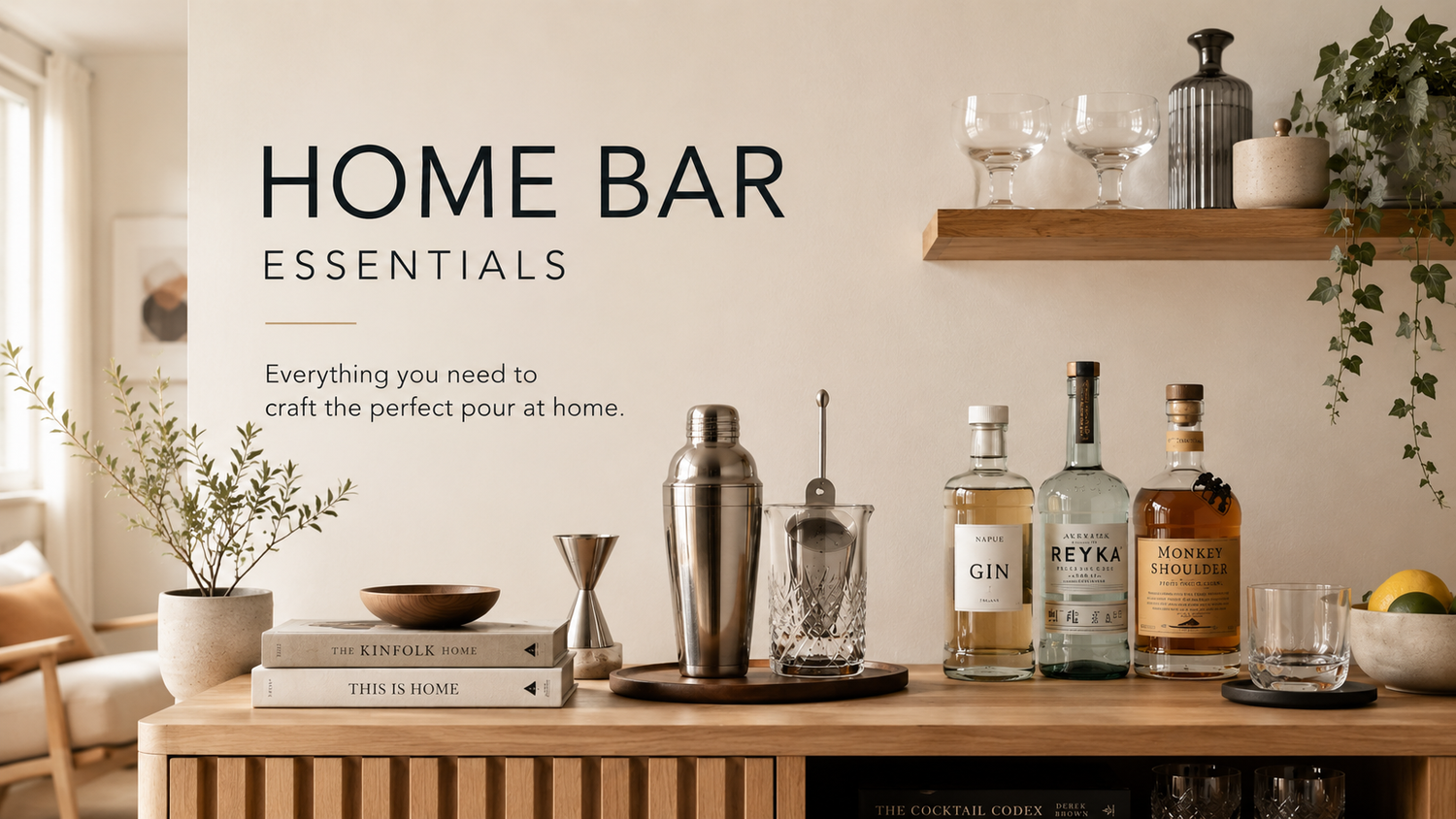
You've probably done some version of this already. Friends come over, someone asks for a Daiquiri or an Old Fashioned, and you realise you have the spirit but not the pieces that make the drink work. No citrus. No bitters. No jigger. Maybe not even enough ice. So the bottle goes back on the counter and everyone ends up with wine, beer, or a splash of something over cubes.
That's the gap many enthusiasts hit when they start thinking about home bar essentials. It isn't usually a lack of enthusiasm. It's a lack of structure. People buy one beautiful shaker, two random bottles, a set of glasses they don't use, and then wonder why making drinks still feels awkward.
The good news is that building a home bar isn't a niche hobby any more. U.S. online sales of barware and glassware reached approximately $1.4 billion in 2022, which says a lot about how normal at-home cocktail making has become for regular households, not just collectors and enthusiasts, as noted in Mary Jurek Design's home bar overview.
A good setup doesn't start with a giant shopping list. It starts with a bar that works on an ordinary Tuesday, in a small flat, with a sensible budget. That's where a tiered approach helps. Build the core first. Add upgrades when your habits justify them. Leave the specialist gear for later, if ever.
Table of Contents
- From Wishful Thinking to Well-Crafted Drinks
- The Building Blocks of a Great Home Bar
- Essential Bar Tools and Why They Matter
- Stocking Your Bar with Foundational Spirits
- Choosing Your Supporting Cast of Glassware and Mixers
- Designing Your Bar for Any Home and Budget
- Maintaining and Growing Your Home Bar Collection
From Wishful Thinking to Well-Crafted Drinks
The most common beginner mistake isn't buying the wrong gin or choosing the wrong shaker. It's building a bar backwards. People start with bottles they like the look of, then add tools that seem professional, and only later discover they still can't make a clean, balanced drink on demand.
A practical bar starts with function. If someone asks for a Martini, a Margarita, or a Whiskey Sour, you need more than the headline bottle. You need a way to measure, a way to chill, a way to strain, and a few supporting ingredients that do a lot of work. Once those are in place, the whole thing becomes easier and cheaper to build.
That's why the modular approach works so well. Level 1 covers the must-haves you'll use every week. Level 2 adds range and polish. Level 3 is where you indulge a favourite style, whether that's stirred whiskey drinks, tropical rum drinks, low-ABV spritzes, or alcohol-free serves that still feel grown-up.
Start with the drinks you want to make twice a month, not the drinks you admire once a year.
This matters even more in smaller homes. A crowded bar is usually a badly edited bar. One good jigger beats three novelty tools. One coupe that works for multiple drinks beats a shelf of fragile glassware you rarely touch.
When people say they want home bar essentials, what they usually want is confidence. They want to know that when guests arrive, they can make something balanced, cold, and deliberate without turning the kitchen into a scavenger hunt. That comes from a bar with a clear purpose, not a bar with the biggest footprint.
The Building Blocks of a Great Home Bar
A useful home bar works like a compact kitchen. You need something to cook with, ingredients worth cooking, and the right way to serve the final result. If one part is weak, the whole setup feels patchy.

Three parts that make the system work
Most people think in terms of bottles first. Bartenders don't. They think in systems.
- Bar tools give you control. They handle temperature, dilution, texture, and portioning. A shaker, jigger, strainer, spoon, and muddler cover most of what a beginner needs.
- Core ingredients create the drink itself. This includes spirits, liqueurs, vermouths, mixers, citrus, syrups, and bitters.
- Serveware finishes the job. A drink poured into the wrong glass can still taste fine, but it often warms too quickly, looks clumsy, or feels less intentional.
A tidy way to browse practical starter gear is through a collection of kitchen tools and gadgets for everyday setups. The same principle applies here. Buy for fit, not for drama.
A modular bar beats a perfect bar
The reason giant checklist articles fail beginners is simple. They flatten everything into one level of urgency. A Hawthorne strainer is not as urgent as fresh limes. A coupe isn't as urgent as a jigger. Orange liqueur may be more useful to you than a second whiskey.
Here's a cleaner way to approach it:
| Category | Level 1 | Level 2 | Level 3 |
|---|---|---|---|
| Tools | Shaker, jigger, strainer | Bar spoon, muddler | Mixing glass, fine strainer |
| Ingredients | Core spirits, citrus, bitters, soda | Vermouth, orange liqueur, ginger beer | Amaro, specialty syrups, niche modifiers |
| Serveware | Rocks glass, coupe | Wine glass, highball | Specialty glassware |
Practical rule: If an item only serves one drink you rarely make, it belongs in Level 3.
That single rule keeps a home bar organised. It also keeps you from buying attractive clutter. The strongest setups aren't the biggest. They're the ones where every item has a reason to be there.
Essential Bar Tools and Why They Matter
Tools decide whether your drink is balanced, cold enough, and consistent from one round to the next. The good news is that the essentials list is short. The bad news is that cheap versions of those essentials can make the job harder than it needs to be.
Level 1 tools you should buy first
Begin with the essentials.
Shaker
If you make anything with juice, syrup, egg white, or dairy, you need a shaker. A Boston shaker is what many bartenders prefer because it seals well, chills quickly, and tends to outlast cobbler shakers with built-in tops that can stick. A cobbler shaker is easier for some beginners to understand, but it has more moving parts and more opportunities to frustrate you.
Jigger
This is the backbone of control. Drinks made with calibrated jiggers show 89% consistency in taste profiles versus 34% for estimation, according to Holy City Handcraft's home bar guide. The same source notes that stainless steel jiggers maintain measurement accuracy indefinitely, while plastic versions can warp after 50 to 100 uses, causing measurement drift.
That tells you exactly where not to save money. Buy stainless steel. Skip plastic.
Strainer
If your shaker doesn't include one you trust, add a Hawthorne strainer. It's the general-purpose choice for shaken drinks. It catches ice shards and larger solids and gives you a cleaner pour into the glass.
Here's the simple version of Level 1. If you own these and know how to use them, your drinks improve immediately.
- Shaker for chilling and dilution
- Jigger for balance and repeatability
- Hawthorne strainer for clean pours
A home bar also lives or dies by its ice. Large cubes melt more slowly and usually make stirred drinks taste more composed. A tray that gives you dependable, larger-format ice is often more useful than another bottle on the shelf, especially for Old Fashioneds and Negronis. A practical example is a large silicone ice cube tray for slow-melting cocktail ice.
Level 2 upgrades that earn their space
Once the core is covered, buy the tools that widen your range without cluttering the drawer.
Bar spoon
A proper bar spoon stirs smoothly, reaches the bottom of tall mixing vessels, and helps with gentle layering. You can stir with a teaspoon, but it won't feel as controlled or as tidy. If you like Martinis, Manhattans, or any spirit-forward drink, this tool earns its keep.
Muddler Useful, but only if you work with mint, citrus peels, berries, cucumber, or sugar cubes. A muddler should press ingredients, not shred them into bitterness. Smooth-ended muddlers tend to be friendlier than sharp-toothed designs for most home use.
A good tool should reduce guesswork. If it creates a workaround every time you use it, it isn't a good buy.
Level 3 specialist tools for specific drinks
These are for preference, not necessity.
- Julep strainer works well for stirred drinks when used with a mixing glass.
- Fine mesh strainer helps with double-straining cocktails that contain citrus pulp or herbs.
- Mixing glass is pleasant to use if you make a lot of stirred drinks, though a sturdy pint glass can cover the same job at home.
The trade-off is straightforward. Specialist tools can improve workflow and presentation, but they don't rescue a weak foundation. If you're still free-pouring, using tired ice, and guessing proportions, another polished accessory won't fix the drink.
Stocking Your Bar with Foundational Spirits
The smartest bottle strategy is versatility first. One bottle should be used in several classic drinks, not sit on the shelf waiting for a single annual craving.

Level 1 bottles that pull real weight
If you're starting from zero, build around bottles that stretch across the widest range of drinks.
- Gin gives you Martinis, Gin & Tonics, Negronis, Tom Collins variations, and plenty of citrus drinks. A classic dry style is the easiest entry point because it mixes cleanly.
- Rum earns a spot because it can move from a simple Daiquiri to a Mojito, Cuba Libre, or darker, richer serves depending on the style you choose. If you only buy one at first, a versatile light rum is usually easier to deploy.
- Tequila opens the door to Margaritas and highballs and works beautifully with citrus and salt. Look for a bottle you'd also be happy to sip in a small pour.
- Bourbon or rye covers Old Fashioneds, Whiskey Sours, and boulevardier-style drinks. Bourbon runs rounder and sweeter. Rye tends to read drier and spicier.
- Vodka is less exciting to talk about, but very useful when guests want something neutral and easy-drinking.
These aren't the only spirits worth owning. They're the ones that give beginners the broadest practical range.
Level 2 bottles that broaden your range
The next tier isn't more base spirits. It's the modifiers that tie drinks together.
Orange liqueur is one of the hardest-working bottles in a home bar. It supports Margaritas, Sidecars, and plenty of citrus-led drinks.
Vermouth matters if you want Martinis, Manhattans, Negronis, and other classics to taste complete rather than blunt.
If your budget is tight, buy one base spirit you love, one secondary spirit for guests, then add orange liqueur and vermouth before chasing a sixth base bottle. That usually creates a more functional bar than buying every major category at once.
This short video gives a useful visual reference for how a basic bottle lineup comes together in practice.
Level 3 choices for personal taste
This tier should reflect how you drink.
If you love bitter aperitif-style cocktails, add an amaro. If you host brunch often, a coffee liqueur may pull more weight. If you favour smoky or savoury drinks, your next bottle might be a peated whisky or a mezcal-style option. Let your habits decide.
The same goes for alcohol-free hosting. In California, sales of non-alcoholic spirits surged 28% in the last year, and NA alternatives now make up 15% of home bar spirit purchases in the state, according to Beestiing's overview of modern home bar stocking. That makes a strong case for including at least one thoughtful non-alcoholic bottle in a modern setup.
Good NA bottles don't need to imitate every spirit category at once. Start with one that works in multiple serves, then support it with citrus, tonic, soda, herbs, and bitters if appropriate. The goal is the same as with the rest of the bar. Give people a proper drink, not a consolation prize.
If a guest doesn't drink alcohol, they should still get something built with the same care as everyone else's glass.
Choosing Your Supporting Cast of Glassware and Mixers
A lot of bar setups get expensive because people overbuy glassware and underthink mixers. It should be the other way round. A compact glassware lineup is fine. Flat tonic is not.
Glassware that does more with less
For most homes, two glass types handle the bulk of service neatly.
Rocks glasses cover anything served over ice, from whiskey pours to Negronis and spritzed short drinks.
Coupe or Nick & Nora glasses handle up drinks such as Martinis, Manhattans, Daiquiris, and sours served without ice.
That's enough for a sharp, functional start. If you entertain often with long drinks, add a highball later. If you're in a smaller flat, resist buying a separate glass for every recipe card you see online.
A practical modular approach looks like this:
- Level 1 means rocks glasses and coupes
- Level 2 adds a highball or wine glass
- Level 3 is specialty territory such as dedicated Martini glasses, mugs, or niche stemware
Restraint pays off in this situation. Smaller homes benefit from multi-use pieces far more than from ceremonial ones.
Mixers and enhancers that make drinks taste finished
Mixer quality changes a drink faster than many beginners expect. Carbonated mixers in standard bottles lose integrity within 2 to 3 hours of opening, and switching to individual single-serve bottles can increase perceived cocktail quality by approximately 40% in taste tests, according to A Turtle's Life for Me on home bar essentials.
That's the case for cans and small bottles right there. They stay fresh, they reduce waste, and they keep your G&T or highball from tasting tired halfway through the evening.
Keep this part of the bar simple and reliable:
- Tonic water and soda water in single-serve format
- Ginger beer for mules and darker highballs
- Bitters with a classic aromatic bottle as your first purchase
- Simple syrup made in a small batch so it stays useful
- Fresh citrus because bottled lemon and lime juice flatten drinks fast
Freshness does more for a drink than a fancy garnish ever will.
For simple syrup, the home version doesn't need ceremony. Stir sugar into warm water until dissolved, cool it, and keep it chilled. Make small amounts so you use it while it's still tasting clean.
Designing Your Bar for Any Home and Budget
A home bar should fit your room before it fits your fantasy. That's especially true in California, where average apartment size in major metros sits at 750 sq ft or less, 68% of residents rent, and 55% of renters cite storage as their top home bar barrier, as noted in this California renter-focused discussion.

Tray, cart, or cabinet
Here's the practical comparison.
| Setup | Best for | Strength | Watch-out |
|---|---|---|---|
| Compact tray | Small kitchens, sideboards, countertops | Easy to edit and keep tidy | Very limited bottle capacity |
| Bar cart | Flexible entertaining spaces | Mobile and visually pleasing | Can become cluttered fast |
| Cabinet | Growing collections and cleaner sightlines | Hides visual noise and protects supplies | Easy to overbuy and lose track |
A compact tray is the strongest Level 1 option. It forces discipline. One shaker, one jigger, a few glasses, a few bottles, bitters, citrus bowl. Done.
A bar cart works best when you host often and want mobility. Keep the top shelf for active service and the lower shelf for backup bottles and unopened mixers. If both shelves become bottle storage, the cart turns into furniture with traffic.
A dedicated cabinet suits people who've settled into the hobby. It protects glassware, keeps dust off tools, and lets you separate everyday bottles from occasional ones. The danger is invisible clutter. If you can't see what you own, you'll buy duplicates.
What renters should prioritise
Renters benefit from modular pieces and strict editing.
- Use vertical storage with shelves or risers where appropriate
- Choose stackable or nested tools instead of bulky sets
- Buy multi-use glassware before specialty pieces
- Keep open bottles to a working lineup rather than a display lineup
If you're building out a general home setup alongside your bar area, a broader collection of home essentials for compact living and organisation can help keep the whole space functioning well.
The key trade-off is simple. A smaller bar that stays organised is more usable than a larger one that spills into cupboards, drawers, and random corners of the kitchen.
Maintaining and Growing Your Home Bar Collection
A home bar doesn't need much maintenance, but the basics matter. Sticky tools, stale modifiers, and cloudy glassware make the whole setup feel neglected.
A simple care routine
Keep the routine boring and consistent.
- Wash shakers and strainers promptly so syrup and citrus don't dry into seams
- Dry metal tools fully to prevent odours and sticking
- Refrigerate items that fade after opening such as vermouth and homemade syrup
- Check mixers before guests arrive so you're not serving flat tonic
- Polish glassware with a lint-free cloth if you want drinks to look crisp
The principle is the same across the whole bar. Anything delicate gets used fresher and stored colder. Anything metal gets cleaned before residue hardens.
How to expand without wasting money
The best next purchase is usually the one that deepens a category you already use. If whiskey drinks dominate your evenings, add a second whiskey with a different profile. If you've been making lots of citrus cocktails, add one liqueur that broadens your options instead of buying three unrelated spirits at once.
That's how a bar grows with purpose. Not by getting bigger, but by getting more intentional.
If you want help choosing practical gear without getting buried in endless product pages, GrifGlo is built for exactly that kind of decision. It curates home, kitchen, and organisation essentials into clearer buying paths, so you can put together a home bar that fits your space, your routine, and the way you host.

Laisser un commentaire
Ce site est protégé par hCaptcha, et la Politique de confidentialité et les Conditions de service de hCaptcha s’appliquent.