

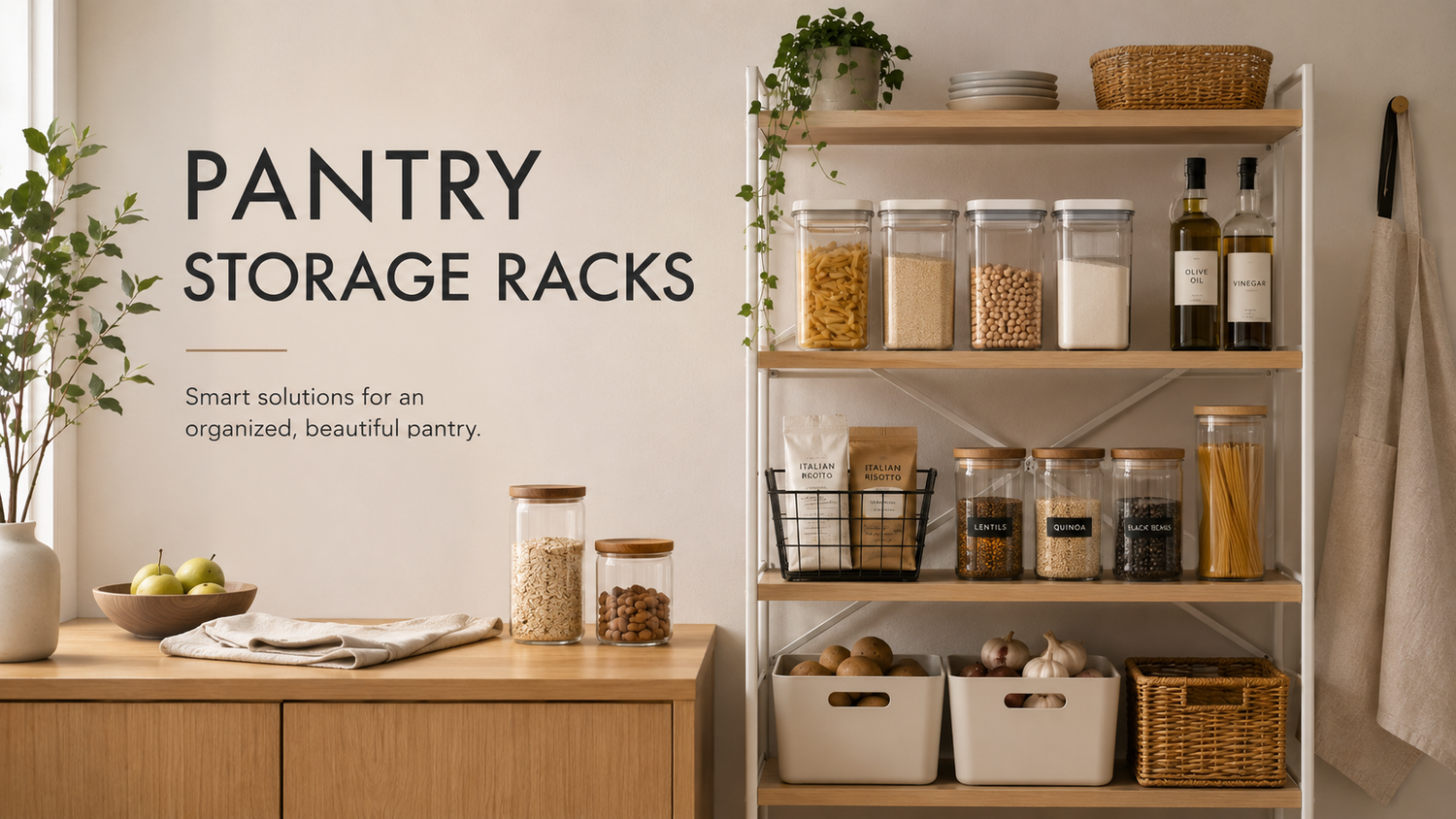
You open the pantry to grab rice, and a bag of pasta slides forward. Behind it, there's a half-used bag of flour, three cans of tomatoes you forgot you had, and a snack box crushed under something heavier. That kind of pantry isn't just messy. It slows dinner down, hides what you already bought, and makes small kitchens feel even smaller.
That's why pantry storage racks matter more than often assumed. They're not just shelves. They're the difference between a pantry that fights you and one that works with your routine. Interest in kitchen organisation keeps climbing. The global kitchen storage and organisation market reached USD 131.43 billion in 2023 and is projected to reach USD 182.08 billion by 2030, which reflects how many households are trying to reduce clutter and make kitchens work harder.
If your pantry is stuffed with mismatched bins, deep shelves, or awkward dead space, the fix usually isn't buying more containers at random. It's choosing the right rack style for the space you have, then building zones that match how you cook and shop. If you also need a simple way to sort categories once the rack is in place, this guide to organising your pantry with bins and zones pairs well with the rack decisions below.
Table of Contents
- From Pantry Chaos to Calm Control
- A Guide to Common Pantry Rack Types
- Measure Twice and Buy Once
- Choose Materials for Durability and Use
- Installation for Homeowners and Renters
- Pantry Layouts for Different Lifestyles
- A Framework for Your Final Decision
From Pantry Chaos to Calm Control
Most pantry problems look like storage problems, but they usually start as visibility problems. Food gets pushed to the back. Tall bottles block shorter items. Bulk buys land wherever there's room. Then the pantry becomes a holding area instead of a working part of the kitchen.

A good rack system changes that by giving every category a defined home. Cans sit where labels stay visible. Dry goods stop toppling over. Backstock stops mixing with everyday items. In practice, that means fewer duplicate purchases and less time spent digging through shelves before a meal.
What a rack system fixes
Some homes need more capacity. Others need better access. Those are different problems, and they need different solutions.
- If shelves are deep: pull-out formats or tiered inserts help you see what's hiding in back.
- If the pantry is narrow: slimmer freestanding units or door-mounted racks make use of vertical space.
- If you buy in bulk: stronger shelving and wider spacing stop heavy items from stacking dangerously.
- If you rent: removable systems matter more than a built-in look.
Practical rule: Don't start with the product. Start with the frustration you want to remove.
Canadian homes add another layer. A downtown condo pantry, an older rental with odd shelf dimensions, and a humid coastal kitchen won't all suit the same rack. That's where generic advice falls apart. The best pantry storage racks are the ones that fit your space, your climate, and the way you buy food.
A Guide to Common Pantry Rack Types
Not every rack belongs in every pantry. Some are best for open visibility. Some are built for depth. Some are ideal only when you can attach hardware to walls or cabinet sides. Knowing the main types helps you avoid buying a system that looks tidy online but fails in a real kitchen.

For a broader look at products across categories, it helps to browse a focused collection of kitchen storage and organisation options before you narrow down one rack style.
Fixed shelves and freestanding units
Fixed shelving is the standard setup in many pantries. It can be wire or solid.
Wire shelving is lighter, allows airflow, and works well for packaged goods. The downside is that small items wobble, bags sag between bars, and thin canisters don't always sit flat. Solid shelving gives better support and cleaner lines, but crumbs and spills stay put unless you clean regularly.
Freestanding racks are one of the safest choices for renters and for awkward pantry spaces. They don't depend on existing shelf spacing, and you can often move them later to a laundry room, utility closet, or garage shelf zone. Their weakness is footprint. If the unit is too deep, it eats the walkway and makes the pantry feel tighter.
Here's the simplest way to compare them:
| Rack type | Best for | What works well | What often goes wrong |
|---|---|---|---|
| Fixed wire shelves | General pantry goods | Airflow, light feel, easy visibility | Small items tip or sag |
| Fixed solid shelves | Containers, jars, heavy flat-bottom items | Stable surface, cleaner look | Dead space if shelf heights can't change |
| Freestanding units | Renters, secondary pantries, utility use | Flexible placement, no major install | Can feel bulky in tight spaces |
Door racks, pull-outs, and adjustable systems
Over-the-door racks solve one specific problem very well. They use unused vertical space for small, light items such as spices, pouches, wraps, or snack bars. They are not the place for heavy bottles or bulk cans unless the door and hardware are built for it. Too much weight on the door creates rattling, swing issues, and hardware fatigue over time.
Pull-out organisers are the strongest fix for deep shelves and lower cabinets. If you've ever had to kneel down and remove five items to reach one bottle at the back, this is the upgrade that changes daily use the most. Soft-close slides feel nice, but the main value is access. You can see everything at once.
Pull-outs cost more and take more planning, but they solve a real problem that fixed deep shelves never do.
Adjustable track systems work well if your pantry stores mixed categories. One month you need tall space for cereal and oil. The next, you need shorter levels for cans and jars. This format is practical for changing households, growing families, and anyone who shops seasonally.
A few no-nonsense trade-offs:
- Door-mounted racks: best for light, frequently used items.
- Pull-outs: best for deep spaces and lower reach zones.
- Adjustable systems: best when your inventory changes often.
- Tiered shelf risers: good as add-ons, not as a full rack strategy.
- Stackable shelves: useful for short-term fixes, but they can create awkward dead zones if they aren't sized well.
Measure Twice and Buy Once
Most pantry rack mistakes happen before installation. The product isn't always bad. The measurements are. That's a big reason shoppers end up returning systems that looked right on a product page but don't fit around trim, doors, hinges, or shelf lips once they get home.

In Canadian homes, dimensions matter even more because pantry spaces vary so much between newer condos, older houses, and rentals. According to this pantry unit reference that cites Canadian ergonomic guidance, pantry shelf depths typically range from 14 to 16 inches (36 to 41 cm) in Canadian residential construction to fit standard 24-inch deep closets, and that depth also supports easier access with less overreaching. If you're also sorting canisters and dry goods while planning the shelf layout, this guide to food storage container sizes helps prevent mismatched shelf heights.
What to measure before you shop
Start with the inside width, not the outside cabinet width. Then measure the depth from the usable front edge to the back wall, not just to the door frame. Finally, measure height in more than one spot, especially in older homes where floors or shelves may not be perfectly level.
Use this checklist:
- Width at the narrowest point: include anything that reduces clearance, such as trim, shelf brackets, or side lips.
- Usable depth: account for doors that close inward, hinges, or frame overhang.
- Height between shelves: check whether cereal boxes, oil bottles, or appliance bins need taller openings.
- Door swing clearance: a rack may fit the opening but still block the door from closing cleanly.
- Baseboard or toe-kick interference: freestanding units often fail here.
Measure the space the rack will actually occupy, not the space you think you have.
Why depth matters more than people expect
Depth looks like extra storage, but too much depth often creates hidden storage. That's not the same thing. In a reach-in pantry, a rack that's too deep turns the back third into forgotten territory.
If you want a visual walkthrough before buying, this short video covers the basics of measuring cabinet and pantry space accurately.
For many households, the sweet spot is a rack that lets you see labels without having to shift your torso into the pantry opening. That matters in narrow condo kitchens especially, where a few extra inches can make the difference between smooth access and constant annoyance.
A practical habit helps here. Take measurements in inches and centimetres, photograph them on your phone, and bring those photos when shopping. If you're comparing online products, check the assembled dimensions, not just shelf dimensions. Those two numbers aren't always the same.
Choose Materials for Durability and Use
Material choice decides how a pantry rack ages. It affects rust, wipe-downs, shelf sag, noise, and whether the unit still feels solid after months of cans, flour bags, and bottled sauces. Looks matter, but performance matters more.
What each material does well
Chrome-plated wire is common because it's widely available and usually lighter in appearance than solid shelving. It suits dry interiors and lighter pantry categories. It's less forgiving when the room runs damp, and it can feel slippery or unstable with narrow-bottom containers.
Powder-coated or epoxy-coated steel is the better pick if moisture is part of the equation. In humid Canadian provinces, consumer tests found powder-coated or epoxy-coated steel had 35% less corrosion than standard chrome in high-humidity environments. That makes it the more sensible long-term choice for coastal regions, basements, and kitchens where ventilation isn't great.
Solid wood feels warmer and usually supports flat-bottom containers well. It works best when the shelving is properly sealed. Raw or poorly finished wood can stain, absorb odours, and react badly to repeated spills.
MDF or composite shelving can look clean at first and often costs less than solid wood. The problem is edge wear and moisture sensitivity. If water gets into seams or corners, swelling is hard to reverse.
Plastic shelving has a place, especially in lightweight setups, utility pantries, or kid-access zones. It's easy to clean and won't rust, but it can flex under heavier goods and may not hold up well in a heavily used household pantry.
Match the finish to your environment
The wrong material usually fails in predictable ways. In dry spaces, the issue is often stability. In damp spaces, it's finish breakdown. In busy family kitchens, it's cleanability.
A quick comparison helps:
| Material | Best use | Strength | Weak spot |
|---|---|---|---|
| Chrome wire | Dry pantry goods | Airflow, visibility | Corrosion risk in damp spaces |
| Powder-coated steel | Humid homes, heavy use | Better durability, easier upkeep | Less decorative than wood |
| Solid wood | Built-in pantry look | Stable surface, good support | Needs sealing and maintenance |
| MDF/composite | Budget built-ins | Smooth look | Moisture damage |
| Plastic | Light-duty storage | Easy to wash, renter-friendly | Lower rigidity |
If you live in a humid area, choose for corrosion resistance first and appearance second. You'll care more about the finish after a year than on day one.
There's also the pest question. Open wire helps airflow and visibility, but it doesn't protect dry goods by itself. If moths or pantry beetles are a concern, use sealed containers on the rack instead of expecting the rack material to solve the problem.
Installation for Homeowners and Renters
A rack can be well designed and still fail because of a poor install. The load shifts. The shelf leans. The door doesn't close. The unit scrapes the wall. Good installation is mostly about matching the mounting method to the building and the user.

Permanent installs that hold up
Homeowners have more flexibility, but that doesn't mean every wall should carry every rack. If you're mounting shelving or vertical track systems, locate studs first when the load will be substantial. Canned goods, oils, and bulk dry goods add up fast.
Permanent installs tend to work best when you:
- Anchor for the full load: don't estimate based on how empty shelves look on day one.
- Leave clearance for trim and doors: many installations fail at the final inch.
- Keep heavy goods lower: this improves stability and makes daily use easier.
- Use pull-outs only where slides can run cleanly: side clearance and level mounting matter.
In a reach-in pantry, fixed upper shelves paired with lower pull-outs usually outperform a single repeated shelf pattern. The top can hold backup goods. The lower levels handle daily traffic.
Renter-friendly setups that still work
Renters need systems they can remove without repairs and without sacrificing usability. That usually means freestanding racks, over-the-door organisers, stackable shelf inserts, and tension-based or modular systems that don't need screws in the wall.
The key is restraint. A renter setup falls apart when too many add-ons compete for the same narrow footprint.
A strong renter layout often includes:
- A slim freestanding unit for bulk goods or appliances.
- One door rack for light categories such as wraps, packets, or spices.
- Shelf risers only where they improve visibility, not everywhere.
- Bins with handles so categories can lift out without disturbing the whole shelf.
The best renter pantry isn't the most customised one. It's the one you can live with now and move later.
If you're in a condo or older rental, check shelf depth before ordering any pull-over or hanging rack. A lot of bad fits come from assuming standard dimensions in spaces that aren't standard at all.
Pantry Layouts for Different Lifestyles
The same rack system won't suit every household. A family pantry should reduce weekday friction. A condo pantry should earn every inch. A breakroom needs order and compliance. A short-term rental has to be obvious to strangers who won't learn your system.
Family pantry and condo pantry
Busy family pantry
This layout needs zones that match how meals happen. Put lunch items and snacks at grab height. Keep weeknight staples together. Reserve lower shelves for heavier backstock.
A practical family setup often looks like this:
- Top shelf: backup paper goods, extra cereal, duplicate staples
- Eye level: pasta, sauces, grains, common canned goods
- Mid-lower level: snacks, lunch supplies, breakfast items
- Bottom shelf or floor rack: drinks, bulk flour, rice, pet food
Fixed shelves can work here, but bins and risers usually do the heavy lifting. The goal isn't showroom neatness. It's fast resets after groceries and less rummaging during busy evenings.
Compact urban condo pantry
Condo pantries punish wasted vertical space. Deep baskets and oversized racks usually make the problem worse. Go narrower, taller, and lighter.
For these spaces, the smartest moves are often:
- slim freestanding racks
- door-mounted storage for light items
- pull-out baskets for lower shelves
- uniform containers only where they improve fit
In small spaces, visibility beats capacity. If a deep rack lets you store more but makes the back impossible to reach, it's not better.
Breakrooms and short-term rentals
Small business breakroom
Breakrooms need less personality and more consistency. Coffee supplies, tea, snacks, cleaning extras, and disposable service items all compete for the same shelves. Wire shelving earns its place.
According to AAFC efficiency audits cited in this pantry storage reference, 16 to 18 inch vertical spacing on wire shelves can reduce food spoilage by up to 22% by improving airflow, and NSF/ANSI 51 compliant racks are important for meeting Canadian Food Premises Regulations. For offices, hospitality, and other shared settings, that means choosing racks that are easy to wipe, easy to inspect, and suited to food-contact environments where required.
Short-term rental pantry
Guests don't know your system, so clarity matters more than density. Open visibility works better than layered storage. A guest should find coffee, tea, salt, oil, and breakfast basics without opening six bins.
This layout works well:
| Setting | Rack approach | Why it works |
|---|---|---|
| Family pantry | Mixed fixed shelves plus bins | Handles variety and repeat use |
| Condo pantry | Slim vertical racks and door storage | Preserves walkway and sightlines |
| Breakroom | NSF-compliant wire shelving | Easy cleaning and shared-use order |
| Short-term rental | Simple open shelving with labelled zones | Fast guest understanding |
The common thread is fit for routine. Good pantry storage racks don't just hold items. They reduce friction for the people using them.
A Framework for Your Final Decision
Buying the right rack gets easier when you stop asking which product is best and start asking which failure you need to avoid. For some people, that failure is inaccessible depth. For others, it's rust, wobble, poor fit, or a setup that a landlord won't allow.
There's one more reason to slow down before clicking buy. Canadian home improvement retailer data shows pantry rack return rates can reach 40%, largely because buyers choose units that are too deep or too wide for their space. That's especially common in urban condos and non-standard pantry closets.
Five questions to ask before buying
-
What annoys you most right now?
If you can't see what's in back, focus on access. If bags and cans are overflowing, focus on structure. If the pantry feels cramped, protect walkway space first. -
Is your pantry standard or awkward?
A builder-grade pantry can handle more off-the-shelf options. A condo nook, older closet, or rental shelf often needs slimmer and simpler solutions. -
What are you storing most?
Heavy cans, glass jars, bulk flour, snack packs, and small spice bottles all behave differently on racks. Match the shelf surface and spacing to the goods. -
Is this permanent or temporary?
Homeowners can justify mounted systems and custom pull-outs. Renters usually do better with freestanding or removable formats they can repurpose later. -
What environment are you dealing with?
If the pantry is damp, near a basement stair, or in a humid region, durability should outrank aesthetics.
What a good decision usually looks like
A solid choice usually has three traits. It fits the exact measurements, suits the heaviest items you store, and makes common items easier to reach than they are today.
If you want a quick final check, use this simple filter:
- Choose pull-outs if the problem is deep, hidden storage.
- Choose freestanding racks if you rent or need flexibility.
- Choose adjustable systems if your pantry inventory changes often.
- Choose coated steel if humidity is a concern.
- Choose door storage only for light, small items.
Buy for your worst constraint, not your best-case photo. That's how you end up with a pantry that still works six months later.
A good pantry doesn't need to look custom. It needs to make everyday cooking easier, grocery put-away faster, and forgotten food less likely.
If you want a simpler way to compare practical pantry storage options without digging through endless listings, GrifGlo curates decision-friendly home and kitchen essentials with a focus on fit, everyday usability, and reliable buying guidance for households, rentals, and business needs.

Laisser un commentaire
Ce site est protégé par hCaptcha, et la Politique de confidentialité et les Conditions de service de hCaptcha s’appliquent.