

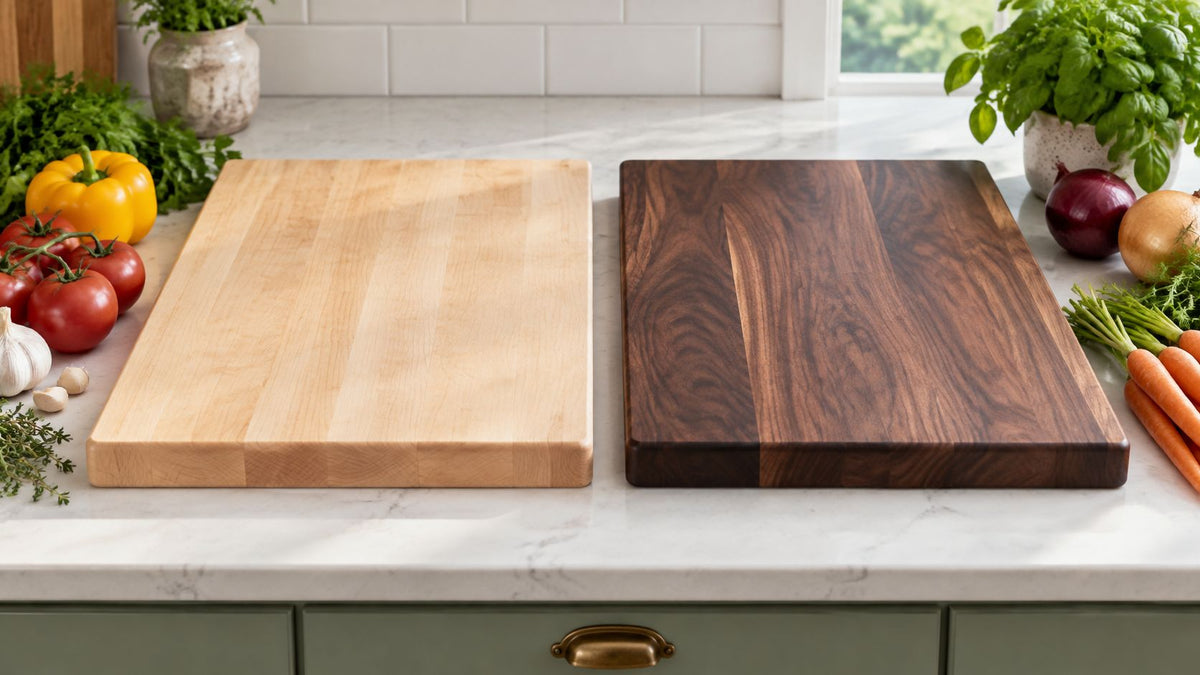
Hard maple and black walnut can both make useful kitchen cutting boards. Maple offers a lighter appearance and greater resistance to indentation; walnut offers a darker appearance and a softer surface. Construction, cleanability and the way you care for the board matter alongside the species.
Choose between comparable boards: similar dimensions, thickness and grain construction. A species label does not establish food safety, resistance to warping or years of service.
Maple vs Walnut at a Glance
| Consideration | Hard maple | Black walnut |
|---|---|---|
| Appearance | Pale cream to light brown | Medium to dark brown |
| Indentation resistance | Generally higher | Generally lower |
| Visible marks | Food stains can be more apparent | Dark colour can make some marks less obvious |
| Cleaning | Hand wash and dry thoroughly | Hand wash and dry thoroughly |
| Best reason to choose it | A light surface and resistance to dents | A dark surface and your preferred feel and appearance |
Hardness describes resistance to indentation. It does not directly measure knife dulling, hygiene or dimensional stability. Avoid buying either wood on a promise that it will preserve a knife edge for a specific period.
Construction Matters Alongside Species
Edge-grain and end-grain describe how the wood is arranged. They change the appearance, manufacturing work and cutting feel. Neither label guarantees a well-made board.
- Check flatness: the board should sit securely without rocking.
- Inspect joints: avoid open glue lines, cracks and loose pieces.
- Confirm food-contact use: the maker should identify the intended use and care of the finish.
- Choose manageable weight: you need to lift the board for washing and drying.
- Measure the working area: allow room for the board, ingredients and a plate without crowding the counter.
A thick board can offer more material for future resurfacing, but thickness alone does not determine suitability. A thinner, well-built board can be practical for everyday preparation. Buy the construction you can comfortably handle and maintain.
For a broader material comparison, see our guide to cutting-board wood types.
Food Safety and Cleaning for Either Wood
Colour and species do not replace cleaning. Health Canada recommends separate boards for produce and raw meat, poultry, fish and seafood.
- Remove food debris and wash with hot, soapy water after use.
- Rinse, then sanitize using a food-contact kitchen sanitizer according to its label and the board maker’s instructions. Follow any required contact time and rinsing directions.
- Dry thoroughly, allowing air to reach both faces. Avoid soaking the board or putting it in a dishwasher unless the maker explicitly permits it.
- Maintain the finish with a food-contact product recommended by the maker, such as food-grade mineral oil for boards intended for that treatment.
Vinegar is not a substitute for a validated sanitizing method. Oiling maintains the wood; it does not disinfect it or repair a crack. Replace a board whose deep grooves, splits or other damage prevent effective cleaning.
Use the maker’s oiling guidance rather than assuming every board needs the same monthly schedule. A sealed finish may require different care from an oil-finished board.
Price, Lifespan and Sourcing
Compare current prices for boards of the same size and construction. Walnut may carry a price premium, but finish, workmanship, shipping and warranty also affect the total.
No species label can guarantee a 10-, 20- or 25-year service life. Cost per year can help you consider value only when you label the assumed lifespan honestly. Start with build quality, a useful return policy and care you will actually perform.
For sourcing, ask where the wood was harvested and where the board was made. “Designed in Canada” and “made in Canada” describe different things. Ask for support for certification or sustainability claims instead of inferring a lower environmental impact from the wood’s colour or national association.
Which Board Should You Choose?
Choose hard maple when you prefer a pale surface and resistance to indentation. Choose walnut when you prefer its dark appearance and are comfortable with a surface that may dent more readily. In either case, favour a stable, cleanable board that fits your sink, counter and storage.
If the household prepares raw meat and ready-to-eat food in the same session, plan separate boards before spending more on a decorative upgrade. Our cutting-board set guide explains how to pair sizes and tasks.
Browse GrifGlo Cutting Boards and confirm the material listed for each product. Do not assume every board in the collection is maple or walnut.


Laisser un commentaire
Ce site est protégé par hCaptcha, et la Politique de confidentialité et les Conditions de service de hCaptcha s’appliquent.