

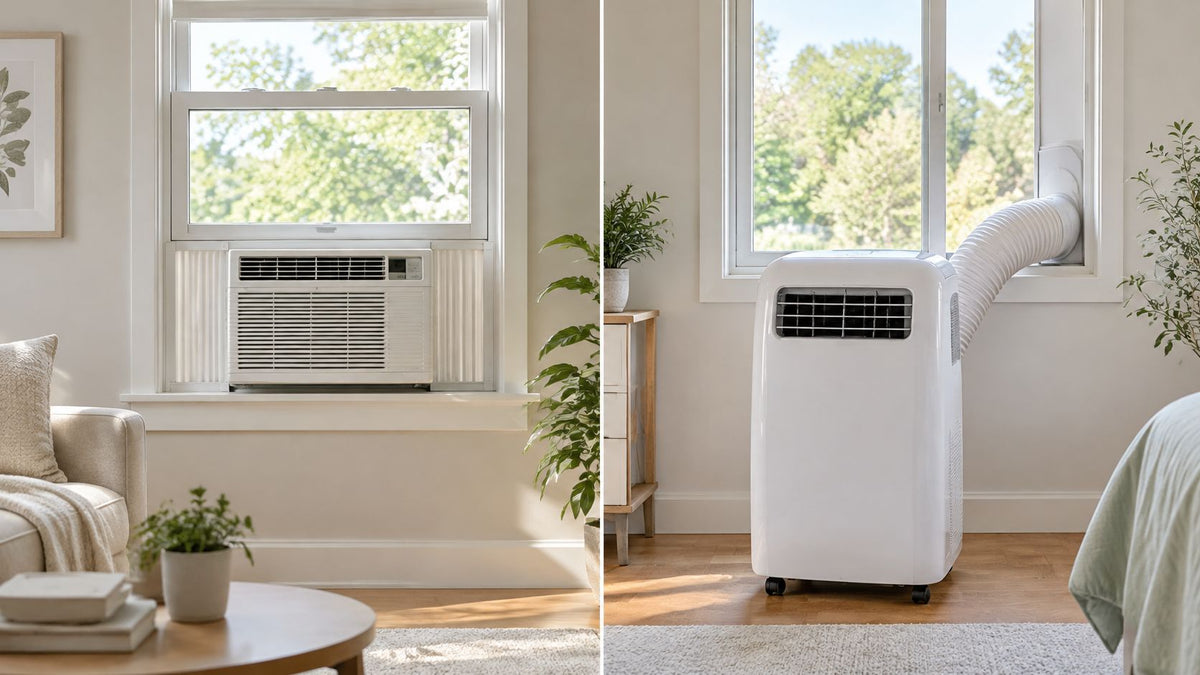
A window air conditioner is often a good choice for regular room cooling when a compatible, secure installation is available. A portable can be more practical when mounting restrictions or window geometry rule that out. The right comparison starts with what you can safely install, then moves to cooling capacity, noise and operating cost.
A useful portable air conditioner vs window unit comparison starts with permission and window geometry, then moves to usable cooling, noise and electricity costs. The best purchase is the lowest-cost safe option that can serve your room, not the appliance with the strongest efficiency label.
Portable and Window Units Side by Side
A window unit is usually the stronger choice for ongoing room cooling; a portable wins when mounting, window fit or temporary use makes a window installation impractical. Neither category is automatically right for every rental, bedroom or home office.
Portable vs window units on the criteria that matter
| Criterion | Portable air conditioner | Window unit |
|---|---|---|
| Typical cooling range | Select by certified usable cooling capacity, not headline capacity alone | Select the capacity required by the room and available window opening |
| Installation | Exhaust hose through a sealed window kit | Mounted in a compatible window; wall installation requires a model approved for it |
| Window requirement | An opening that accepts and securely holds the hose kit | A window that fits the unit frame and closes against it |
| Portability | Can move between rooms, with venting set up again | Stays in its installed location |
| Noise | Compressor operates inside the room | Compressor sits on the outdoor side, although sound still reaches indoors |
| Efficiency | Generally lower, especially for single-hose designs | Generally stronger when correctly sized and sealed |
| Best fit | Temporary cooling, mounting restrictions and awkward windows | Regular cooling in a room with a compatible, secure opening |
The table is a screening tool, not a model-by-model verdict. A portable with an appropriate window panel can be more useful than a window unit that requires prohibited alterations. Conversely, wheels don't add much value if the appliance will stay in the same bedroom all summer.
The widest practical gaps are installation feasibility and operating efficiency. Installation decides which products remain on your shortlist; efficiency helps you choose among the products you can use.
Match the appliance to the room
Don't choose the largest cooling figure on the box. Record the room's floor area, ceiling height, sun exposure and usual occupancy, then use the window air conditioner sizing guide to build a capacity estimate.
Keep the physical measurements separate from that estimate. Cooling capacity won't tell you whether the chassis clears the sash, whether a hose panel reaches across a sliding window or whether an outside support bracket can be fitted.
First purchase check: Write down the window type and whether mounting hardware or alterations are permitted before comparing appliance features.
Renter Rules, Permission and Window Types
Permission can eliminate an otherwise efficient appliance before its energy rating matters. Don't assume a landlord's acceptance of a floor-standing portable extends to a heavy window-mounted unit, exterior brackets or holes through a frame.
Canadian rental and condominium requirements vary by location and building. Check your lease, building rules and any required approval before buying. Confirm whether brackets, screws, window alterations or exterior equipment are permitted, and keep required emergency exits clear.
A floor-standing appliance can avoid lifting a chassis into the window, but it still needs a safe venting arrangement.
A renter's fit and permission checklist
- Notice and approval: Read the lease and applicable local rules. Send any required written notice, and describe the appliance, venting arrangement and proposed mounting hardware clearly.
- Electrical capacity: Compare the appliance's nameplate requirements with the outlet and circuit. Ask building management or an electrician to resolve uncertainty about shared loads.
- Emergency exit: Identify whether the window is needed for emergency escape. Don't obstruct a required exit with a chassis, panel or hose.
- Hose routing: Choose a position where the hose can reach the window without crossing a doorway or forcing furniture into a walking route.
- Mounting permission: Get clarity about brackets, screws, security locks and any proposed changes to the window frame.
- Window geometry: Measure the opening and identify whether the window moves vertically, slides horizontally or swings outward.
Sliding and casement windows need different answers
A horizontal slider doesn't accept the same arrangement as a vertically opening sash. Look for a purpose-designed compatible unit or a panel kit that matches the actual opening, rather than assuming an included kit will work.
Casement windows need particular attention because the sash swings away from the frame. A portable may need a rigid adapter panel; a window appliance must be designed for that opening and supported according to its instructions.
Portable doesn't mean permission-free, and window-mounted doesn't necessarily mean permanent. What matters is the proposed installation, its safety and the rules that apply to the property.
Before paying, answer a concrete question: Can this particular appliance be installed legally and physically in this room?
Installation, Hoses and Window Fit
A single-hose portable exhausts indoor air outdoors, so replacement air can enter through gaps and reduce useful cooling. Compare portable models using their seasonally adjusted cooling capacity (SACC), where provided, rather than treating an unadjusted headline BTU figure as equivalent. Canada’s Energy Efficiency Regulations define SACC as cooling delivered to the conditioned space.
A dual-hose arrangement reduces that particular penalty. It doesn't remove the need for careful hose routing, a sealed window adapter and appropriate drainage.
Set up a portable without avoidable losses
- Measure the opening. Check the adapter panel's extension range and the hose connection position before unpacking everything.
- Fit and secure the window kit. The panel should sit firmly without relying on loose tape to carry its weight.
- Route the exhaust hose directly. Keep it within the manufacturer's permitted arrangement, without kinks, crushed sections or unnecessary loops.
- Seal the panel perimeter. Use suitable removable foam weatherstripping or panel-sealing tape where the kit meets the frame.
- Arrange condensate handling. Check whether the selected operating mode needs a drain hose or reservoir emptying. Keep the drainage path unobstructed.
- Connect the power safely. Use the wall outlet specified by the manufacturer, not a power strip or extension cord. Confirm any dedicated-circuit requirement.
Don't improvise a longer hose to place the appliance across the room. Move the appliance closer to the approved outlet and vent opening, or choose a different installation.
Secure a window unit as a supported load
- Check sash dimensions and clearances. Confirm that the model fits the opening and that the sash can secure it as designed.
- Install the specified support. Fit brackets and other supporting hardware in the manufacturer's sequence before leaving any weight unsupported.
- Position and secure the appliance. Use help for lifting, and follow the prescribed drainage angle rather than guessing.
- Fit the side panels and locks. These close the opening and help secure the installation, but they don't replace structural support.
- Seal the top and sides. Keep outdoor ventilation openings and drainage paths clear.
A standard window unit isn't automatically suitable for a wall sleeve. Use only an appliance explicitly approved for that installation.
Finish with a simple leak check on a windy day. Hold a strip of tissue near the panel edges and investigate movement that suggests air entering through a gap.
Noise, Portability and Daily Use
Compare the sound of actual models, not just appliance categories. A portable places the compressor in the occupied room. A window unit moves that component to the outdoor side, but the indoor fan, compressor vibration and transmitted sound can still be audible.
That distinction matters for a bedroom or a desk beside the appliance. It doesn't justify promising that every window model will be quieter than every portable.
Read the acoustic specification carefully
- Match operating modes: Compare published sound ratings at equivalent fan or cooling settings, not a quiet-mode figure against another model's maximum output.
- Check sleeping conditions: Look for a low-speed rating and information about compressor cycling, display brightness and audible alerts.
- Consider placement: Avoid letting a portable's casing or hose press against furniture that could vibrate. Check window mounting hardware if a window appliance rattles.
Portability also has limits. Wheels help you relocate the cabinet, but the receiving room still needs compatible venting, electrical supply and a clear floor position. Moving the machine isn't the same as moving a fan.
For a home office, decide whether you'll transfer the appliance between work and sleeping spaces. If not, judge it as a stationary appliance and give less weight to its wheels.
A movable appliance is useful only when the next room is ready to receive it.
Use a comfortable thermostat setting and a fan mode that still provides adequate cooling. For shoulder-season evenings when mechanical cooling isn't necessary, the guide to cooling a room without AC offers complementary measures.
Record the sound specification and intended room beside each shortlisted model. That makes daily usability part of the purchase decision rather than a surprise after installation.
How Efficiency Ratings Compare for Cooling per Watt
Cooling capacity and efficiency answer different questions. Capacity describes how much heat an appliance removes under its rating method. Efficiency describes how much electricity that cooling requires. Confusing the two leads shoppers to rank machines by the biggest number on the box, which is the wrong comparison.
Portable labels deserve particular care because headline capacity and seasonally adjusted usable capacity are not interchangeable. Compare products using their current certified ratings rather than treating every large BTU figure as equivalent.
Read the labels without mixing the measures
- BTU/h: Cooling output per hour; it measures heat removal, so a higher figure means a stronger appliance rather than a cheaper one to run.
- EER: Cooling output divided by electrical input under a specified test condition.
- CEER: A combined efficiency measure that accounts for operating and non-cooling energy use under the applicable test procedure.
- SACC: Seasonally adjusted cooling capacity for portables, reflecting the penalties their hose and indoor installation impose in realistic use.
Efficiency benchmarks for room air conditioners
Use the exact model’s certified label and specifications. EER and CEER describe performance under specified test methods; SACC is a capacity rating, not an efficiency score. Avoid calculating promised savings by dividing figures produced under different methods.
For window-unit comparisons, ENERGY STAR room-air-conditioner guidance can help identify efficient models. The U.S. Department of Energy explains that its room-air-conditioner category excludes portable units, so do not assume the same label criteria cover both.
Ratings don't replace fit or sealing
Fit decides before efficiency does. A renter whose lease or window geometry rules out a window unit has no rating comparison left to make, and an oversized fixed-output appliance can cool the air quickly yet cycle off before removing satisfactory moisture. An undersized appliance may struggle during the room's hottest conditions. Neither problem is solved by a strong efficiency score.
Separate appliance selection from building leakage. Check the room's window seals and use appropriate door weatherstripping where draughts enter, without obstructing required ventilation.
Shortlist by usable capacity, comparable efficiency information and physical fit together. An excellent rating on the wrong-sized appliance is still the wrong purchase.
What Each Option Costs to Run
Use your own electricity rate and the input power of the actual shortlisted models. There is no single monthly cost that applies across Canadian provinces, room conditions and operating schedules.
Estimated cost = input kW × operating hours × price per kWh.
For a hypothetical unit drawing 1 kW continuously for eight hours a day over 30 days, consumption would be 240 kWh. At an assumed CAD $0.15/kWh, that is CAD $36. This illustrates the calculation; it is not a typical bill or a model performance claim. Thermostat cycling and variable-speed operation affect actual use.
Include the installed purchase cost: window panels, approved supports, sealing materials and any professional work. Compare equivalent usable cooling rather than the largest BTU figure on the box.
Which Cooler Fits Your Room and Verdict by Situation
Choose the installation that works, then minimise its operating penalty. The strongest efficiency case remains with a compatible window appliance, while a dual-hose portable is a practical fallback when the building or window prevents that choice.
The important distinction is between avoidable inefficiency and necessary compromise. Paying more to operate the only safe, permitted cooling option can be rational. Paying more because you never checked whether an efficient window unit would fit is a different decision.
Match the recommendation to the situation
- Bedroom with a suitable vertically opening window: Confirm support, security and cooling capacity, then compare low-speed sound specifications. For ongoing use, favour a window unit.
- Office with a casement window: Investigate a purpose-designed casement appliance before assuming a standard unit will fit. If no approved window installation works, choose a dual-hose portable.
- Rental with mounting restrictions: Complete the required permission or notice process and confirm the vent panel can be installed without prohibited alterations. The practical choice may be a dual-hose portable.
- Room used only temporarily: If relocation and removable venting outweigh the operating penalty, a portable air conditioner can make sense.
- Room without a usable outdoor opening: Neither appliance is automatically suitable. A portable still needs approved outdoor heat rejection; obtain a professional assessment before choosing a professionally designed cooling solution.
- Brief need with limited available stock: A single-hose portable may be a workable last resort, provided its adjusted capacity and safe installation meet the room's needs.
Keep the trade-offs explicit
Portables offer relocation and less conspicuous mounting, but occupy floor space and require a hose arrangement. Window units offer a stronger efficiency position, but need a compatible opening, secure support and acceptance of a fixed installation.
Don't substitute an air-treatment appliance for refrigeration-based cooling. Our air purifier vs dehumidifier comparison helps separate particle removal and moisture control from the job of lowering room temperature.
Before ordering, check the shortlist against comparable efficiency information, window and lease compatibility, and your operating budget. Write down the room's window type, permission status and each candidate's input wattage, then compare a portable and a window model only if both installations are feasible.
Our Home Appliances category includes Air Purifiers, Heaters & Cooling, Garment Care and Vacuums, supported by practical comparisons and sizing guidance. Visit GrifGlo with your window measurements and installation requirements ready, and use those constraints to narrow your cooling choices before comparing features.



Laisser un commentaire
Ce site est protégé par hCaptcha, et la Politique de confidentialité et les Conditions de service de hCaptcha s’appliquent.