

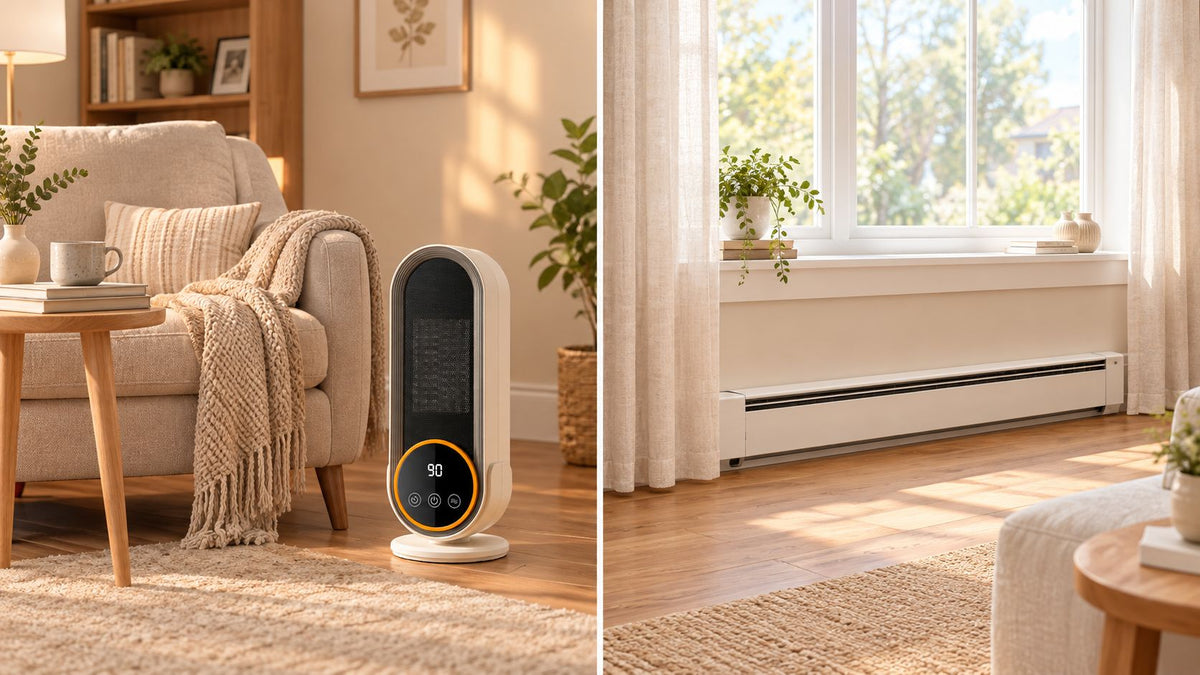
Stop shopping for the more efficient resistance heater. Popular advice treats ceramic, oil-filled and baseboard designs as if one extracts more heat from the same kilowatt-hour, and that's the wrong test. In a space heater vs baseboard heater comparison, purchase price is also the least useful number. What decides your bill and comfort is wattage, runtime, distribution, control and circuit capacity. Run the cheap heater all day and it becomes the expensive choice.
Table of Contents
- Space Heater vs Baseboard Heater at a Glance
- How Each Heater Turns Electricity Into Warmth
- Installation Needs and Circuit Limits
- Running Costs Per Hour and Per Month
- Safety Risks and Placement Rules
- Which Heater Suits Each Room
- Choose the Heater That Fits Your Lease, Home or Portfolio
Space Heater vs Baseboard Heater at a Glance
Both heaters convert electricity to heat at the same point-of-use rate. The practical differences are where heat goes, how the unit is controlled, what the circuit can support and how long it runs. A portable heater directs warmth toward a nearby person; a baseboard distributes it gradually along a wall. Neither changes the cost per kilowatt-hour.
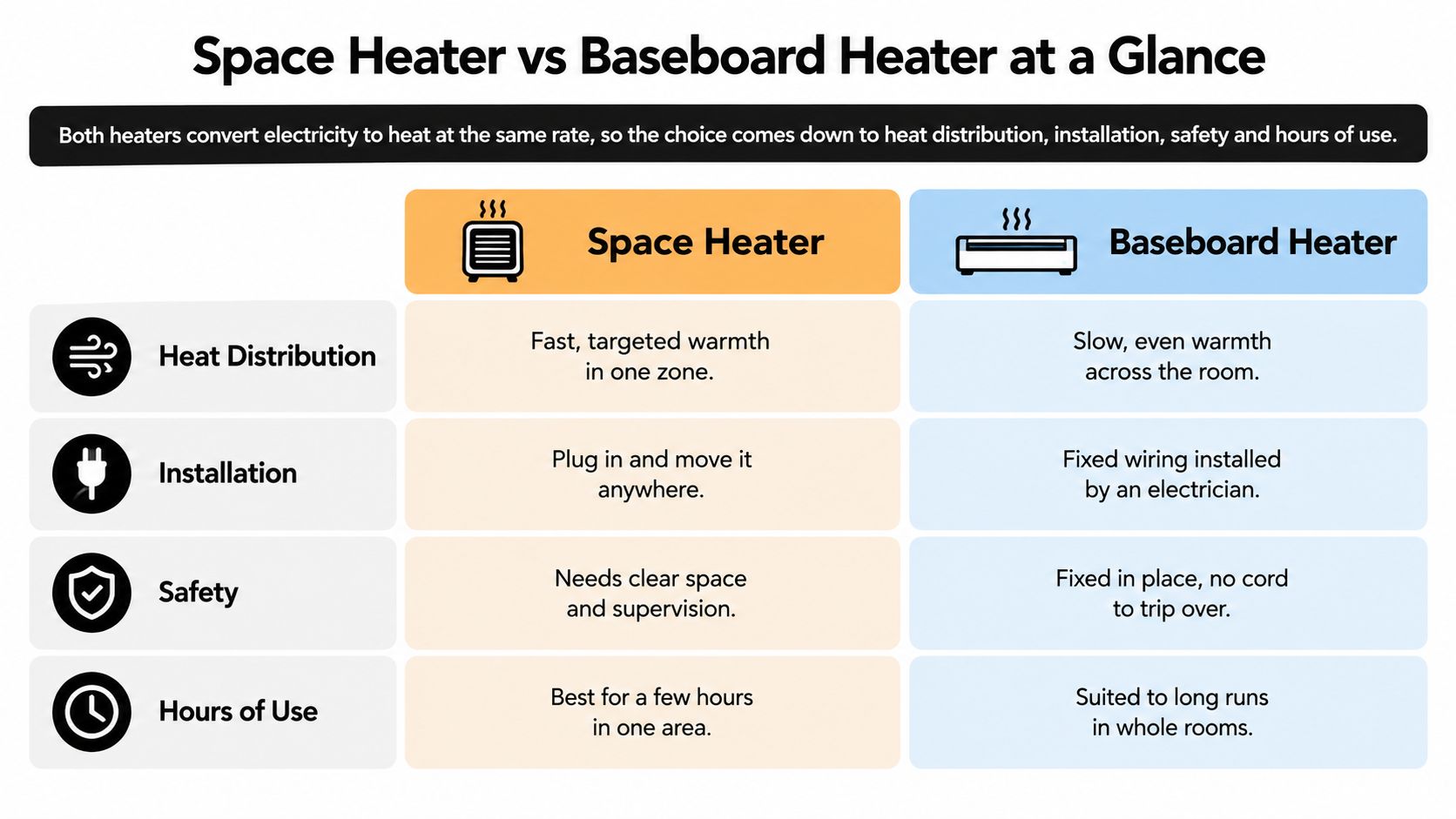
Space Heater vs Baseboard Heater on Core Criteria
| Criterion | Portable space heater | Electric baseboard heater |
|---|---|---|
| Heat delivery | Concentrates warmth in one room, reaching the nearest area quickly | Runs along a wall and warms a zone gradually by convection |
| Installation | Plugs into a wall outlet | Hardwired to a dedicated circuit, usually by an electrician |
| Running cost per hour at equal wattage | Same as a baseboard with equal wattage | Same as a portable heater with equal wattage |
| Safety profile | Tip-over, cord and placement risks near bedding or furniture | Fixed position and wall thermostat; dust, blockage and wiring still matter |
| Portability | Moves with the occupant | Fixed to the wall |
| Best fit | Temporary heat for one occupied room | Planned, room-by-room heat for permanent use |
At equal wattage and full output, a 1,500 W portable heater and a 1,500 W baseboard heater cost the same to run per hour. The bill changes with runtime and the area being heated. Two hours of targeted heat in an occupied office is a different use pattern from keeping a large living room warm all evening.
Three factors narrow the choice:
- How long is the room occupied? A portable unit suits short periods of use. Longer daily heating can suit an installed system controlled by a thermostat.
- Can you hardwire it? Owners can consider a dedicated baseboard circuit. Renters generally need permission before changing wiring.
- Must heat move with you? A portable heater can follow you from room to room. A baseboard remains where it is installed, often near the area it serves.
Match the heater to the room and your ability to install it, then check circuit capacity before comparing purchase prices. For a closer look at controls and operating features, see this energy-efficient space heater guide. Evaluate those features alongside runtime, since the upfront price alone does not determine the cost of heating.
How Each Heater Turns Electricity Into Warmth
The image below puts the two form factors side by side, a movable tower and a low heater fixed along the floor line.
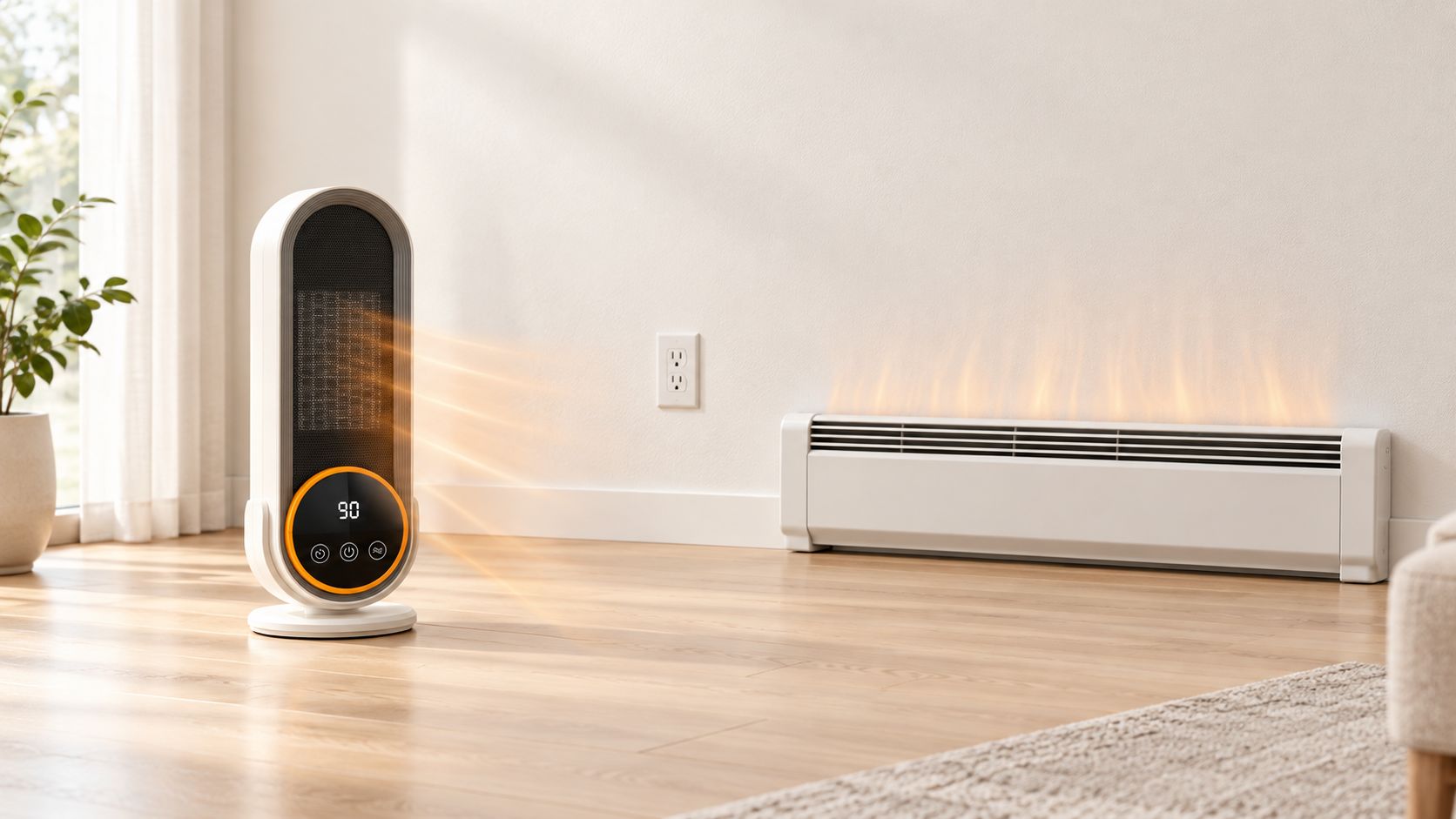
In California, both device types generally use electric resistance heating, where electricity is converted directly into heat at the point of use. The California Energy Commission guidance treats this technology as relatively energy-intensive and restricts its use in many building applications. That restricts neither device in favour of the other. It tells you the element isn't where savings hide.
Concentrated Heat Versus Distributed Heat
A portable unit concentrates output at one point. A fan pushes warmed air toward the occupant, or a radiant element warms the person and objects in front of it. You feel relief quickly, especially at a desk or chair, but temperature falls with distance and around corners. Turn it off and the effect fades quickly because little building fabric has warmed.
A baseboard spreads the same resistance output along a wall, usually below windows on an exterior wall. Cool air enters low, passes the element, rises by convection and circulates gently. Warmth arrives more slowly but covers more of the room with fewer hot and cold spots. It's background heating, not a personal heat beam.
Two Room Layouts That Expose the Difference
Take a small bedroom with the door closed. The portable heater has a contained air volume and one clear target, so it can raise comfort fast before bed or while dressing. Move that same heater into an open-plan living and dining space. Air escapes to the hallway and kitchen, the far sofa stays cool, and you compensate by running it longer or at maximum.
Cold air pools near floors and windows, so placement matters. A baseboard under a window intercepts descending cold air where it forms. A portable heater in a corner behind furniture wastes reach and may create a safety problem, even though its nameplate output is unchanged.
The video below gives a useful visual comparison of the two delivery patterns in a room.
Before choosing, ask three practical questions. How large is the room, can its door close, and how many seated spots need heat at once? One person in a closable room points portable. Several occupants spread across an open area point installed. Once you accept that conversion efficiency is settled, the useful comparison becomes control, cost, circuit load and risk.
Installation Needs and Circuit Limits
A portable heater needs only a suitable wall outlet, but that simplicity can mislead you. The U.S. Consumer Product Safety Commission guidance says a portable heater should plug directly into a wall outlet, never use an extension cord or power strip, and stay at least 3 feet from combustibles. Treat 1,500 W as a major appliance load, not a lamp.
An electric baseboard takes the opposite route. It's hardwired to a correctly sized circuit, fixed to the wall and usually controlled by a wall thermostat. Use a licensed electrician where required, confirm permit rules locally, and size the breaker and conductors to the heater nameplate and applicable code. Installation costs more upfront, but it removes the loose cord, movable plug and tip-over route.
Current Draw and Circuit Headroom by Heater Wattage
| Heater rating | Current at 120 V | Current at 240 V | Share of a 15 A, 120 V circuit |
|---|---|---|---|
| 750 W | 6.3 A | 3.1 A | 42% |
| 1,000 W | 8.3 A | 4.2 A | 56% |
| 1,500 W | 12.5 A | 6.3 A | 83% |
| 1,800 W | 15 A | 7.5 A | 100% |
Current comes from watts divided by volts. That arithmetic explains why doubling voltage halves current for the same heat output. A 1,500 W baseboard on 240 V draws about 6.3 A, while a 1,500 W portable on 120 V draws 12.5 A. Lower current doesn't reduce energy use. It gives the circuit designer more practical headroom.
Apply the 80 percent continuous-load guideline when judging a heater that may run for hours. On a 15 A circuit, that points to about 12 A of continuous load. The common 1,500 W portable slightly exceeds that working figure by itself. Put a microwave, hair dryer, kettle or another heater on the same branch circuit and nuisance trips or overheated connections become plausible.
Circuit rule: If you can't identify everything else supplied by the outlet's breaker, don't assume it can carry a full-power heater for hours. Map the circuit first.
Checks to Make Before You Buy or Install
Read the heater nameplate for watts, volts and amps. Don't rely on marketing labels such as low, medium and high. Then read the breaker label in the panel, identify which outlets and lights it supplies, and list other likely loads that could run at the same time. A vacuum cleaner's short burst differs from a second heater's sustained draw.
For a baseboard, confirm breaker size, wire gauge, voltage, thermostat rating and a thermostat location away from the heater's rising warm air and direct sun. Ask for two quotes because a new circuit's price changes with distance to the panel, access through walls or floors and local labour. For a portable heater, inspect the outlet for looseness or heat discolouration and stop using it if the plug doesn't fit firmly.
Your pre-installation list is therefore short. Check breaker rating, wire size, outlet condition, shared loads and thermostat placement. If those answers don't work, a lower-wattage heater or a new dedicated circuit is safer than hoping the breaker will sort it out.
Running Costs Per Hour and Per Month
Running cost is arithmetic, not product magic. Divide watts by 1,000 to get kilowatts, multiply by operating hours, then multiply by your electricity rate. The U.S. Energy Information Administration price table reports California's residential electricity price at 34.74 cents/kWh, and at that rate a 1,500 W heater uses approximately 1.5 kWh per full-power hour and costs about $0.52 per hour.
Running Cost by Heater Rating at 34.74 Cents per kWh
| Heater rating | Cost per hour at full output | Cost for 8 hours |
|---|---|---|
| 1,000 W | $0.35 | $2.78 |
| 1,500 W | $0.52 | $4.17 |
| 1,800 W | $0.63 | $5.00 |
Extend the eight-hour figures across 30 days and full-output use becomes roughly $83.40 for 1,000 W, $125.10 for 1,500 W and $150.00 for 1,800 W. Those are worked examples from the table, before taxes, fixed charges, rate tiers and thermostat cycling. They show why a modest purchase can produce a serious monthly bill.
Duty Cycle Changes the Table More Than Device Type
A thermostat-controlled baseboard doesn't necessarily draw full power for every minute it's switched on. It cycles to hold the set temperature. If a 1,500 W heater runs at full output for 40 percent of an eight-hour period, its energy use for that period is about 40 percent of the full-output example. Mild weather, good insulation and a lower setpoint reduce that on-time.
A portable heater without a useful thermostat behaves differently. You may leave it on high until the room feels warm, overshoot the temperature, then switch it off. A model with a thermostat and lower settings gives you control, but ceramic, oil-filled and fan designs don't change the cost of producing a kilowatt-hour of resistance heat.
A heater that's on for fewer minutes in a smaller occupied zone beats a supposedly efficient heater warming empty floor space.
Heated area is the other multiplier. A portable unit in one occupied office may let you avoid heating a larger zone. That's a real saving from zoning, not from the element. Reverse the pattern and the result reverses. If several people need whole-room comfort, a portable heater may run at maximum for hours while the far side remains cool.
Measure your own pattern before replacing equipment. Record wattage setting, start and stop times, and whether the door was open. A home energy monitor can help you separate heater use from cooking, laundry and other loads. Then apply your actual utility rate, including the tier or time period that applies to your household.
Compare the wattage you'll run, the hours you'll run it and the area you're heating. Purchase price predicts none of those. That's the central cost conclusion in the space heater vs baseboard heater decision.
Safety Risks and Placement Rules
A baseboard heater has a fixed location, while a portable unit can be moved next to bedding, curtains, clothing or upholstered furniture. Its cord can also cross a walkway or lie under a rug, where damage may go unnoticed. The U.S. Consumer Product Safety Commission release estimates portable heaters, including electric space heaters, were involved in an average of 1,600 fires annually during 2019 to 2021, causing about 70 deaths and 160 injuries per year. These national figures show the scale of the hazard.
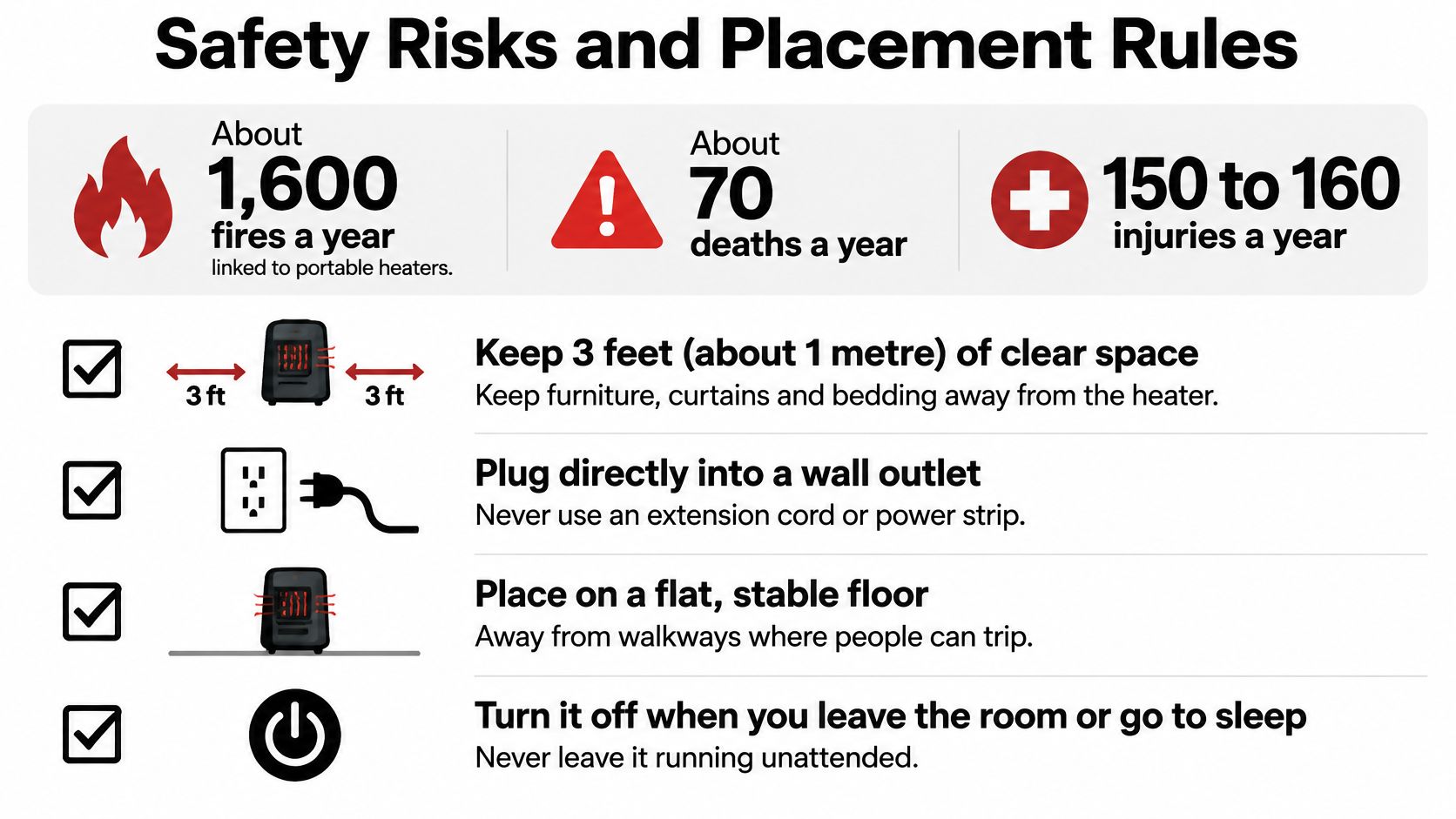
Portable Heater Checklist
- Keep the required clearance: Maintain the 3-foot buffer covered in the installation guidance. Move bedding, curtains, furniture, clothing, paper and other combustibles out of the space before switching the heater on.
- Use a wall outlet: Follow the installation guidance to connect the heater directly to the wall, not an extension cord or power strip.
- Check protective controls: Choose tip-over shutoff and overheat protection, and confirm the unit sits flat and stable.
- Supervise each run: Switch the heater off when sleeping, leaving the room or leaving the home.
- Keep the cord visible: Route it away from walking paths and rugs, where damage or heat may go unnoticed.
Safety controls reduce specific risks, but they cannot make poor placement safe. A tip-over switch will not stop a curtain that already touches the heater. An auto-off timer will not fix a damaged cord or loose plug.
Baseboard Risks You Still Have to Manage
Dust and lint collect around baseboard elements and fins. Switch power off at the breaker, let the heater cool, then clean it according to the manual. Keep furniture, drapes, bedding and stored items at the manufacturer's stated clearance. Clear airflow helps the heater release heat as intended; blocked airflow can raise surface temperatures and reduce useful heat.
Test the thermostat at the start of the heating season. If the heater ignores the setpoint, cycles erratically or stays on continuously, have the control and circuit inspected. For help comparing portable-heater safety features in Canadian conditions, consult portable heater guidance for Canadian conditions. Follow local electrical rules and the product manual when using any heater.
Stop using a heater if you notice a burning smell, scorch marks, a hot or discoloured outlet, sparking, repeated breaker trips, a frayed cord or a loose-feeling plug. Repeatedly resetting the breaker and trying again can leave the underlying fault unresolved. Isolate the circuit if it is safe to do so, and have an electrician find the fault.
Portable heaters suit short-duration, supervised spot heating. Baseboards can serve a room over longer periods, provided their clearances, airflow and wiring are maintained.
Which Heater Suits Each Room
Room use determines the right device faster than product category. A heater that's sensible at a desk can be a poor overnight choice, and a heater that's ideal along a living room window is wasted in a workshop used twice a month.
Heater Choice by Room Type
| Room | Better fit | Why |
|---|---|---|
| Bedroom | Baseboard on a thermostat, portable only with auto-off | A sleeper cannot supervise a running portable heater |
| Home office or reading nook | Portable | One occupant at a fixed seat gets quick warmth |
| Living room or open-plan space | Baseboard along an exterior wall | Heat spreads across a larger area |
| Bathroom | Heater rated for damp locations on a GFCI-protected outlet | Moisture raises shock risk |
| Basement, garage or workshop | Portable for occasional use | Short sessions suit it, but weak insulation raises the load |
| Rental unit | Portable if the lease allows, baseboards belong to the landlord | Ownership and alteration rules decide the option |
Bedrooms demand the strictest reasoning. Warm the room before bed, then switch a portable heater off, or use a baseboard controlled by a thermostat for longer periods. If a portable unit is used while you're awake in the bedroom, it still needs tip-over shutoff, an auto-off timer and clear space from bedding. Comfort doesn't override supervision.
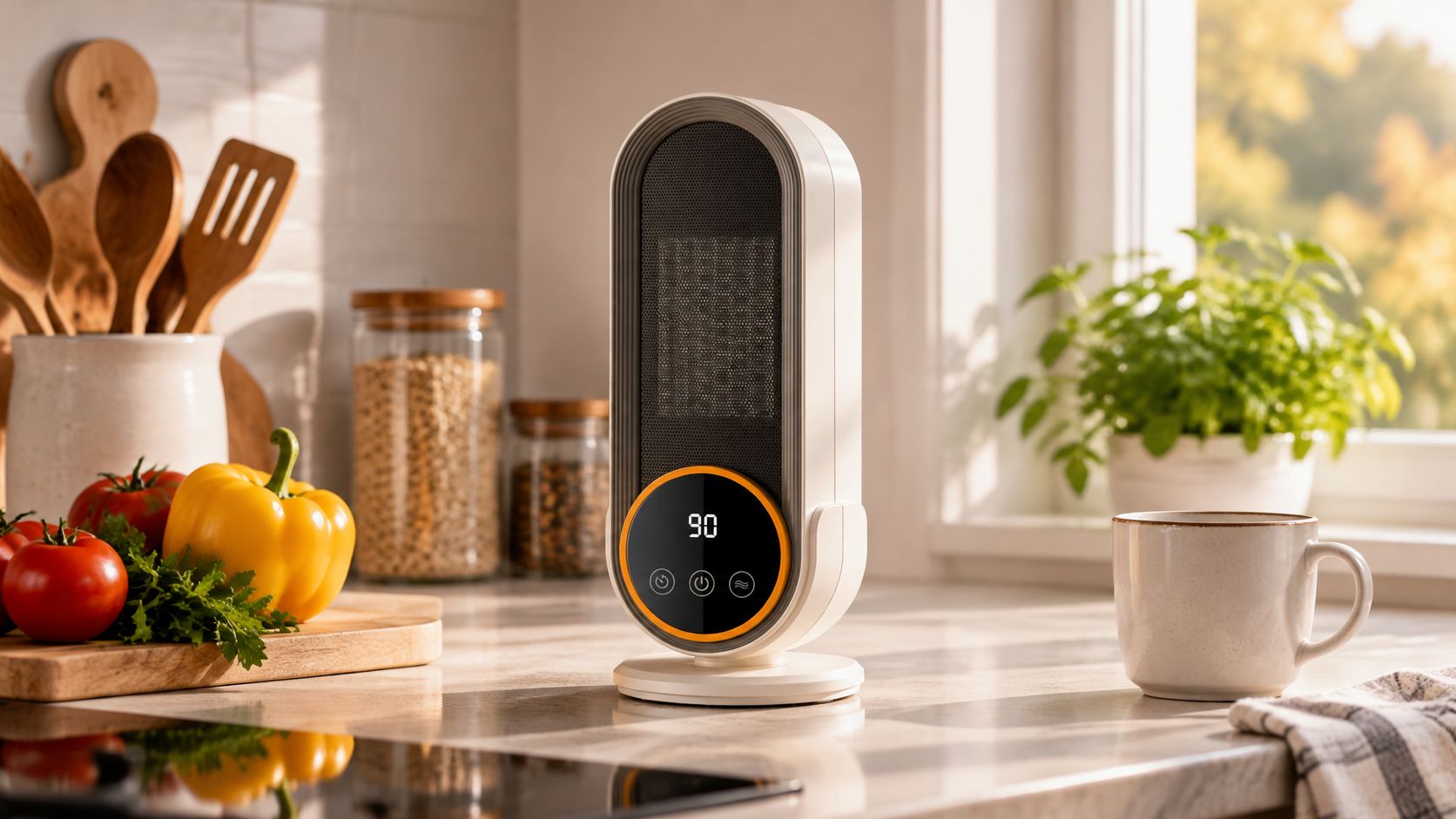
A home office is the portable heater's best case. You sit in one place, the door can close, and the heating period has a clear end. A product such as the FAN HEATER E68S PTC Ceramic Heater With Remote Control uses PTC heating technology, a touch panel and an upgraded turbo engine intended to circulate warm airflow. Those are control and delivery features. They don't repeal the wattage and runtime calculation.
Living rooms favour baseboards because people sit in several places and windows create a broad cold surface. Put the heat along that exterior wall and the room equalises more gradually. Draughts can still defeat either heater, so sealing gaps matters. A weatherstripping for doors guide is relevant when cold air enters faster than the heater can replace lost heat.
For bathrooms, don't improvise. Check that the heater is rated for damp locations, use GFCI protection where required, and keep portable appliances away from water. In basements and garages, a portable heater works for a repair session, but concrete, large doors and weak insulation can make the space expensive to hold at temperature.
Insulation can overturn a size-based guess. A small room with single glazing and leaky doors may need more output than a larger, well-insulated room. Match the heater to heat loss, occupancy and supervision, not floor area alone.
Choose the Heater That Fits Your Lease, Home or Portfolio
One Pick for Each Reader
Renters can use a portable heater for occasional, supervised spot heating, provided the lease allows it. Choose a model with tip-over shutoff and overheat protection. Get written landlord consent before changing wiring or adding a circuit, and do not install, remove or modify a baseboard that belongs to the property.
Homeowners can use thermostat-controlled baseboards in rooms heated for long, predictable periods, while keeping a portable heater for a cold snap or one occupied workspace. Smart thermostat benefits matter only when compatible controls are available. The thermostat must also be rated for the baseboard's load and voltage.
Property managers and short-term rental hosts can standardise on hardwired baseboards in permanently heated rooms after documented clearance and circuit checks. Fixed equipment is easier to inspect, explain and maintain across occupants. For supplemental portable units, set written placement rules and remove damaged cords or plugs from service.
The Third Option You Should Not Skip
For whole-room or whole-home heating, compare resistance heaters with a heat pump. The California Energy Commission Energy Code support centre states that California's 2025 Energy Code takes effect January 1, 2026, steers new construction increasingly toward heat pumps, and requires electric-ready infrastructure when gas or propane space-heating equipment is installed. The commission expects the updated code to save $4.8 billion in energy costs over 30 years and reduce greenhouse-gas emissions by about 4 million metric tons, according to the California Energy Commission Energy Code support centre.
Local climate affects how much a heat pump comparison matters. In mild coastal areas, a portable heater may cover occasional cool mornings without a permanent project. In colder inland and mountain areas, resistance heat may run for long periods, making the operating-cost comparison more consequential.
Use these checks to narrow the choice:
- Match the heater to the room's doors, windows and insulation.
- Confirm the breaker rating and account for other loads on the circuit.
- Check lease, landlord or portfolio requirements.
- Select a heater strategy suited to how long the room is occupied and heated.
Purchase price is the least useful comparison on its own. Both resistance heaters convert electricity to heat at the same point-of-use rate, so distribution, controls, circuit capacity and runtime determine how well the choice fits and what it costs to operate.
Visit GrifGlo to compare heaters and practical home essentials using product details, fit guidance and categories organised around rooms and routines. Use the wattage, circuit and room checks to shortlist the heater type, then select a model and controls that fit your lease, home or property portfolio.


Laisser un commentaire
Ce site est protégé par hCaptcha, et la Politique de confidentialité et les Conditions de service de hCaptcha s’appliquent.