

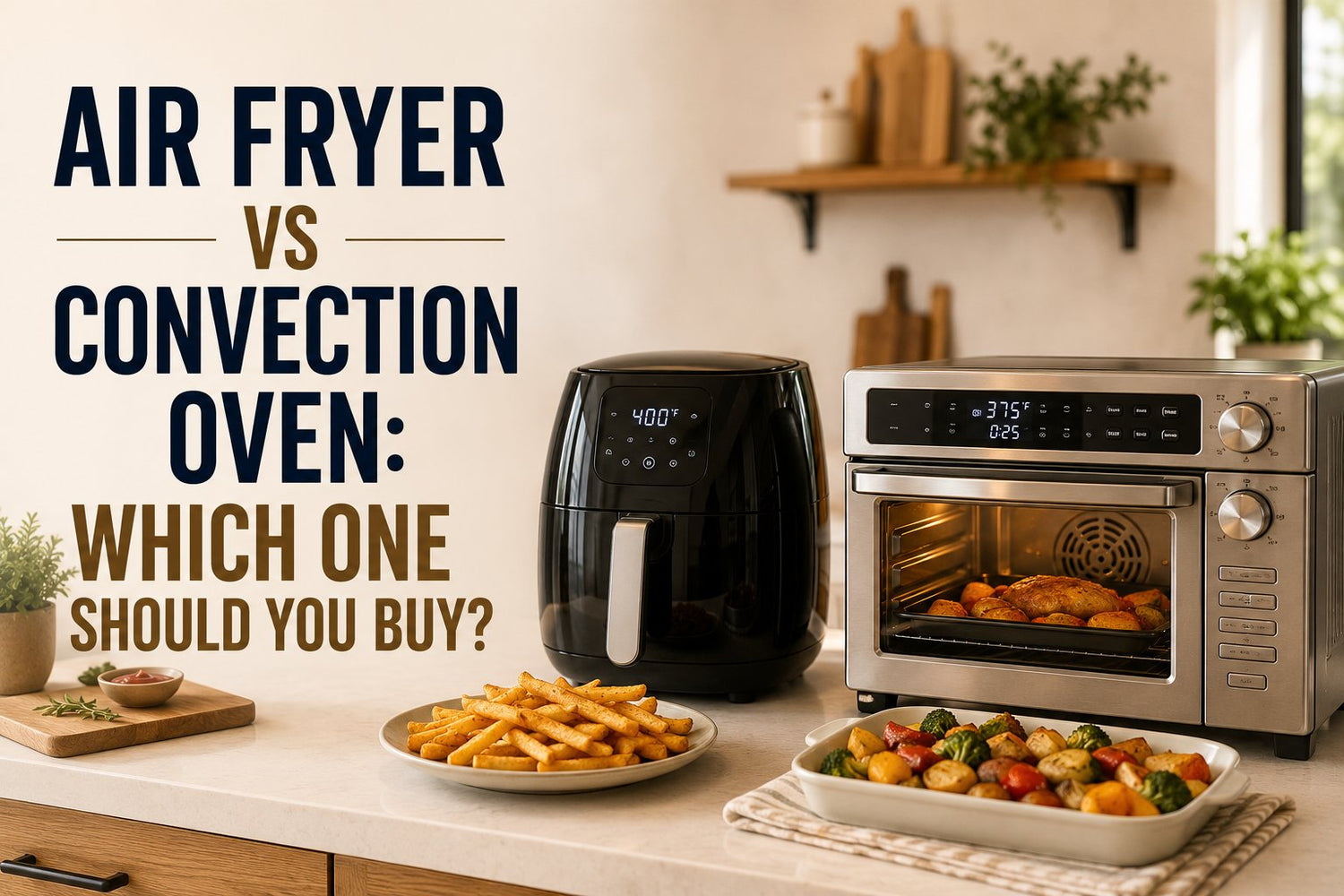
You're standing in a Canadian appliance aisle with two tempting options in front of you. One promises crisp fries, quick chicken wings, and little fuss. The other offers a larger cavity, broader cooking modes, and enough room for a family meal. The problem is that both appliances circulate hot air, and product listings often reduce the choice to “faster” versus “bigger.”
That shortcut misses the decision that matters. Your counter space, household size, cooking habits, cleaning tolerance, and existing oven should determine what you buy. A dedicated air fryer can be the right answer for a couple in a condo, while a multifunction countertop oven may make more sense for a family replacing an old toaster oven. Buying both can be smart, but only when each appliance earns its space.
Table of Contents
- Why This Decision Matters More Than You Think
- How Air Fryers and Convection Ovens Actually Work
- Side by Side Performance Comparison
- Recipe Conversion Tips Between Appliances
- Which Appliance Fits Your Household
- Buying Recommendations for Every Kitchen
- Do You Really Need Both Appliances
Why This Decision Matters More Than You Think
A home cook can spend an evening comparing basket sizes, wattage, presets, and online reviews, then still end up with the wrong appliance. The usual mistake is choosing based on the food pictured on the box rather than the routine in the kitchen. Crispy fries look appealing, but the more useful question is whether you usually cook one small batch or an entire meal for several people.
In Canadian homes, counter space is often the first constraint. A compact apartment kitchen may have room for one appliance beside the kettle, not two large countertop units. A rental kitchen may also lack convenient storage, making an appliance that stays buried in a cupboard less useful than its feature list suggests. The market context supports this shift toward practical small-appliance decisions. Canadian small kitchen appliances are projected to grow at a 4.45% CAGR from 2026 to 2031, while large kitchen appliances remain the larger spending category, according to Canada air fryer market coverage from 6Wresearch.

The real cost of duplicate functions
An air fryer and a convection oven overlap heavily. Both brown food with moving hot air, and both can roast, reheat, and cook frozen foods without deep frying. Owning both means paying not only for the appliances, but also for the counter footprint, storage, cleaning, and the daily irritation of deciding which one to use.
That doesn't mean dual ownership is wasteful. A household may use a basket air fryer for a quick side dish while the main oven handles a roast or casserole. The arrangement works when the appliances solve different capacity problems, not when they perform the same small-batch task.
Judge the appliance by your week
The useful buying criteria are straightforward:
- Speed: How quickly does the appliance heat and finish common foods?
- Texture: Does it produce the crispness or even browning you want?
- Capacity: Can it handle your normal portion without repeated batches?
- Energy use: Are you heating a large cavity for a small meal?
- Noise and maintenance: Will the fan, basket, trays, and grease be tolerable?
- Reliability: Can you find replacement parts and get support if something fails?
For a broader look at connected and automated kitchen tools, the smart kitchen appliances guide from GrifGlo is useful context. The same principle applies here: convenience only counts when the appliance fits the way you live.
How Air Fryers and Convection Ovens Actually Work
The two appliances share a basic idea, but they apply airflow very differently. A convection oven moves heated air around a relatively large cavity, usually with a rear fan and an exhaust path. That circulation reduces hot spots and helps food brown more evenly than it would in a conventional radiant oven.
A dedicated air fryer compresses the process. Its smaller chamber places the food close to the heating element and fan, while a perforated basket lets hot air reach the underside as well as the top and sides. The result is stronger airflow around a smaller amount of food. Air fryers trade capacity for air velocity and proximity. Convection ovens trade some speed for volume and flexibility.

Why the basket changes the result
A sheet pan gives hot air less direct access to the food's underside. A perforated basket creates openings beneath the food, so moving air can strip away surface moisture from more angles. That's why an air fryer performs particularly well with fries, wings, breaded foods, and reheated snacks.
The compact chamber also loses less heat when you open the drawer than a large oven loses when you open its door. Temperature recovery depends on the heating element, fan design, insulation, and the amount of cold food loaded into the appliance. A more forceful air-fry system usually restores surface heat quickly, but it still can't overcome an overcrowded basket.
Frigidaire Canada's comparison, republished in this convection oven cooking guide from Blanc Haute Luxury Kitchens, describes air-fry elements as more than twice as powerful as standard convection elements. That design difference helps explain the characteristic speed and crisping advantage, while the gentler circulation of a convection oven remains better suited to multi-rack baking and larger roasts.
The larger oven's advantage
A convection oven has room for deeper pans, broader trays, and multiple racks. Its airflow is designed to distribute heat across that space rather than blast a small basket from close range. That makes it more useful for sheet-pan dinners, cakes, pastries, casseroles, and food that needs room around it.
The trade-off is obvious once you understand the mechanics. A larger cavity takes more energy and time to heat for a small portion, while the air fryer's concentrated design can finish a snack before a full oven has become useful. Neither appliance is universally superior. The better design depends on whether your priority is intense airflow around a small batch or consistent heat across a large load.
Side by Side Performance Comparison
For a single serving of frozen fries or a few chicken pieces, the air fryer is usually the more responsive tool. A Canadian technical comparison reports that air fryers typically cook food 20–30% faster than convection ovens, with French fries taking about 15 minutes in an air fryer versus 20 or more minutes in a convection oven. The advantage is strongest with small, high-surface-area foods, not with every recipe or every load. See the air fryer and convection oven time comparison for the underlying comparison.
| Performance Factor | Air Fryer | Convection Oven |
|---|---|---|
| Speed | Quick preheating and aggressive airflow suit small portions | Slower for small jobs, but efficient when the cavity is well filled |
| Texture | Strong crisping on fries, wings, breaded foods, and reheated snacks | Even browning and roasting across larger pans |
| Capacity | Best for a contained batch that can sit in one layer or a loose single load | Handles sheet pans, roasting dishes, casseroles, and multiple trays |
| Energy use | Usually the practical choice for small portions because the chamber is compact | Better suited to large quantities than repeated air-fryer batches |
| Noise | Fan noise is close and noticeable in a small appliance | Fan noise is often less concentrated, though operation varies by model |
| Maintenance | Basket and drawer need frequent washing; grease can collect around the heating area | Trays and racks need cleaning, with more interior surface to wipe |
| Best fit | Quick meals for one or a small household | Family meals, baking, roasting, and entertaining |
Speed and food quality
Speed isn't only about the cooking timer. Preheating, loading, unloading, and cooking in batches all count. An air fryer wins when you can place the food in one basket and leave it alone. It loses some of that advantage when a family meal requires several rounds.
Texture follows the same pattern. The air fryer's close, forceful airflow dries the exterior quickly, which produces convincing crispness on fries and wings. A convection oven gives vegetables and roasts more room to brown without crowding, and it handles foods whose shape or moisture needs a slower, more even bake.
Capacity and meal planning
Capacity claims can mislead because usable space matters more than the number printed on the box. A basket may hold a surprising amount of food, but piling food into it blocks airflow. A countertop oven may offer racks, yet its shallow trays can limit what fits comfortably.
For a couple, one air-fryer batch may cover the main component of dinner. For a larger household, repeating that batch can turn a fast appliance into a bottleneck. A convection oven becomes more practical when you need a roasting dish, vegetables, and a baked side to cook within the same general window.
Energy and noise
The California Energy Commission's commercial-kitchen work gives useful operational perspective. In a high-efficiency kitchen demonstration at UCSF Medical Center, two oven stacks operated about 14.3 and 15.0 hours per day and used 3.4 and 3.8 therms per day, respectively, as reported in the California Energy Commission demonstration report. The same report listed one site's ovens at 5.1 therms per day versus 3.7 therms per day for fryers, a reminder that oven-style cooking can be more energy-intensive in real operations.
That doesn't provide a household cost-per-meal calculation, because home appliance wattage, cooking time, electricity rates, and portion size vary. The practical rule is clearer: use the compact appliance for compact meals, and use the oven when the load is large enough to justify its cavity.
Noise is personal. An air fryer's fan sits close to you, so its whir can seem prominent in a quiet kitchen. A convection oven may sound less intrusive from farther away, but neither is silent. Clean the basket, tray, and accessible fan area regularly, because baked-on grease makes every appliance harder to live with.
Recipe Conversion Tips Between Appliances
Recipe conversion works best when you adjust temperature, time, and food spacing together. Air fryers move heat more aggressively through a smaller chamber, so food often finishes sooner and browns earlier than it would in a convection oven. Start conservatively, then adjust based on the actual food rather than trusting a fixed formula.
For a convection recipe moving to an air fryer, lower the temperature by 25°F and begin checking 5–10 minutes earlier. Those are starting points, not guarantees. Thickness, coating, frozen versus fresh ingredients, and basket crowding can change the result.
A practical conversion method
- Reduce the temperature. Lower the listed convection temperature by 25°F for the first attempt.
- Shorten the cooking window. Check the food 5–10 minutes before the recipe's stated finish.
- Leave room for airflow. Arrange food in a loose layer where possible. A packed basket cooks less evenly and loses the crisping benefit.
- Turn or shake when appropriate. Fries, vegetables, and smaller pieces often benefit from movement halfway through.
- Check the centre. A browned exterior doesn't prove that a thick chicken piece or filled pastry is cooked through.
For food safety, use a thermometer and follow the internal temperature specified by the recipe or applicable Canadian food-safety guidance. Visual browning is especially unreliable when an air fryer colours the outside quickly.
| Food Item | Convection Oven Temp & Time | Air Fryer Temp & Time | Key Tip |
|---|---|---|---|
| Chicken thighs | Follow the recipe's convection setting and begin checking at its stated finish | Start 25°F lower and check 5–10 minutes early | Check the thickest part, not just the skin |
| Roasted vegetables | Use a broad tray with space between pieces | Use a smaller batch and shake or turn during cooking | Smaller pieces brown faster |
| Frozen fries | Spread across a tray and follow the package or recipe timing | Start with a shorter cook and shake the basket | Don't stack heavily |
| Breaded snacks | Use a tray and allow room around each item | Cook in a loose basket layer | Spray or brush only if the coating needs help |
| Cakes and delicate baking | Prefer the convection oven for stable, even baking | Use only when the pan fits with airflow around it | Protect the top from over-browning |
For awkward recipe conversions, the cooking time conversion calculator from Mise can help you organise a first estimate. If you're moving a recipe into a ceramic dish, review the practical advice in GrifGlo's ceramic baking dish guide, then allow for the dish's depth and material rather than copying a basket timing.
Which Appliance Fits Your Household
The right choice changes with the people at the table and the space around it. A compact appliance that feels perfect for one household can become a frustrating second job for another.

The single person or couple in a small kitchen
If you cook one or two portions, reheat leftovers, and want dinner without heating the full oven, choose a basket-style air fryer. It gives you fast access to crisp vegetables, frozen foods, chicken pieces, and snacks while keeping cleanup contained.
This is especially useful in a small urban kitchen where counter space doubles as food-preparation space. Don't buy a large oven-style unit just because it offers more modes if you'll rarely use its racks or baking functions. A smaller basket you can lift, wash, and store easily is more likely to become part of your weekday routine.
The family that needs a complete meal
Families need capacity before they need another preset. If dinner regularly includes a main, vegetables, and a side, a countertop convection oven or air-fryer oven is usually the better single appliance. It gives you broader trays and more flexible loading, even if it doesn't crisp a small handful of fries quite as aggressively.
A basket air fryer can still work for a family when everyone accepts multiple batches. Most households won't enjoy that arrangement every night, especially when the first batch cools while the second cooks.
The frequent entertainer
Choose the convection option if you host often, bake, roast large cuts, or prepare several dishes at once. The larger cavity supports the shapes that make entertaining easier, including roasting pans, casseroles, and broad trays.
A dedicated air fryer becomes worthwhile only when crisp snacks are a distinct part of your hosting routine and you have a clear place to keep it. Otherwise, a good multifunction countertop oven gives you more useful range in one footprint.
The renter or summer cook
Many Canadian households already own a conventional oven. In that case, the air fryer is an addition, not a replacement. It can handle a small meal while the main oven stays off, which helps reduce unnecessary heat in the kitchen during summer.
For more small-space ideas, GrifGlo's guide to the best kitchen appliances for small spaces is a helpful planning reference. My recommendation is simple: buy the appliance that solves your most frequent inconvenience, not the one with the longest feature list.
Buying Recommendations for Every Kitchen
Buy by category, not by marketing language. A compact basket air fryer, a countertop convection oven, and a multifunction combination unit serve different routines even when their product pages use similar terms.
Compact and focused
For a single cook or couple with limited counter space, choose a basket-style air fryer in the 3–5 quart range. Prioritise a removable dishwasher-safe basket, clear digital time and temperature controls, and a coating you're comfortable maintaining. If avoiding Teflon matters to you, confirm the exact cooking-surface material in the manufacturer's documentation rather than assuming from a vague “non-stick” label.
The Hamilton Beach 35065C 3 Liter Digital Air Fryer is a compact example with 8 preset cooking functions, digital time and temperature control, a nonstick easy-clean basket, and a 3L capacity.

Balanced and versatile
For a family or a cook replacing an old toaster oven, look at an air-fryer oven or countertop convection oven with enough interior width for your usual tray. A larger cavity can cook more flexibly, but check the actual rack positions, door clearance, and accessory dimensions. The product's exterior measurements matter just as much as its internal capacity.
If one appliance must handle toast, baking, roasting, broiling, and air frying, skip the basic basket category and compare multifunction countertop ovens. A single unit often makes more sense than adding a basket air fryer beside an ageing toaster oven.
Premium and built-in
If your kitchen renovation includes a built-in oven, consider whether convection, air-fry capability, and a second cavity can replace several countertop tasks. GrifGlo's guide to an electric stove with a double oven can help frame that larger kitchen decision.
Before buying, check:
- Power: Confirm the electrical requirements and whether your counter location can support them.
- Capacity: Measure the usable tray area, not only the advertised cavity.
- Accessories: Look for the rack, basket, pan, and crumb tray you'll use.
- Warranty: Read the coverage terms and exclusions.
- Replacement parts: Confirm that baskets, trays, racks, and seals can be sourced.
- Cleaning: Inspect how easily grease-prone areas can be reached.
The winning appliance is the one that fits your counter, your portions, and your maintenance habits without requiring a second purchase to become useful.
Do You Really Need Both Appliances
Not everyone needs both. A dedicated air fryer and a convection oven overlap enough that buying two can create more clutter than capability, especially in a Canadian kitchen with limited counter and cupboard space.
Choose one multifunction countertop oven when you want a single footprint for air frying, convection baking, broiling, and toasting. It won't always match a basket air fryer's concentrated crisping, but it can replace an older toaster oven while giving you more room for family-sized food. That combination is often the smarter purchase for renters, couples planning ahead, and households that already have a full-size oven for very large meals.
Dual ownership makes sense in narrower circumstances. A larger household may run the main convection oven for a roast while using the air fryer for a quick side. Frequent entertainers may value simultaneous cooking, and someone who prepares crisp foods constantly may prefer the dedicated basket's speed over an oven mode.
My buying rule: Don't buy both until you can name two meals you regularly cook at the same time and explain why one appliance can't handle each job.
Maintenance also decides whether dual ownership is worthwhile. Before adding a second appliance, review GrifGlo's practical guide to cleaning an air fryer and picture the actual routine, including washing baskets, wiping trays, and clearing grease from accessible surfaces.
For most households, my recommendation is firm. Buy a dedicated air fryer for small, crisp, fast meals. Choose a convection or multifunction countertop oven when capacity and versatility matter more. Buy both only when simultaneous cooking is a genuine weekly need, not an imagined future use.
GrifGlo helps shoppers compare kitchen appliances and everyday home essentials through practical guides, fit-for-purpose criteria, and sizing advice. Visit GrifGlo to narrow your air fryer or convection oven choice around counter space, household size, and the cooking jobs you perform.

Leave a comment
This site is protected by hCaptcha and the hCaptcha Privacy Policy and Terms of Service apply.