

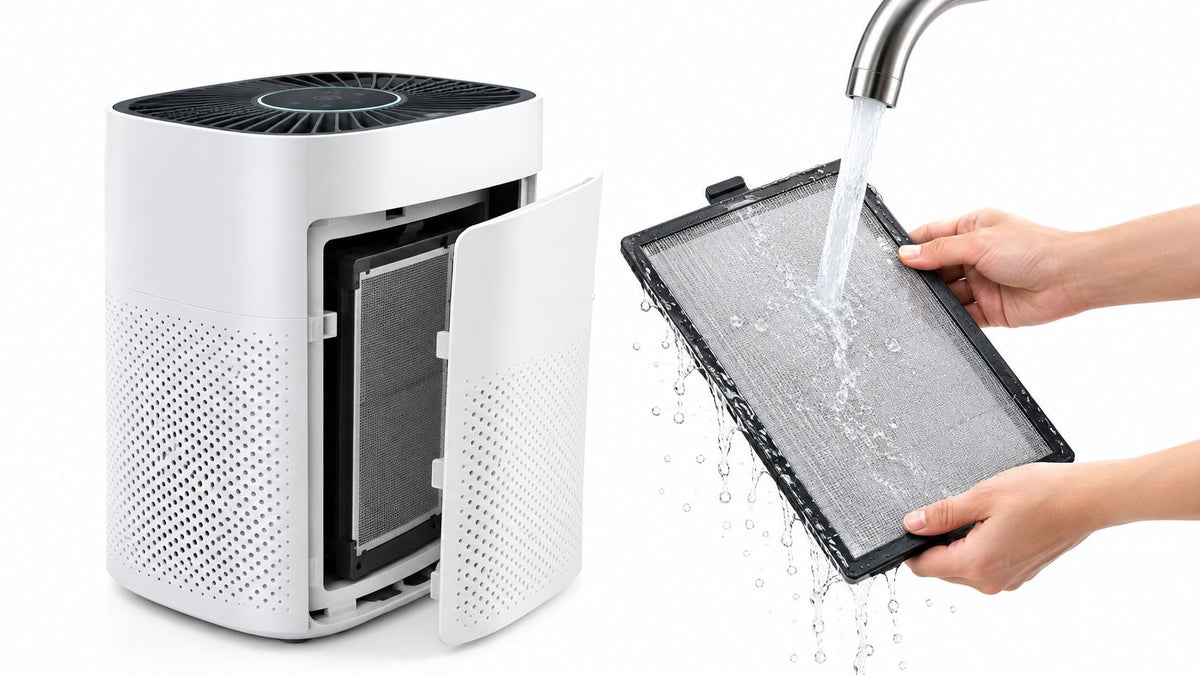
An air purifier with a washable filter works best when the washable part is a pre-filter protecting a separate HEPA stage, not when it replaces the main particle filter. Portable air cleaners have reduced indoor PM2.5 concentrations by approximately 40% to 90%, depending on the building and operating conditions.
That distinction matters because “washable” sounds like a complete maintenance and cost solution. In practice, it may describe only a coarse mesh that catches hair and lint, while the filter responsible for removing wildfire smoke and fine particles still needs careful inspection or replacement. A purifier can be convenient to wash and still deliver too little clean air if its airflow, room coverage, or downstream filtration is inadequate.
Table of Contents
- Why This Matters Before You Buy
- What a Washable Filter Actually Is
- Washable Filters Versus Disposable Filters
- How to Maintain a Washable Filter Properly
- Performance Tradeoffs and Airflow Reality
- Sizing for Your Room and Checking Certifications
- How to Choose the Right Air Purifier With Washable Filter
Why This Matters Before You Buy
A household buys a purifier advertised with a washable filter after a smoky summer. The owner expects to rinse the filter occasionally, avoid replacement purchases, and keep the machine running without much thought. A few weeks later, the unit has collected pet hair, cooking residue, and fine dust. The washable screen is visibly dirty, the fan sounds strained, and nobody has checked the filter behind it.
That's the maintenance gap. A washable component can reduce waste and protect the finer filter, but it doesn't remove the need to preserve airflow through the entire machine. Open windows, vacuuming, cooking, pets, and heating or cooling systems all introduce particles that can load a pre-filter faster than the product box suggests.
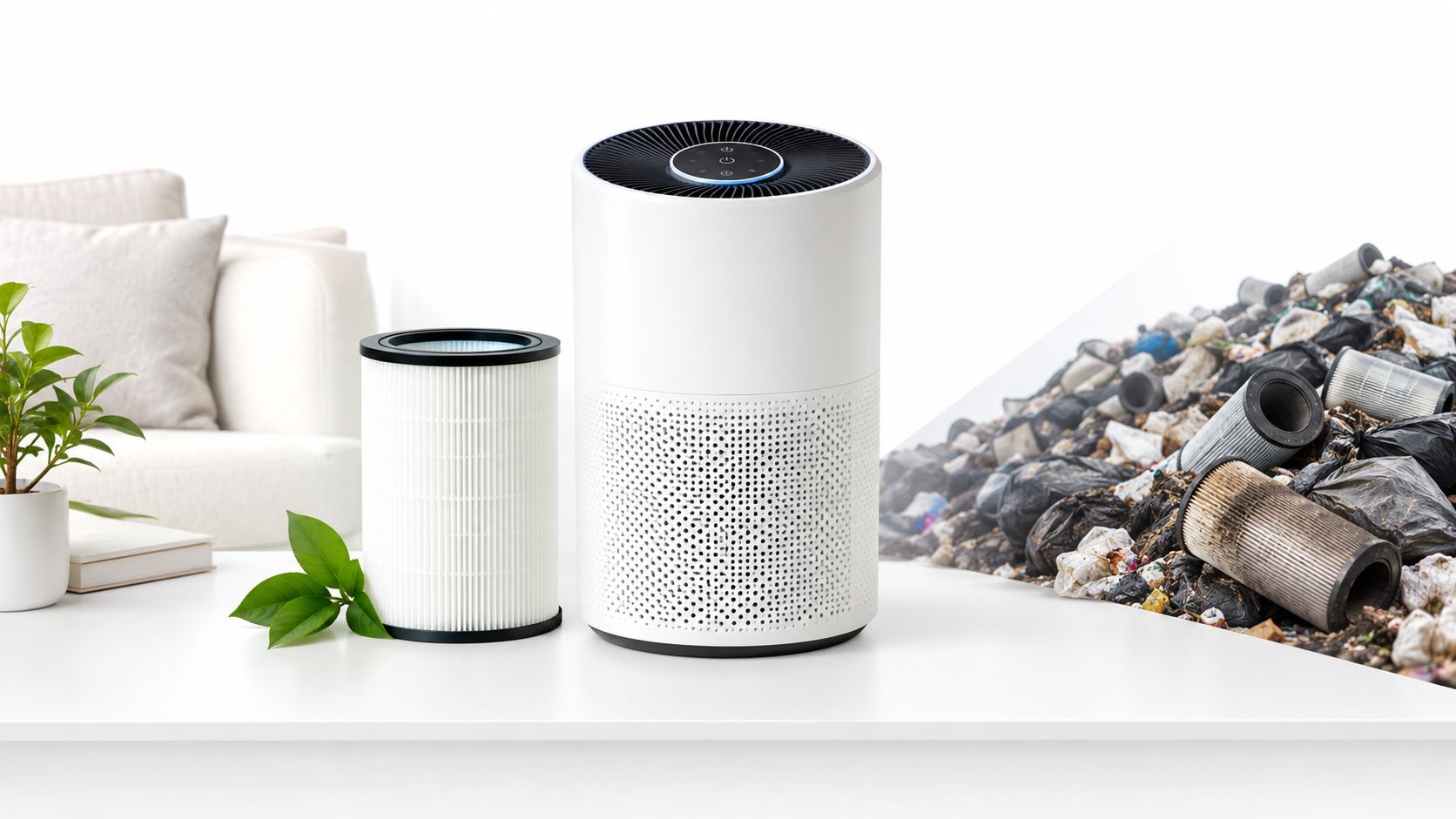
The evidence supports portable air cleaners as a practical way to reduce indoor smoke particles, but it doesn't support treating washability as a performance rating. A California-focused analysis of portable air cleaners cites a U.S. Environmental Protection Agency literature review that found indoor PM2.5 reductions of approximately 40% to 90%, with results depending on building characteristics and study design. That variation is the important part. Room leakage, fan speed, filter efficiency, and placement can matter more than whether one layer can be rinsed.
Practical rule: Treat “washable” as a maintenance feature, not proof that the purifier can capture fine smoke particles.
The same principle applies beyond wildfire season. A home with shedding pets may value a washable pre-filter because it catches larger debris before that material reaches the primary filter. A renter in a tightly sealed apartment may care more about quiet continuous operation and verified clean-air delivery. Someone cooking frequently may need to clean the outer filter often while still replacing a carbon or particle stage according to the manufacturer's instructions.
Before comparing designs, ask a simple question: which filter is washable, and which filter does the actual smoke removal? That answer will tell you more than the front-panel label. GrifGlo's guide to what an air purifier is used for provides useful context, but the purchase decision should come down to measurable airflow and realistic upkeep.
What a Washable Filter Actually Is
Most multi-stage portable purifiers move air through several layers. The first layer is commonly a coarse pre-filter, often a mesh or screen. It catches larger dust, hair, lint, and some pet debris before the air reaches the finer filter.
The next layer does the demanding particle-capture work. In a dependable mechanical design, that stage is usually a pleated HEPA or other high-efficiency filter. It may be disposable, and washing it can damage the media or leave it unable to perform as designed. A carbon layer may sit alongside or behind the particle filter to help with odours, but carbon also has its own replacement and loading limits.
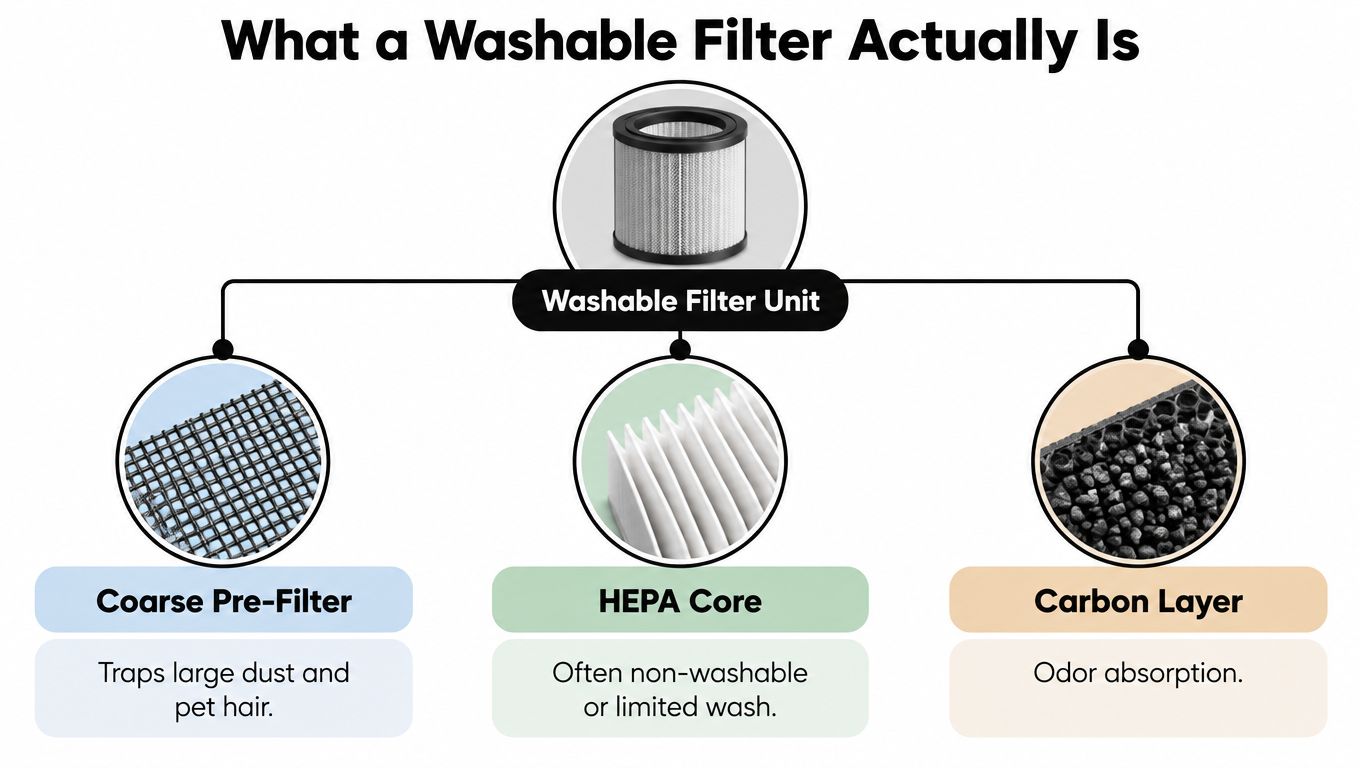
This is why “washable air purifier” can be misleading. The purifier itself isn't necessarily washable, and the main fine-particle filter may not be reusable. The phrase often means that one protective layer can be removed, cleaned, dried, and returned to service.
The three layers to identify
- Coarse pre-filter: Captures larger debris and helps prevent rapid loading of the finer stage. This is the layer most likely to be washable.
- HEPA or mechanical core: Determines much of the purifier's particle-removal capability. Check whether it's washable, replaceable, or permanently fitted, and follow the manufacturer's instructions.
- Carbon layer: Helps address certain odours and gases, but it isn't a substitute for a particle filter and may need separate replacement.
Some products use electrostatic or electrically assisted filtration instead of relying only on mechanical media. Those designs need closer scrutiny because electronic stages can generate by-products, and repeated washing may alter the material or its charge. A simple reusable mesh is easier to understand: it protects the main filter but doesn't replace it.
The CLOROX 11021 Alexa Smart Tabletop True HEPA Air Purifier illustrates why product descriptions need to be read carefully. Its catalogue snapshot describes voice control through an Alexa smart speaker or app and identifies a True HEPA system, but it doesn't establish that the filter assembly is washable. Smart controls and a HEPA claim are separate questions from pre-filter maintenance.
Look inside the replacement-filter instructions before buying. If the manual identifies a washable outer screen and a separate non-washable particle cartridge, you understand the design. If it says “washable filter” without identifying the layer, treat that omission as a reason to investigate further.
Washable Filters Versus Disposable Filters
A washable pre-filter and a disposable HEPA system solve different problems. The washable design reduces the need to discard the coarse outer layer and can be useful in homes with pets, dust, or frequent smoke exposure. The disposable design offers a clearer replacement cycle for the filter media that performs fine-particle capture.
Neither approach automatically costs less. A washable filter still requires water, handling, inspection, complete drying, and occasional replacement of downstream media. A disposable system adds recurring filter purchases, but replacement is usually more predictable and avoids the risk of reinstalling a damp or damaged component.
| Factor | Washable Filter System | Disposable HEPA System |
|---|---|---|
| Main advantage | Reusable outer layer can reduce waste and protect the finer stage | Straightforward replacement of the particle-capture media |
| Maintenance | Requires regular removal, cleaning, inspection, and complete drying | Requires monitoring loading and installing a new filter when specified |
| Performance risk | Dirty or damp pre-filter can restrict airflow | Neglected replacement filter can also reduce airflow |
| Smoke suitability | Depends on the separate fine-particle stage and verified CADR | Depends on HEPA design, airflow, room fit, and filter condition |
| Ownership considerations | Lower replacement burden for the washable layer, but not necessarily for every stage | Ongoing replacement cost and local media availability matter |
| Best fit | Owners willing to maintain the unit consistently | Owners who prefer a clear, repeatable replacement routine |
The mistake is to compare only the price of a washable filter with the price of one replacement cartridge. A realistic ownership comparison should include electricity, replacement media, cleaning supplies, noise-related compromises, and the likelihood that the household will maintain the unit. A purifier that gets switched off because it's loud may deliver less useful clean air than a quieter model with a replaceable filter.
The washable option wins only when the household follows the cleaning routine and the unit still has a capable fine-particle stage.
Before choosing, check the filter construction, replacement availability, and manufacturer instructions. GrifGlo's guide to the air purifier filter can help frame that comparison, but the product manual remains the authority on what can be washed and what must be replaced.
For smoke-heavy conditions, don't accept a reusable outer screen as a substitute for verified CADR. A disposable HEPA unit with known airflow may be the more dependable choice for a buyer who wants fewer maintenance decisions. A washable pre-filter system may be sensible for someone who will inspect it routinely and keep the main particle stage in serviceable condition.
How to Maintain a Washable Filter Properly
Maintenance starts before water touches the filter. Turn off and unplug the purifier, remove the washable pre-filter, and check the housing for accumulated dust. Vacuum loose debris from the screen or use the method specified by the manufacturer, then rinse gently if washing is permitted.
Avoid harsh chemicals unless the instructions explicitly allow them. Strong cleaners can degrade mesh, coatings, seals, or adhesives. Inspect the filter for tears, warped edges, brittle sections, or a permanently clogged texture. A damaged screen may allow larger debris to reach the downstream filter.
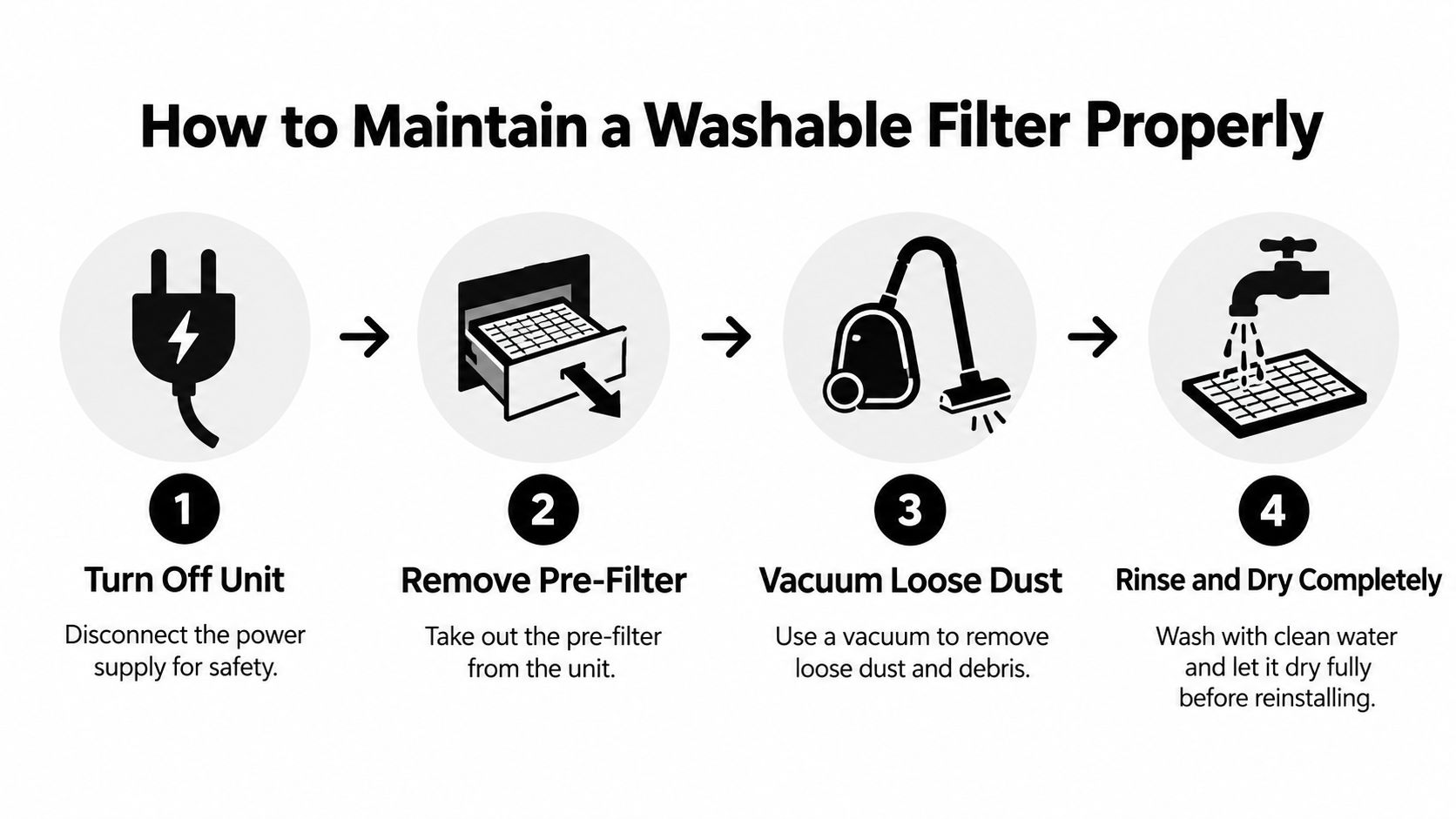
Use this sequence:
- Turn off and unplug the unit. Prevents the fan from running while the filter is removed.
- Remove the pre-filter carefully. Don't bend the frame or force clips that may have become brittle.
- Vacuum loose dust first. This reduces the amount of debris entering the sink or drain.
- Rinse only as directed. Use gentle water pressure and avoid reinstalling the filter while it's damp.
- Dry it completely. Place it where air can circulate freely, away from the purifier housing.
- Inspect the downstream filter. Washing the pre-filter doesn't restore a loaded HEPA or fine-particle cartridge.
The last step is the one many owners skip. A damp filter can restrict airflow and create an unsuitable environment inside the purifier. Complete drying isn't a cosmetic preference. It's part of maintaining the machine safely and preserving its intended airflow.
A practical air purifier filter cleaning routine should include a simple log. Record the date, household conditions, visible loading, and whether the main filter looks damaged or heavily loaded. During wildfire smoke, check more frequently. Health Canada guidance on filtration during smoke events warns that clogged filters become ineffective and should be checked, cleaned, or replaced regularly.
The right frequency depends on the home. Pet shedding, renovation dust, open windows, cooking, and smoke can all shorten the interval. Let the filter's condition and the purifier's airflow guide you, rather than relying only on a generic calendar reminder.
Performance Tradeoffs and Airflow Reality
A filter can be washable and still become a restriction. As dust accumulates on the pre-filter, the fan has to pull air through a more resistant surface. That pressure drop can lower fan throughput, reduce effective clean-air delivery, and make higher settings noisier.
Washing helps only if the washable layer is the part causing the restriction and the cleaning process restores its airflow. It won't revive a loaded HEPA cartridge, replenish exhausted carbon, or compensate for a small fan serving a large room. The purifier's performance depends on the complete air path.
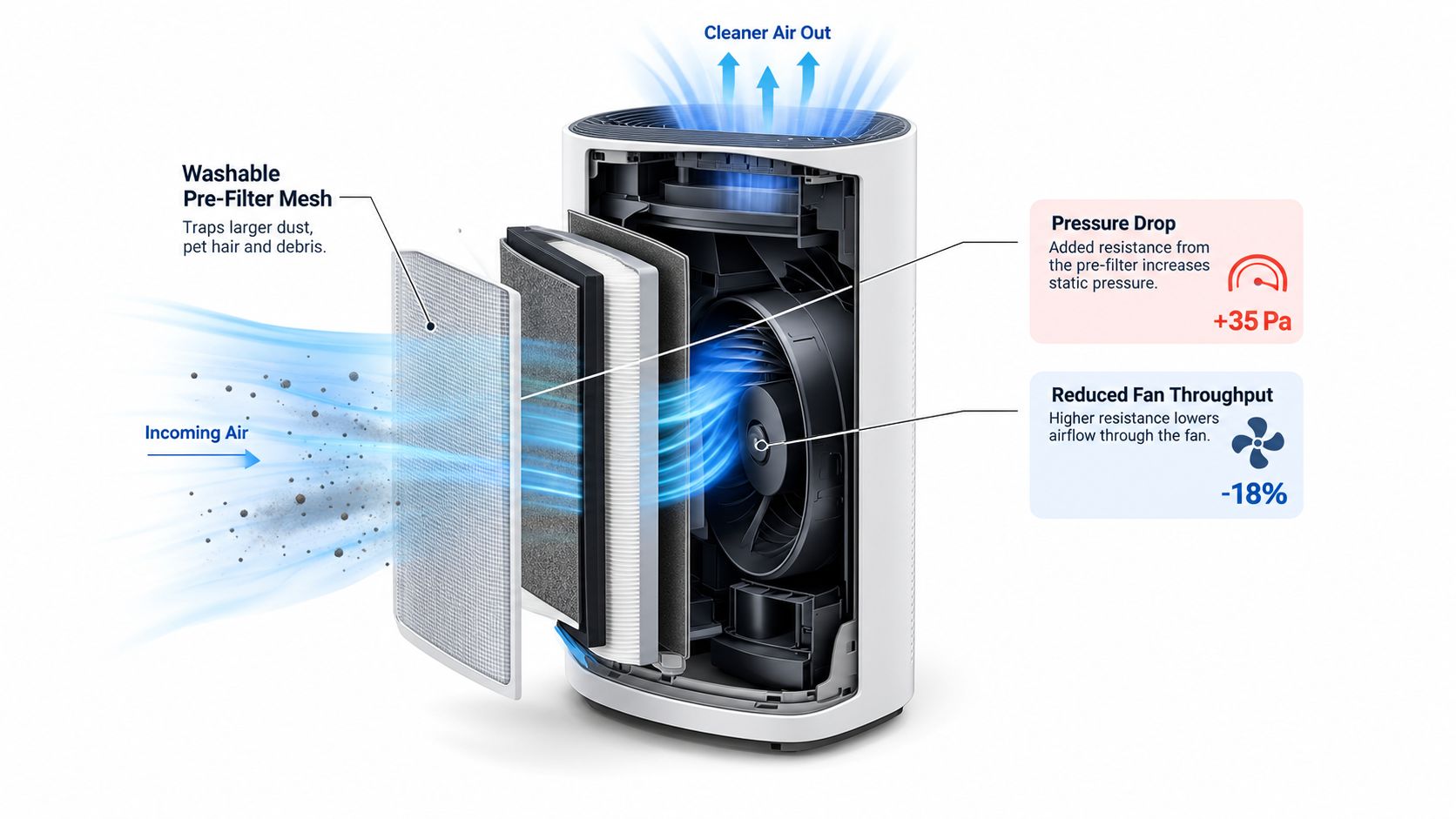
CADR, or Clean Air Delivery Rate, is more useful than a washable label because it combines particle removal with the amount of cleaned air delivered. A purifier can have efficient media but inadequate airflow, or strong airflow through a filter that captures too little. You need both elements working together.
A U.S. Department of Energy-supported analysis of a 10-day Southern California wildfire-smoke episode estimated that portable air cleaners alone reduced mean indoor PM2.5 by 45% in homes without forced-air HVAC systems. When portable cleaners operated with continuously running HVAC systems and high-efficiency filters, the model reached a 62% reduction. These figures come from a specific modelling scenario, not a guarantee for every home, and the Southern California wildfire filtration analysis shows why operating conditions matter.
Noise and power use affect real performance too. A high setting may provide more clean air but become unpleasant in a bedroom. A quiet lower setting may encourage continuous operation, but only if it still delivers enough air for the room. Compare the published CADR at the settings you can tolerate, not only the maximum figure.
A cleanable pre-filter protects airflow. It doesn't create airflow.
When a product highlights capture efficiency but gives no independent CADR, room-size basis, noise information, or replacement-filter details, the claim is incomplete. Judge the whole operating system, especially during the smoke conditions that motivated the purchase.
Sizing for Your Room and Checking Certifications
Start with the room, not the product's largest marketing coverage. Measure the floor area where the purifier will operate, then compare that figure with the tobacco-smoke CADR. Health Canada recommends a minimum tobacco-smoke CADR equal to two-thirds of the room's floor area in square feet. For a 300-square-foot room, that means at least 200 cfm tobacco-smoke CADR, as explained in its portable air-cleaner sizing guidance.
That benchmark gives you a practical starting point, not permission to ignore room layout. An open-plan area, high ceiling, connected hallway, or leaky building may require more capacity or more than one unit. A purifier placed behind furniture may also struggle to move air through the occupied space.
Check these details before purchase:
- Tobacco-smoke CADR: Useful for comparing fine-particle delivery between portable units.
- Independent performance reporting: Prefer a published test basis over an unsupported room-size badge.
- Noise at usable speeds: A bedroom unit must be tolerable when operated continuously.
- Energy consumption: Compare realistic operating modes, not only standby behaviour.
- Filter availability: Confirm that the downstream HEPA or fine-particle stage can still be obtained locally.
- Maintenance access: Make sure the washable screen can be removed without damaging clips or seals.
- Room placement: Leave the intake and outlet clear so the fan can circulate air effectively.
A washable pre-filter is especially useful only when the rest of the system matches the room. If the CADR is too low, cleaning the screen more often won't solve the underlying sizing problem. If the unit is oversized but too loud to use, the theoretical capacity doesn't translate into consistent filtration.
A home air-quality monitor can help you observe changes and notice patterns, but it doesn't replace a purifier's CADR rating or a proper filter schedule. GrifGlo's guide to an air quality monitor for home is relevant when you want to track indoor conditions alongside the purifier's maintenance and operating settings.
How to Choose the Right Air Purifier With Washable Filter
Use the washable feature as a supporting criterion, not the deciding one. The strongest shortlist will have a washable pre-filter, a genuine mechanical particle-capture stage, verified CADR suited to the room, and clear instructions for cleaning, drying, and replacing the downstream media.
Ask the seller or manufacturer:
- Which layer is washable?
- Is there a separate HEPA or high-efficiency mechanical filter?
- What is the independently reported tobacco-smoke CADR?
- Can replacement filters be obtained in Canada?
- What are the noise and energy figures at usable operating speeds?
- Can any ionizer or electronic mode be disabled?
- What does the maintenance schedule require during smoke events?
Avoid products that provide no clear filter diagram, no meaningful airflow rating, or only a headline capture claim. Also avoid intentional ozone-generating features. Health Canada sets a residential ozone maximum exposure limit of 40 micrograms per cubic metre, equivalent to 20 parts per billion averaged over eight hours, and advises against products that intentionally release ozone, according to Canadian guidance on air-cleaner emissions.
The most useful decision framework is simple: select the unit that can deliver enough clean air, operate at a level quiet enough to stay on, and be maintained correctly. A washable pre-filter can reduce waste and protect the main filter, but it isn't a substitute for verified performance. Use GrifGlo's decision-making framework to compare those practical factors before ordering.
GrifGlo offers decision-friendly guides and comparisons for air purifiers and other home essentials, with practical attention to room fit, maintenance, and reliability signals. Visit GrifGlo to compare options with a clearer understanding of what washable-filter marketing does and doesn't promise.


Leave a comment
This site is protected by hCaptcha and the hCaptcha Privacy Policy and Terms of Service apply.