

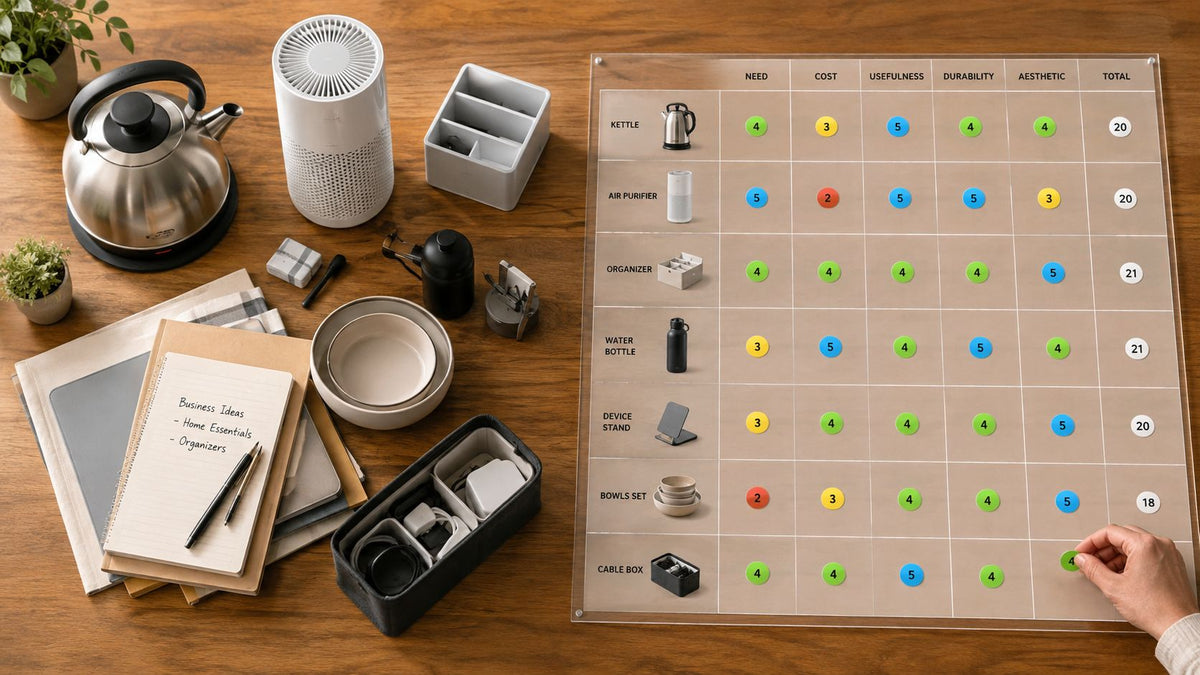
You're standing in a kitchen aisle with several kettles open on your phone, each one promising durability, convenience, or better performance. Then the same thing happens with air purifiers, storage containers, cookware, and office supplies. Reviews disagree, specifications use different language, and the cheapest option may not be the least expensive choice after replacement parts, cleaning effort, or early failure.
A decision making framework cuts through that noise. It gives you a repeatable way to define the need, identify what matters, compare realistic options, and commit without second-guessing every review. The method works for a household purchase, a rental property refresh, or a small business buying essentials in bulk.
Table of Contents
- Why Most Purchasing Decisions Feel Overwhelming
- What a Decision Making Framework Is
- Comparing Four Popular Decision Models
- Building Your Own Decision Matrix for Home Purchases
- Applying Frameworks to GrifGlo Product Categories
- Scaling Decision Frameworks for Business and Bulk Buying
- Common Decision Framework Mistakes to Avoid
- Your Quick-Start Decision Making Checklist
Why Most Purchasing Decisions Feel Overwhelming
Option overload usually starts with a vague question. “Which air purifier should I buy?” sounds simple, but it hides several separate decisions. Do you need quiet operation, smart controls, a particular room fit, easy filter replacement, or the lowest upfront cost? Until you answer those questions, every product feature competes for attention.
A small business faces the same problem at a larger scale. A property manager replacing kitchen essentials across several units may compare material, reliability, supplier support, storage requirements, compatibility, and consistency. If each person chooses differently, the business inherits a collection of products that are difficult to maintain and reorder.
The result is often decision fatigue, followed by a purchase made on one vivid feature. A shopper sees a highly rated product and stops checking whether it fits the available space. A café owner selects a low-cost appliance without considering cleaning time. A household buys an organiser that looks useful but doesn't match the cupboard dimensions.
Practical rule: If you can't explain why an option fits your actual routine, you haven't finished evaluating it.
High-consideration purchases deserve more than a quick star-rating comparison. Resources on why furniture purchases require careful thought make the same practical point from another category. The more an item affects space, comfort, workflow, or replacement costs, the more valuable a clear process becomes.
A useful framework doesn't promise perfect information. It prevents you from treating irrelevant information as decisive. The rest of this guide turns that idea into practical workflows for kitchens, smart living, organisation, rental properties, and small-business sourcing.
What a Decision Making Framework Is
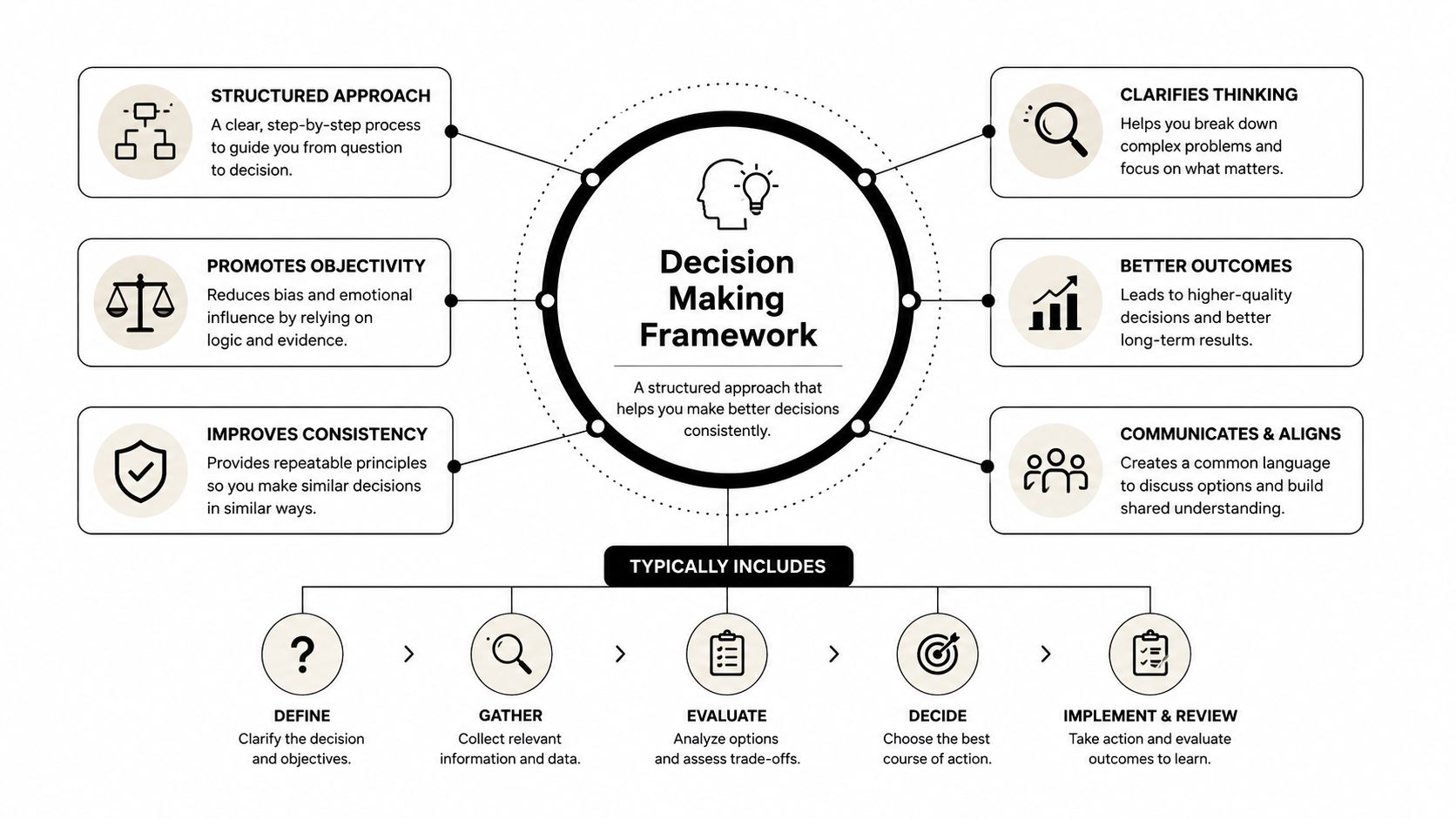
A decision making framework turns a purchase into a repeatable workflow. It defines what you need, how you will compare options, and when you will review the result. The framework will not guarantee a perfect choice, but it makes the reasoning visible and helps prevent one appealing feature from controlling the entire decision.
Use five components:
- Define the problem. Describe the purchase in operational terms. “Choose an air purifier for a bedroom where noise matters” gives you a workable brief. “Buy an air purifier” does not.
- Identify criteria. List the conditions that distinguish a suitable option from an unsuitable one. Include space, maintenance, compatibility, delivery, support, and budget alongside attractive features.
- Generate realistic options. Compare products that meet the required conditions. Remove any option that cannot fit, ship, be cleaned, or receive support before it reaches the shortlist.
- Evaluate consistently. Apply the same criteria and scoring method to every option. Do not inspect one product closely while judging another from its headline claims.
- Select and review. Choose the option that best fits the defined need. After purchase, check its performance in the actual household or business routine.
Health Canada's Decision Making Framework for science and research shows why sequence matters. Its process separates issue identification, risk assessment, and risk management, so a team does not move from incomplete evidence straight to a preferred action.
Apply the same discipline to purchasing. Define the problem first, examine evidence and trade-offs next, then choose a product, control, or supplier. The weight of evidence approach also works when product information is incomplete. Record what is known, what is inferred, and what still needs verification. A sparse specification sheet should not carry more authority than it deserves.
Purchasing decisions rarely offer complete information. Time is limited, reviews conflict, space is fixed, and the budget must cover other priorities. A clear structure gives households and small businesses a defensible way to choose under those constraints, whether they are assessing GrifGlo organisation products, kitchen equipment, or supplies for a rental property.
Comparing Four Popular Decision Models
No single model handles every buying situation. A weighted decision matrix is excellent for comparing products against defined criteria, while RACI is better at preventing team confusion. The Eisenhower Matrix helps decide what deserves attention first, and the OODA Loop supports repeated decisions when conditions change.
Four models through a purchasing lens
The Decision Matrix ranks options against criteria. You assign greater importance to factors that matter most, score each option, and review the result. It suits a household comparing kettles or an office comparing printers, but it can create false precision if the criteria are poorly chosen.
The Eisenhower Matrix sorts tasks by urgency and importance. It isn't a product-ranking tool. Use it to decide whether a purchase needs immediate action, careful planning, delegation, or removal from the list. A property manager might use it to separate a broken essential from a cosmetic upgrade.
The OODA Loop, observe, orient, decide, and act, was developed by John Boyd for decision-making in changing environments. In purchasing, it works when you need to monitor stock, supplier performance, usage feedback, and changing requirements. It falls short as a standalone method for comparing detailed product specifications.
RACI assigns responsibility as Responsible, Accountable, Consulted, and Informed. It helps when several people influence a purchase. A small hospitality team can define who gathers options, who approves the standard, who provides operational input, and who receives the final decision. RACI won't tell you which product has the best value. It tells you who owns the process.
| Model | Best For | Complexity | Time Required |
|---|---|---|---|
| Decision Matrix | Comparing products against weighted criteria | Moderate | Moderate |
| Eisenhower Matrix | Prioritising purchasing tasks | Low | Short |
| OODA Loop | Repeated decisions with changing information | Moderate | Ongoing |
| RACI | Clarifying roles in team purchases | Low to moderate | Short to moderate |
Use the simplest model that fits the decision. For a solo purchase, start with a short matrix. For a team purchase, add RACI before anyone starts researching. For a fast-moving sourcing problem, use OODA to establish a feedback loop instead of treating the first order as the end of the process.
A useful comparison of the models is that they answer different questions. The matrix asks, “Which option fits?” Eisenhower asks, “What deserves attention?” OODA asks, “How should we adapt as information changes?” RACI asks, “Who does what?” Combining them is sensible, but building an elaborate process for a minor purchase wastes time.
Building Your Own Decision Matrix for Home Purchases
A weighted decision matrix works best when the purchase has several meaningful trade-offs. Start with a product category, not a brand. Suppose you need an air purifier for a medium room and care about filtration, noise, controls, visibility of air-quality information, and cleaning effort.
Set the criteria before browsing
Write down the requirements before you look at individual products. Separate must-haves from preferences. A product that fails a must-have should be removed, even if it performs well on other dimensions.
Assign each criterion a weight based on your routine. You can use any consistent scale, such as low, medium, and high importance, or a numerical scale if you prefer more detail. Then score each surviving option against the same criteria. Multiply the score by the weight, add the results, and inspect the ranking.
The arithmetic matters less than the conversation it creates. If “quiet operation” receives the highest weight, you shouldn't let a decorative feature overturn the result. Ontario's health technology decision framework offers a useful policy example because it makes criteria explicit, including clinical benefit, societal and ethical values, value for money, and feasibility of adoption. Its lesson transfers directly to household purchasing: a good option must be useful, acceptable, affordable, and workable in context, not merely impressive on one dimension.
Use this reusable template:
- Decision: What exactly am I buying, and for which use?
- Must-haves: What disqualifies an option immediately?
- Criteria: Which factors will determine satisfaction after purchase?
- Weights: Which factors deserve the most influence?
- Evidence: What information supports each score?
- Score: How does each option perform against the same criteria?
- Reality check: Does the winner fit the room, routine, maintenance capacity, and budget?
For example, the CLOROX 11031 Alexa Smart Medium Room True HEPA Air Purifier can be recorded by its listed features, including Alexa voice control, True HEPA three-stage filtration, a real-time air-quality display, and auto mode with smart adjustment. Those features may score well for a connected household, but they shouldn't automatically outweigh room fit, ongoing maintenance, or the buyer's preference for simple controls.
The same logic applies to larger purchases. Anyone reviewing a buying homes to flip guide needs criteria that extend beyond the headline purchase price, such as location, repair scope, financing conditions, and resale practicality. For kitchen equipment, GrifGlo's guide on choosing induction cookware can help you define compatibility as a criterion before comparing individual pieces.
Applying Frameworks to GrifGlo Product Categories
A framework becomes useful when it changes an actual purchase. Consider a home cook replacing a kettle. The first step isn't to compare every available model. It's to define the job: boil water on a particular stovetop, signal completion clearly, withstand regular handling, and suit the household's capacity needs.
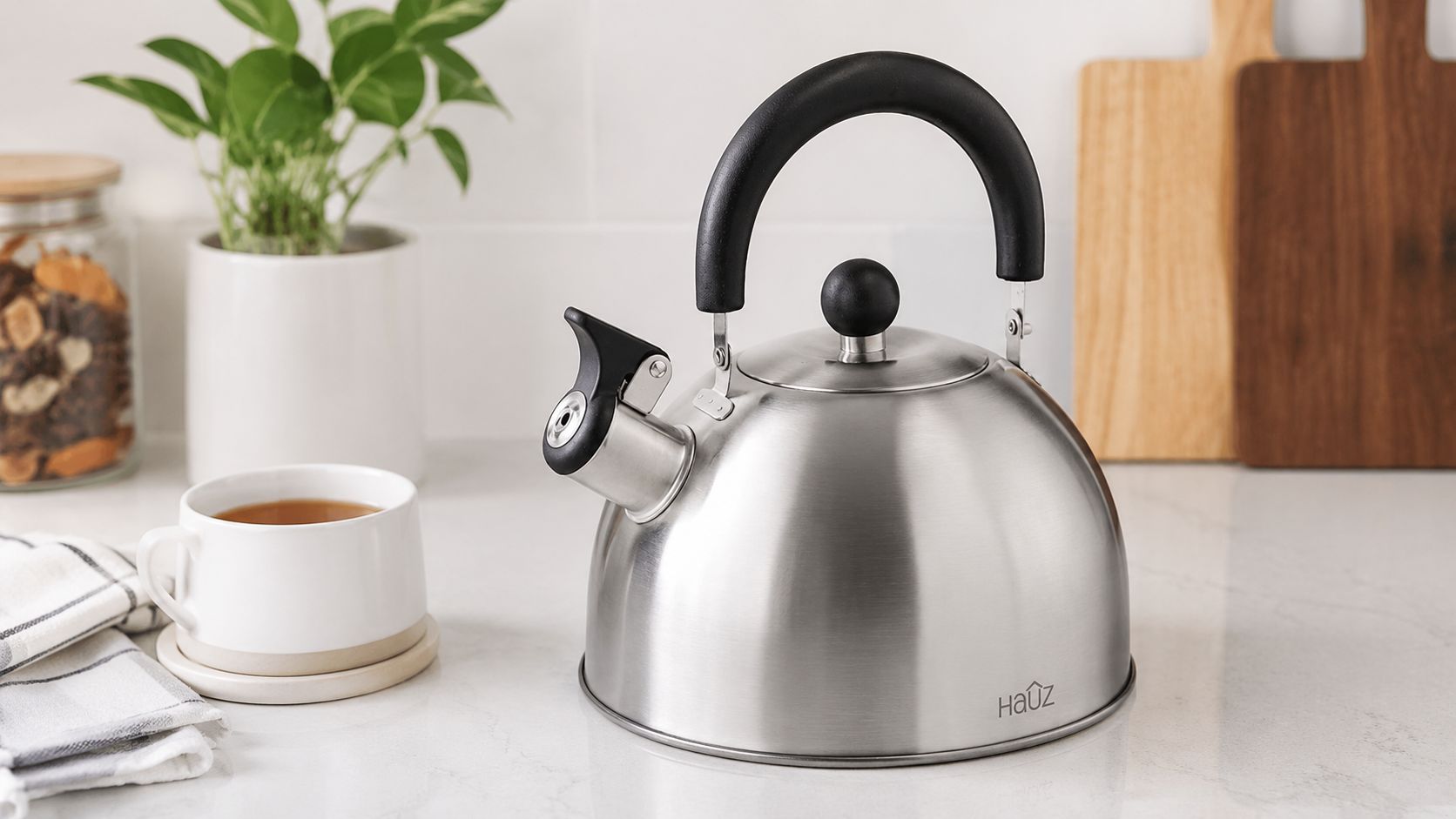
The cook might compare stainless steel durability, whistle reliability, capacity, handle comfort, cleaning access, and stovetop compatibility. The HAUZ AKL1695 Whistling Stovetop Stainless Steel Kettle 2L is described as a durable stainless steel kettle with efficient heating and a whistle that signals when water reaches temperature. Those are inputs to the matrix, not automatic reasons to choose it. The buyer still needs to confirm that the listed design matches the stovetop and daily routine.
A team purchase needs ownership
Now consider a property manager outfitting rental units. A matrix can compare kitchen essentials, but it doesn't resolve who makes the final call. Use a simplified RACI arrangement:
- Responsible: The person who gathers options and checks dimensions.
- Accountable: The owner or operations lead who approves the standard.
- Consulted: Maintenance staff, cleaners, or hosts who understand daily use.
- Informed: The purchasing or bookkeeping contact who places and records the order.
This structure prevents a familiar failure: one person chooses a product for appearance, another discovers it is awkward to clean, and nobody knows who approved the change. A shared standard also makes replenishment easier. The same principle applies when organising pantry and food supplies, where a consistent approach to bulk food storage containers can reduce incompatible purchases and simplify replacement decisions.
Record the decision in a short note. Include the selected criteria, the product evidence reviewed, the owner of the decision, and the condition that would trigger a review. That record turns a one-off purchase into an operating tool.
Scaling Decision Frameworks for Business and Bulk Buying
Business purchasing adds stakeholders, repeat orders, operational consequences, and exposure to supplier inconsistency. The answer isn't a longer spreadsheet for its own sake. The answer is a framework that separates product fit, process ownership, evidence quality, and post-purchase feedback.
California's public-sector experience shows why iteration matters. A California Department of Social Services framework for Expanded Subsidized Employment directs county welfare departments to access relevant data, establish a baseline, test programme changes, and validate decisions with results. It also refers to administrative wage and placement data and calls for examining outcomes over time and across demographic characteristics such as race, age, and gender. For a small business, the equivalent evidence might include damage reports, replacement frequency, staff feedback, cleaning time, or order accuracy.
Build a repeatable sourcing loop
A practical bulk-buying loop looks like this:
- Define the standard. Describe the required function, dimensions, materials, compatibility, and acceptable variation.
- Screen suppliers. Check whether the channel can support repeat ordering and consistent specifications.
- Run a controlled trial. Test a limited purchase in the setting where the item will be used.
- Collect operational feedback. Ask the people who clean, install, handle, or replenish the product.
- Validate the outcome. Compare the result with the original criteria and record failures as carefully as successes.
- Set a review trigger. Revisit the standard when usage, supplier performance, or operating requirements change.
For Canadian organisations, structured information exchange is becoming more important in public policy. Assembly Bill 133 in California, for example, required most health care providers to begin data sharing in January 2024, with a signed data-sharing agreement due by January 2023, as described in the California report on data-driven decision-making. The purchasing lesson is broader than health care: decisions improve when information can move reliably between the people who use, approve, and monitor a solution.
Use GrifGlo's wholesale kitchen supplies guide as a category reference when defining a sourcing list. Don't treat a catalogue as a decision framework. Turn the catalogue into a shortlist, apply your criteria, and preserve the evidence behind the standard.
When evidence is incomplete, use weight-of-evidence reasoning. Give more influence to information that directly answers your use case, flag assumptions clearly, and choose a review point rather than waiting indefinitely for perfect data.
Common Decision Framework Mistakes to Avoid
A framework can create false confidence if you apply it badly. The worksheet isn't the decision. Your definitions, weights, evidence, and ownership determine whether the process helps.
Equal weighting hides real priorities
A buyer gives price, durability, cleaning, capacity, and appearance identical influence, even though cleaning effort drives the household's satisfaction. The fix is simple: rank criteria before scoring and explain why the top priorities matter.
Feasibility gets ignored
A product may look strong on paper but require a power connection, replacement component, storage space, or staff training you don't have. Add feasibility as a separate criterion. Ontario's framework makes feasibility of adoption explicit for precisely this reason, as described in the Ontario health technology decision framework.
One feature hijacks the choice
Voice control, a stylish finish, or an unusually low price can dominate attention. Force every shortlisted option through the full list, and apply must-have filters before scoring attractive extras.
The decision never gets reviewed
A purchase may appear successful until users reveal a recurring problem. Set a review trigger tied to an observable issue, such as repeated damage, poor fit, or difficult cleaning. The OODA model is useful here because it treats observation and action as connected rather than treating the first decision as permanent.
A solo model gets imposed on a team
One buyer's matrix won't resolve conflicting responsibilities. A property manager may select an item, but maintenance staff may carry the operational burden. Use product standardization guidance to support consistent choices, then assign who recommends, approves, orders, and reviews the standard.
The strongest correction is to keep the process proportional. A minor household accessory doesn't need a formal committee. A repeat order affecting several properties shouldn't rely on one person's memory and a star rating.
Your Quick-Start Decision Making Checklist
Use this workflow before your next meaningful purchase:
- Define the decision clearly. Write the use case, location, users, essential function, and constraints.
- List and weight criteria. Separate must-haves from preferences, then give greater influence to what affects daily satisfaction or operating cost.
- Gather realistic options. Use trusted product information, remove options that fail basic requirements, and record uncertainty.
- Score consistently. Compare every shortlisted option against the same criteria. Add a note explaining each unusual score.
- Validate the choice. Check dimensions, compatibility, cleaning, storage, adoption, supplier continuity, and who owns the decision after purchase.
Choose the model to match the situation. Use a decision matrix for product comparisons, RACI for team ownership, Eisenhower for purchase priorities, and OODA when feedback or conditions will keep changing. For category planning, a practical kitchen essentials list can help you start with a defined scope instead of browsing without an endpoint.
Good decision-making improves through use. Start with a short matrix today, keep the evidence behind your choice, and adjust the criteria when real use proves them wrong.
GrifGlo organises home, kitchen, organisation, and smart-living products into decision-friendly categories, with guides that help households and small businesses compare practical fit. Visit GrifGlo to build a focused shortlist for your next household purchase, rental-property setup, or bulk order.


Leave a comment
This site is protected by hCaptcha and the hCaptcha Privacy Policy and Terms of Service apply.