

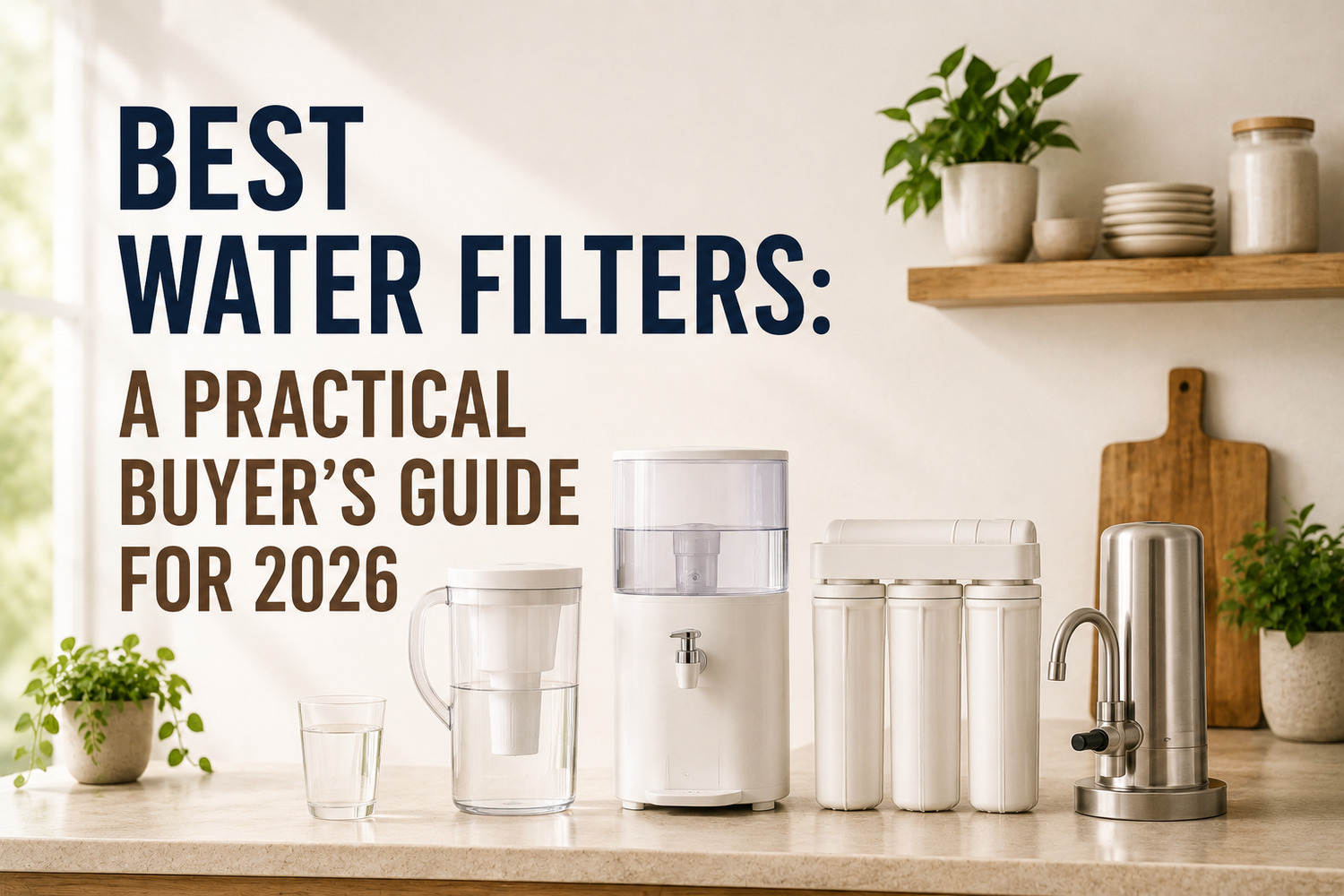
You turn on the kitchen tap, fill a glass, and do the same little mental check every time. Does this water need a filter, or are you just shopping because the label on the pitcher looked convincing?
That's the wrong way to buy one. The best water filters are the ones matched to your local water report, your home layout, and the amount of upkeep you'll tolerate. In California especially, the right choice depends on the Consumer Confidence Report, because community water systems must provide one every year by July 1, and those reports are the public record shoppers should use before choosing a filter Green America.
If you're comparing filters right now, start with your actual problem, not the brand. Lead, PFAS, nitrate, arsenic, hard-water scale, chlorine taste, and under-sink space all point to different solutions. A good filter doesn't just make water taste cleaner, it solves the issue you have without creating a maintenance mess you'll hate six months later.
| Filter Family | What It's Good At | Main Trade-Off | Best For |
|---|---|---|---|
| Pitchers and faucet-mounts | Quick, point-of-use improvement for taste and basic contaminant reduction | Slower output, smaller capacity | Renters, small households, low-commitment buyers |
| Under-sink carbon blocks | Dedicated drinking-water filtration with better capacity | Needs under-sink space and installation | Households that want a stronger everyday setup |
| Reverse osmosis systems | Strong dissolved-contaminant reduction | More maintenance and wastewater | Homes dealing with PFAS, arsenic, nitrate, or similar issues |
| Whole-home systems | Point-of-entry treatment for the whole house | Highest complexity and cost | Larger properties and buyers solving more than drinking-water issues |
Table of Contents
- Why Choosing the Right Water Filter Matters
- The Four Filter Families Every Buyer Should Understand
- Comparing Performance Across Filter Types
- What NSF and ANSI Certifications Mean
- Installation, Space, and Daily Maintenance
- Upfront Price vs Lifetime Cost Per Gallon
- Best Pick for Each Type of Buyer
- A Simple Checklist Before You Buy
Why Choosing the Right Water Filter Matters
The biggest mistake shoppers make is buying for the wrong problem. They see a slick “improves water taste” promise and assume it covers PFAS, lead, or nitrate. It doesn't.
California makes that mismatch easy to spot because water quality varies sharply by location, and the state's disclosure system pushes you to choose from the newest report, not from a generic product ranking Green America. That is why “best” is local. A filter that handles chlorine taste in one city can be the wrong tool for a household with a PFAS advisory or a well with nitrate concerns.
Buy for the report, not the box
Start with the Consumer Confidence Report and identify the contaminant that matters most in your home. If the report shows lead, you need a filter with verified lead reduction. If the concern is taste and odor, you do not need to overbuy a system built for dissolved contaminants. If your area has broader industrial or agricultural contamination, the bar rises fast.
Practical rule: do not shop by “best overall”, shop by the one contaminant you need to reduce.
That is why so many buyers waste money. They choose the wrong filter family, then deal with cartridges that need replacing too often, weak flow, or a system that never matched the problem in the first place. The smart move is to treat filtration like a matching exercise, not a beauty contest.
What this guide is really solving
The rest of the guide is built around three questions. What contaminants matter in your water, which filter family handles them well, and how much space and maintenance you are willing to live with? Answer those questions and the shortlist gets much shorter.
If you live in a California home with a dated plumbing setup, a private well, or a rental with no room for drilling, your best choice probably is not the same as your neighbour's. That is the point. A good filter fits your water and your house, not a lab chart in isolation.
A similar trade-off shows up in other home filters too. If you want a practical maintenance example, see this guide on how to clean an air purifier filter.

The Four Filter Families Every Buyer Should Understand
Pitchers and faucet-mounts
A cheap pitcher looks harmless until you have to keep refilling it for cooking, or a faucet-mount starts slowing the sink to a crawl. These are the easiest filters to live with, but they only treat the water you pour or draw at the tap. You fill a pitcher at the sink, or clamp a faucet-mount directly onto the faucet, and water passes through a small cartridge before it reaches your glass.
Pitchers are the least committal option and a sensible starting point if you are not sure what your water needs. Faucet-mounts give you a more continuous stream, so they fit better into everyday kitchen use. The trade-off is simple. Capacity is limited, cartridges wear out quickly, and they usually do little for the bigger dissolved-contaminant problems that call for a more serious setup. If your water report points to PFAS, arsenic, or nitrate, this family is usually the wrong place to start.
Under-sink carbon blocks
Under-sink carbon blocks are the practical middle ground. The filter sits below the sink and sends treated water to a dedicated faucet, which keeps the counter clear and gives you a steadier supply than a pitcher. For many homes, this is the point where filtered water stops feeling like a chore.
Carbon block systems make sense when taste, odour, chlorine, and some health-related contaminants need attention, but the household does not need full reverse osmosis. They are the workhorse choice for buyers who want a permanent kitchen solution without turning the install into a bigger project than it needs to be. If a pitcher feels flimsy and RO feels like overkill, this is usually the family that fits.
A practical maintenance mindset matters here too. If you stay on top of cartridges and clean parts before buildup becomes a problem, the system performs better for longer. For a related maintenance example outside water filtration, see this guide on how to clean an air purifier filter.
The same logic applies outside water filtration. The DYSON HEPA Air Carbon Purifier Filter - 965432-01 uses 360° HEPA filtration and activated carbon in a sealed design, which mirrors the principle of matching filter technology to a specific contaminant rather than chasing broad marketing claims.
Reverse osmosis systems
RO is the heavy hitter. Water passes through multiple stages and a membrane designed to strip out dissolved contaminants more aggressively than basic carbon alone. That is why RO keeps coming up in California conversations about PFAS, arsenic, and nitrate. It is not the most convenient option, but it is the one people reach for when reduction matters more than speed.
One mistake shoppers make is assuming RO is the answer for every household. It is not. If your local issue is mostly chlorine taste, RO is often too much system for the job. If the issue is dissolved contaminants, RO starts to make sense fast, and that is the point where a lot of the generic “best water filters” advice falls apart.
Whole-home systems
Whole-home units treat water at the point where it enters the house. That means the water at taps, showers, and appliances all goes through the system. For buyers dealing with a broad source-water problem, or who want to address bathing water as well as drinking water, this can be the right approach.
Whole-home water treatment is not necessary for everyone. It is the most complex approach, and it only makes sense if you are dealing with a property-wide issue, not just trying to improve the water at one kitchen tap.
Comparing Performance Across Filter Types
The fastest way to compare best water filters is to stop asking which one sounds strongest and ask which one fits the contaminant in your water report. Pitchers and faucet filters handle basic taste and some metals well enough, but they are limited by cartridge size and limited contact time. Under-sink carbon blocks give you more capacity and better day-to-day use at the kitchen sink. RO systems usually win once dissolved contaminants like PFAS, arsenic, or nitrate are the primary problem. Whole-home systems cover the entire house, so they matter more for broad source-water issues than for one drinking tap.
The practical rule is simple. If convenience matters most, choose a point-of-use filter. If you want stronger ongoing filtration without cluttering the counter, pick an under-sink setup. If your local report points to PFAS, arsenic, or nitrate, RO deserves serious attention. If the issue reaches every faucet, shower, and appliance, go broader.
| Filter Family Performance Compared | Contaminant Removal | Flow & Capacity | Best Fit |
|---|---|---|---|
| Pitchers and faucet-mounts | Good for taste and some basic reduction, but limited by cartridge size | Low capacity, easiest to use, smallest footprint | Renters, small households, trial buyers |
| Under-sink carbon blocks | Better than pitchers for sustained treatment, especially for common tap-water issues | Strong daily flow, hidden install, moderate upkeep | Families who want a permanent kitchen solution |
| Reverse osmosis systems | Best for dissolved-contaminant reduction, especially when the problem is more than taste | Slower, more complex, maintenance matters more | Buyers focused on PFAS, arsenic, nitrate, or similar issues |
| Whole-home systems | Covers the entire house, including bathing and appliance water | Highest installation complexity and ongoing upkeep | Homes that need treatment beyond the kitchen sink |
TechGearLab's testing gives the comparison some teeth. Its lab data showed PUR Plus removed 100% of lead, copper, and iron in its city-water test, but only reduced nitrate by 53%, and the measurements even showed increases in barium and zinc in the reported results TechGearLab. By contrast, ZeroWater's 5-stage ion-exchange approach reduced PFOA/PFOS by 99%, lead by 95%, mercury by 96%, and chlorine by 97%. That is the trade-off buyers need to understand, stronger reduction usually comes with slower throughput and more cartridge churn.
Under-sink carbon blocks sit in a useful middle ground, and they are a better fit than pitchers for people who want a permanent kitchen setup without jumping all the way to RO. They also make sense for homes that need ordinary tap-water improvement, not heavy dissolved-contaminant removal. If your real problem is kitchen air and odour from cooking, a separate solution like a kitchen air purifier deals with that issue directly instead of asking a water filter to do the wrong job.
RO has a different trade-off. It is the blunt instrument in this category. TechGearLab's lab testing found the APEC Essence ROES-50 delivered 100% reduction for lead, arsenic, and uranium in its city-water test, while Wirecutter reported the Cloud RO at 54% efficiency, meaning roughly a 1:1 ratio of wastewater to filtered water Wirecutter. That is why RO makes sense when the target matters more than the convenience hit.
My take: if you are buying for taste alone, stop at carbon. If your report names dissolved contaminants, step up to RO or you are probably underbuying.
A separate problem is the mismatch between what shoppers want and what they buy. Many buyers choose by brand reputation, then discover the issue was nitrate or PFAS, which is exactly where a generic pitcher becomes the wrong tool. A filter should be chosen by contaminant, not by aisle placement.
What NSF and ANSI Certifications Mean
Most boxes throw certification language around like confetti. Ignore the noise. A label only matters if the standard matches the contaminant in your water report.
The three labels buyers should know
NSF/ANSI 42 covers chlorine, taste, and odour reduction. That is the right standard if your water is safe enough but tastes or smells off. NSF/ANSI 53 is the one to look for when the concern is a health-related contaminant such as lead. NSF/ANSI 58 applies to reverse osmosis systems and is the certification that matters when you are shopping RO specifically.
If the certification does not match the problem in your report, it is just decoration on the box.
That is the mistake buyers make again and again. A filter can be properly certified and still be the wrong answer for your water. NSF/ANSI 42 does not solve a lead issue. NSF/ANSI 53 will not help if the problem is mostly taste. NSF/ANSI 58 only matters if you are buying an RO system.
How to read your California report
Your Consumer Confidence Report is the starting point in California because it tells you what your local system is reporting. If lead or PFAS show up in the report, do not buy a filter that only talks about taste. If nitrate or arsenic are part of the issue, check whether the product's certification and testing claims line up with that problem. Once you know what you are dealing with, keep the report and the bottle organization in the same place, especially if you are comparing cartridges, manuals, and test notes with a practical guide to commercial food storage containers.
There is also a reason certification gets more attention in California than in generic shopping guides. State and utility reporting has kept public attention on PFAS and other emerging contaminants, which pushed buyers away from “good enough” carbon pitchers and toward products with verified contaminant reduction claims Frontiers in Environmental Chemistry. That is not marketing hype. It is how people now evaluate filters.
The right move is simple. Match the standard to the contaminant, then match the format to your space. Anything else is guesswork, and on a real household water issue, guesswork wastes money fast.
Installation, Space, and Daily Maintenance
A filter can match your water report and still be a bad fit if it eats cabinet space or demands upkeep you will not do. That is why installation and maintenance matter as much as contaminant claims. The common regrets come from shoppers who checked the marketing first and the plumbing second.
What each setup asks of you
Pitchers require no installation, which is why they suit renters and first-time buyers who want the least hassle. Faucet-mounts need a compatible tap and a little patience during setup, but they stay simple after that. Under-sink systems take cabinet space and usually need a dedicated faucet, so they fit best in kitchens with room to spare and permission to make a small plumbing change.
RO systems ask for more. They usually need more space under the sink, a separate faucet, and a plan for wastewater routing. That is workable in the right kitchen, but it is a poor match for a renter or anyone who cannot modify plumbing.
The same fit-first logic applies in other home setups too. A product like the OMEGA J8006HDC All in One Nutrition System Cold Press Juicer is built around triple-stage masticating extraction, 80 RPM, and 3 adjustable pressure settings, which makes the point clearly. Features matter less than whether the machine fits the way you live and the space you have.
Maintenance is the hidden cost
Cartridges do not replace themselves. Pitchers need regular cartridge swaps, faucet-mounts need attention once the flow drops, and under-sink systems need a replacement routine you will remember. RO has the heaviest maintenance load of the common kitchen options, partly because the system is more complex and partly because performance depends on keeping each stage in shape.
Practical rule: if you will not change cartridges on time, buy a simpler system with a smaller promise.
That rule matters because missed maintenance breaks filtration faster than shoppers expect. A buyer who wants a set-it-and-forget-it setup should be honest about that. In many homes, the easiest systems to maintain are also the least invasive to install, which is why pitchers stay popular even when they are not the strongest option.
Under-sink systems also bring a refrigerator angle that people often overlook. If your kitchen already uses a fridge filter, refrigerator water filter replacement becomes part of the same maintenance rhythm, and it should be scheduled with the rest of your cartridge changes instead of treated as an afterthought.
A compact, renter-friendly setup usually means a pitcher or a faucet-mount filter. A more permanent kitchen solution usually means under-sink carbon or RO. If you need broader treatment but cannot modify the home, the practical choice is usually the simplest point-of-use option you can maintain correctly, not the system with the longest claim sheet.
Upfront Price vs Lifetime Cost Per Gallon
Sticker price lies to people. A cheap pitcher can turn expensive once you start replacing cartridges often, and a pricier RO system can look a lot less intimidating once you count what it replaces. The number that matters is lifetime cost per gallon, not what the box says at checkout.
What changes the total
The biggest cost drivers are easy to name. Unit price is only the starting point. Replacement cartridges, water waste for RO, and any extra hardware needed for installation all push the total up over time. If a system uses a pump, electricity can add a little more, but the bigger truth is simple, upkeep never stops.
California buyers should pay close attention to wastewater because drought awareness makes waste feel less abstract. A reported 54% efficiency for the Cloud RO means about a 1:1 ratio of wastewater to filtered water, which is a serious factor if you are comparing it with a simple pitcher or an under-sink carbon system Wirecutter. That does not make RO a bad buy. It means stronger filtration comes with operating trade-offs, and those trade-offs belong in the price check.
How to think about the comparison
A pitcher is cheap to buy and cheap to replace, but it is also the weakest choice for tougher contaminants. An under-sink carbon block usually costs more up front, yet it often lands in the sweet spot for households that want a better daily experience without RO complexity. RO has the biggest install and maintenance burden, but it is the family worth paying for when the water report justifies it.
The product pages shoppers love to compare rarely tell the whole story. A system that looks pricey can be the smarter buy if it lasts longer and handles the contaminant in your report. A system that looks affordable can become irritating fast if it cannot keep up with household use or needs frequent cartridge changes. That matters even more if your cabinet is already crowded, so planning around under-sink storage ideas helps keep the system practical after installation.
The right way to shop is to compare what you will spend over time, not just what you will pay today. That is the only comparison that tells the truth.
Best Pick for Each Type of Buyer
A renter in a small apartment should start with a pitcher or faucet-mount filter. That's the cleanest choice when you can't drill, don't want cabinet work, and mainly need a better glass of water. If the local report points to something more serious than taste, move straight to a compact under-sink option only if the lease allows it.
A homeowner on a private well should think harder and act faster. If the concern is nitrate or arsenic, don't waste time with a basic pitcher. An RO system is the more serious answer, and that's where the best water filters conversation finally becomes about contaminant fit instead of convenience.
A family of four in a mid-sized house usually does best with an under-sink carbon block if the issue is common tap-water stuff like taste, odour, or ordinary municipal concerns. If the report points to broader dissolved contaminants, step up to RO. You'll feel the difference every day at the sink, and you won't be refilling a pitcher all afternoon.
An office break room needs something simple and maintainable. A pitcher is easy, but it can get annoying fast with heavy use. A faucet-mount or a compact under-sink system is usually the more practical route if you want filtered water available without a constant refill cycle.
A short-term rental or property manager should prioritise consistency and low drama. Standardise on a simple point-of-use setup unless the property's water report clearly demands more. If storage planning matters, the under-sink storage ideas guide is a useful reminder that cabinet layout can make or break an installation.
Straight answer: if the space is temporary, keep the system temporary. If the water problem is serious, stop pretending a decorative filter will solve it.
A Simple Checklist Before You Buy
Start with the report, not the product page. Identify the contaminant that matters in your area, then match it to the right certification. NSF/ANSI 42 for taste and odour, 53 for specific health contaminants, and 58 for RO systems.
Then check your space. If you can't spare under-sink room or can't change plumbing, rule out systems that need it. If you want filtered water for a whole family, make sure the flow won't drive you crazy after the first week.
Use this before checkout
- Identify local contaminants. Pull the latest Consumer Confidence Report and look for the specific issue, not just “water quality.”
- Match the certification. Make sure the label lines up with the contaminant you need to reduce.
- Check installation fit. Confirm whether you have room for a pitcher, faucet mount, under-sink unit, or RO setup.
- Estimate lifetime cost. Include cartridges, maintenance, and RO wastewater instead of looking only at the sticker price.
- Decide on maintenance tolerance. If you hate upkeep, don't buy a system that depends on disciplined cartridge changes.
- Think beyond the kitchen if needed. If bathing water or broader household treatment matters, a point-of-use filter may not be enough.
The bottom line is simple. The best water filters are the ones that match your water report, your home, and your patience level. Buy the system that solves the problem you have, not the one with the loudest packaging.
GrifGlo curates practical home essentials and decision-friendly guides for shoppers who want a cleaner, simpler buying process. If you're comparing water filters and want more structured product guidance across home, kitchen, and under-sink storage, visit GrifGlo and use its curated categories to narrow your options faster.


Leave a comment
This site is protected by hCaptcha and the hCaptcha Privacy Policy and Terms of Service apply.