

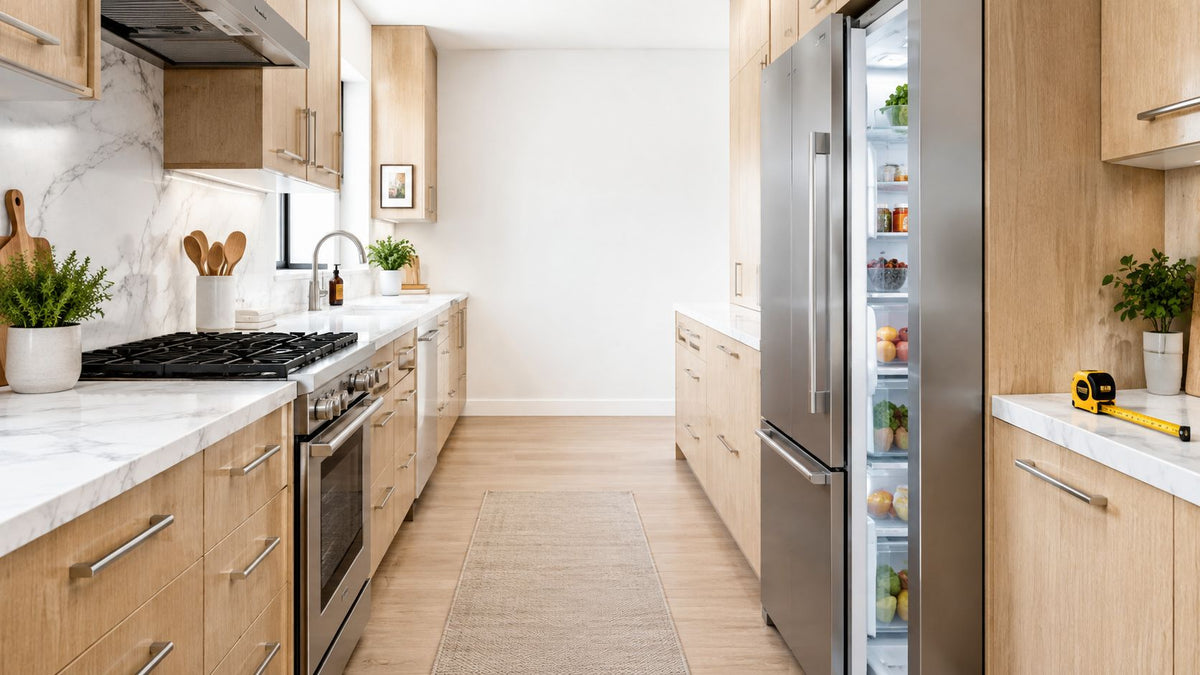
You've measured the opening, checked the cabinet colour, and found a refrigerator that looks perfect online. Then it arrives, and the doors extend into the walkway, the handle catches the adjacent drawer, and the appliance sits noticeably past the cabinet line. The problem usually isn't the refrigerator's finish or features. It's the difference between a cabinet-depth body, a door, a handle, and the hinge space needed to use all three.
A countertop depth fridge can improve that situation, but “counter-depth” isn't one precise installation category. A true built-in, a zero-clearance freestanding model, and a shallower cabinet-depth refrigerator can all create a cleaner profile, yet they change your measurements and your expectations in different ways. The right choice depends on your cabinets, walkway, storage habits, and whether you're renovating, renting, or working with an existing opening.
Table of Contents
- When the Fridge Starts to Dictate the Kitchen
- What Countertop Depth Really Means
- Counter-Depth Fridge vs Standard Fridge
- Measuring Your Kitchen Before You Order
- Capacity, Footprint, and Energy Tradeoffs
- Matching the Right Model to Your Space
- Buying and Specification Checklist
When the Fridge Starts to Dictate the Kitchen
The trouble often appears after the refrigerator is installed, not while you're standing in the showroom. In a narrow galley kitchen, a standard-depth fridge can project well beyond the cabinet fronts. The walkway feels pinched, the view from the sink to the cooktop is interrupted, and an open refrigerator door leaves little room for someone to pass.
The smaller frustrations add up. A crisper drawer may hit the handle of a nearby cabinet. The freezer door may stop short of opening fully. A counter edge that once looked tidy now seems to collide with the appliance, even though the refrigerator technically fits the opening.
The shallow profile is only the beginning
A shallower refrigerator body can bring the appliance closer to the cabinet line, which may make the kitchen feel more open and easier to move through. It can also improve sightlines in an open-plan room, where a deep stainless-steel box becomes part of the visual centre of the kitchen.
But the body is only one part of the measurement. Doors and handles still project forward, and hinges can determine whether the door swings into the next cabinet or stays within the intended opening path. A model that looks flush when closed may still create a poor working area when the right door is open.
Practical rule: If the problem happens while the refrigerator is being used, measure the open-door position, not just the closed cabinet line.
The useful question isn't just, “Do I need a counter-depth fridge?” Ask instead: Do I need a true built-in fit, a zero-clearance hinge, or a shallower freestanding cabinet? A new kitchen with planned panels may support a different solution from a rental where the existing cabinet opening must remain untouched.
That distinction shapes everything that follows. You'll need to compare the actual depth of the cabinet, doors, and handles, then check how the hinge behaves beside a wall or cabinet. You'll also need to decide whether giving up some internal depth is worthwhile for a clearer walkway and a more organised visual line.
What Countertop Depth Really Means
In kitchen planning, counter-depth usually describes a refrigerator designed to sit close to a standard base-cabinet run. Canadian guidance generally places the refrigerator body around 24 to 25 inches deep before doors and handles, with total installed depth commonly under 30 inches. The exact fit depends on the model and the clearances required by its doors and ventilation system, as explained in this Canadian counter-depth dimension guide.
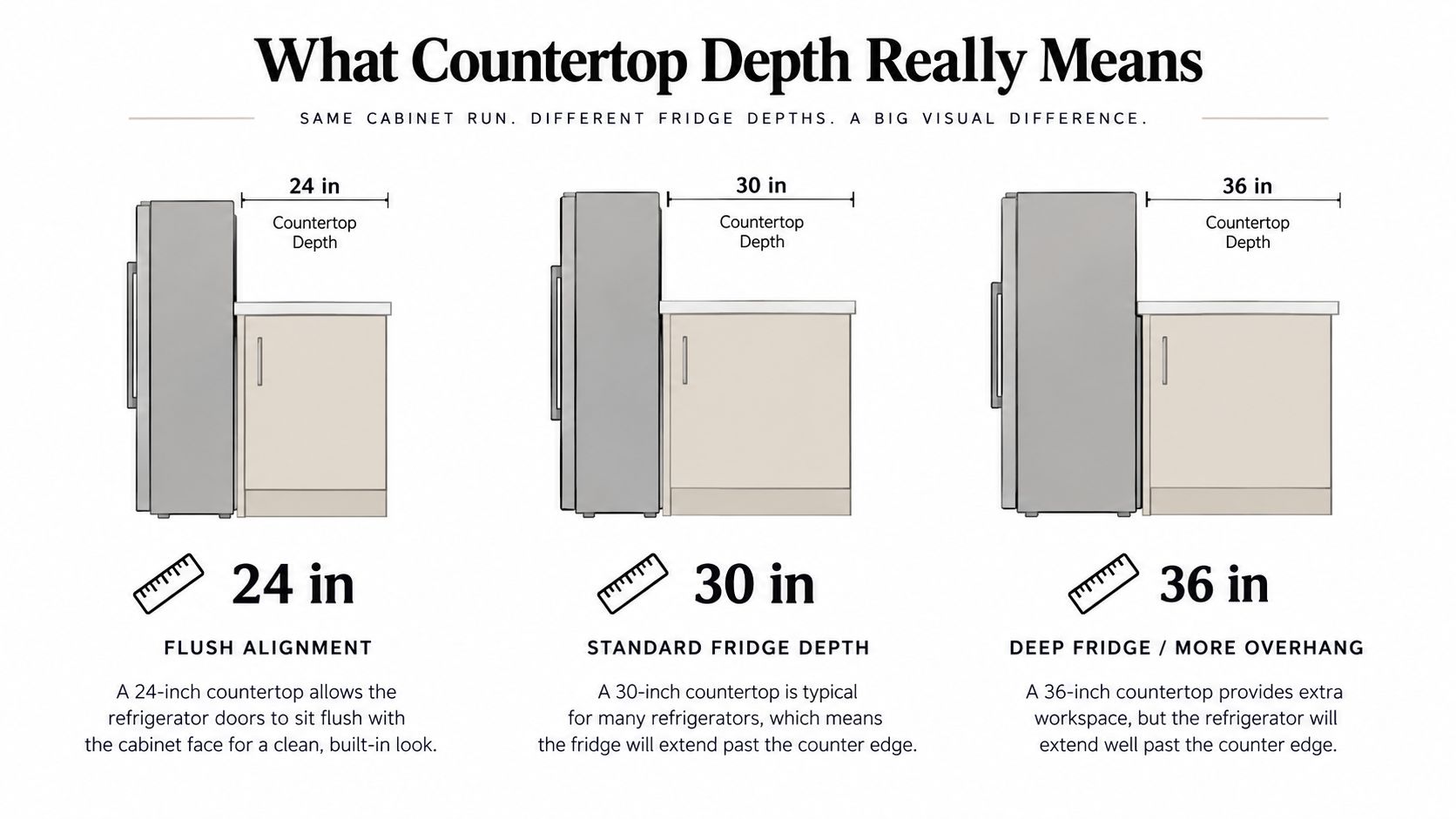
The phrase describes a freestanding category, not automatically a fully integrated appliance. A counter-depth refrigerator may have finished side panels, exposed doors, and a conventional plug. It aims to mimic the sightline of built-in cabinetry without requiring the custom enclosure that a true built-in refrigerator needs.
Place your current appliance into the right category
Start with these four categories:
- Standard-depth refrigerator: A full-depth freestanding unit that commonly extends well past the counter and cabinet fronts. It prioritises interior volume and may suit a roomy kitchen or an existing deep alcove.
- Counter-depth refrigerator: A shallower freestanding model intended to reduce the cabinet overhang. Its doors and handles may still sit forward of the counter, so the product label isn't a guarantee of flush installation.
- True built-in refrigerator: A purpose-designed appliance installed into cabinetry, often with a more integrated appearance and a fixed enclosure. It requires more detailed planning than a freestanding replacement.
- Compact refrigerator: A smaller appliance category, not just a shallow full-size fridge. California's air-resources definition separates compact refrigerators from built-in household refrigerators at 7.75 cubic feet, or 220 litres, of total refrigerated volume. The same rule defines a built-in household refrigerator as having at least that volume and a depth of 24 inches or less, excluding doors, handles, and custom front panels. See the California household refrigerator definition for the regulatory distinction.
A compact or apartment refrigerator may fit a tight space, but it can change how you shop and store food. A counter-depth full-size model is usually chosen when the household wants a more refined cabinet line without giving up the basic layout of a full kitchen refrigerator.
Measure your existing unit from the back wall to the front of the cabinet body, then repeat the measurement to the front of the doors and handles. That quick comparison usually reveals whether your kitchen assumes a standard-depth appliance or whether it was planned around a shallower profile.
Counter-Depth Fridge vs Standard Fridge
A refrigerator can look close to the cabinets and still project farther than expected. The cabinet body, doors, handles, hinges, and ventilation space each occupy a different part of the kitchen. Compare those measurements before deciding that one depth category automatically suits your room.
A counter-depth refrigerator usually keeps its cabinet body nearer to the cabinet line. A standard-depth refrigerator extends farther into the room, but often provides more front-to-back storage. The practical choice depends on whether your kitchen benefits more from open circulation or additional interior capacity.
Canadian specifications show why the word “depth” needs a measurement label. One Samsung Canada model lists 24 inches without the door and 28.75 inches with the handle. Check the model's specification sheet for those figures. An LG Canada model lists 24 3/4 inches without the doors and 27 1/2 inches overall, according to the LG Canada refrigerator specification. The comparison is useful because the cabinet depth alone does not describe the installed footprint.
| Specification | Counter-Depth | Standard-Depth |
|---|---|---|
| Main cabinet profile | Sits closer to the cabinet line | Extends farther beyond the cabinet line |
| Doors and handles | Still add front projection | Add projection to a deeper cabinet |
| Interior volume | Usually gives up some front-to-back space | Generally offers more depth for storage |
| Kitchen effect | Cleaner sightline and potentially easier movement | More capacity where the room can absorb the overhang |
| Best fit | Galley kitchens, open-plan walls, and tight circulation areas | Spacious kitchens, deep alcoves, garages, or households prioritising volume |
Counter-depth is not one precise installation style. A shallow freestanding cabinet may only reduce projection. A model with a zero-clearance hinge design may work closer to a side wall because its door movement needs less additional space. A true built-in fit involves cabinetry, enclosure, and ventilation planning that a freestanding replacement may not require. These choices change the measurements you make around the appliance, even when the product label sounds similar.
The Canadian market includes counter-depth models with zero-clearance hinge designs and capacities reaching 24 to 25.1 cubic feet, according to the LG Canada counter-depth model page. Wider or taller cabinets can recover some usable capacity, but hinge clearance and cabinet height still need checking.
Let the kitchen decide
Choose standard depth when the refrigerator sits in a deep alcove, the walkway remains comfortable, or your household regularly needs more internal room. It can also suit a garage or secondary food-storage area, where cabinet alignment matters less than capacity.
Choose counter-depth when the refrigerator sits in the main circulation zone. A shallower box can preserve a sightline and make the room feel less crowded. A 36-inch refrigerator comparison can help when width, door layout, and capacity must be assessed together.
Storage needs depend on the items you use. A shallow shelf can make smaller containers easier to see, while a deeper model may hold larger quantities without stacking. For a household that prepares large meals, compare the shelf width with the largest platter or sheet pan you own. The All-Clad HA1 Double Burner Grill Pan – 13×20-Inch Nonstick illustrates why oversized cookware may belong in a cabinet or pantry rather than on a refrigerator shelf.
The decision is about how the available space works. Deeper storage may serve a high-volume household better, while a shallower cabinet can improve movement and keep the refrigerator closer to the kitchen's visual line.
Measuring Your Kitchen Before You Order
A refrigerator can fit the cabinet opening and still fail the kitchen test. The common mistake is measuring the empty space but not the path created when the door opens, especially in a galley kitchen or beside a wall.
Begin with the rough-in location and record the measurements in a notebook. Take the width at the top, middle, and bottom because walls and cabinets can vary. Use the narrowest usable measurement when comparing it with the manufacturer's required opening.
Record the complete appliance envelope
Measure:
- Width: Include the space needed for side panels, hinge movement, and ventilation. If the refrigerator will sit between finished panels, measure between the panels rather than assuming the cabinet opening is perfectly square.
- Height: Measure from the finished floor to the underside of the cabinet, soffit, or other obstruction. Check both sides of the opening. A refrigerator that is taller than the opening can't be corrected by shifting it forward.
- Depth: Record the distance from the back wall to the cabinet or counter front. Then check the manufacturer's depth with doors and with handles. The body may align neatly while the handle extends into the walkway.
- Door swing: Open each door to its intended position and note what it hits. A zero-clearance hinge can let the door swing without projecting as far past the side of the cabinet, which is particularly valuable near a wall or in a narrow passage.
- Ventilation and services: Follow the model's installation instructions for air space behind and above the unit. Confirm that the electrical outlet is reachable without an extension cord, and check the water connection if the ice maker or dispenser requires one.
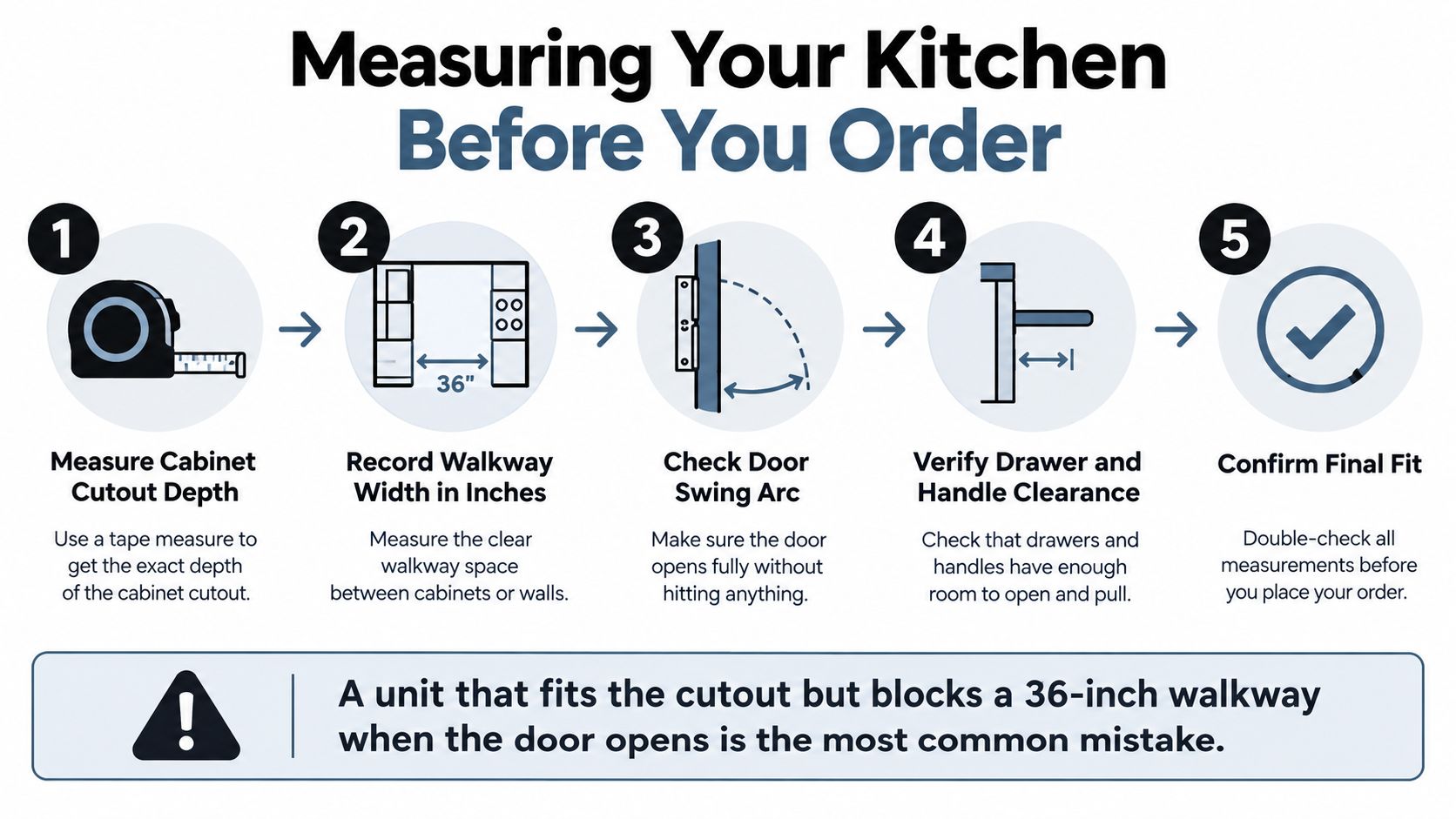
The kitchen appliance dimensions guide can help you organise these measurements before comparing products. Treat the manufacturer's installation diagram as the final authority because hinge clearance, rear airflow, and door-opening requirements vary between models.
Test the open-door position
Stand in the walkway while another person opens the refrigerator door. Can you pass without turning sideways? Does the open door block the sink, cooktop, or an adjacent drawer? Does the freezer drawer have room to extend without striking the island?
Delivery access deserves the same attention. Measure the entrance door, hallway turns, stair corners, and elevator opening if applicable. A refrigerator may be narrow enough for the kitchen but too tall or wide to turn through the front entrance.
A cardboard template can make the final check more realistic. Mark the appliance's cabinet body on the floor, then extend the outline to represent the doors and handles. Open the template area with painter's tape and walk through the kitchen before placing the order.
Capacity, Footprint, and Energy Tradeoffs
Depth changes more than the appearance of a refrigerator. It changes how far shelves extend, where large containers fit, and how much food can be grouped without stacking. A counter-depth model may make everyday items easier to see because the contents aren't buried as far back, but households that buy in bulk may notice the reduced internal room quickly.
Energy use also belongs in the comparison. ENERGY STAR's refrigerator guidance says certified refrigerators are about 9% more energy efficient than models that only meet the federal minimum standard. It also notes that refrigerator size affects energy use, with the most efficient models typically in the 16 to 20 cubic-foot range, and that top-freezer configurations generally use the least energy among common layouts.
| Configuration | Width Range | Depth Range | Typical Capacity | Est. Annual kWh |
|---|---|---|---|---|
| Counter-depth | Varies by model, often wider to recover storage | About 24 to 25 inches before doors and handles in Canadian guidance | Reduced front-to-back room, with newer models reaching 24 to 25.1 cubic feet | Compare the model's certified energy label |
| Standard-depth | Varies by model and configuration | Deeper cabinet with greater front projection | More internal depth where the kitchen can accommodate it | Compare the model's certified energy label |
| Built-in | Designed around a specific cabinet installation | Cabinet-aligned body, with model-specific requirements | Depends on the appliance design | Compare certification and size together |
A California-focused consumer estimate illustrates how local electricity costs can change the decision. At an electricity benchmark of 34.7 cents per kWh, the cited guidance estimates annual refrigerator operating costs of about $591 for older models versus $174 for new ENERGY STAR models, a difference of roughly $417 per year in that rate environment. Those figures come from California refrigerator operating-cost guidance, so they shouldn't be treated as a universal tariff calculation.
Count usable storage, not marketing language
Open the doors in a showroom and inspect the shelves. Can a wide platter sit flat? Are the crisper drawers deep enough for your routine? Does the door storage accept the bottles and cartons you buy?
A taller or wider counter-depth cabinet can recover some capacity, but it doesn't make the front-to-back trade-off disappear. Use the energy label and the manufacturer's usable capacity together, then compare that information with your shopping habits. For a broader look at efficient kitchen choices, review this guide to eco-friendly kitchen appliances.
Matching the Right Model to Your Space
Three kitchens can use the same phrase, “counter-depth,” and need three different refrigerator designs. The hinge, cabinet style, and delivery path often matter more than the label on the showroom tag.
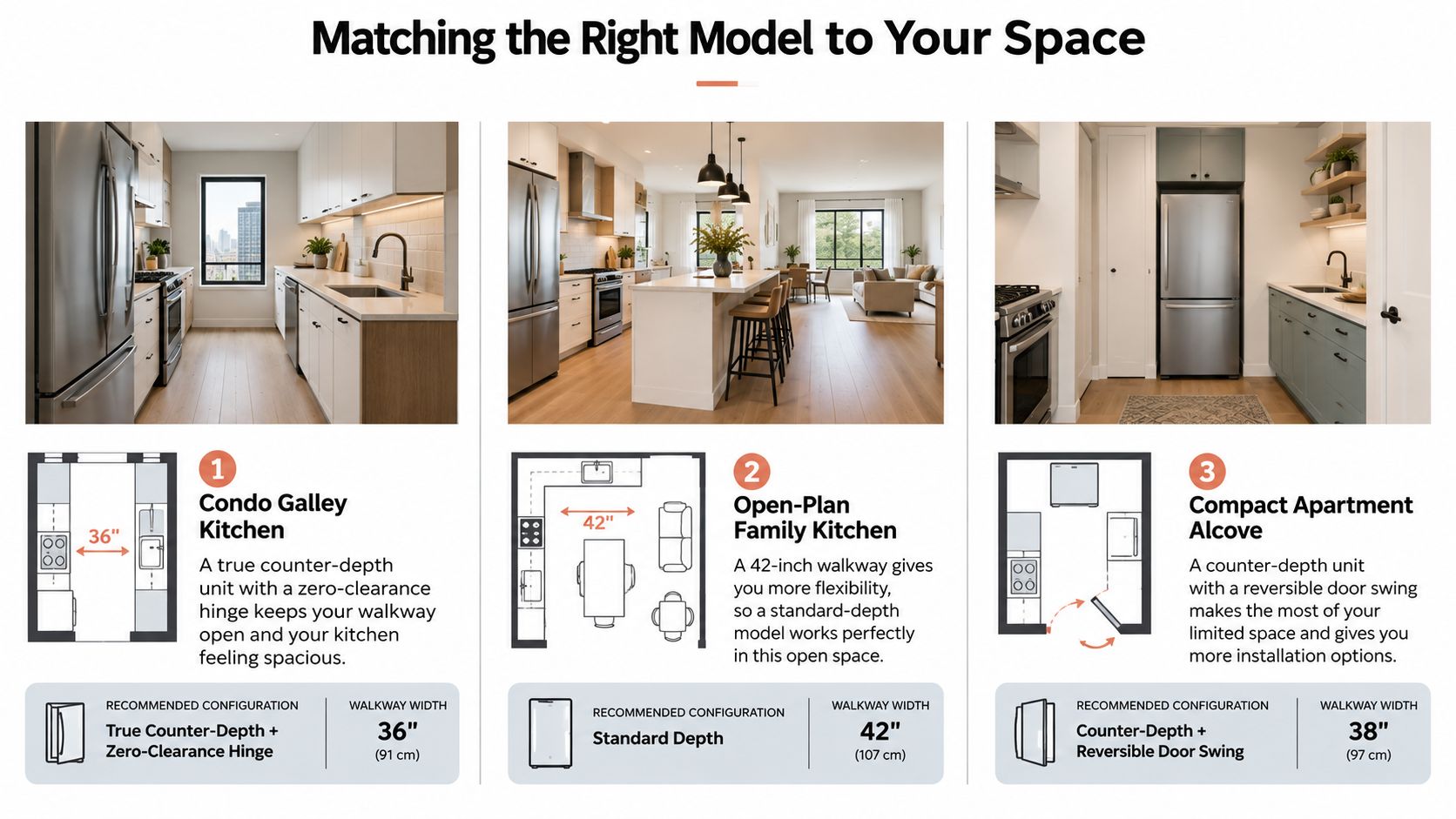
The condo galley
A condo galley kitchen has little tolerance for a door that swings into the passage. If the refrigerator sits beside a wall or opposing counter, look for a true counter-depth body with zero-clearance hinges. The goal isn't merely to bring the closed doors closer to the counter. The hinge should allow the door to open without demanding extra side space that the walkway can't provide.
Check the hinge side, handle projection, and the width of the open-door arc. A model with a reversible door can help in some compact layouts, but only if the manufacturer permits the reversal and the new swing works with nearby cabinets. Confirm all of this before delivery, not after the unit is in the room.
The family renovation
A family kitchen with a generous island has more flexibility. A counter-depth French-door model can keep the refrigerator aligned with surrounding cabinetry while giving the room a broad, organised front. The split upper doors also reduce the swing width compared with one large door, although the drawers and handles still need a clear path.
This is the point where storage planning matters. Measure the platters, trays, and produce containers you use. A wider cabinet may recover usable room, while adjustable shelves and a full-width drawer can be more valuable than a deep, narrow compartment. Review ideas for the best kitchen appliances for small spaces even in a larger renovation, because the same principles of access and circulation still apply.
The rental or short-term home
A renter usually needs a shallower freestanding cabinet-depth refrigerator, not a built-in appliance. Choose a model that uses the existing electrical outlet, doesn't depend on custom panels, and can be removed without drilling into stone or altering the millwork.
Measure the rental's doorway and delivery route before choosing a taller or wider design. Keep the finish practical as well. A conventional stainless front or another readily replaceable exterior is easier to move between homes than a panel-ready unit that depends on one specific cabinet design.
The most reliable match connects the room to the specification. A condo needs hinge and walkway discipline. A renovation can prioritise cabinet alignment and storage organisation. A rental needs reversibility, ordinary connections, and a delivery path that won't require permanent changes.
Buying and Specification Checklist
Use the product specification sheet as an installation document, not just a list of features. The model name may say “counter-depth,” but the detailed drawing tells you whether the doors, handles, hinges, and ventilation requirements suit your kitchen.
Check the working geometry
- Hinge type: Confirm whether the model uses a standard hinge, a restricted-opening hinge, or a zero-clearance design. Ask what happens beside a wall and whether the door must open beyond a particular angle for the drawers to pull out.
- Handle projection: Measure from the cabinet body to the furthest point of the handle. This is the dimension that affects a narrow walkway after installation.
- Shelf layout: Look for split shelves, adjustable shelves, and storage that suits your containers. A shallow refrigerator can still waste space if the shelves don't accommodate the food you buy.
- Drawer depth: Check whether wide platters, sheet pans, and produce bins fit without forcing the door open farther than the kitchen allows.
- Finish and panels: Decide between a stainless front, another finished door, or a panel-ready model. Confirm that any required panel is compatible with the surrounding cabinet design.
- Warranty coverage: Read the warranty terms for the sealed system and major components. Record what the manufacturer covers and who handles service in your area.
Confirm the installation details
Electrical and water requirements should be checked against the actual kitchen, not assumed from the old refrigerator. Confirm the required outlet location, the circuit instructions, and the shutoff arrangement for an ice maker or water dispenser. If the outlet sits behind the appliance, make sure the plug remains reachable as specified by the installation instructions.
Delivery planning deserves a written check. Measure the entry door, the tightest hallway point, the turn at the stairs, and the elevator opening if one is involved. Ask the retailer whether the delivery team removes doors, and confirm whether the finished refrigerator can be reassembled without affecting the warranty.
For a broader purchasing framework, use this kitchen appliance buying guide while you compare models. GrifGlo also groups home and kitchen products into practical categories and provides sizing and comparison guidance for everyday purchasing, which can be useful when you're coordinating a refrigerator with storage and cooking equipment.
Run the final check before payment
Set aside fifteen minutes and write down these details for the exact model:
- opening width at its narrowest point
- height to the lowest obstruction
- cabinet-body depth
- depth with doors
- depth with handles
- hinge side and door swing
- ventilation requirements
- outlet and water-line location
- delivery path from entrance to kitchen
If one measurement is missing, don't rely on an estimate. Ask the retailer or manufacturer for the installation drawing. A counter-depth refrigerator earns its place in the kitchen only when the closed profile, open-door movement, storage layout, and service connections all work together.
GrifGlo offers decision-friendly guides and organised product categories for shoppers comparing kitchen appliances, cookware, and home essentials. Visit GrifGlo with your measurements in hand to compare practical options and plan a refrigerator purchase around the way your kitchen works.


Leave a comment
This site is protected by hCaptcha and the hCaptcha Privacy Policy and Terms of Service apply.