

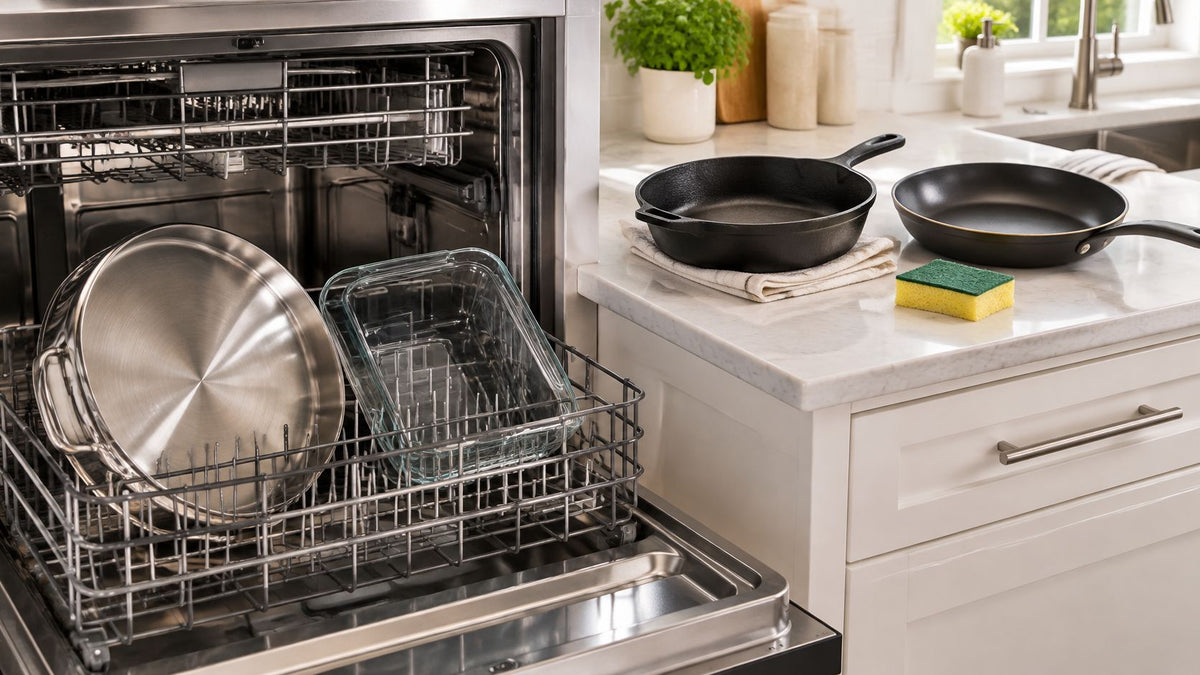
Dinner's finished, the dishwasher has room, and you're holding a greasy pan wondering whether loading it will save effort or damage the finish.
Table of Contents
- Dishwasher Safe Cookware Compatibility by Material
- What the Dishwasher Label and Markings Really Mean
- Why the Dishwasher Wears Some Materials Faster
- Pros and Cons of Machine Washing Your Pans
- How to Prep and Load Cookware for the Dishwasher
- Fixing Stains, Discoloration and Warped Pans
- Choose Dishwasher Safe Cookware for Your Kitchen
Dishwasher Safe Cookware Compatibility by Material
Dishwasher rating and main risk by cookware material
| Material | Typical rating | Main risk in the machine | Best practice |
|---|---|---|---|
| Stainless steel (fully clad) | Usually yes | Water spots, heat tint, mineral film | Use rinse aid and a gentle cycle |
| Nonstick (PTFE) | Check the label | Coating wear from heat and detergent | Hand wash for longer life; use the gentlest approved cycle if machine washing |
| Ceramic-coated nonstick | Check the label | Coating dulls and loses slickness faster | Hand wash with a soft sponge |
| Bare cast iron | No | Rust and stripped seasoning | Hand wash, dry on the stove, then oil lightly |
| Enameled cast iron | Check the label | Chips, dull glaze, thermal shock | Cool before loading and follow the care sheet |
| Copper (unlined) | No | Tarnish and dull finish | Hand wash with a mild cleanser |
| Anodized or uncoated aluminum | Usually no | Darkening and pitting from alkaline detergent | Hand wash with a soft cleaner |
| Tempered glass bakeware | Usually yes | Thermal shock and cloudiness | Let cool before washing; avoid cold water on hot glass |
Use these ratings as a starting point, not permission for every pan. Fully clad stainless steel and tempered glass are generally the easiest materials to accommodate in a machine-washing routine, provided their individual care instructions allow it.
Coated cookware needs closer inspection. With PTFE nonstick, ceramic-coated pans and enameled cast iron, the cooking surface or exterior finish can be more vulnerable than the body underneath. Ceramic-coated nonstick also isn't the same thing as a solid ceramic baking dish.
Read the whole construction
A stainless pan might have an exposed aluminum rim, a bonded base or a handle with its own cleaning restriction. Likewise, a glass dish's lid may need different treatment from the dish itself.
Bare cast iron, unlined copper and most aluminum cookware belong in the hand-washing group unless the manufacturer explicitly says otherwise. For a closer distinction between treated and untreated aluminum, our anodized aluminum cookware guide explains what the surface treatment changes.
Practical rule: Match the dishwasher rating to the exact product, not just the material named on the box.
A pan that remains usable after a cycle hasn't necessarily retained its original appearance or release performance. Brand, construction and handle design all affect the result, so the product's own care wording takes priority over any general compatibility chart.
What the Dishwasher Label and Markings Really Mean
Dishwasher safe is a manufacturer's care instruction, not, by itself, proof of independent certification or unlimited resistance to machine washing. A symbol may approve the pan body while a separate instruction excludes the lid, detachable handle or seal.
Dishwasher markings and what each one means
| Marking | What it tells you | What to do |
|---|---|---|
| Dishwasher-safe symbol | Maker approves machine washing for listed parts | Confirm which components it covers |
| Hand wash only | Machine washing falls outside the maker's care promise | Hand wash every time |
| Top rack only | Bottom-rack exposure may exceed the component's limit | Load on the top rack |
| Do not use abrasive cleaners | The finish needs protection from scratching | Use a soft sponge and non-abrasive detergent |
| Temperature or cycle limit | Approval applies within stated conditions | Choose an approved cycle |
| Chemical disclosure (California) | Identifies intentionally added designated-list chemicals in relevant surfaces or handles | Check the label and online disclosure separately |
Find the complete instructions in the packaging insert or the manufacturer's product page under Care and Use. A model number stamped on the base helps distinguish similar-looking product lines.
Ask these questions before buying:
- Explicit approval: Does the manufacturer name dishwasher use?
- Component coverage: Does approval include the handle, lid knob, seals and cooking surface?
- Limits and warranty: Are particular cycles excluded, or does machine washing affect warranty coverage?
A dishwasher-safe label confirms suitability under stated conditions, not that the pan will keep its finish for years.
California disclosure is a separate check
Check the use and care instructions for the exact pan, including any separate instructions for lids, handles and coatings.
PTFE is a fluoropolymer within the PFAS family, and a dishwasher rating doesn't establish that a coating is PFAS-free, as the BCLP cookware regulation overview explains. Look for a defined chemical claim rather than assuming that cleaning compatibility answers a composition question.
Save the model, material and care statement before discarding the packaging. Keep appliance permissions separate too: how to tell if a pan is oven safe involves different limits.
Why the Dishwasher Wears Some Materials Faster
A dishwasher exposes cookware to a combination that a quick sink wash usually doesn't: sustained heat, alkaline detergent, prolonged wetting and moving water. The result isn't always immediate damage. More often, repeated exposure changes the surface gradually.
Heat and detergent act together
Hot wash water loosens grease, while drying adds further heat exposure. Different parts expand and contract as temperatures change, which can stress bonded joints, handle attachments and interfaces between materials.
Alkaline detergent helps remove food, but it can also react with susceptible metal surfaces. Uncoated aluminum may develop a dark or chalky appearance, and more severe attack can leave pits rather than a removable film.
Nonstick coatings don't all respond identically. Their formulation, condition and manufacturer-approved care determine how well they tolerate repeated washing. A pan may still look intact while releasing eggs less easily than it once did.
Consider identical coated pans used in different routines. One goes through machine washing after every meal; the other gets a soft-sponge wash once cool. Their surfaces receive different chemical and heat exposure, so you shouldn't assume their useful coating life will be identical.
Water, minerals and physical contact
Water introduces another set of problems:
- Mineral deposits: Dissolved minerals can remain on stainless steel or glass after droplets dry.
- Damp iron: Bare cast iron can rust when moisture remains on an unprotected surface.
- Metal reactions: Copper can tarnish, while vulnerable aluminum surfaces may discolour.
- Rack contact: A pan touching a knife, lid or neighbouring pot can get scratched or chipped during washing.
Seasoning needs particular care. It's a maintained layer on bare iron, not a factory-applied enamel coating, and harsh cleaning can remove it. Our cast iron cookware care guide covers the separate cleaning routine that surface needs.
Spray pressure isn't a reason to fear every dishwasher cycle. The more avoidable problem is loading cookware so pieces knock or rub together, particularly where enamel edges and coated interiors meet metal utensils.
Water alone isn't the whole explanation. Detergent chemistry, temperature, exposure time and contact all matter. A gentler approved cycle reduces some stresses, while rinse aid helps droplets drain and limits spotting; neither makes an unsuitable pan dishwasher compatible.
Pros and Cons of Machine Washing Your Pans
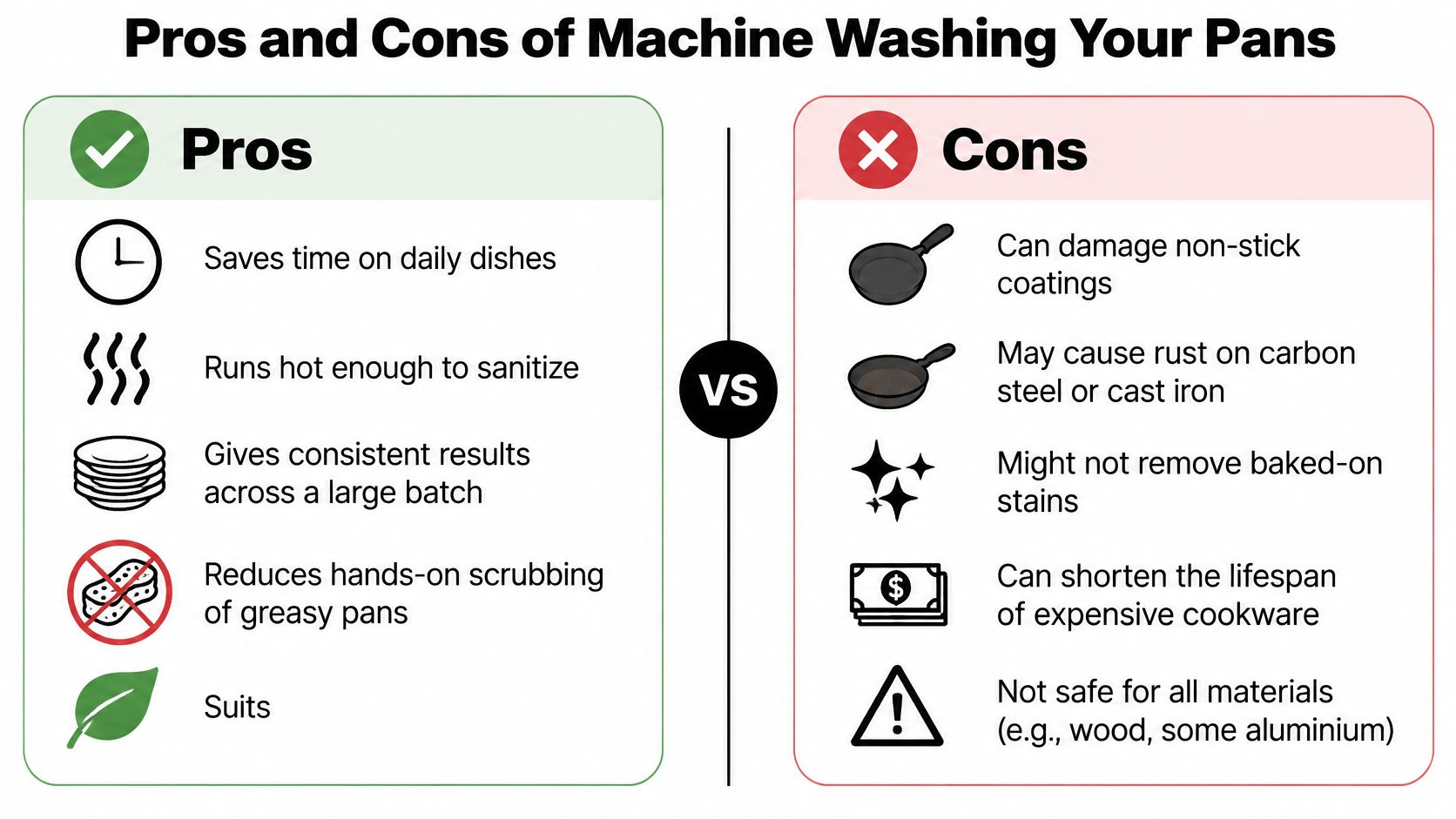
Machine washing is most useful when it replaces a substantial amount of hands-on cleaning. A full rack of compatible cookware, plates and utensils can simplify the evening routine without asking you to scrub every greasy surface.
This comparison summarises the practical trade-offs.
Convenience versus finish longevity
For compatible stainless steel and glass, the machine offers consistent cleaning with less handling. A dishwasher with an appropriate sanitizing programme can also support hygiene, but an ordinary wash shouldn't automatically be described as sanitizing.
Hand washing gives you closer control over coated or decorative surfaces. You can stop when grease is removed instead of exposing an already-clean pan to the rest of a wash and dry programme.
The stainless steel versus nonstick cookware comparison is useful when cleaning habits matter as much as cooking performance. A pan that fits your routine is often a better choice than one whose care requirements you'll regularly ignore.
Compare realistic loads
Water and energy use depend on your dishwasher, programme and load. Follow the appliance manual and run a full load when practical.
- Full compatible load: Spreads the cycle's resource use across many items.
- Mostly empty machine: May be difficult to justify for an easily cleaned pan.
- Controlled sink wash: A basin or briefly running tap avoids leaving hot water flowing throughout scrubbing.
For a hospitality team, accumulated labour savings can favour documented dishwasher-compatible stainless cookware. Commercial operations must still follow their applicable cleaning and sanitizing procedures rather than treating a household care rating as sufficient.
The following video offers additional visual context for cookware-cleaning decisions.
How to Prep and Load Cookware for the Dishwasher
Good preparation improves cleaning without demanding a hotter programme or extra detergent. Start with cookware that has explicit machine-washing approval, then match the loading method to its shape and components.
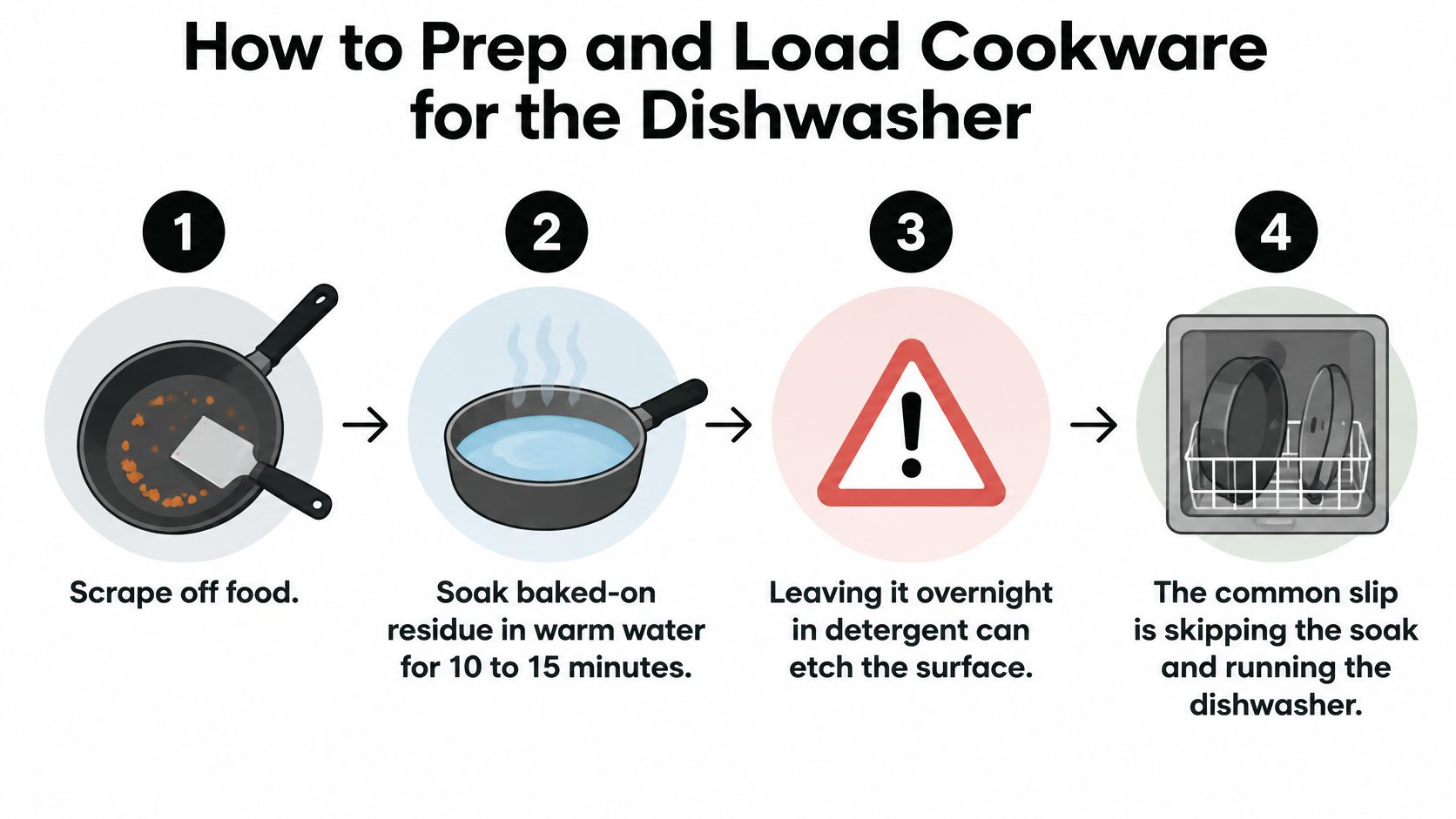
Use this visual as a preparation reminder, while following the product-specific instructions for soaking and loading.
Prepare the surface and components
- Scrape food into the bin. Use a silicone scraper or wooden utensil to remove loose food, then briefly soak stubborn residue in warm water if the care sheet permits it. Don't expect a hardened layer of baked-on sauce to disappear because you choose a more aggressive cycle.
- Remove detachable parts and sort them by their individual instructions. Lids, removable handles, silicone seals and pressure-cooker gaskets may need separate cleaning; don't assume the pan body's approval covers everything attached to it.
- Let the cookware cool before adding water. Abrupt temperature changes can damage glass and enamel or distort a metal base. The common mistake is moving a hot pan straight from the burner into a cold rinse.
Leave room for water to reach the pan
- Position approved pans securely, with dirty interiors facing the spray and openings angled so water drains. Use the rack specified by the manufacturer, check spray-arm clearance and keep long handles from blocking the detergent dispenser.
- Don't nest pans during washing. Overlapping pieces trap residue and shield surfaces from detergent and water. Protective separators belong in storage unless specifically designed and approved for dishwasher use, not between pans that need cleaning.
- Choose a gentle or eco programme only when it meets both the cookware's care limits and the cleaning task. Measure detergent using the package guidance and local water-hardness instructions; more detergent isn't a substitute for removing baked-on food, and eco doesn't necessarily mean the shortest programme.
- Use rinse aid where appropriate. Follow the dishwasher's dosing instructions to improve drainage and reduce spots on stainless steel and glass. Don't pour extra into the wash compartment or treat it as a cleaner for an existing mineral coating.
- Allow cookware to become safe to handle, then inspect and dry it before storage. Skip heated drying when the care instructions recommend reducing heat exposure, and don't leave pooled water around rims, handle joints or exposed metal edges.
Before putting the pan away: Check the interior, underside and handle connections, not just the cooking surface.
A finished load should leave cookware free of food, greasy patches and loose residue. If you see haze or feel stickiness, identify the cause before repeating the same wash programme.
Fixing Stains, Discoloration and Warped Pans
A cloudy white film on stainless steel or glass often comes from hard-water minerals or detergent residue. Before assuming the finish has failed, wash a small area gently and check whether the haze lifts.
Symptom, likely cause and fix for dishwasher damage
| Symptom | Likely cause | Fix |
|---|---|---|
| Cloudy film on stainless or glass | Hard-water minerals or detergent residue | Try diluted white vinegar if permitted, rinse thoroughly and check rinse-aid settings |
| Sticky or dull nonstick | Food or detergent film, or coating wear | Wash with mild soap and a soft sponge; replace if the coating is damaged or sticking persists |
| Dark, chalky aluminum | Alkaline detergent attack | Use a manufacturer-approved aluminum cleaner; avoid further machine washing |
| Rust spots on cast iron | Damp storage or machine washing | Remove rust, dry thoroughly and restore seasoning |
| Chipped or dull enamel | Impact, thermal stress or abrasion | Stop using pieces with chipped food-contact enamel; gently clean intact dull surfaces |
| Rocking or warped base | Overheating or abrupt temperature changes | Test on a flat surface; replace if unstable or unsuitable for the hob |
| Loose handle | Loose fasteners or a damaged attachment | Tighten accessible screws as instructed; repair or replace if movement remains |
Distinguish residue from lost material
Mineral film sits on the surface, so a suitable mild acid can sometimes remove it. Permanent glass etching, pitted aluminum and missing coating aren't deposits, so stronger scrubbing won't restore them.
For nonstick interiors, avoid abrasive pastes unless the manufacturer explicitly approves them. A tacky layer of cooked-on oil needs gentle degreasing, not an attempt to polish the coating back into smoothness.
Our guide to cleaning burnt pots and pans helps separate food removal from surface repair. Keep acid cleaners away from bare cast iron unless you're deliberately removing rust before re-seasoning, and never mix cleaning chemicals.
Check stability before cooking again
Place the cool, empty pan on a clean, known-flat surface and press gently around its rim. Unexpected rocking or a visible gap may indicate distortion, although some bases have an intentional profile that changes during heating.
A small irregularity may be less noticeable over a gas flame than on a flat electric or induction hob. Instability still matters on any cooker, especially when a pan contains hot oil or liquid.
Don't hammer a base flat or tighten a rivet with improvised tools. Accessible screws can sometimes be adjusted, but a damaged riveted joint needs manufacturer-approved repair or replacement.
Cosmetic deposits may lift during cleaning; restoring cast iron seasoning requires a separate process. Neither has a universal recovery deadline. Many stains are reversible, but warping, pitting and coating loss usually aren't.
Choose Dishwasher Safe Cookware for Your Kitchen
Dishwasher safe cookware choices by buyer type
| Buyer | Priority | Look for | Avoid |
|---|---|---|---|
| Household home cook | Easy daily cleaning | Fully clad stainless and tempered glass bakeware | Bare cast iron in the machine |
| Renter | Light weight and low replacement cost | Stainless with a clear care sheet and a budget nonstick pan | Premium coated pans that are costly to replace |
| Small business or hospitality | Sanitizing and volume | Stainless with a documented dishwasher rating and spare stock | Mixed coatings on a heavy-cycle rack |
| Property manager | Consistent setup across units | A consistent material family, brand and care card | Mixed materials with conflicting care needs |
For daily household cooking, build the core set around the cleaning routine you'll maintain. Keep specialty cookware for tasks that justify its extra care rather than expecting every piece to follow the same routine.
Renters should also test weight and storage fit before buying. A manageable saucepan with readable instructions is more useful than a heavy matching set that crowds the cupboard.
Standardise the care routine
In shared kitchens, keep a list of cookware approved for the machine and note which pieces require hand washing.
Property managers can reduce guesswork with a care card beside the dishwasher. Name the pieces that belong in the machine and identify anything that must be washed separately.
Before buying, check the exact care statement, record the model and material, and choose a consistent material family for your main pans. Photograph the instructions so you can retrieve them when a lid, handle or finish needs attention.
Our Kitchen collection includes Cookware alongside Kitchen Appliances, Food Storage, Cutting Boards and other practical kitchen categories. Visit GrifGlo to browse cookware and decision-friendly guides, then compare each shortlisted item's care notes before choosing pans for your dishwasher routine.

Leave a comment
This site is protected by hCaptcha and the hCaptcha Privacy Policy and Terms of Service apply.