

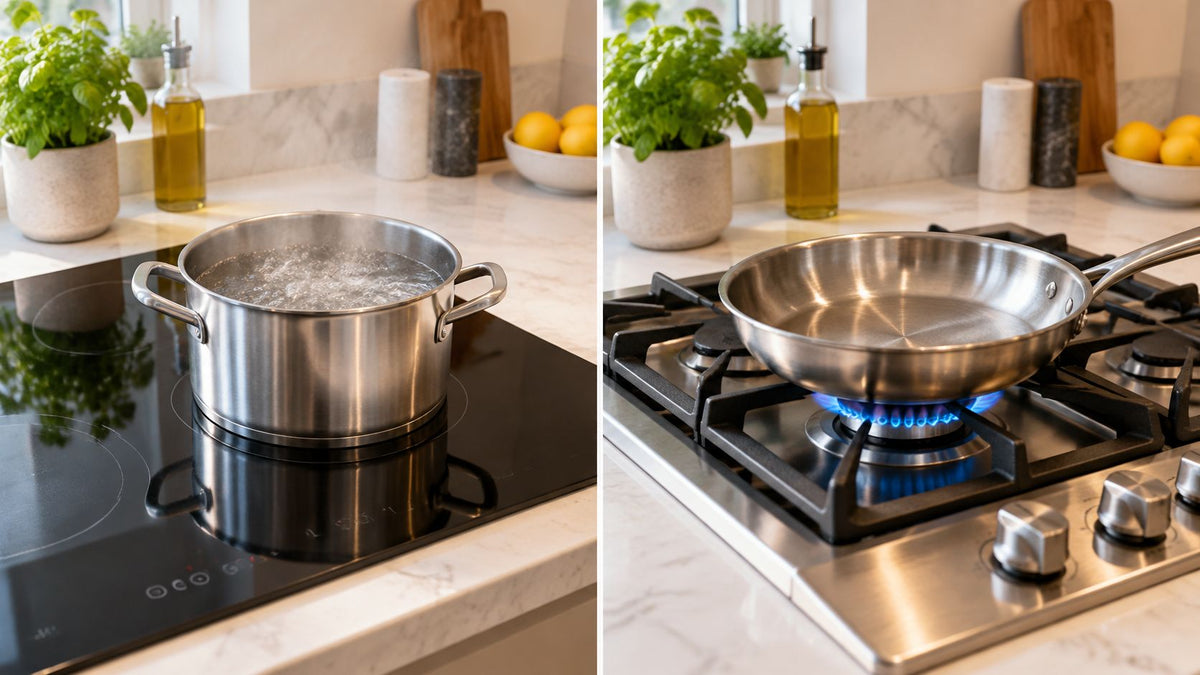
Induction and gas differ in installation, cookware compatibility, cleaning and combustion at the cooking surface. For a planned Canadian kitchen upgrade, compare those practical differences before choosing by burner power alone.
Induction is a strong option when the electrical installation is practical and you want a smooth surface without an open flame. Gas may suit an existing installation or techniques that rely on flame. The right answer depends on your cooking, ventilation, local utility rates and installed cost.
Induction and Gas Cooktops Compared at a Glance
| Criterion | Induction | Gas |
|---|---|---|
| Heat source | Electromagnetic field heats the pan base directly | Open flame heats the pan and surrounding air |
| Boil time for one litre of water | Typically shorter, because energy goes into the pan | Typically longer, because flame heat escapes around the pan |
| Energy reaching the pan | Direct pan heating limits heat escaping around the cookware | Hot combustion gases escape around the pan |
| Low simmer control | Good models hold gentle heat well; check for pulsing | Adjustable flame, but very low settings can be disturbed by draughts |
| Cookware required | Magnetic base, including cast iron and magnetic stainless steel | Heat-safe cookware that fits the grate securely |
| Supply needed | Dedicated circuit matched to the appliance's installation requirements | Compatible gas line, accessible shutoff and suitable exhaust ventilation |
| Emissions at cooking surface | No fuel-combustion emissions; food and oil still produce pollutants | Combustion pollutants alongside emissions from food and oil |
| Cleaning effort | Flat glass surface without removable burner parts | Grates, burner caps and recessed surfaces need separate attention |
Use the comparison without buying the promises
Treat broad infographic claims about speed, efficiency and upfront cost as prompts to check the actual appliances, not guaranteed results. Both cooktops need ventilation for cooking pollutants, and neither guarantees even heating across a poorly matched pan.
Induction is not a conventional smooth-top electric stove. The glass can look the same. The response when you change the setting does not. Our induction stove vs electric stove comparison explains that split.
In an older apartment, the supply row often settles the decision before simmer quality matters. A homeowner opening the kitchen for a full renovation can put more weight on cleaning and combustion-free cooking than on keeping the existing gas connection.
Practical rule: Choose the rows that would actually change life in your kitchen. Don't give every feature equal weight.
How Each Cooktop Heats and Controls Cooking
An induction coil beneath the glass creates a changing magnetic field that generates heat in compatible cookware. A gas burner burns fuel beneath the pan, transferring heat through the flame and hot gases.
Both respond promptly to a control change, but neither can instantly cool a heavy pan. A cast-iron skillet retains heat regardless of what's underneath it, so turning down the control isn't a rescue plan for butter that's already burning.
What happens during dinner
- Pasta water: Induction's concentrated pan heating makes it a strong choice for bringing a large pot to the boil. Use a lid during heat-up, then reduce power once the water boils; maintaining an unnecessarily violent boil just creates more steam.
- Delicate sauces: Test the lowest usable setting, not merely the highest output. Some induction models pulse noticeably at low power, while a gas burner may need a compatible flame diffuser to make gentle cooking manageable.
- Searing and stir-frying: Induction works well with a suitably sized, flat-bottomed skillet or wok. Gas better accommodates techniques involving a round-bottomed wok, lifting the pan and deliberately working around a flame.
- Batch cooking: Check how an induction model shares power between zones. A spectacular single-zone demonstration doesn't tell you how it behaves with a stockpot, frying pan and sauce all running together.
For searing, match the pan base to the heating zone rather than buying the widest skillet you can fit on the glass. A thick base helps spread heat, but induction doesn't automatically heat every part of an oversized pan evenly.
Gas gives you a visible flame cue. Induction asks you to learn the controls and watch the food, which is why a cooking demonstration is more useful than repeatedly tapping an unpowered showroom display.
Safety still requires attention
Induction removes the open flame, not the burn risk. A hot pan transfers heat back into the glass, and surrounding surfaces can warm during cooking.
Keep handles turned inward, use the control lock where available and keep loose sleeves away from either appliance. Gas installation also needs a professionally checked connection and a properly vented hood; don't accept a flame that behaves abnormally as something you'll get used to.
Cookware and Electrical Needs Before You Buy
Complete the installation checks before paying a deposit. An appliance that fits the countertop can still exceed the available electrical capacity or require cabinet modifications underneath.
- Test your pans with a magnet. It should stick firmly across the base; cast iron and magnetic stainless steel are good candidates, while plain aluminium and copper need an induction-compatible magnetic layer.
- Have an electrician assess capacity. Ask for a load assessment and a circuit specification matched to the exact appliance, not an assurance that there's an empty breaker position.
- Identify existing connections. Record the outlet or hardwired supply and any gas line, but don't assume an existing connection suits a replacement.
- Measure the cutout and clearances. Check the opening, countertop thickness, drawer space and ventilation clearances against the installation drawing.
- Inspect the exhaust route. Confirm that a ducted hood discharges outdoors; for gas, have the supply and shutoff inspected too.
- Get written installation quotes. Include disconnection, gas capping where needed, electrical work, countertop changes and appliance installation.
Replace selectively, not by the set
Start with the frying pan and stockpot you use most. Our guide to choosing induction cookware helps you distinguish compatibility from a useful pan shape and base.
Our Kitchen category includes Cookware, Knives & Sharpening, Kitchen Appliances, Racks & Holders, Food Storage, Cutting Boards and Kitchen Tools & Gadgets. Keep this purchase focused on what the conversion requires.
If a gas connection appears damaged or unsafe, stop and arrange a licensed inspection. Don't move or disconnect it yourself to finish measuring.
What Each Cooktop Really Costs Over Five Years
Compare installed ownership cost, not sticker prices. An induction model with an attractive purchase price can become the expensive option once you add a difficult cable route, panel work and countertop alterations.
An existing gas connection can make a like-for-like replacement cheaper to install. That advantage disappears if the gas line needs work or the kitchen needs a proper exhaust route.
| Cost item | Induction | Gas | What changes the answer |
|---|---|---|---|
| Cooktop purchase | Price the model with the controls and zone sizes you need | Price a comparable size and feature level | Brand, size and features |
| Installation | Dedicated supply, possible panel work and gas capping | Gas connection, shutoff and exhaust work | Existing infrastructure and access |
| Cookware | Replace incompatible essentials | Keep suitable existing cookware | Your current pan collection |
| Running energy cost | Electricity consumed multiplied by the applicable tariff | Gas consumed multiplied by the applicable tariff | Cooking pattern and local rates |
| Utility cost trend | Use your utility's current and proposed electricity tariffs | Use your utility's current and proposed gas tariffs | Service territory and rate plan |
| Rebates | Deduct confirmed eligible incentives | Deduct confirmed eligible incentives | Programme rules and qualifying equipment |
Build a cost sheet you can defend
Use current Canadian utility tariffs for the property. Electricity and gas prices, service charges and time-of-use periods vary, so a general comparison cannot establish your payback.
Price these items separately:
- Appliance and delivery. Include tax, removal and any required installation accessories.
- Site work. Obtain competing written quotes with the same scope so a low headline price doesn't conceal excluded work.
- Essential cookware. List individual replacements rather than automatically budgeting for a complete set.
- Energy. Use your actual electricity and gas tariffs, including time-of-use periods that overlap with dinner.
- Confirmed incentives. Check appliance eligibility, applicant eligibility and whether approval must happen before purchase.
- Non-energy benefits. Record the value you place on easier cleaning, less room heat and avoiding indoor combustion separately from bill savings.
Five-year total = purchase + installation + cookware + energy and applicable service costs − confirmed rebates.
Expected weekly cooking hours help describe your use, but hours alone don't determine consumption. A burner maintaining soup doesn't use the same energy as one running at full power; avoid multiplying the appliance's maximum rating by every hour you cook.
Don't count the entire gas service charge as a cooking saving if your water heater or furnace will keep the gas account open.
Run the calculation with current tariffs, then test a less favourable electricity scenario and a less favourable gas scenario. If induction only wins under optimistic assumptions, buy it for its practical benefits rather than claiming guaranteed financial payback.
Indoor Air, Methane and Whether Ventilation Fixes It
Gas adds combustion emissions at the cooktop; induction does not burn fuel at the cooking surface. Food and oil can still release particles on either appliance, so switching to induction does not remove the need to manage cooking emissions.
Health Canada’s cooking and indoor-air guidance recommends using a range hood and favouring back burners when practical. Outdoor-exhausting ventilation removes air from the room; recirculating filtration returns it indoors.
- Confirm where the hood discharges and maintain its filters.
- Use ventilation while cooking rather than waiting for visible smoke.
- Match the hood’s capture area to the cooking position.
- Have concerns about a gas connection assessed by a qualified professional; ventilation does not repair a leak.
Our range-hood carbon-filter guide explains the distinction between filtration and exhaust.
Which Cooktop Fits Your Home or Kitchen
| Situation | Better fit | Deciding factor |
|---|---|---|
| Homeowner remodelling with spare electrical capacity | Induction | Practical circuit installation and overall budget |
| Renter who cannot change the installation | Keep the existing cooktop unless unsafe | Landlord approval and wiring |
| Household prioritising no fuel combustion at the cooktop | Induction | Priority placed on avoiding indoor combustion |
| Cook who relies on open-flame high heat | Gas | Actual flame-dependent techniques |
| Short-term rental host standardising units | Induction where the electrical infrastructure supports it | Consistent installation and guest instructions |
| Hospitality kitchen running batch simmers | Induction | Repeatable output, room comfort and cleanability |
Renters need permission before a purchase
A portable induction hob can offer a way to try the technology without replacing the installed cooktop. Check the lease, counter space, outlet suitability and circuit loading first; don't run a high-load cooking appliance through an extension lead.
For a built-in conversion, get written landlord approval before requesting installation work. In a condominium or multifamily building, the owner may also need building approval for work affecting shared electrical infrastructure.
Hosts should consider guest usability alongside the appliance specification. Clearly labelled controls, compatible pans and brief operating instructions matter more than an elaborate feature list guests won't understand.
Long-running kitchens should test the workflow
For a shared or hospitality kitchen, trial the actual cookware, simultaneous cooking loads and controls before standardising. Confirm electrical capacity, cleaning requirements and local service support. Commercial use also requires equipment approved for that intended use.
For household purchasing, our kitchen-appliance buying guide helps organise requirements before comparing models.
Choose Your Cooktop Before the Installer Arrives
Choose induction when the home can support it without disproportionate electrical work and you value avoiding indoor combustion; choose gas when flame-dependent cooking or immovable installation constraints justify keeping it. Gas shouldn't be the default merely because you recognise the controls.
The final purchase should follow a site assessment, not precede one. Before ordering, compare the installation drawing with your measurements using our kitchen appliance dimensions guide.
Turn the decision into an order
- Request competing written quotes. Each should include the complete electrical or gas scope, appliance connection, removal and any countertop work. Ask installers to identify exclusions explicitly.
- Calculate ownership cost. Enter your local tariffs, expected cooking pattern, confirmed incentives and quoted installation costs into the comparison. Keep comfort and air-quality priorities visible rather than disguising them as guaranteed energy savings.
- Arrange a cooking demonstration. Bring your everyday frying pan and saucepan, with permission, and test a gentle simmer as well as high heat. Try the controls with the other zones operating.
If you rely on lifting a wok or charring directly over a burner, demonstrate that technique rather than assuming a flat induction zone will replace it. If you mostly boil, sauté and simmer, don't pay to preserve a flame you rarely need.
GrifGlo offers organised kitchen categories, cookware guidance and appliance comparisons to help you match purchases to your home. Visit GrifGlo to narrow down compatible cookware and practical kitchen essentials, then take your shortlist and installation measurements to the professionals quoting the work.

Leave a comment
This site is protected by hCaptcha and the hCaptcha Privacy Policy and Terms of Service apply.