

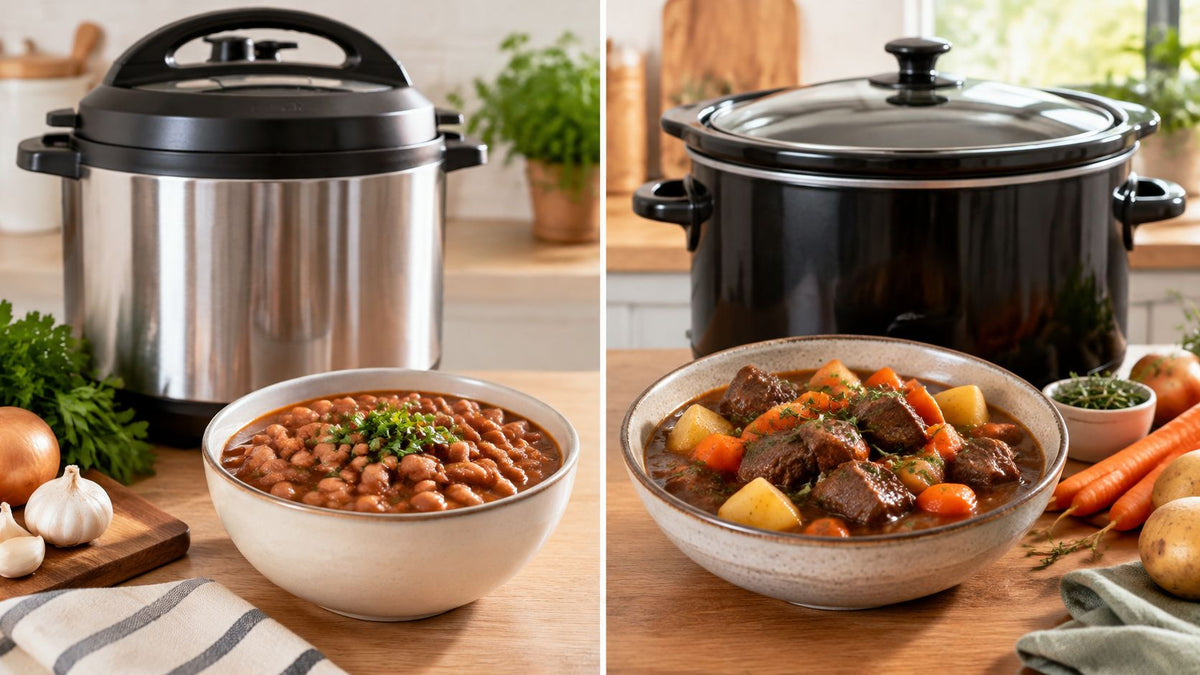
A pressure cooker suits meals you want to start later and finish sooner. A slow cooker suits meals you can prepare well before serving. Both can handle soups, stews and suitable braises, but their timing, liquid requirements and operating procedures differ.
Choose for a meal you regularly cook. A pressure cooker’s shorter programmed time is only part of the elapsed time; heating, pressurising and releasing pressure also count. A slow cooker needs a long enough cooking window and a recipe designed for it.
Pressure Cooker vs Slow Cooker at a Glance
| Factor | Pressure cooker | Slow cooker |
|---|---|---|
| Method | Steam pressure raises the cooking temperature | Low heat cooks food over a longer period |
| Scheduling | Useful for starting closer to dinner | Useful for planned meals started earlier |
| Total time | Include heat-up and pressure release | Include preparation and the full recipe time |
| Liquid and fill limits | Model- and food-specific limits are essential | Follow the maker’s fill guidance and recipe |
| Opening the lid | Only after safe depressurisation | Possible, but repeated opening releases heat |
| Best purchase test | Will you use the pressure procedure regularly? | Can you plan the meal far enough ahead? |
What Each Method Does Well
Pressure cooking can make suitable dried-bean, grain and tough-cut recipes practical on a shorter schedule. It retains liquid, so a sauce may need a separate reduction step after safe pressure release. Use a recipe developed for the appliance rather than simply cutting a conventional cooking time.
Slow cooking suits meals that benefit from a long, gentle cook. It is convenient when preparation happens earlier in the day. Not every ingredient should be added at the beginning: dairy, delicate vegetables and thickeners often need recipe-specific timing.
An electric multicooker may offer both programmes. That does not mean its slow-cook mode behaves identically to a dedicated slow cooker. Check the manufacturer’s guidance and recipes for the programme you intend to use.
Compare Complete Cooking Sessions
For a pressure recipe, add preparation, any sautéing, heat-up, the pressure timer, release time and finishing. For a slow recipe, count preparation, any separate browning, the long cook and final adjustments.
Do not use a general comparison table as a cooking-time chart for meat. Food size, starting temperature, altitude, recipe and appliance all affect the result. Use a digital food thermometer and the Health Canada safe internal cooking temperatures for the food you are preparing.
For electricity, compare energy used for the same finished batch. A higher-wattage appliance running briefly can use less energy than a lower-wattage one running for hours, but there is no universal saving for every pair of models. Keep-warm time and separate browning also count.
Safety Before Convenience
- Read the exact manual: stovetop pressure cookers, electric pressure cookers and slow cookers have different operating requirements.
- Respect fill limits: expanding and foaming foods may have lower limits. Instant Pot’s safety guidance specifies its half-fill line for foods such as rice and dried vegetables; use your own cooker’s limit.
- Keep steam paths clear: inspect the required parts and never cover a pressure-release valve.
- Release pressure correctly: use the method specified for the recipe and appliance, keeping your face and hands clear. Never force a pressurised lid open.
- Thaw before ordinary slow cooking: USDA food-safety guidance recommends thawing meat and poultry before slow cooking. Do not improvise with frozen meat or assume extra time makes every method suitable.
- Use approved frozen-food recipes: pressure cooking from frozen is appropriate only where the maker and recipe support the food, size and method, followed by a temperature check.
For dried kidney beans, follow an established safe preparation method. Do not assume a slow cooker alone provides the required treatment; canned beans are a convenient alternative for suitable recipes. Avoid delayed starts that leave perishable ingredients unrefrigerated.
Set the appliance on a stable, permitted surface with the cord and hot surfaces clear of traffic. Follow its instructions about supervision; a timer does not make any location or unattended routine safe.
Plan Leftovers and Capacity
Nominal pot capacity is not the amount you can safely pressure-cook. Compare the permitted working load for your recipes, along with how comfortably you can lift and clean the insert.
Prepare storage before cooking a large batch. Divide leftovers into shallow containers and refrigerate promptly according to Health Canada’s leftovers guidance. A keep-warm setting is not a substitute for safe storage or a method for reheating cold leftovers.
Compare grocery cost per portion you will actually eat. Neither machine saves money if the batch goes unfinished. Our meal-prep container guide can help plan portioning and storage.
Which Cooker Fits Your Week?
Choose pressure cooking when you want to shorten suitable recipes and are willing to follow the sealing and release procedure. Choose a slow cooker when you can prepare earlier and the cooking window suits your schedule.
For a straightforward catalogue example, the Hamilton Beach 33140VCR 4-quart oval slow cooker lists Off, High, Low and Keep Warm settings. It is a slow cooker, not a pressure cooker; check its manual and capacity against your recipes.
Compare current options in GrifGlo Kitchen Appliances, including warranty, controls, cleaning access and storage size. Buy for the meal you expect to make regularly.

Leave a comment
This site is protected by hCaptcha and the hCaptcha Privacy Policy and Terms of Service apply.