

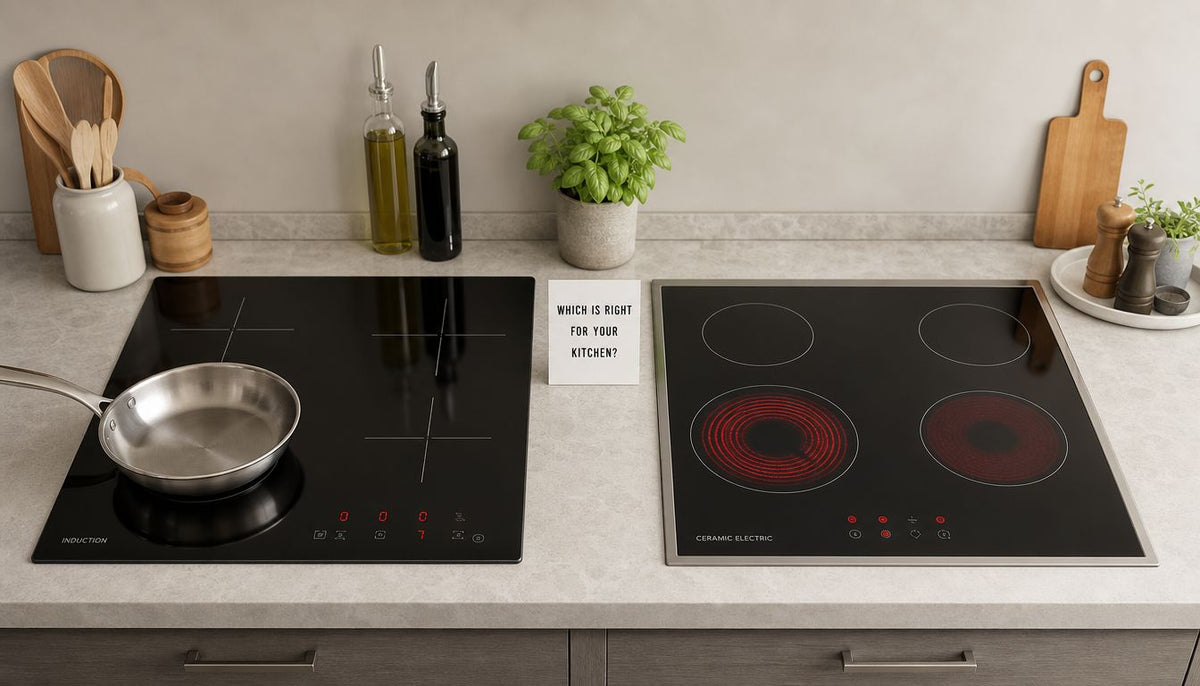
You're standing in a California kitchen with a failing electric range, a cabinet opening that can't change, and a drawer full of pans you'd rather not replace. The obvious question is “Which is better, induction or electric?” The useful question is narrower: Will an induction upgrade work with your electrical service, cookware, budget, and cooking habits?
Induction is usually the stronger choice for speed, control, efficiency, and a cooler kitchen. Standard electric coil and radiant cooking still make sense when the priority is a simple replacement, compatibility with every flat-bottomed pan, or avoiding electrical and cookware costs. California rebates can change the calculation, but incentives vary by utility and may be limited or fully subscribed.
This guide treats the induction stove vs electric stove decision as a practical purchasing problem. You'll compare how both technologies heat food, what measured efficiency data says, what happens to indoor comfort and safety, which cookware works, and what installation may involve in a California home. The recommendations follow a straightforward decision-making framework: start with the constraint that can eliminate an option, then compare performance and total cost.
Table of Contents
- Introduction That Helps You Choose With Confidence
- How Induction and Electric Stoves Work
- Performance Efficiency and Safety Compared Side by Side
- Cost Cookware and Long Term Running Costs
- Installation Retrofit and Maintenance Realities
- Which Stove Fits Your Home and Lifestyle
- Buyers Checklist to Make the Final Decision
Introduction That Helps You Choose With Confidence
A renter replacing a broken range may be limited to the existing outlet, circuit, and cabinet opening. A homeowner planning a remodel can budget for wiring, a new appliance, and replacement cookware. A small hospitality operator also needs consistent controls and maintenance that multiple users can handle. Those constraints should shape the decision before cooking speed enters the discussion.
California homes do not all offer the same electrical starting point. A countertop or plug-in appliance may work from an existing 120V connection, while a full-size induction range commonly needs a suitable 240V circuit. Retrofitting that circuit can involve the panel, wiring route, inspection, and local installation requirements. Confirm the service first. A rebate cannot make an appliance practical if the home cannot support it.
Induction can cook faster and waste less heat, but it requires magnetic cookware and an electrical connection that can supply the appliance. Electric coil or radiant cooking changes temperature more slowly, yet it accepts many flat-bottomed pans and may be the simpler replacement when the existing setup already works. Replacing cookware can materially change the purchase cost, especially if several pans are still usable on a conventional electric surface.
| Decision factor | Induction | Electric coil or radiant |
|---|---|---|
| Heating method | Electromagnetic energy heats compatible cookware directly | A resistive element heats the coil or surface, then the pan |
| Cookware | Requires magnetic cookware | Works with flat-bottomed cookware of many materials |
| Heat response | Fast and precise | Slower to change, with more residual heat |
| Surface temperature | Generally cooler away from the pan | Remains hot after the element is switched off |
| Energy use | More efficient in monitored and benchmark comparisons | Uses more energy than induction for comparable cooking |
| Electrical planning | Often uses a dedicated 240V circuit | Often fits an existing electric arrangement, subject to inspection |
| Best fit | Performance-focused homeowners and suitable retrofits | Simple replacements, broad cookware compatibility, limited upgrade budgets |
California Energy Commission testing reported 80% to 85% efficiency for induction, compared with 65% to 75% for resistive electric cooktops, in monitored residential testing (California Energy Commission testing). The comparison is useful for households already using electricity, because it measures induction against the electric equipment it may replace.
Check four items before choosing: whether a magnet sticks to your pans, whether the panel and circuit support the appliance, whether your utility offers a usable rebate, and whether energy savings justify installation and cookware costs. Use this decision-making framework to rank those constraints, then choose the technology that fits the kitchen you have.
How Induction and Electric Stoves Work
In a California kitchen, the wiring and cookware often decide the choice before appearance or controls do. Electric and induction stoves may look similar, but they create heat in different places and place different demands on the home.
Electric heats the surface first
A conventional electric stove sends current through a resistive coil or radiant element. The element heats up, then transfers that heat through contact or radiation to the pan. On a smooth-top model, a glass-ceramic surface sits between the element and cookware, so the surface becomes part of the heat-transfer path.
That arrangement is straightforward and works with a broad range of cookware. Flat-bottomed stainless steel, aluminium, copper, and cast-iron pans can generally work when they sit securely and suit the surface. The drawback is thermal lag. The element and cooktop retain heat after you lower the setting or switch the burner off, so the pan keeps receiving heat before it cools.
Induction heats the pan directly
An induction cooktop places an electromagnetic coil beneath the cooking surface. Set compatible cookware above it, and the magnetic field creates electrical currents in the pan's ferrous base. The pan produces the cooking heat instead of waiting for a hot coil or heated glass surface to transfer it.
The cooktop can still warm where a hot pan sits, so “cool” does not mean completely cold. Unused areas generally retain less leftover heat than those around a conventional electric element.
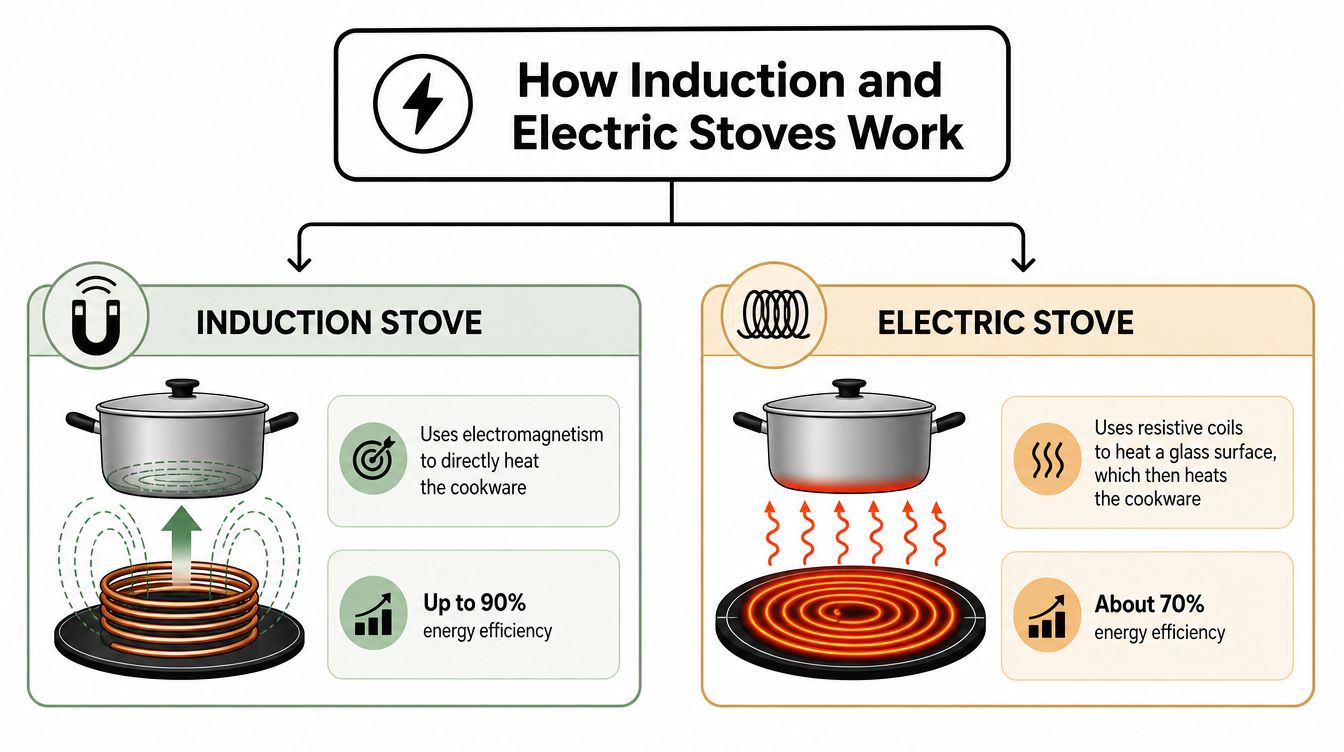
Core difference: Electric cooking heats the element and then the pan. Induction makes the compatible pan the main heating element.
The cookware test is simple
Place a magnet against the underside of each pan. If it sticks firmly, the pan is a candidate for induction. If it does not, that pan will not activate an induction zone. An adapter can sometimes provide a workaround, but it adds compromises in responsiveness and efficiency.
Check this before comparing finishes or control layouts. Also confirm whether the appliance fits the electrical service available in your California home. A model requiring 240V may call for a dedicated circuit, while a 120V portable unit avoids that retrofit but offers a smaller cooking area and different output.
A portable appliance such as the HAMILTON BEACH 51182JC Blend Now Portable Cordless Blender is a countertop tool, not a replacement for either stove technology. The buying principle remains the same: match the appliance to the task, cookware, electrical setup, and space you have.
Performance Efficiency and Safety Compared Side by Side
For a California renter with existing service, performance depends on more than the burner technology. A 240V induction range may deliver the strongest control, but a 120V portable unit avoids electrical work and limits the cooking area. Homeowners and small hospitality operators should compare cooking response with panel capacity, cookware, and retrofit cost before choosing.
Heat-up and control
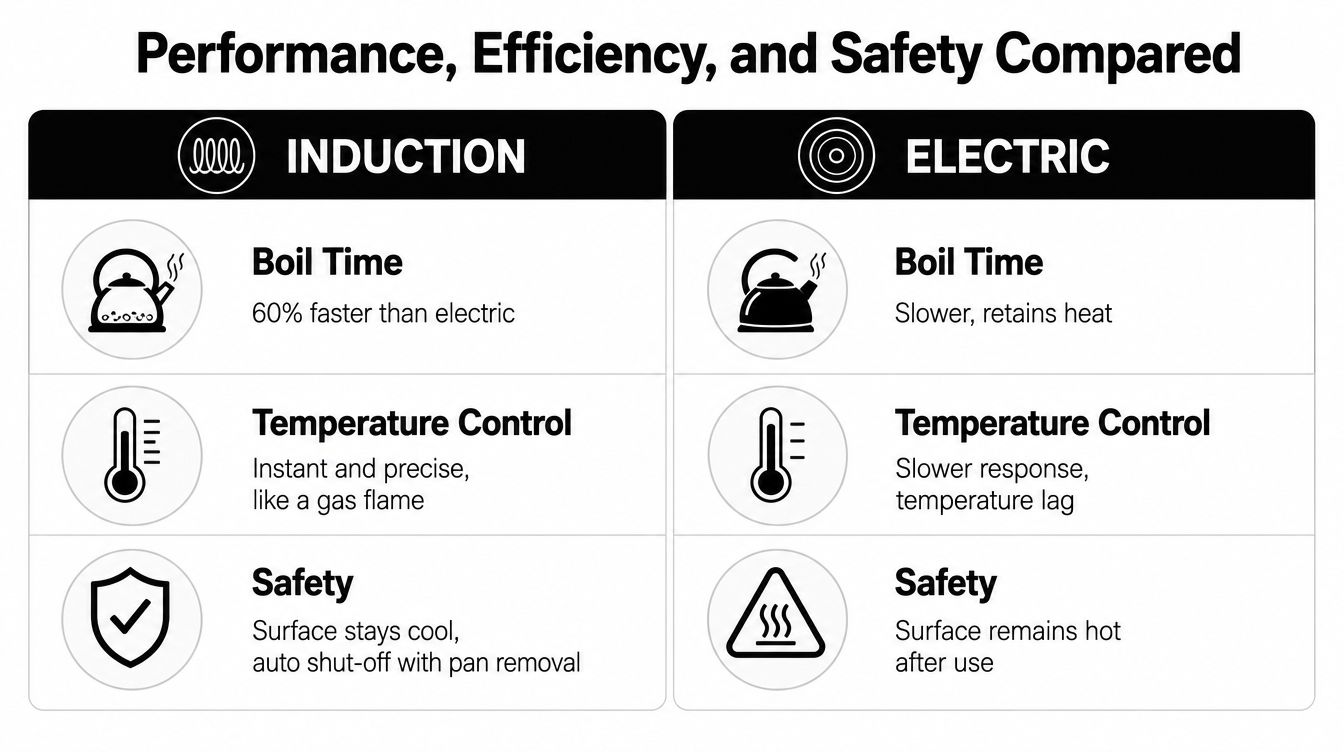
Induction is usually faster for boiling and responds sooner when you lower the setting. Canadian guidance describes induction as “much faster” to boil water than an electric coil or conventional electric range, and identifies direct cookware heating as a reason induction ranks among the more efficient cooking technologies (Canadian induction guidance).
Radiant and coil stoves still handle steady simmering and everyday frying well. Their element and surface retain heat, so food may continue cooking after you reduce the control. That slower response can suit cooks who prefer gradual changes, but it makes rapid searing, sautéing, and temperature corrections less precise.
Practical verdict: Choose induction for boiling, searing, sautéing, and recipes that require quick temperature changes. Choose electric when steady heat matters more than fast response, or when your current electrical service makes a 240V upgrade impractical.
Efficiency and kitchen comfort
California Energy Commission testing found induction cooktops delivered about 80% to 85% efficiency, compared with 65% to 75% for resistive electric cooktops. More electricity reaches the pan, while less heats the element, glass, and nearby air.
The difference is most noticeable during extended cooking. A radiant electric surface continues releasing stored heat after the burner is lowered. Induction still heats the cookware and food, but the surrounding cooktop generally stays cooler, which can make the kitchen more comfortable.
California indoor-air evidence adds context for households replacing gas. California Air Resources Board materials report that switching from gas to electric can reduce indoor NO2 concentrations by 42% to 51%, while California research found 48-hour average NO2 levels were 63% lower in electric-stove homes than gas-stove homes (California market characterisation and indoor-air data). These figures compare gas with electric cooking. They do not establish an indoor-air advantage for induction over standard electric.
Surface safety
Induction offers the clearer surface-safety advantage. It does not depend on a glowing exposed coil or a continuously heated radiant zone, and many models stop applying power when the pan is removed. The glass can remain hot from contact with the cookware, so use the residual-heat indicator and follow the care instructions.
Electric surfaces store more heat. A switched-off radiant zone may look safe while remaining hot, and an exposed coil can burn skin or ignite nearby items. Both technologies require supervision, but induction is the better choice for households prioritising surface safety and quick shutdown.
For broader lower-impact purchasing guidance, GrifGlo's eco-friendly kitchen appliances guide helps place the stove decision alongside the rest of the kitchen.
Cost Cookware and Long Term Running Costs
A California renter may find the stove affordable but the cookware incompatible. A homeowner may have suitable pans yet face electrical work or limited rebate availability. Compare the full cost, including the appliance, cookware, installation, electrical changes, incentives, and future electricity use.
Start with the pans you own
Test every pan you use regularly with a magnet, not only the saucepan used most often. Cast iron and magnetic stainless steel usually work. Non-magnetic aluminium, copper, and some stainless-steel cookware may not. An induction symbol or product specification provides a second check.
If only one or two pieces fail, replacing them may be manageable. If most of your daily cookware is non-magnetic, a standard electric replacement can cost less overall. Use this induction cookware selection guide before buying pans, and replace the pieces you use most instead of buying a complete new set automatically.
Put energy data in context
A Canadian benchmark comparison cited by the Endeavour Centre reports most freestanding 30-inch ranges at about 470 to 515 kWh per year, while a Frigidaire induction range in the same comparison is rated at 293 kWh per year (Canadian range energy comparison).
| Range type | Annual energy use | Difference vs standard electric |
|---|---|---|
| Standard freestanding 30-inch range | About 470 to 515 kWh/year | Baseline |
| Frigidaire induction range in the comparison | 293 kWh/year | About 177 to 222 kWh/year lower |
These figures are benchmarks, not a household guarantee. Cooking frequency, pan size, heat settings, oven use, and appliance condition change actual consumption. Induction can reduce cooking electricity compared with standard electric equipment, but your local rate and the purchase cost determine whether the savings justify the upgrade.
A California Energy Commission model used an average residential electricity price of $0.16 per kWh and showed induction savings scenarios of up to 72% versus certain conventional electric conduction setups. Treat that model as a planning input rather than a guaranteed payback result. A separate California calculator uses an average electricity rate of about $0.29 per kWh and estimates induction efficiency at 85% to 90%, compared with lower efficiency for electric resistance cooking (California induction cost calculator). The assumptions differ, so do not combine the figures into one payback calculation.
Rebates can change the answer
California utilities may offer separate incentives for electric-to-induction and gas-to-induction upgrades. SMUD's separate rebate categories show why you should check the programme serving your address before calculating payback. Funding may not be available when you apply (California induction market report).
My recommendation is direct. If your existing electric range still works, don't replace it solely for a vague promise of savings. Upgrade when you also want better control, cooler operation, safer surfaces, or a remodel. Subtract verified rebates, realistic cookware costs, and any electrical work from the purchase price before deciding.
Installation Retrofit and Maintenance Realities
The first installation question isn't “Will the range fit the cabinet opening?” It's “Can the circuit safely support the appliance?”
Confirm the electrical path
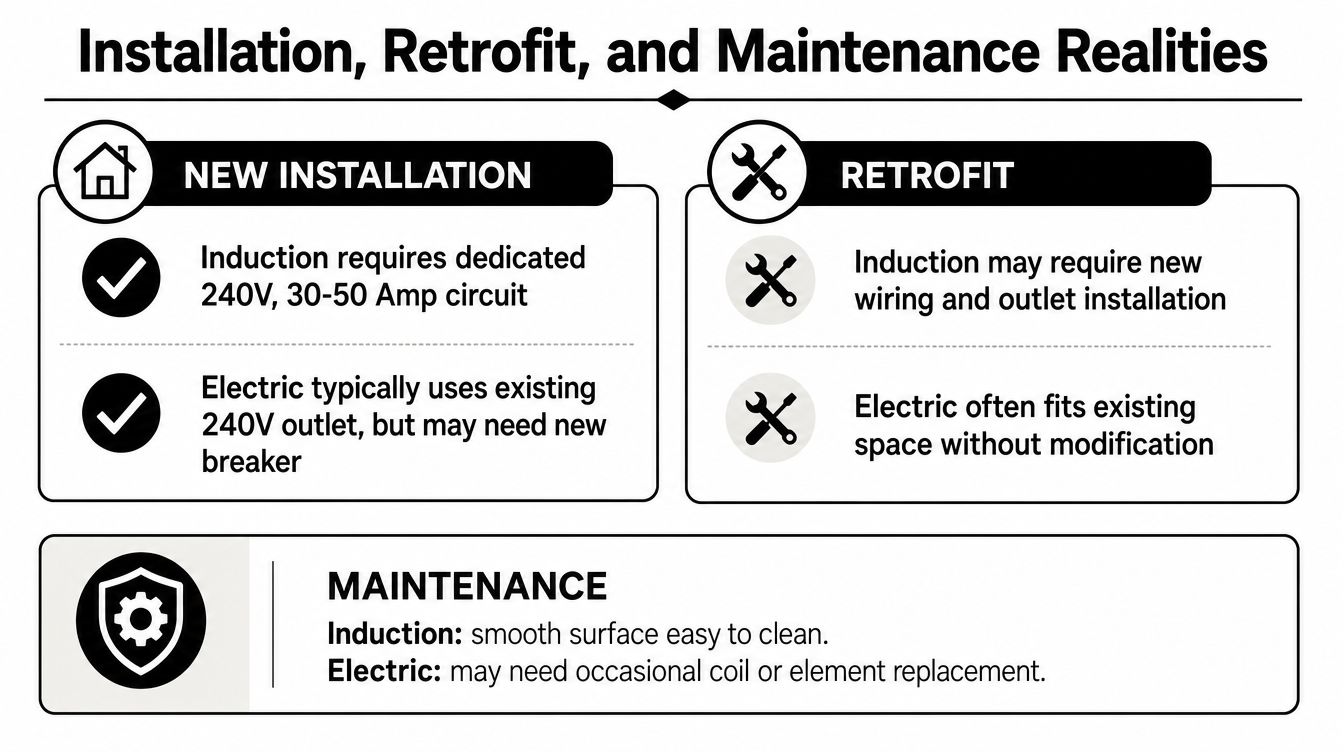
Canadian electrification guidance describes induction cooktops and ranges as typically using a 240V, 30A to 50A circuit, while electric coil cooktops and ranges typically use 240V, 40A to 50A (Canadian electrical guidance). Those ranges overlap, so an induction appliance may not automatically require a larger supply than an electric replacement. The exact requirement comes from the model's installation documentation and your local code.
Ask an electrician to verify the breaker, conductor size, receptacle or hardwire arrangement, panel capacity, and the distance between panel and appliance. Don't assume an old outlet is suitable because another electric range used it. A qualified installer can identify whether the appliance is a direct replacement or whether the project needs new wiring.
Choose the right format for the home
A 240V built-in range is straightforward in a remodel when the electrical plan includes it. It can be much less straightforward in a rental, older bungalow, or multifamily building where the panel, wiring route, landlord approval, or building rules limit changes.
California programmes and field work are also drawing attention to 120V induction stoves and battery-equipped models for homes where a conventional 240V conversion is difficult. A CalMTA field study reported that an integrated battery supported nearly all of 6,175 documented cooking events (California plug-in induction reporting). That finding makes battery-assisted formats relevant for constrained homes, but it doesn't make every model a full-size range replacement. Check cooking capacity, circuit limits, oven needs, ventilation, and the manufacturer's installation requirements.
Never use an extension cord or improvised adapter for a high-load appliance unless the manufacturer and a qualified electrician explicitly approve the arrangement. Renters should get written landlord approval before altering outlets, breakers, or cabinetry.
Cleaning is easier, not maintenance-free
Both smooth-top induction and radiant electric surfaces need prompt spill removal and compatible cleaners. Induction usually leaves less baked-on residue because the surface isn't the main heat source, while electric radiant zones can transfer more heat into spills. Glass can scratch or crack under impact, so lift heavy cookware instead of sliding it.
Exposed electric coils add a separate maintenance concern because an element may eventually need replacement. Keep the cooktop, controls, seals, and ventilation area clean, and arrange service when heating becomes uneven or a control behaves unpredictably. For ventilation planning, use GrifGlo's practical guide to installing a range hood, particularly if your remodel changes the appliance layout.
Which Stove Fits Your Home and Lifestyle
The best recommendation changes with the building.
Renters and older homes
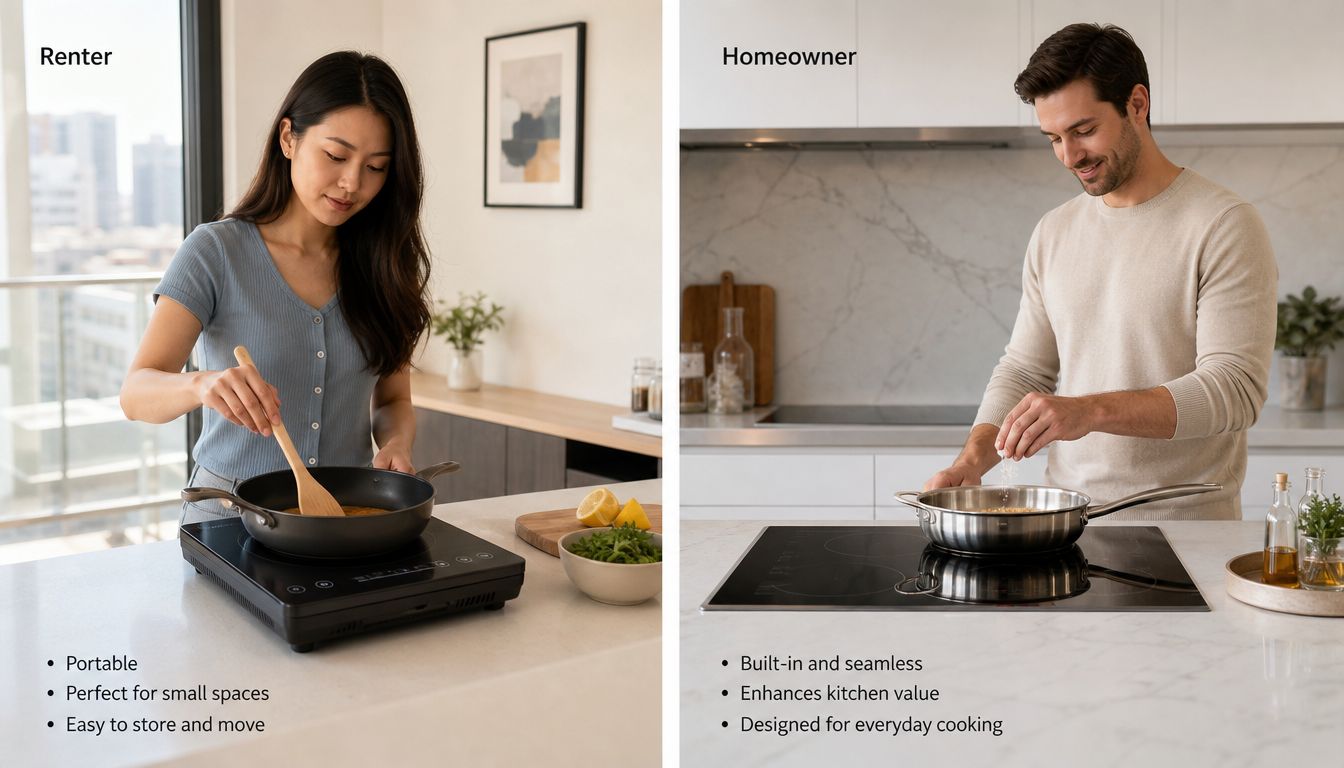
For a renter, I'd start with permission and power, not appliance features. If you can't modify the electrical system, a suitable 120V induction format may be more practical than a built-in 240V range. Confirm that the circuit can carry the appliance without sharing an unsafe load, and ask the landlord about countertop use, ventilation, and storage.
A portable induction unit can suit a household that needs one cooking zone and already owns a magnetic pan. It won't replace the capacity or oven function of a full range, so be honest about the cooking job. If you need a complete replacement and can't alter the property, standard electric may remain the simpler choice.
Homeowners planning a remodel
Choose induction during a remodel if you want precise control, lower heat spill, and a cleaner work surface, and you're prepared to verify the circuit and cookware before ordering. This is the situation where induction's higher purchase and installation effort makes the most sense because you can coordinate cabinetry, electrical work, ventilation, and appliance dimensions together.
Don't order the range before the electrician confirms the service. A beautiful appliance that can't be connected safely is an expensive delay.
Busy families
Induction earns my recommendation for families that cook several times a day. Fast response, pan-detection features on many models, and less residual surface heat reduce the friction of busy meals. Parents still need to supervise children, keep handles turned inward, and follow the manufacturer's safety instructions.
Budget cooks and small operators
If your budget is tight and your cookware is mostly non-magnetic, replace a failed electric stove with another compatible electric model unless a verified incentive materially changes the total. You'll avoid a coordinated pan replacement and may avoid electrical work.
Small hospitality operators and rental hosts should value standardisation. Induction can provide a consistent cooking experience across suitable properties, but every location needs the same checks for circuits, cookware, user instructions, and service support. GrifGlo's kitchen appliance buying guide is useful for organising those decisions across individual and business purchases.
Buyers Checklist to Make the Final Decision
Use this checklist before you place the order:
- Test your cookware. Use a magnet on the pans you cook with. Budget for replacements only where needed.
- Verify the electrical supply. Confirm whether you have a suitable 240V circuit, or whether a 120V option is more appropriate. Have an electrician inspect the setup.
- Check the address-specific incentive. Look at your utility's current electric-to-induction programme, eligibility rules, application timing, and remaining funds. Don't count a rebate until you've verified it.
- Measure the installation. Confirm the cutout or range space, clearances, ventilation, controls, and door swing before purchasing.
- Price the complete change. Include the appliance, cookware, electrician, delivery, disposal, and any required accessories.
- Match the technology to your routine. Choose induction for responsive control, efficiency, cooler operation, and surface safety. Choose electric coil or radiant for the simplest replacement, broad pan compatibility, and fewer changes to your current setup.
- Plan for the people using it. A rental, family kitchen, and small hospitality property need different controls, instructions, and service arrangements.
My final advice is simple: buy induction when the electrical path and cookware plan are clear, and buy standard electric when avoiding retrofit complexity matters more than performance. In California, the smartest choice isn't the appliance with the most impressive feature list. It's the one that works safely in your home and makes financial sense after verified incentives and real setup costs.
GrifGlo helps households, renters, property managers, and hospitality teams compare practical kitchen appliances and cookware with fit, use case, and purchasing needs in mind. Visit GrifGlo to organise your stove upgrade and find decision-friendly guidance before you buy.

Leave a comment
This site is protected by hCaptcha and the hCaptcha Privacy Policy and Terms of Service apply.