

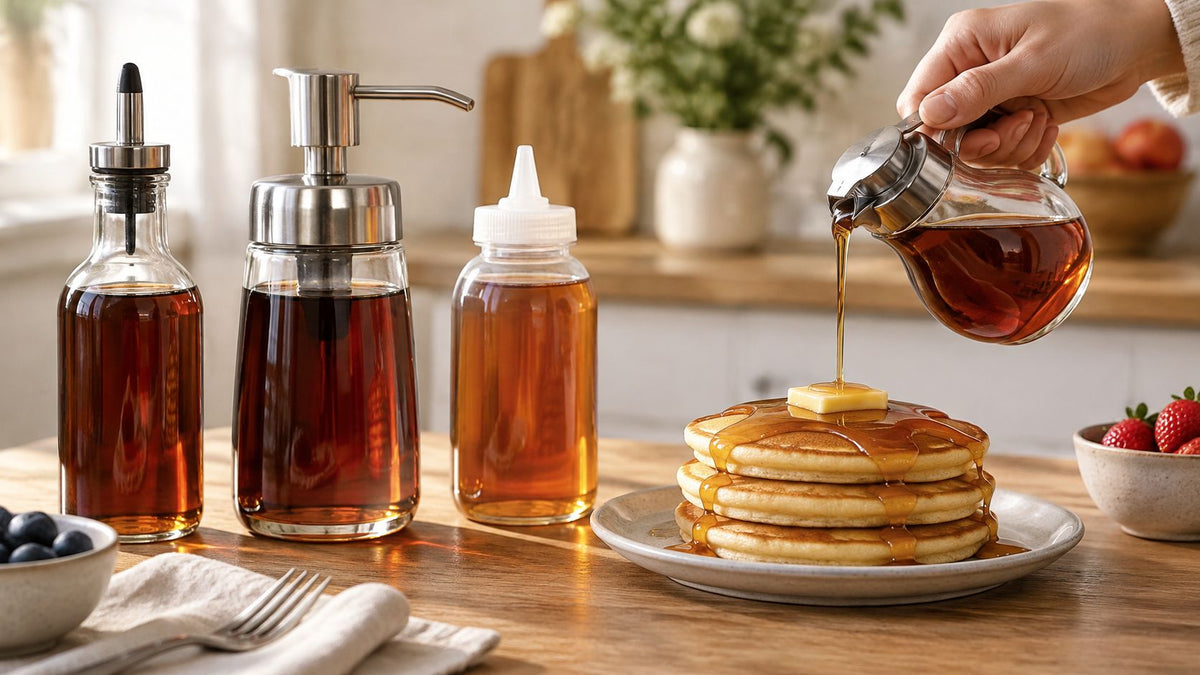
Most buyers choose a maple syrup dispenser the way they'd choose a water jug, by picking the largest, prettiest vessel that looks right on the table. That's backwards. For pure maple syrup, the best server is usually smaller, closable, and easy to wash, because its job isn't storage. It's the short trip from a cold, sealed container to a warm plate.
Table of Contents
- Why the Serving Vessel Matters More Than the Look
- Four Maple Syrup Dispenser Types Side by Side
- Food-Contact Materials and Finishes Worth Buying
- Capacity and Pour Control for Real Mealtimes
- How to Clean and Store Syrup After Opening
- Pick the Right Setup for Home or Hospitality
Why the Serving Vessel Matters More Than the Look
Say a family buys a tall glass cruet, fills it on Monday, and leaves it beside the toaster for weekday waffles. By Wednesday the lip is sticky, dust has settled near the opening, and no one remembers when the syrup first left the fridge. A smaller capped dispenser, filled for one meal and returned to cold storage, avoids that slow drift into waste.
A maple syrup dispenser works like a creamer jug: it holds a service portion for a short time, controls the pour, then goes back for washing or refrigeration. The retail can, jug, or bottle does the storing.
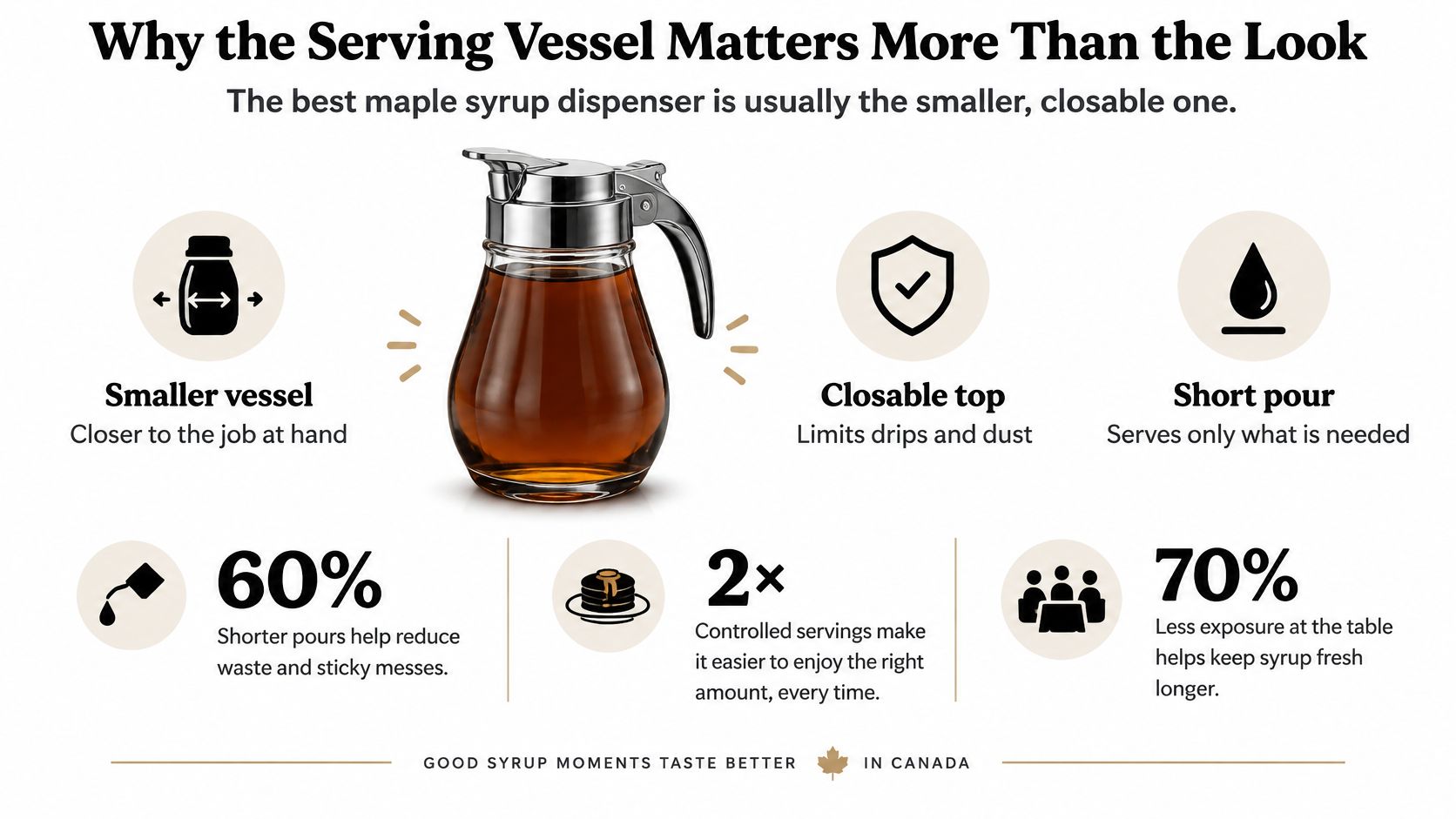
A product with no preservatives needs a short stay out
Pure maple syrup gives you a narrower margin than a preserved table syrup. Once the seal is broken, the vessel decides how much air reaches the surface, how much film builds around the spout, and how long the syrup sits warm between pours. A wide open top looks generous. It also invites drips down the side and repeated exposure through a long brunch, and every warm hour out of the fridge shortens the syrup's life.
A closable top, a narrow pouring path, and a size matched to one meal reduce all three problems. You pour what you need, close it, and put the rest away. The dispenser earns its place by limiting waste, since a server sized to a single meal rarely sits long enough to spoil.
Canadian supply is large, concentrated, and uneven
The Canadian context explains why refillable servers matter. According to Statistics Canada and Agriculture and Agri-Food Canada figures for the 2024 harvest, the 2024 crop reached 19.9 million gallons nationwide, a 90.7% increase from 2023 and 14.3% above the previous record set in 2022: Quebec alone produced more than 18 million gallons, 90.7% of the total, after adding 8.7 million gallons (a 92.2% jump) over 2023, while New Brunswick produced approximately 1.2 million gallons after a 128.8% year-over-year increase, Ontario 607,000 gallons, and Nova Scotia 43,000 gallons.
A dispenser sold anywhere in Canada is therefore usually serving syrup that started in Quebec, even when the jug travelled across the country to reach the table. Swings of that size reward practical formats. Homes, restaurants, and hospitality operations need servers they can refill from whatever can or jug is available, wash quickly, and return to service without old syrup trapped in a decorative neck.
Decide who pours, how many plates are on the table, and how soon the vessel goes back to the fridge. The look comes second.
Choose the smallest closable server that can pour for every plate at the table.
Four Maple Syrup Dispenser Types Side by Side
The four formats differ less in silhouette than in two practical measures: how much air they leave over the syrup and how many parts you have to wash. Treat a dispenser as a service portion. Opened pure maple syrup belongs in the fridge between meals, so a vessel that holds a whole litre on the counter turns that litre into a slow spoilage risk. Match the format to the food and the length of the meal.
| Type | Best for | Pour control | Cleaning load | Main risk |
|---|---|---|---|---|
| Pour spout on a bottle | Home pancakes and standard retail bottles | Thin stream; drip depends on the lip | Few parts, bottle plus spout | Leaks if threads do not match |
| Pump dispenser | Buffet, brunch station, staff service | Measured strokes if the shutoff seals | Pump, gasket and reservoir all need washing | Air exposure and worn gaskets |
| Squeeze bottle | Kids, rentals, condiment stations | Pressure gives small portions | Narrow neck and nozzle trap film | Nozzle clogs and plastic fatigue |
| Cruet or glass pourer | Styled table, small household meals | Open pour, easy to overpour | Wide mouth washes well; lid may be loose | Room-temperature exposure and chips |
Pick a row before you compare colours or shapes. Each format suits a different pourer, a different pace, and a different tolerance for washing.
Pour spout on a bottle
A screw-on spout turns a standard retail bottle into a server. You tip it and get a thin stream that works well for pancakes, where you want syrup across the stack rather than pooled in the centre. Control lives in the lip. A clean, raised lip cuts the stream off neatly. A flat or worn lip lets syrup run down the outside of the bottle.
Threads are the weak point. If the spout does not match the bottle exactly, syrup finds the gap and leaks with every tip. Test the fit with water first, and check that the cap or flap closes. For households that already like the bottle their syrup arrives in, this is often the simplest upgrade.
Pump dispenser
A pump suits a buffet or brunch station because each stroke delivers a repeatable portion. A pump works like a coffee scoop for liquid: one stroke should equal one small pour, so staff do not have to judge a tip angle and guests are less likely to flood a plate. A working shutoff matters more than stroke size. If the pump keeps oozing after the stroke, syrup collects at the outlet and the station turns sticky within an hour.
The trade-off is parts. The pump head, dip tube, gasket, and reservoir all touch syrup or sit close to it, so all of them need washing. Air also reaches the reservoir each time the pump cycles. Buy a pump only if it comes fully apart and someone resets it between services.
Squeeze bottle
A squeeze bottle, often in a small service size, is the practical choice for kids and short-term rentals. Pressure controls the pour, so a light squeeze gives a small portion and releasing pressure stops the flow. It is light, it does not chip if it drops, and guests understand it without instructions.
The narrow nozzle is its flaw. Syrup film builds inside the tip, and a quick rinse will not reach it. Over time the plastic also tires from repeated squeezing and washing. Choose a bottle with a removable nozzle and a mouth wide enough for a bottle brush, and replace it when the walls cloud or crack.
Cruet or open glass pourer
A glass cruet looks right on a set table, and its wide mouth is very easy to wash. For a short, small meal where you fill it, serve, and wash it the same day, it works. The problems start when it becomes permanent countertop storage.
An open or loosely covered top invites over-pouring, because there is nothing metering the flow. It also leaves syrup at room temperature for hours and exposes the surface between meals. Glass chips at the lip, and a chipped lip pours worse and holds residue. Treat a cruet as a short-service piece for specific meals.
Edge cases change the pick. A left-handed pourer needs a lip that does not run syrup down the bottle when the handle sits on the awkward side. A pump in a cool dining room moves thick, cold syrup slowly, while a squeeze bottle that has been in hand for a minute pours more readily. Similar thinking applies to other tabletop pourers, which is why guidance on choosing oil and vinegar bottles for controlled pouring stresses the lip and closure over the silhouette.
Choose by pourer and table time: pick the type for who pours and how long the vessel stays out. Appearance is the last filter.
At home, start with a capped squeeze bottle or a spouted bottle. In hospitality, use a pump only where staff reset it between services. An open cruet is the exception, reserved for short meals and same-day washing.
Food-Contact Materials and Finishes Worth Buying
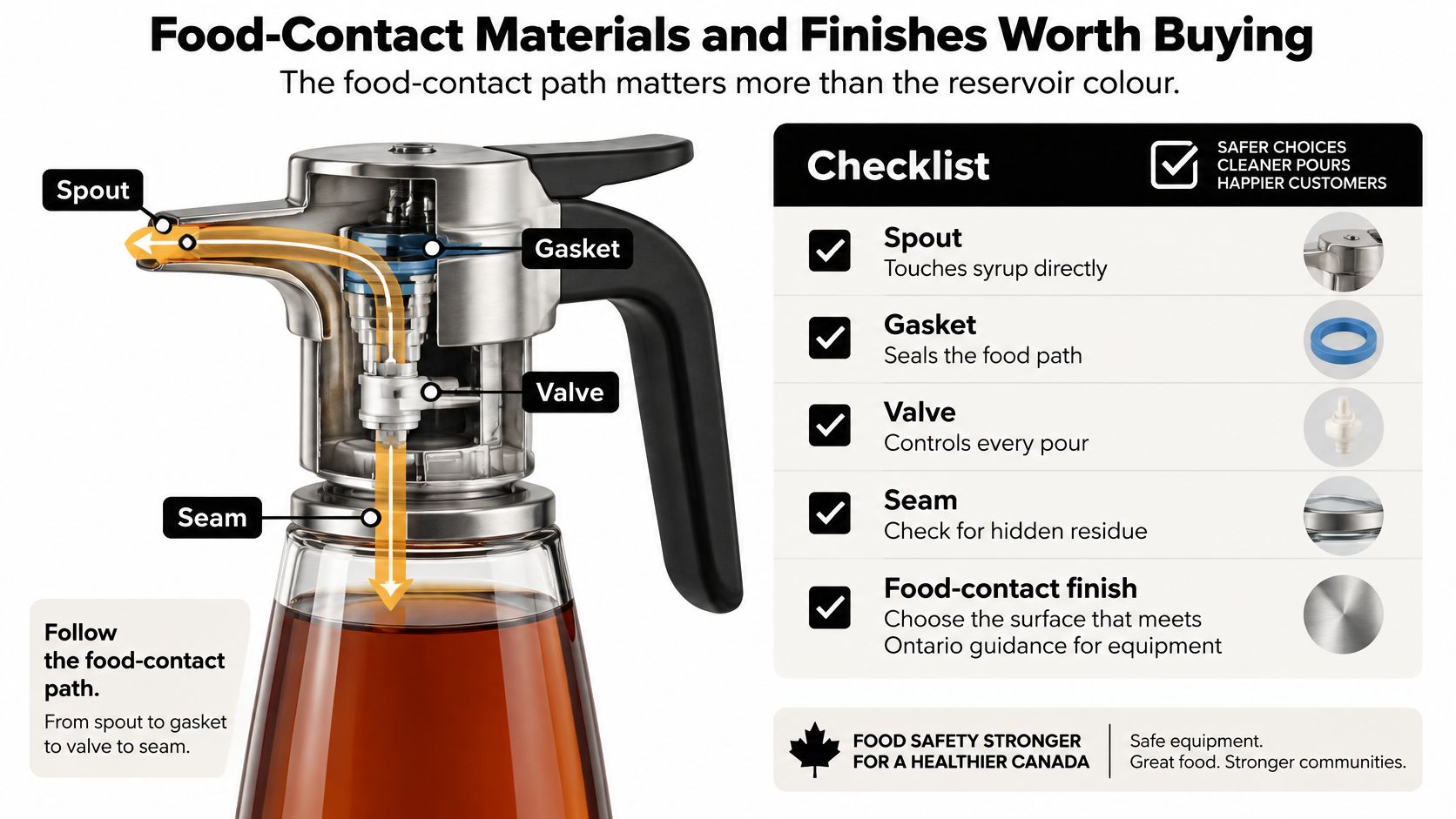
Judge the food-contact path first; the reservoir matters less. The food-contact path is every surface the syrup touches on its way out: the inside wall, the spout, the valve, the gasket, the cap threads, and any seam where two pieces meet. Syrup is sticky and leaves a film. Film you cannot reach becomes residue that survives the wash, and residue is where mould gets its start.
A clear glass body with a cheap seamed spout and a fixed gasket can be worse than a plain bottle that comes completely apart. Syrup lingers in the spout between pours, so a removable spout you can rinse in seconds counts for more than the shape of the reservoir.
What Ontario guidance asks of food-contact surfaces
Ontario's guidance on premises and food-grade material requirements for producing maple syrup sets two tests at once: food-contact surfaces must be non-toxic and food grade, smooth, non-porous, non-absorbent, durable, and resistant to corrosion, heat, moisture and cleaning chemicals, and thick-walled food-grade HDPE is suitable for short-term hot packing but not for prolonged evaporator temperatures.
That pairing points you toward stainless steel, glass, or appropriately rated food-contact polymers. It points you away from porous wood, cracked plastics, soldered components, and decorative coatings of uncertain composition. Porous or damaged surfaces hold syrup residue and can support microbial or mould contamination. Corrosion or a chemical mismatch can introduce material into the syrup and make sanitation unreliable.
The heat limit deserves a plain reading. A server holding warm syrup at the table is doing its job. A plastic dispenser is not a reheating pot, and syrup near boiling belongs in a pot on the stove.
A four-part buyer check you can run in the store
You don't need lab testing to screen a dispenser. You need your eyes, your fingers, and the willingness to take it apart before you pay.
- Read for an explicit claim: Look for a clear food-contact material statement, not vague language about a premium finish.
- Inspect the syrup path: Look through the spout and under the gasket for seams, crevices, and rough joins where film will hide.
- Confirm full disassembly: The spout, pump, gasket, and cap should separate so every surface can be washed and dried.
- Reject damaged surfaces: Put back anything with clouded or cracked plastic, flaking coating, or a chipped pouring lip.
If a listing won't say what touches the syrup, that ends the discussion.
How finishes affect daily use
A matte exterior hides fingerprints, which helps a server look clean through a brunch service, and it belongs on the outside of the vessel. The surface that meets syrup still has to pass the food-grade test above. A tinted body may suit your table, but a clear wall shows the level at a glance, which lets hospitality staff spot a near-empty dispenser and stops anyone topping up an unknown leftover with fresh syrup.
The same material reasoning carries into wider kitchen storage, including the checks used for commercial food storage containers in repeated service. In rentals and brunch rooms, repeated use fails first at the gasket. Gaskets compress, absorb odours, and crack. A dispenser with a replaceable food-grade gasket outlasts a prettier one with a sealed, fixed seal.
Capacity and Pour Control for Real Mealtimes
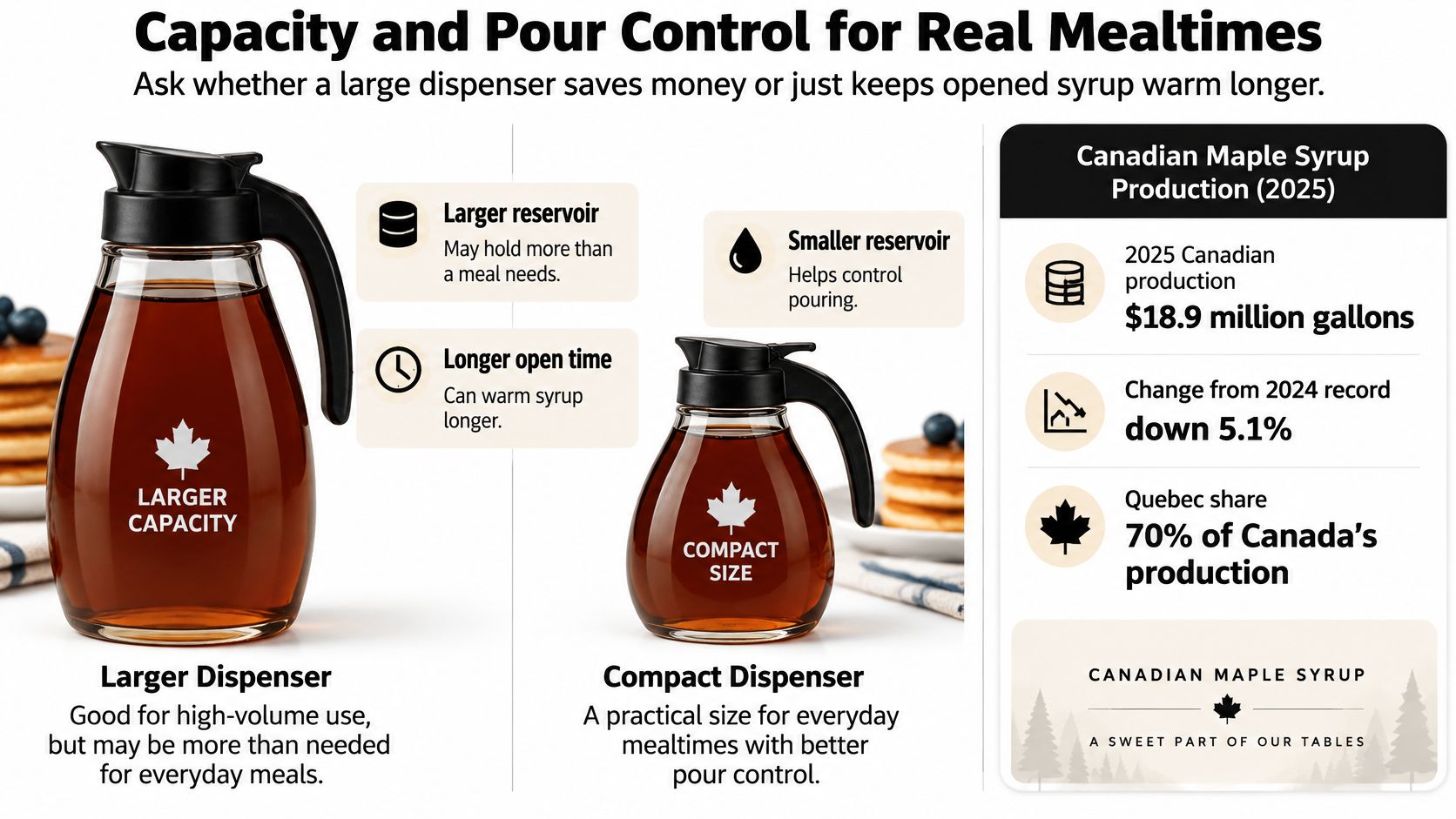
Fill the server for the meal and keep the bulk container cold. A capped 150 to 250 mL pourer gives a family breakfast enough syrup while the jug, can or bottle stays refrigerated. A large display cruet earns space only when it will be emptied and washed soon after; left warm, it stretches the time opened syrup sits at room temperature and invites topping old syrup with new.
Supply swings do not change serving physics
In Statistics Canada reporting on the 2025 maple harvest, Quebec production declined 5.9% to 17.0 million gallons in 2025; Canadian output reached 18.9 million gallons, down 5.1% from the 2024 record, with New Brunswick, Ontario, and Nova Scotia supplying the remainder.
A tighter harvest makes every wasted tablespoon easier to notice, and a bigger harvest does not make a warm reservoir safer. Oversized vessels mainly increase warm exposure time. For cafés, rentals, and brunch operations, capacity sits beside controlled portioning, refill traceability, leak resistance, cleaning turnaround, and whether staff can identify the syrup's opening date.
| Setting | Who is served | Service reservoir | Where the rest stays | Refill rhythm |
|---|---|---|---|---|
| Weekday home | 1 to 2 people, a few tablespoons | 150 to 250 mL capped dispenser | Refrigerated jug, can or bottle | Top up from the fridge as needed |
| Weekend brunch at home | About 4 to 8 guests | 250 mL capped pump or squeeze bottle | Same cold bulk; do not leave it out overnight | Empty and wash after the meal |
| Café or brunch service | Many covers, staff pouring | Small reservoir plus backup bottles | Dated backup in the fridge | Refill on a schedule and note the open date |
| Short-term rental | Guests with unknown habits | 150 to 250 mL squeeze bottle or pump | Sealed retail bottle left by the host | Host washes between stays |
| Counter filling customer bottles | Buyers taking syrup home | Valve dispenser with a shutoff | Clean, sound reservoir; new closed consumer bottles | Controlled fill; avoid an open cruet |
What good pour control actually looks like
Judge the pour at the outlet. A good valve or spout shuts without leaving a puddle at the opening, because syrup film around the outlet builds residue and attracts contamination. The neck should be narrow enough that a tip doesn't flood the plate, and the base should have no inaccessible bottom pocket where old syrup hides below the reach of a brush.
Syrup in motion is easier to judge than syrup in a still photo, so watch how a controlled stream starts and stops.
Under Ontario regulation for maple products, containers must be clean and sound, consumer containers must be new and securely closed, and containers must be filled to at least 90% of capacity. A dispenser used to sell syrup in bulk and fill customer containers at purchase does not need its label to state the syrup volume, while other applicable identification and labelling requirements remain relevant. Prefer a replaceable food-grade gasket and a shutoff that limits how much air reaches the syrup inside.
A refill check you can do in your head
Estimate servings per day, allow roughly a tablespoon or two per serving as your planning example, and choose the smallest vessel that covers one meal rather than the week. If four people sit down to Sunday brunch, a 250 mL server is generous. Filling a litre cruet for the same table mainly extends warm exposure. This sizing habit pairs well with broader guidance on matching food storage container sizes to actual portions.
Canadian packaging adds one more wrinkle. Syrup reaches buyers in cans, glass, and plastic jugs rather than one standard bottle. A federal historical overview notes a producers' cooperative promoted a sanitary can in 1952, and that federal overview of the Canadian maple industry records the format held 26 ounces of syrup. Match a screw-on spout to the container you buy, or decant a meal's worth into a server. A spout that fits only one imported bottle will fail on a local can.
How to Clean and Store Syrup After Opening
Don't leave a maple syrup dispenser on the table as day-long storage. Syrup shouldn't stay in the dispenser on the table for longer than one meal service. When the meal ends, the dispenser goes to the fridge or to the sink.
An opened dispenser works like a gravy boat: useful for serving, unsuitable for storing. Sealed syrup keeps well in a pantry, but opening the container and decanting it into a server introduces air, handling, and a warmer spot on the table.
Why cool storage is required
Ontario guidance on preventing mould growth in maple syrup says pure maple syrup contains no preservatives and mould grows optimally at ambient temperatures, so syrup should be kept consistently cool; the guidance also says opened syrup should be refrigerated or frozen and that cold-packed consumer syrup requires immediate refrigeration or freezing.
Hot-packed syrup is more stable while sealed, but opening it removes that protected condition. Each pour leaves a thin film around the lip and threads, while handling can carry crumbs or utensil residue back toward the opening. Those small deposits give mould more places to take hold the next time syrup warms on the table.
Wash, rinse, and dry in six steps
Cleaning a dispenser requires deliberate washing. Syrup film clings to threads and valves, and a quick rinse can leave a slick layer behind.
- Decide on leftovers: Pour only what you expect to use. Discard syrup left in a shared serving dispenser, and keep the opened bulk container refrigerated according to its label.
- Take it apart: Separate the spout, pump, gasket, cap, and any dip tube before washing.
- Wash in hot soapy water: Scrub the valve, threads, and nozzle with a small brush, where film hides.
- Rinse until clean: Rinse until no slick film remains on any surface.
- Air-dry fully: Let every part dry completely before reassembly, because trapped water dilutes the next fill of syrup.
- Refill small: Add a small service amount and return the bulk container to the fridge.
Many pumps, wooden collars, and gaskets aren't dishwasher-safe even when the glass body is. Check each part rather than relying on the product headline. The same full-disassembly habit applies across the kitchen, as shown in practical routines for cleaning food storage containers thoroughly.
If you see mould, the syrup is finished
Don't scoop mould off and keep pouring. Discard the syrup, then wash and fully dry the dispenser before the next fill. Mould on the surface tells you the syrup spent too long warm or the vessel carried residue into the fill. Serving the rest puts that history on the next plate.
Fridge fit is the final practical test. A short, capped bottle sits well on a door shelf and comes out easily with one hand. A tall cruet may not fit the shelf at all, which is how it ends up living on the counter. If the dispenser can't go where the cold storage is, you'll store it warm by default. Buy the shape your fridge can hold.
A dispenser that fits the fridge door gets refrigerated. A dispenser that doesn't fit becomes countertop storage, whatever you intended.
Pick the Right Setup for Home or Hospitality
For a household, buy a closable 150 to 250 mL dispenser in glass or food-grade plastic with a replaceable gasket. Keep the retail container at 0 to 4°C, fill the server for the meal, and save the open cruet for short meals where it goes straight into the wash afterward.
A café, brunch room, or short-term rental needs a pump or squeeze bottle that comes fully apart, resists leaks, and lets staff check the level or mark the open date. Give each shift one dispenser and a dated backup in the fridge.
Refuse anything without a food-contact claim, with a spout you can't remove, or with a decorative coating on the syrup path. Careful washing cannot fix those three flaws.
Before the first real meal, run a five-minute counter test. Fill the dispenser with water, tip and pump it, and watch the threads and outlet for drips. Then wash it, dry it, and confirm every part separates and dries fully. Water shows leaks without wasting syrup.
Buy for the meal, not for the month. If you want a sense of how portioned serving scales up, look at how a drink dispenser and stand manages higher service volume before settling on a setup. GrifGlo makes its products available for delivery across Canada, with fast shipping across Canada.
Visit GrifGlo to compare closable dispensers, cold-storage bottles, and everyday kitchen essentials chosen for Canadian homes, rentals, and brunch service. Choose a server sized for one sitting, add the storage piece that keeps the rest at 0 to 4°C, and retire the open cruet from countertop duty.

Leave a comment
This site is protected by hCaptcha and the hCaptcha Privacy Policy and Terms of Service apply.