

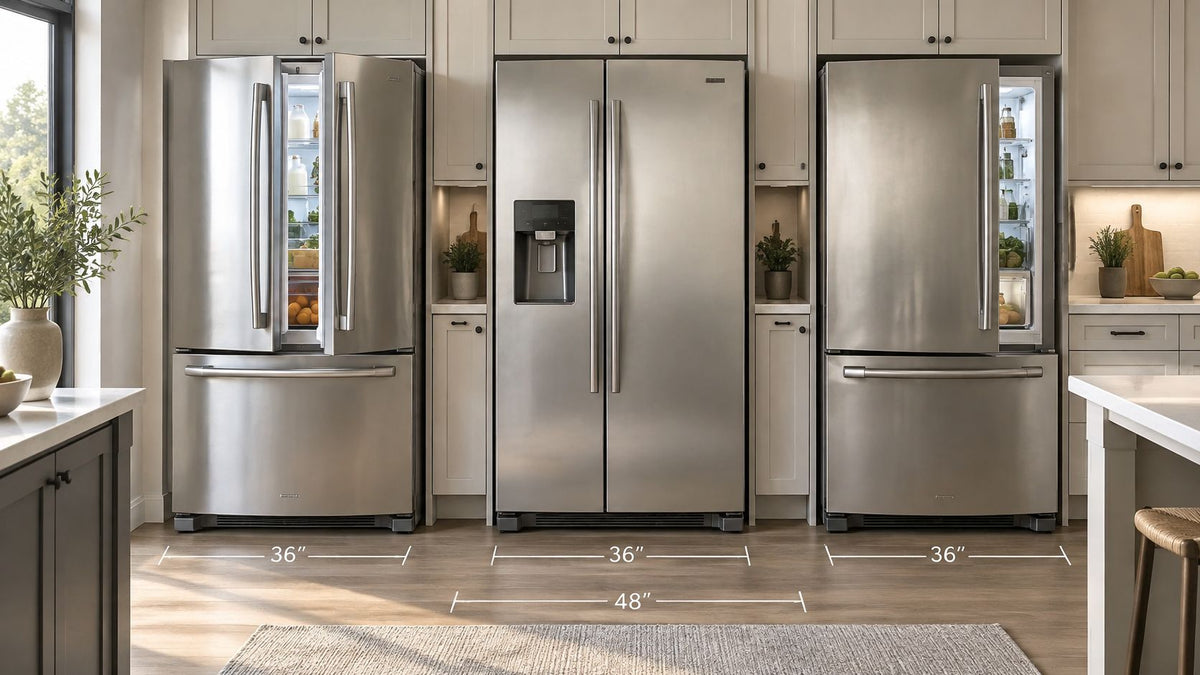
A common shortcut is to choose the 36 inch counter depth refrigerator that sits closest to flush and offers the most listed capacity. That can leave you with a fridge that blocks the aisle or whose doors hit a wall. Check the aisle, door swing and utility rebate rules before giving the counter-depth label much weight.
“Counter depth” does not guarantee that the refrigerator will stay out of the walkway once its handles and open doors are in play. Two models with the same exterior width can also differ in how much usable space they offer. And an efficiency badge may not translate into savings if your utility's rebate rules exclude that model or configuration. Compare fit, usable capacity and running cost before weighing the feature list.
Table of Contents
- Standard 36 Inch Counter Depth Measurements at a Glance
- Real Capacity Versus Exterior Footprint
- French Door, Side-by-Side and Bottom Freezer Layouts Compared
- Fit Test for Your Kitchen Aisle and Walls
- Energy Use and Yearly Running Cost
- Rebates and Utility Eligibility by Territory
- Matching a 36 Inch Model to Your Household
- Confirm the Fit and Order Before You Buy
Standard 36 Inch Counter Depth Measurements at a Glance
The 36-inch label describes the intended opening, not the refrigerator's full footprint. Before choosing a model, record six measurements and compare them with the specifications for its exact model number.
Typical dimensions vary by manufacturer and measurement method. The body depth may exclude doors or handles, so compare like with like. Our guide to counter-depth refrigerator sizing explains the terminology.
The Six Measurements to Record
| Measurement | Typical range | Check before buying |
|---|---|---|
| Nominal width | 36 inches | Measure the opening at the top, middle and base |
| Body depth without doors or handles | Varies by model | Compare with the counter face |
| Overall depth with handles | Varies by model | Check how much space remains in the aisle |
| Door swing radius | Set by model and hinge side | Mark the open-door arc with tape |
| Rear and top ventilation | Set by manufacturer | Follow the installation manual |
| Water and electrical provisions | Supply line for a plumbed ice maker; outlet for power | Confirm the supply line and outlet position |
Measure the opening at three heights. Older walls can bow inward, and baseboards can reduce clearance near the floor. Use the narrowest reading when checking the fit. Compare the refrigerator's body depth with the cabinet face for its finished position, then account for handles when assessing the aisle.
Why One Passing Number Isn't Enough
A refrigerator can match the opening and still sit too far forward or lack required ventilation clearance. Check the installation manual for the rear and top gaps before finalizing placement. An overhead cabinet or a unit pushed too close to the wall can restrict airflow.
Check service locations early. A plumbed ice maker needs a reachable water line, while an outlet behind the refrigerator may push it forward. That projection changes the footprint in the room.
For example, if the opening is wide enough but a handle meets a nearby wall as the door swings open, the refrigerator may fit in place yet fail in daily use. Mark the door arc and check the walkway before buying.
Keep all six measurements together. If a salesperson can provide only width and total depth, ask for the installation manual. Its clearance requirements determine how the refrigerator can be installed.
Real Capacity Versus Exterior Footprint
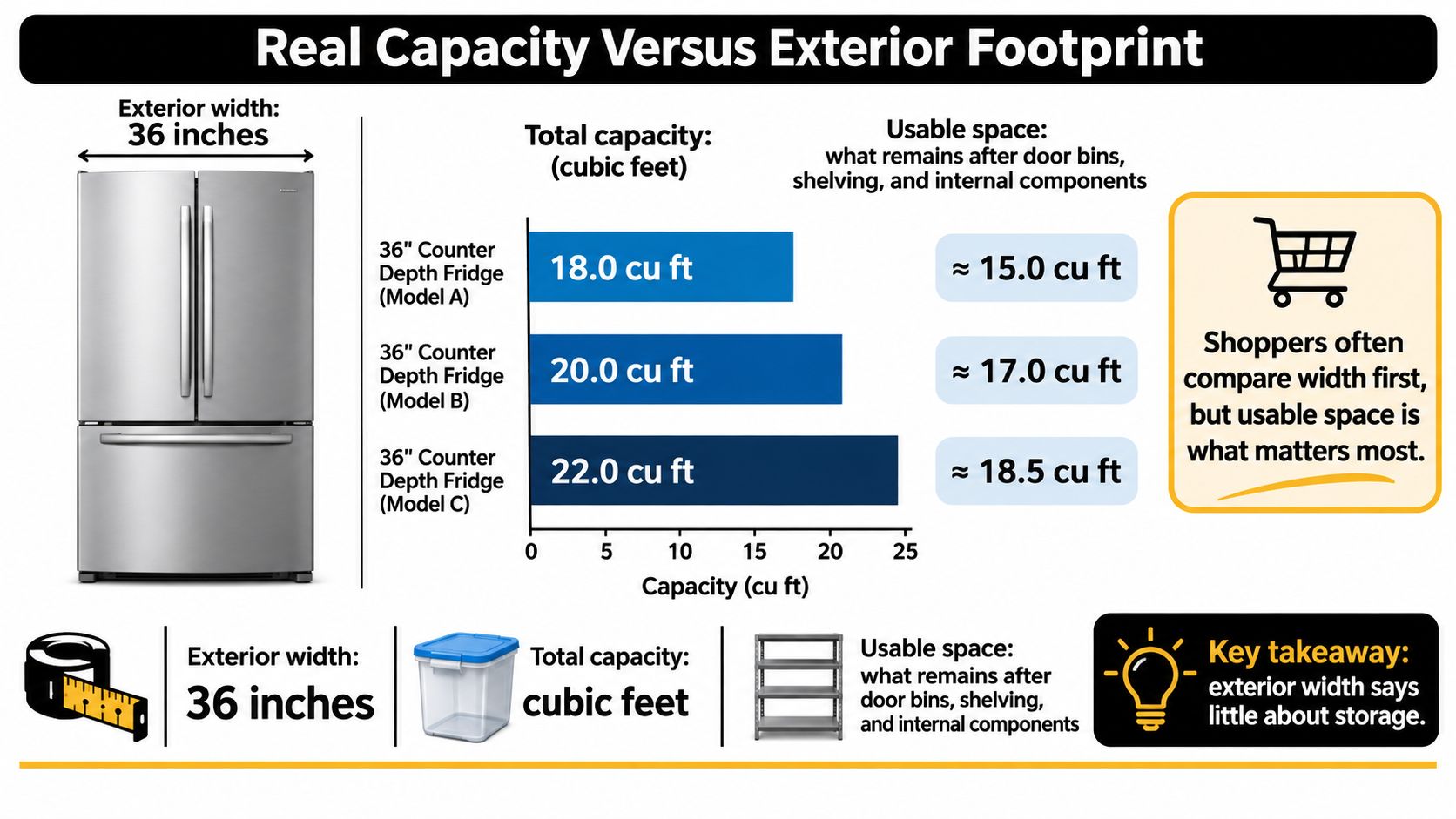
Exterior width says little about storage. Manufacturers quote total capacity in cubic feet, but usable space is what remains after door bins, crisper drawers, the ice-maker bin and the freezer partition take their share. Two 36-inch models can carry the same headline rating and still behave very differently on grocery day.
The chart below separates footprint from the space you can fill.
Adjusted Volume Is the Better Comparator
Compare the annual electricity use on the Canadian EnerGuide label for each exact model. The label gives the model’s estimated annual use in kWh.
That figure is a benchmark, not a prediction for a specific model. Its value is that it ties energy expectations to adjusted volume rather than nominal width. The same guide notes a qualifying ENERGY STAR model must exceed Canada's minimum regulated efficiency requirement by at least 20%, though you must verify the category for the exact configuration.
Test Shelf Depth, Not Just Cubic Feet
Say two hypothetical 36-inch units share a cubic-foot rating. A shallower body may hold shallower shelves than a deeper body in the same class. A large roasting pan or sheet tray may slide into one and jam against the door bins in the other. Cubic feet won't warn you about that.
Use this process for each candidate:
- Record the regulated figures: Note adjusted volume, annual kWh, freezer type, ice-maker configuration and certification status together.
- Confirm the depth basis: Check whether cabinet depth includes or excludes doors and handles before assuming alignment with your countertop.
- Run a grocery test: Picture a typical week, including a sheet tray, two large containers, tall bottles and leftovers, and map where each item sits.
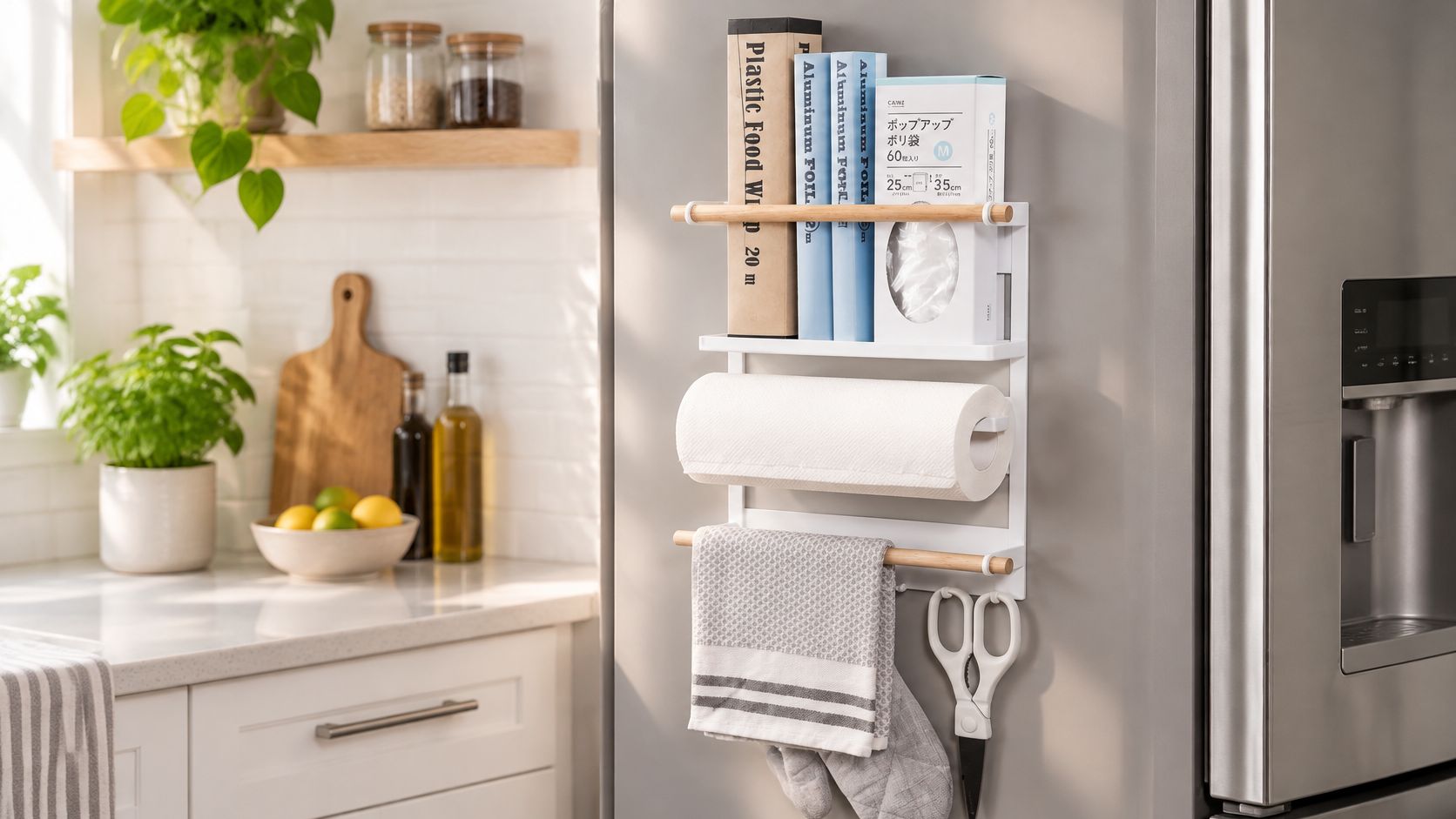
Counter-depth interiors reward organisation because you can't bury food at the back. Some households add exterior storage such as the Magnet Shelf Rack for Refrigerator - Kitchen Organizer, which is described as having a stable tray for seasoning bottles, magazines and plastic wrap, a middle hook position for paper towel storage and a bottom wooden rail for towels and kitchen tools. That doesn't create cold space, but it can move non-perishables off crowded counters.
Don't pay for capacity you can't reach or organise. A slightly smaller interior with full-width shelves often holds a family shop better than a larger rating split into narrow, awkward compartments.
Width predicts footprint, not storage.
French Door, Side-by-Side and Bottom Freezer Layouts Compared
Three layouts dominate 36-inch counter-depth lines, and each one changes daily use in a different way. Judge them on the same three criteria: fresh-food access, freezer use and the trade-off a 36-inch width creates.
The three formats look like this side by side.
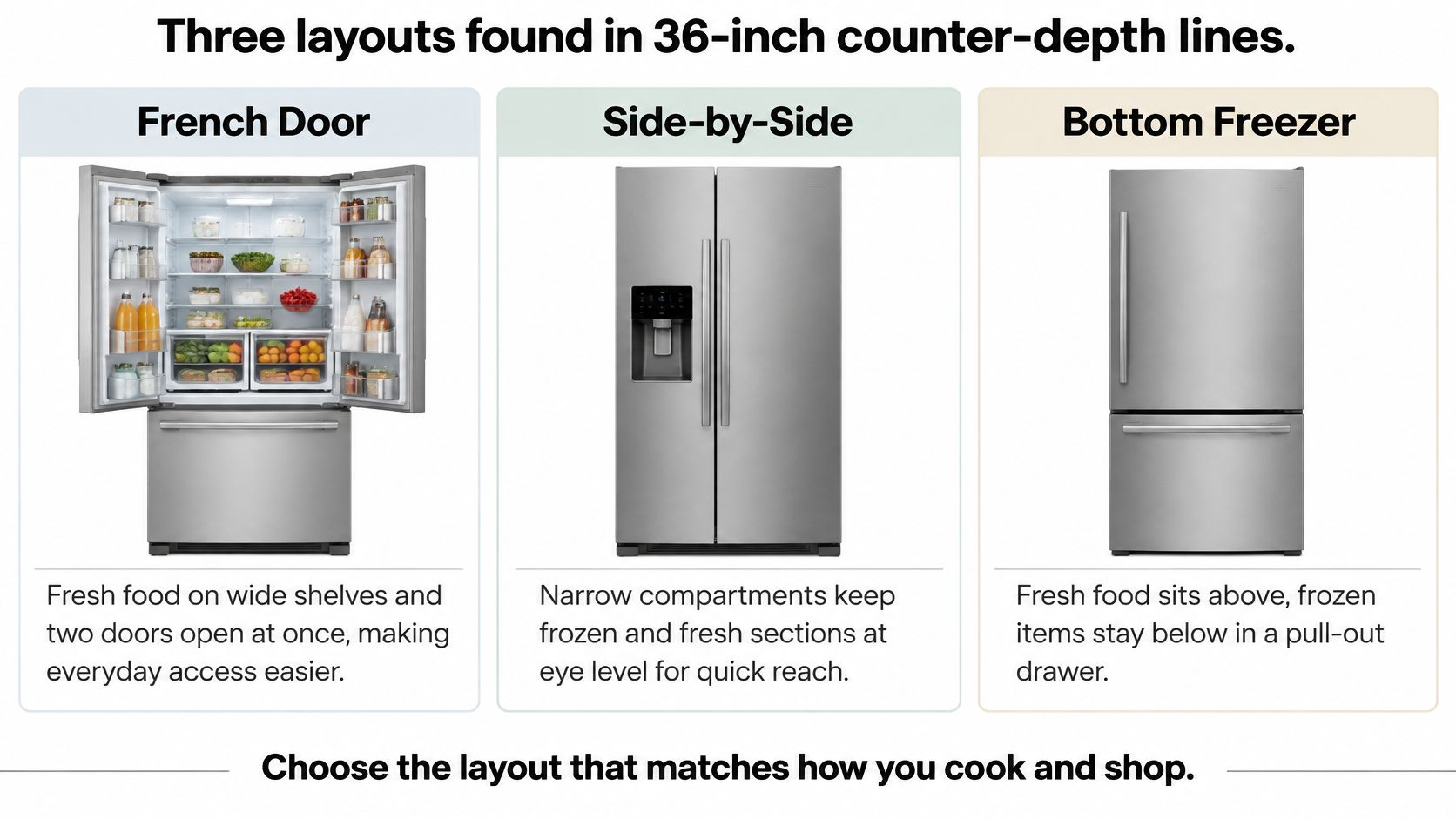
| Layout | Fresh food access | Freezer use | Main 36 inch trade-off |
|---|---|---|---|
| French door with freezer drawer | Wide shelves; two doors open together | Drawer below, often shallower | Doors need more aisle swing |
| Side-by-side | Tall, narrow compartments | Vertical freezer column | Less shelf width; freezer takes fresh-food space |
| Bottom freezer | Fresh food at eye level | Full-width freezer below | Freezer harder to reach; ice maker placement varies |
French Door
French door models put fresh food on wide shelves behind two doors. You can see everything at once, fit party platters and store sheet pans without tilting them. That suits households that cook from fresh ingredients most nights.
The cost is movement. Two doors need more aisle swing than a single narrow panel, and you'll often open both to reach the centre. The freezer drawer below is frequently shallower than a full compartment, so bulky boxes stack poorly and smaller items disappear under larger ones unless you use bins.
Side-by-Side
Side-by-side units split the cabinet into tall, narrow columns. Fresh and frozen foods both sit at eye level, and each door is light with a short swing. That's a genuine advantage in a narrow galley where a wide door would hit an island or opposite counter.
At 36 inches, though, shelf width is the constraint. A frozen pizza, wide cake box or roasting pan may not fit either column. The freezer also takes a fixed share of width from fresh food all the time, even in weeks when you barely use it.
This short video walkthrough helps you visualise how door style changes reach and swing in a real kitchen.
Bottom Freezer
Bottom-freezer models keep fresh food at eye level behind a single door or French doors, with a full-width freezer below. If you reach for milk, produce and leftovers far more often than frozen goods, this layout reduces bending for everyday items.
The freezer itself is harder to reach and organise, especially for anyone with limited mobility. Ice-maker placement also varies by model. Some put the maker in the freezer drawer, others in the fresh-food door, and that choice affects both usable space and service complexity.
Don't choose by showroom looks. Decide whether you reach for fresh food or frozen food more often, because that single habit decides which door configuration will feel right every day. Then check whether your widest regular item, not your largest occasional one, fits the shelves without forcing the door bins.
Fit Test for Your Kitchen Aisle and Walls
The word “counter-depth” describes a category, not a flush installation. The refrigerator body may align with the counters while handles, hinges and open doors project into the aisle. Measure the full footprint before choosing a model.
Mark the doors and drawers at full extension using the manufacturer’s installation drawing. Check the space left to pass and consult local requirements where accessibility rules apply.
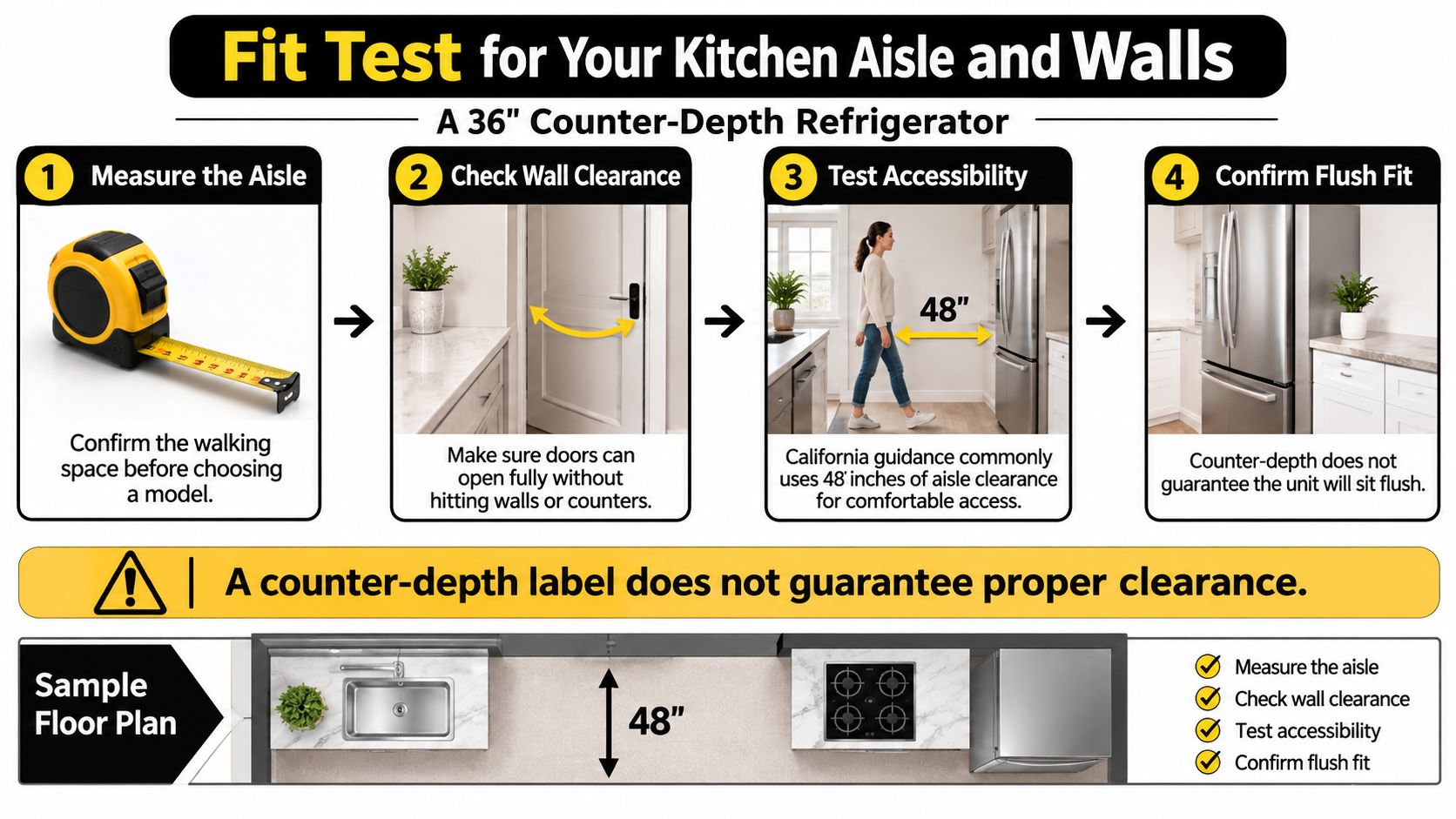
Run the Seven-Step Test
- Measure the opening at three heights: Record the width at the top, middle and base. Note bowed walls and trim that narrows the space.
- Separate body and handle depth: Record both measurements. The difference determines how far the handles project into the aisle.
- Tape the door swing: Mark the doors' opening arcs on the floor, including hinge-side clearance. Check what each open door reaches.
- Measure the aisle with doors open: Compare the remaining clear width with the 48- or 60-inch benchmark that applies to your layout.
- Walk the delivery path: Measure doorways, hallways, stair turns and elevator openings. The appliance must pass through every restriction on the route.
- Confirm services: Locate the outlet and water line, if needed. Check whether either position forces the refrigerator forward.
- Check permit triggers: Identify whether the installation involves a new circuit, extensive ice-maker plumbing or structural changes.
The San José residential kitchen remodel permit guidance explains when kitchen changes may require permits. Confirm local requirements before arranging installation. If the project also changes the cabinets, use this guide to standard kitchen cabinet depth to plan the opening.
Adjust the Test to Your Situation
Renters should get written landlord approval before changing plumbing or adding anchoring. A plug-in replacement that can be removed cleanly may be the simpler option.
During a remodel, specify the refrigerator model in the cabinet plan and coordinate the opening, outlet and water line with its clearances. In a U-shaped kitchen, check the 60-inch aisle benchmark first. If open doors on opposing runs collide or block access to the sink, prioritize door clearance over extra capacity.
Energy Use and Yearly Running Cost
Annual electricity cost is the refrigerator's labeled kWh per year multiplied by your electricity rate. The counter-depth label and exterior width do not predict the bill.
Compare annual electricity use for models with similar capacity and features.
Convert kWh Into Dollars
| Annual use (kWh) | Cost at $0.12 per kWh |
|---|---|
| 350 | $42 |
| 550 | $66 |
Use the applicable rate from your electricity bill. At an illustrative rate of $0.18 per kWh, a 100 kWh annual difference is about $18 per year.
How you load and access the refrigerator can affect how long its doors stay open. A smaller model with lower annual kWh may also have less usable storage, sending overflow to a second fridge and eroding the energy savings. The guide to energy-efficient kitchen appliances offers a label-first way to compare appliances.
Counter-depth construction improves alignment with cabinets and can preserve aisle space, but it does not automatically lower energy use. Insulation, compressor technology, configuration and the certified rating all matter. An external ice-and-water dispenser also adds components, including seals and heaters, compared with a simpler internal ice maker.
If two refrigerators cost about the same and hold the groceries your household needs, the lower-kWh model is the stronger choice. When it costs more, compare the annual savings with the price premium to see how long repayment would take.
Rebates and Utility Eligibility by Territory
A rebate can change which refrigerator makes financial sense, but eligibility depends on the utility serving your address. A model that qualifies on one side of a city boundary may not qualify on the other.
Check your utility or provincial energy agency for current eligibility, qualifying models and any requirement to apply before purchase.
| Utility | Minimum capacity | Rebate detail |
|---|---|---|
| Your local utility | Confirm the current minimum in cubic feet | Check current program rules before buying |
Use a Utility Lookup Checklist
- Confirm the utility from the service address: A neighbouring city's program may not apply to your home.
- Check the capacity and certification threshold: Verify the minimum cubic feet and whether the model must be ENERGY STAR or ENERGY STAR Most Efficient.
- Ask about recycling: Confirm whether the old unit must be recycled, who collects it, and whether it must be working.
- Subtract excluded costs: If delivery, taxes, or shipping are excluded, account for them when comparing net prices.
- Compare the premium with energy savings: Set the rebate and yearly energy savings against the price difference between models.
A rebate does not automatically justify paying more for a higher-efficiency model. Compare the price premium with the rebate and expected energy savings, and check whether your household has claimed a refrigerator rebate recently or the model meets the program's capacity minimum.
Statewide efficiency savings cover many appliance categories. They cannot show whether a particular 36-inch refrigerator will repay its premium in your kitchen. Your utility's rules and the costs of recycling the old unit determine what you can save.
Check eligibility before ordering. Some programs require pre-approval or a purchase through a specific marketplace, so a model's advertised rebate may not be available for every purchase.
Matching a 36 Inch Model to Your Household
Say a couple lives with a narrow galley kitchen. Their binding constraint is passage: aisle clearance and door swing come first, capacity second. A family of five who cook daily face the opposite problem. They need adjusted volume and shelf width before anything else, provided the doors can still open.
The right 36 inch counter depth refrigerators choice depends on which constraint binds first in your home. Start there and you'll eliminate half the catalogue for the right reason.
| Household situation | Check first | Layout that usually suits | Watch out for |
|---|---|---|---|
| Couple or single in a narrow kitchen | Aisle clearance and door swing | Side-by-side or bottom freezer | Narrow freezer capacity |
| Family cooking daily | Adjusted volume and shelf width | French door | Door swing needs aisle room |
| Renter | Landlord approval and plug-in fit | Standard plug-in model | Plumbed ice maker needs landlord sign-off |
| Open-plan remodel | Cabinet opening and vent clearance | Panel-matched French door | New circuit may need a permit |
| Short-term rental host | Durability and simple service | Simple side-by-side | Rebate minimums may exclude smaller units |
Read the Table by Constraint
For a narrow kitchen, a side-by-side or single-door bottom freezer keeps each door swing short. You'll accept narrower shelves in exchange for being able to pass an open door without turning sideways. Test your widest everyday pan before you commit.
For a family cooking daily, French doors earn their popularity. Wide shelves hold bulk produce, marinating trays and leftovers in one view. The watch-out is freezer organisation. Use shallow bins so the drawer doesn't become a frozen dig site, and confirm the aisle still works with both doors open and a child beside you.
Renters should prioritise removability. A standard plug-in model that fits the existing opening, outlet and water provision avoids disputes at move-out. If there's no water line, choose a model without a plumbed dispenser rather than running a line you don't have permission to install.
Remodel owners can design around the fridge instead of squeezing it in. That includes planning panel alignment if you want an integrated look. Our guide to panel-ready fridge options covers what panel matching requires from surrounding cabinetry. Lock the exact model before cabinets are built, because a late swap can break vent and hinge clearances.
Short-term rental hosts need a different kind of value: durability, simple controls and a standard layout that's easy for guests to understand and easy to replace. Fewer door electronics and a simpler ice system usually mean fewer service calls between stays. Standardise on one configuration across properties if you can, so cleaners and maintenance staff learn one machine.
A feature that helps one household can cost another usable space. A large through-door dispenser may delight a family that drinks iced water all day and frustrate a small household that loses door-bin storage and gains a more complex door.
The best 36-inch refrigerator is the one whose constraint you checked first, not the one with the most features.
I would not name a single winner for every home. Match the layout to your tightest constraint, then choose the simplest version of that layout that holds your normal weekly shop.
Confirm the Fit and Order Before You Buy
The counter-depth label does not tell you whether a refrigerator will work in your kitchen. The deciding details are the exact model, the route into the room, the space for doors and drawers, and whether your utility's rebate rules cover that unit.
Consider long-term fit and running cost alongside the price. Check the warranty and local availability of service and parts.
Final Decision Before You Order
Use the earlier checks to narrow the choice: Section 1 sets out typical dimensions, Section 2 explains usable capacity, Section 4 covers aisle and wall clearance, Section 5 compares energy costs, and Section 6 addresses local rebate eligibility. If two models pass those tests, choose the one that suits your household without adding features you do not need.
For example, say a French-door model fits your opening and your usual grocery load, and its EnergyGuide label and rebate eligibility meet your criteria. Before ordering, check the retailer's return terms for the specific model. Confirm whether an unopened unit can be returned, what happens if delivery reveals a fit problem, and who pays any return or restocking costs. A return policy that excludes opened or installed appliances changes the risk of ordering before the delivery route is confirmed.
Use the kitchen appliance dimensions guide to compare appliance measurements when planning a kitchen run. GrifGlo groups kitchen guides and product comparisons to help shoppers make decisions, and customer support is available Monday to Friday, 10 am–4:30 pm Pacific Time.
Order once the remaining uncertainty is about preference, not whether the refrigerator can be delivered, opened and used in the space. That distinction matters over the life of the appliance.



Leave a comment
This site is protected by hCaptcha and the hCaptcha Privacy Policy and Terms of Service apply.