

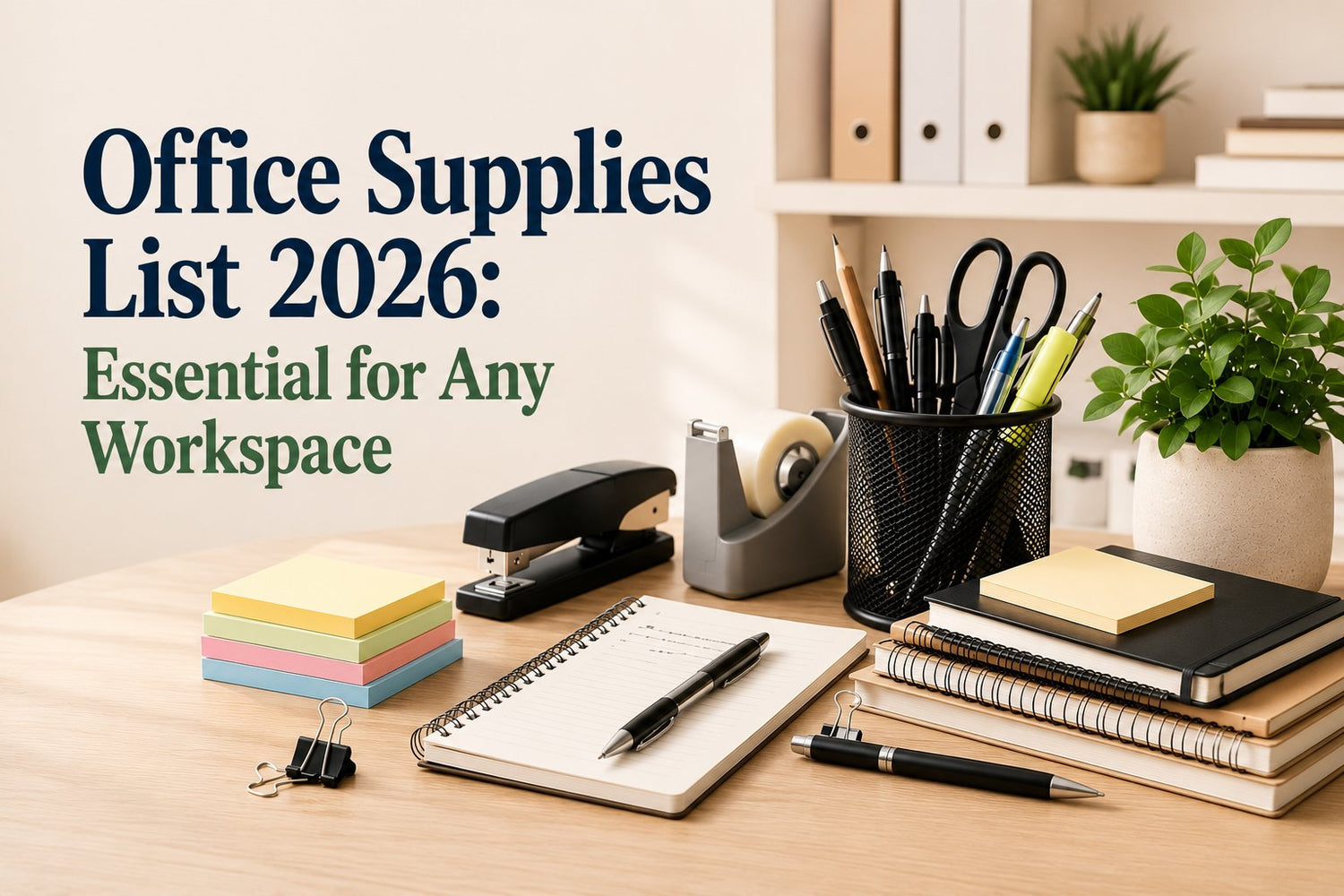
You're probably dealing with one of three situations right now. You're setting up a first workspace, trying to stop a messy supply cabinet from wasting money, or replacing a generic office supplies list that never quite matched how your team works.
That's where most office supply buying goes wrong. People start with a huge checklist, fill a cart, and only later realise half the order supports an office model they don't even have. A hybrid team doesn't need the same quantities as a five-day in-office team. A home office doesn't need the same storage system as a reception area. A rental property office nook has different priorities again.
A useful office supplies list isn't just a list of items. It's a small operating system for how your workspace runs day to day, how you restock, and how you avoid buying clutter.
Table of Contents
- Your Essential Office Supplies List Starts Here
- Build a Smart Procurement Strategy
- The Universal Office Essentials Checklist
- Scaling Your List for Home Office vs Small Business
- Supplies for Hospitality and Rental Properties
- Deep Dive on Paper Mailing and Filing Supplies
- Organizing Cleaning and Breakroom Essentials
- Frequently Asked Questions on Office Supply Management
Your Essential Office Supplies List Starts Here
A new workspace rarely fails because it lacks pens. It fails because nobody decided what needed to be standard, what should be shared, and what didn't need to be bought at all.
I've seen small teams order as if they were outfitting a traditional office from ten years ago. They buy stacks of folders, desk accessories for every seat, and extra paper storage, then discover most work happens in shared files, chat threads, and a few signed documents each month. On the other side, some teams swing too far toward digital-only thinking and forget the basics that still interrupt a workday when missing, like labels, mailing supplies, tissues, batteries, or a first-aid kit.
That tension matters because office purchasing isn't a niche activity. The office supplies sector generated about $1.4 trillion globally in 2024, and California alone contributes over $65 billion annually in a market tied to more than 4.5 million small businesses, according to GrifGlo's market summary.
A shorter list with better logic usually works better than a longer list copied from a generic template.
The right approach starts with three questions:
- What gets used weekly: These items belong on your core list.
- What supports compliance or safety: These can't be treated as optional.
- What only serves a rare task: Buy later, or keep one shared version.
If you build your office supplies list that way, you'll buy fewer dead items, stock the essentials properly, and make reordering much easier.
Build a Smart Procurement Strategy
Before the first order goes out, set up the system that will control every order after it. That means categorising supplies, assigning owners, defining reorder points, and reviewing usage on a fixed rhythm.

Start with operational categories
Treating everything as “stationery” makes inventory sloppy. Best-practice guidance recommends grouping items into operational categories such as writing tools, paper products, and organizational tools so you can run quarterly usage reviews and set precise reorder thresholds, as outlined in Indoff's office supply closet checklist.
A practical category structure looks like this:
-
Writing and desk use
Pens, pencils, markers, sticky notes, notebooks, correction tools. -
Paper and mailing
Printer paper, labels, envelopes, card stock, folders, mailers. -
Organisation and storage
Drawer trays, bins, shelving, label makers, archive boxes. -
Cleaning and facilities
Wipes, soap, liners, tissues, disinfecting products, signs. -
Breakroom and shared use
Cups, coffee supplies, dish soap, towels, food storage. -
Safety and compliance
First-aid items, extinguishers, wet floor signs, emergency basics.
Set thresholds that people will actually follow
A reorder point only works if someone can check it in under a minute. Don't create a spreadsheet so detailed that nobody updates it. Use a master list with a simple minimum level for each item category, then give one person authority to reorder.
Practical rule: Put fast-moving consumables on thresholds. Put long-life equipment on condition checks.
That means paper, toner, hand soap, bin liners, and labels should be tracked by quantity. A laminator, shredder, or spare monitor stand doesn't need the same treatment.
For shared support areas, small organising tools help maintain the system. A product like the ITY Single Sink Organizer with Suction - 90000 fits that logic in a kitchenette because it keeps sponges and brushes contained inside the sink area instead of spreading clutter across counters.
Review quarterly, not only when things run out
Most overbuying comes from panic ordering. A quarterly review catches dead stock, duplicate products, and categories where one site or team is consuming far more than the others.
During that review, check:
- Usage drift: Are you still ordering for a fully in-office team when attendance is mixed?
- Supplier performance: Were deliveries on time, accurate, and responsive?
- Item overlap: Do you have multiple products doing the same job?
- Shared-space friction: Are kitchens, copy areas, and supply cupboards staying organised?
If you also manage facility-related purchasing, category thinking transfers well to adjacent areas like wholesale kitchen supplies for shared-use environments. The same principle applies. Group by function, standardise the basics, and avoid one-off novelty purchases that complicate replenishment.
The Universal Office Essentials Checklist
A strong office supplies list starts with the items that nearly every workspace needs. This isn't the place to overthink quantities. It's the place to make sure you haven't missed a category.
Writing Tools
- Ballpoint pens
- Gel pens for frequent note-taking
- Pencils
- Mechanical pencils and lead refills
- Erasers
- Highlighters
- Permanent markers
- Dry erase markers
- Sticky notes
- Page flags
- Legal pads
- Notebooks
- Clipboards
Desk Organization
- Pen cups
- Drawer organisers
- Desktop trays
- Letter trays
- Document sorters
- Cable ties or cable sleeves
- Monitor risers
- Desk lamps
- Waste bins
- Recycling bins
- Bookends
- Label maker
- Desktop storage caddies
If an item doesn't have a clear home, it turns into visual clutter within a week.
Filing and Storage
- File folders
- Hanging folders
- Folder tabs
- Folder labels
- Archive boxes
- Binders
- Binder dividers
- Sheet protectors
- Storage bins
- Shelving
- Lockable storage for sensitive files
- Mail sorters
- Magazine files
- Document boxes for infrequent records
General Office Tools
- Staplers
- Staples
- Staple remover
- Scissors
- Box cutter
- Packing tape
- Clear tape
- Tape dispenser
- Binder clips
- Paper clips
- Rubber bands
- Ruler
- Hole punch
- Three-hole punch
- Glue stick
- Correction tape
- Batteries
- Extension cords
- Surge protectors
Basic Tech Peripherals
- Keyboard
- Mouse
- Mouse pad
- Headset
- Webcam
- Printer
- Toner or ink
- Scanner
- USB drives
- Charging cables
- Docking station
- Power adapters
- Router or Wi-Fi support equipment
- Paper shredder
The useful distinction here is between items every person may need individually and items that should be centralised. Pens, notebooks, and headsets often work best as assigned tools. Tape guns, label makers, shredders, and archive boxes usually work better as shared resources.
A lean office supplies list also removes outdated assumptions. Many teams no longer need individual desk calendars, excess binders, or large stocks of printed forms. But very few regret having spare cables, labels, mailing supplies, and a properly stocked cleaning cupboard.
Scaling Your List for Home Office vs Small Business
The biggest mistake in office purchasing is copying a team-office order for a single-person setup, or buying home-office style multipurpose gear for a growing business that needs reliability under regular use.
What changes as the team grows
A home office usually benefits from compact, dual-purpose choices. One printer-scanner combo, one set of desk organisers, one small filing solution, and one backup pack of core consumables is often enough. Storage matters, but footprint matters more.
A small business office works differently. Once several people share supplies, shortages show up faster, and duplicate buying becomes common unless someone standardises the list. That's also where safety and facilities items stop being an afterthought and become part of normal procurement.
In California, this matters even more. The average office space there requires an annual supply budget 22% higher than the national average, and hybrid work now represents 45% of the state's workforce, driving 12% year-over-year growth in spending on organisation solutions for both commercial and residential setups, as noted in the verified market data. For practical planning around shared-use support spaces, it can help to think alongside adjacent lists such as a kitchen essentials list for common areas.
A hybrid office usually needs fewer desk duplicates and better shared storage.
Recommended Starter Quantities by Workspace Size
| Supply Item | Home Office (1 Person) | Small Business (2-10 People) | Medium Office (11-50 People) |
|---|---|---|---|
| Pens | 10-20 | 2-4 boxes | Case-based ordering with central stock |
| Notebooks | 3-6 | 1-2 per person plus spare stock | Standard issue plus shared reserve |
| Sticky notes | 3-6 pads | 1 multi-pack per active cluster | Central cupboard with team allocation |
| Printer paper | 1-2 reams | Multi-ream reserve | Pallet or scheduled bulk ordering |
| File folders | 25-50 | 1-2 boxes | Standardised by department |
| Envelopes | Small mixed pack | 1-2 boxes by most-used size | SKU-specific stocking by use case |
| Labels | One basic set | A few standard label types | Restricted to approved formats |
| Bin liners | Small pack | Regular janitorial stock | Facilities-managed supply |
| Tissues | 2-4 boxes | Shared-room placement | Stock by washroom, meeting room, reception |
| First-aid items | One compliant kit | Kits in key locations | Multi-point coverage with inspections |
The table is a starter guide, not a fixed formula. A design studio may need more card stock and fewer mailing supplies. A field-service office may go through labels, clipboards, and batteries faster than notebooks.
What doesn't scale well is letting every employee choose different versions of routine items. Standardising paper sizes, folder types, labels, and cleaning basics reduces storage confusion and makes reordering much easier.
Supplies for Hospitality and Rental Properties
A hospitality office supplies list has to support guests, staff, and turnover. That changes what counts as essential. Durability, easy restocking, and clear presentation matter more than having a broad assortment of desk accessories.

Front desk and admin supplies
For a front desk, leasing office, or host station, keep the list tight and service-oriented:
- Registration forms or check-in sheets
- Pens that write reliably and are easy to replace
- Clipboards or writing boards
- Guest information folders
- Key envelopes or key card holders
- Labelled file folders for receipts, vendor records, and incident logs
- Mailing supplies for document handling
- Laminated quick-reference sheets
- A locked drawer or cabinet for sensitive paperwork
If the property has appliance guides or printed house rules, keep one master copy and one guest copy format. Don't let every unit evolve its own paperwork style.
Guest-facing and back-of-house items
Inside rooms or units, the office-supplies side of hospitality often looks simple but affects guest experience more than people expect. Useful items include a notepad, a working pen, a printed Wi-Fi or contact card, a checkout instruction sheet, and a durable information binder if the property uses one.
For cleaners and maintenance teams, the hidden supplies matter just as much:
- Inventory clipboards
- Restock checklists
- Storage bin labels
- Replacement tags
- Waterproof markers
- Tape and mailers for returns or vendor shipments
- Shelf organisers for linen or amenity rooms
Property teams that already think carefully about fixture sizing and room functionality often benefit from doing the same with support areas. A practical example is reviewing adjacent equipment guides, such as 36-inch fridge planning for hospitality spaces, because storage capacity and restocking flow are closely linked.
The best hospitality supply setups are boring in the right way. Staff know where things are, guests get consistent materials, and replacement decisions don't have to be made from scratch every week.
Deep Dive on Paper Mailing and Filing Supplies
Paper products cause more ordering mistakes than almost any other category because buyers often use informal names instead of exact specifications. “Standard envelopes” or “printer paper” might feel clear, but they're not precise enough for repeat purchasing.
Specify paper by use, not by habit
A technically sound requisition list should specify paper SKUs by format and separate paper products from hardware. One practical example is the envelope size reference that identifies #10 envelopes as 4 1/8 x 9 1/2 inches, noted in The Order Expert office supply checklist.
That sounds minor until someone orders the wrong envelope for a recurring mailing run.
Use the category this way:
- Printer paper for standard internal printing
- Three-hole punched paper for binder-heavy workflows
- Card stock for covers, signs, or presentation inserts
- Mailing labels for shipping and filing
- Pre-sized envelopes based on the documents sent
- Filing folders based on cabinet or shelf system, not habit
Paper should be ordered by task, not by whatever name people happen to use in email.
If your office still prints forms, pre-punched stock can remove a repetitive manual step. If you rarely mail documents, don't carry several envelope sizes without a reason. Standardise the one or two formats you use.
Separate consumables from hardware
Many office supplies lists become hard to maintain. The issue arises because paper, labels, envelopes, and tabs are consumables. Binders, punches, trays, and storage racks are hardware. They shouldn't sit in the same reorder logic.
A cleaner structure looks like this:
| Category | Examples | Reorder logic |
|---|---|---|
| Consumables | Printer paper, labels, envelopes, tabs | Quantity thresholds |
| Filing materials | Folders, hanging files, folder labels | Usage review by team |
| Hardware | Binders, punchers, trays, cabinets | Replace on condition |
| Archival support | Archive boxes, document sleeves | Review by record volume |
That separation prevents a common problem. Teams run out of labels because the category is buried under slow-moving binder stock.
Sustainability should also be specified at the product level, not treated as a vague preference. If your organisation has recycled-content requirements, list that in the item description so buyers don't substitute a non-matching paper stock just because the pack looks similar.
For offices with cramped storage, filing tools and closet systems need to match the paper plan. That's where thinking through closet organization units for supply storage becomes useful, especially when archives, printer stock, and stationery all share one cupboard.
Organizing Cleaning and Breakroom Essentials
A workspace feels organised when support items are easy to find and easy to refill. That usually comes down to three quiet systems working together. Desk and cupboard organisation, cleaning supply control, and breakroom basics.

Organization that supports daily work
Office organisation isn't about buying more containers. It's about making common tasks friction-free.
Keep high-frequency items at point of use. Pens near printers, labels near shipping supplies, tissues in meeting rooms, and spare cables near shared desks. Store low-frequency items higher up or in labelled back stock. If people have to dig for staples, wipes, or bin liners, they'll create unofficial stashes.
A good support layout includes:
- Supply bins by category
- Shelf labels people can read quickly
- One overflow area for reserve stock
- Separate locations for cleaning chemicals and food-related items
- Under-sink or inside-cabinet storage for kitchenette tools
Small-space offices often do better when they borrow organisation ideas from home utility setups, especially under-sink storage ideas for compact shared areas.
Cleaning and breakroom items people actually use
Cleaning stock should cover daily tidying, spills, touchpoint hygiene, and basic washroom or kitchenette upkeep. Don't build the list around rare deep-clean tasks. Build it around what gets reached for every week.
Core cleaning supplies usually include:
- Hand soap
- Disinfecting wipes
- Paper towels
- Facial tissues
- All-purpose cleaner
- Glass cleaner
- Sponges and dish brushes
- Dish soap
- Garbage bags
- Recycling bags
- Wet floor sign
- First-aid basics in the designated safety area
For waste handling, pick bins that fit the room and liner routine. A swing-lid bin often works well in breakrooms and copy areas because it keeps visual mess down and simplifies disposal patterns.
Here's a quick visual reference for breakroom organisation and use:
Breakroom supplies deserve the same discipline as office supplies. If the kitchen is stocked randomly, people overbuy personal duplicates, shared areas get messy, and supplies disappear faster than anyone expects.
A practical breakroom list includes:
- Coffee and tea basics
- Mugs or reusable cups
- Reusable plates or bowls
- Reusable cutlery
- Napkins
- Food storage containers
- Dish towels
- Drying rack or sink-side holder
- Bin liners and recycling support
Clean breakrooms don't stay clean because people are tidy by nature. They stay clean because the supplies, storage, and disposal points are obvious.
Frequently Asked Questions on Office Supply Management
Generic checklists usually stop at item names. That's why they miss the harder buying decisions, such as first-order priorities, team standardisation, and what no longer belongs in a hybrid office. That gap is called out directly in 4AllPromos' discussion of modern business supply lists.
How do I prioritise a first order?
Start with continuity items first. Paper, writing tools, labels, tape, bin liners, soap, tissues, power strips, and safety basics. After that, buy task-specific items that support your actual workflow, such as filing supplies, mailing materials, or breakroom tools.
Leave low-frequency purchases for the second round. That includes niche desk accessories, specialty paper, and extra storage products you may not need once the space is in use.
What should be standardised across teams?
Standardise anything that creates confusion when mixed:
- Paper sizes and common stock
- Envelope formats
- Folder and label types
- Basic pens and markers
- Cleaning staples
- Breakroom consumables
- Shared storage bins and shelf labels
What usually shouldn't be fully standardised are comfort items like keyboards, mice, and some headset preferences, unless policy requires it.
How do I manage supplies for hybrid staff?
Don't try to replicate the full office at every home workstation. Set a minimal personal kit for remote work, then keep shared office stock centralised. Hybrid setups work best when employees know which items are individually assigned and which stay on-site.
Review office attendance patterns before restocking shared desks. If occupancy shifts, your supply volume should shift too.
What do new managers most often forget?
The misses are predictable:
- Bin liners
- Batteries
- Labels
- Extension cords
- First-aid items
- Wet floor sign
- Dish soap and sponges
- Spare charging cables
- Staples for the stapler already ordered
- Folder labels for the folders already ordered
That last point comes up constantly. People buy the main item and forget the accessory that makes it usable.
How do I buy in bulk without overstocking?
Bulk buying only works on stable, fast-moving items. Paper, tissues, soap, liners, and standard pens are usually safe. For anything tied to changing workflows, buy a smaller initial quantity, then reorder based on actual use. A full cupboard isn't efficient if half the stock sits untouched.
If you're building or tightening an office supplies list and want a simpler way to compare practical essentials across organisation, kitchen, and shared-use spaces, GrifGlo offers decision-friendly guides that help offices, rental properties, and small teams structure purchasing without getting buried in endless catalog pages.

Leave a comment
This site is protected by hCaptcha and the hCaptcha Privacy Policy and Terms of Service apply.