

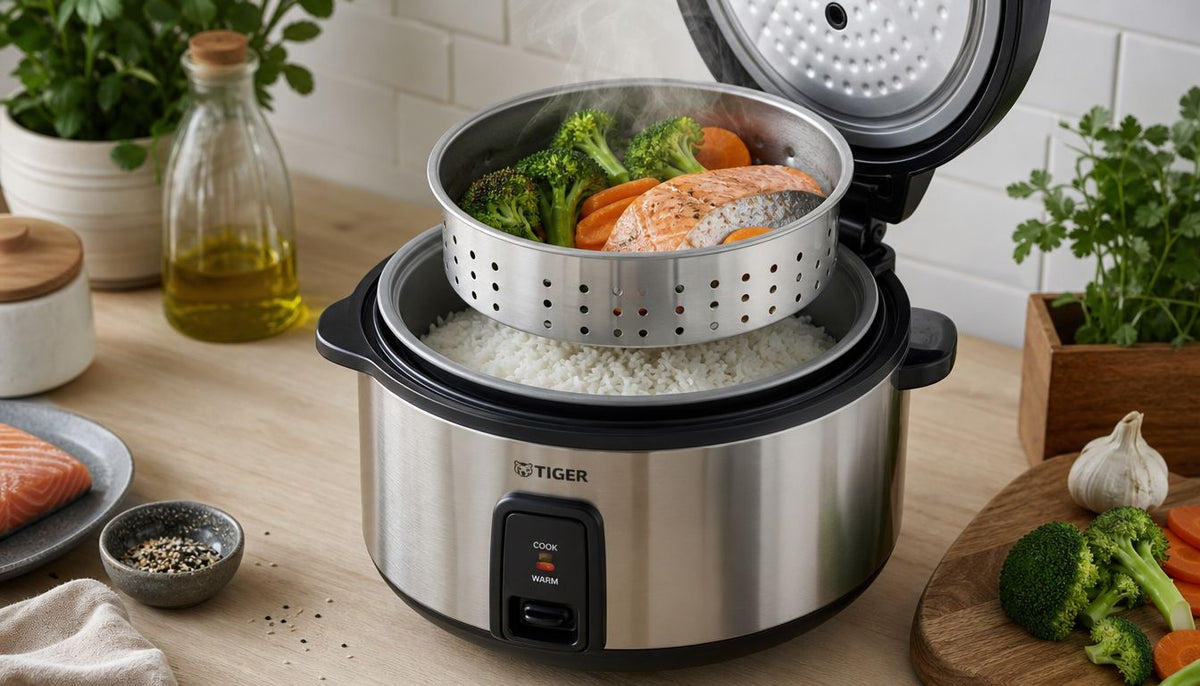
Tuesday evening, the stovetop is already crowded. Soup occupies one burner, the rice still needs cooking, broccoli needs steaming, and the salmon is waiting in the fridge. A rice cooker with steamer gives you another cooking zone: rice in the inner pot, vegetables or protein in the basket above, and the rest of dinner can happen without another saucepan.
That arrangement suits compact Canadian kitchens, busy families, renters, and short-term rental hosts who need dependable equipment without filling a cupboard with single-purpose tools. The appliance isn't magic, and its basket has real limits, but a well-matched model can turn rice plus one steamed component into a hands-off meal.
Table of Contents
- Why a Rice Cooker with Steamer Earns Its Counter Space
- How a Rice Cooker with Steamer Actually Works
- Pros and Cons of Cooking Rice and Steam at Once
- Choosing the Right Size and Features for Your Kitchen
- Setting Up and Cooking with Your Steamer Basket
- Easy Meal Ideas That Use the Steamer Side
- Cleaning, Care, and Long-Term Maintenance
- Where to Buy and What to Look for in Canada
Why a Rice Cooker with Steamer Earns Its Counter Space
A rice cooker with steamer earns counter space when it solves a meal problem you repeat. In a small apartment, start the rice, add vegetables or a modest portion of protein to the basket, and keep the stovetop free for soup, sauce, or aromatics.
The format is easy to find in Canada's mainstream retail market. Best Buy Canada's rice cooker and steamer category shows a broad selection, and Real Canadian Superstore also carries dedicated rice cooker and steamer subcategories. That availability makes the appliance a practical countertop option rather than a niche gadget.
One plug, two cooking jobs
The cooker handles part of the work normally split between a pot and a separate steamer insert. Rice stays in the inner pot while the basket holds another ingredient above it. You also avoid transferring food between vessels, which means fewer dishes and less counter traffic.
For a couple, that can be jasmine rice with bok choy. For a family, rice can cook below carrots and green beans while chicken finishes in a separate pan. The basket has limits, so treat it as one additional cooking level, not a replacement for a full steamer.
The strongest use case is dinner assembly. Rinse the rice, add the measured water, load the basket without packing it tightly, close the lid, and start the automatic cycle. Keep raw protein from dripping onto ready-to-eat food, and avoid placing delicate ingredients where condensation will pool. You can prepare sauce, chop garnishes, or clear the counter while the main cooking stage runs.
Practical rule: Buy this appliance for a meal pattern you repeat. If rice and steamed vegetables appear together on your table, the basket can earn its space. If you mainly need pressure cooking, sautéing, or slow cooking, choose a multi-cooker instead.
Where the compact format wins
Compact countertop capacities suit ordinary household meals better than oversized equipment that spends most of its life in a cupboard. That matters in small Canadian kitchens, where one reliable appliance can serve more often than several specialised tools.
The same logic applies to furnished rentals. Guests can understand a cooker with a simple switch or clearly marked programme, and hosts can provide one appliance for a staple grain and a side dish. Give users clear guidance about basket loading, drip control, and warm-hold limits. Cooked food should not sit warm indefinitely, especially in a rental where the next user may not know when the cycle ended.
A dedicated cooker will not replace every pan. It does give a small kitchen a reliable second cooking surface without adding another burner, and it is often easier to explain and store than a multi-cooker.
How a Rice Cooker with Steamer Actually Works
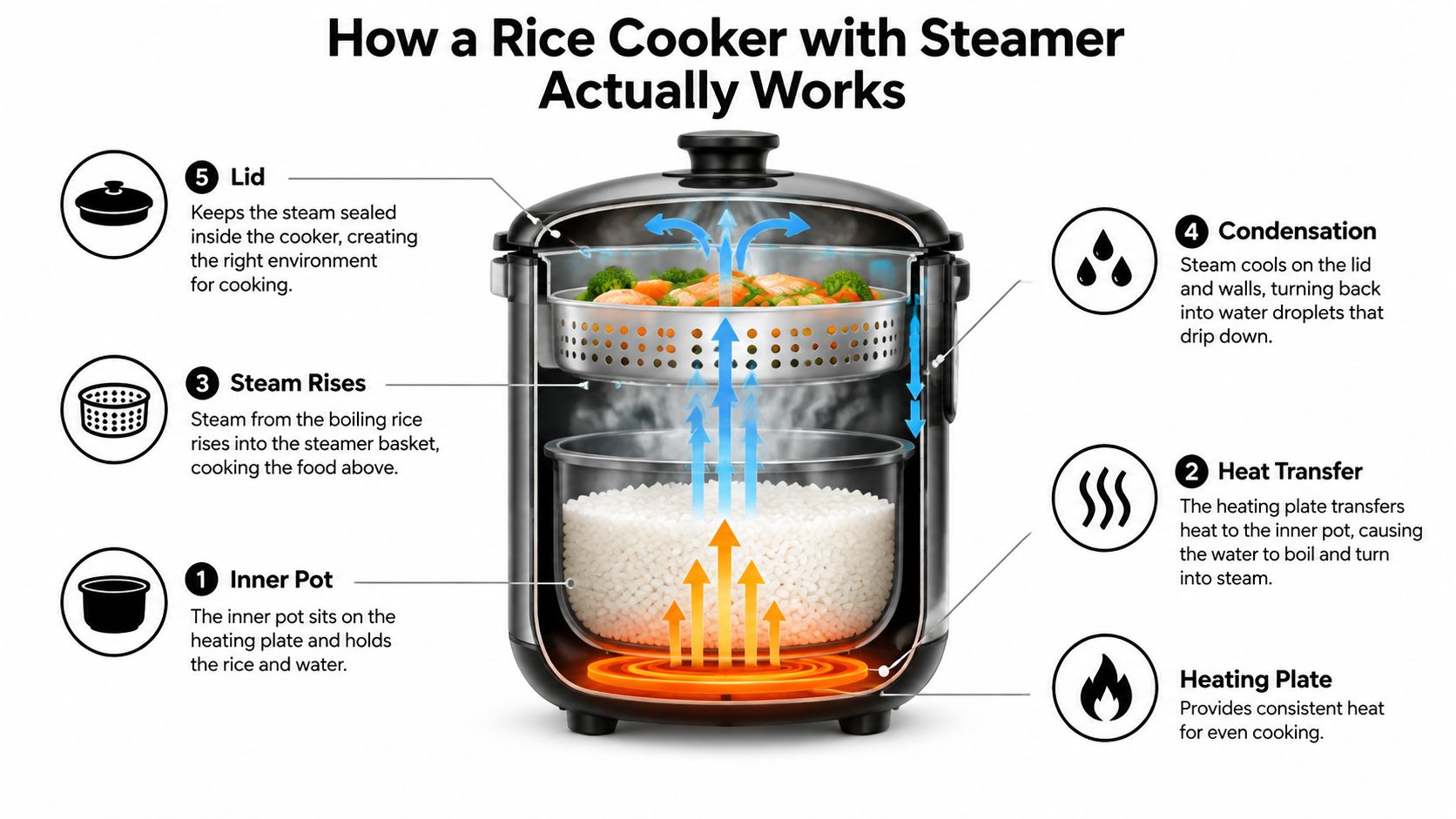
Think of the appliance as a covered pot with an automatic hand on the thermostat. The inner pot sits on an electric heating plate. Rice and water go below, the perforated basket rests above, and the lid keeps the steam inside long enough to cook both layers.
The heat and moisture path
The sequence is straightforward:
- The heating plate warms the inner pot. A temperature sensor at the base detects changes as the water heats and later becomes absorbed.
- Water turns into steam. With the lid closed, moisture rises through the cooking chamber instead of escaping immediately.
- Rice cooks in the inner pot. The grains absorb water while the surrounding heat builds.
- Steam reaches the basket. Steam passes through the perforations and cooks the food above the rice.
- Condensation returns through the lid. Some moisture collects on the lid and may travel back towards the pot, which is why delicate foods need thoughtful placement.
This is similar to placing a colander over a covered pot of boiling water, except the cooker decides when to move from cooking to warming. Canadian documentation describes models with two heat settings and a stated 100 °C maximum operating temperature, supporting the practical view that these appliances are built around atmospheric steaming rather than dry-heat browning. See the Canadian Tire product documentation for a rice cooker and steamer for that operating information.
What each part contributes
The non-stick inner pot holds the rice and water. Its fill lines matter because too much water can create foaming and spillover, while too little can leave the grains firm. The steamer basket must sit securely above the rice line, with enough open space for steam to circulate.
The lid needs a clear vent path. Don't cover the vent, push the appliance against a wall, or position the vent directly beneath a cabinet that could trap condensation. The basket material may be plastic or stainless steel, and the basket shape affects how evenly food cooks.
The HAUZ ARZ866 6-Cup Rice Cooker is one example of the familiar arrangement, with a non-stick bowl, a steam basket for vegetables or shrimp, a warmer option, cool-touch handles and knob, and dishwasher-safe parts.
Pros and Cons of Cooking Rice and Steam at Once
The two-in-one design saves active cooking time, but the basket does not add capacity. It creates a second cooking layer, and that layer works best with portions that leave clear space for steam.
| Factor | What works well | What to watch for |
|---|---|---|
| Simultaneous cooking | Rice and a side use one plug | The basket may finish before or after the rice |
| Counter space | One appliance handles two jobs | Clearance is still needed around the vent |
| Hands-off cooking | Automatic switching reduces stovetop monitoring | Check doneness and remove food safely |
| Flavour control | Vegetables can take on gentle rice steam | Fish, garlic, or marinades can drip into the rice |
| Basket capacity | A shallow basket suits small portions | Crowding causes uneven steaming |
| Warm-hold | Rice stays ready to serve | Quality and safety decline with extended holding |
| Cleaning | Removable parts simplify washing | Starch can block basket holes and vents |
The biggest benefit is active-time reduction. While the cooker handles rice and steaming, you can prepare sauce, set the table, or wash dishes. That matters in a small apartment or busy family kitchen, where one appliance and one outlet can cover two tasks. It also suits short-term rentals, provided guests can see the water lines and understand the vent clearance.
The main limitation is portion geometry. A basket that looks roomy when empty becomes cramped with thick vegetables, dumplings, chicken, or fish. The Sunbeam Canada rice cooker FAQ notes that steaming baskets can be shallow and should not be overloaded. Treat that limit as more important than the headline capacity. Arrange food in a single, loose layer where possible, and cut dense pieces small enough to cook through.
The basket is a steam chamber, not a second pot. Leave room for steam, or expect uneven cooking.
Drip management needs planning. Meat or fish juices can fall into the rice, changing its flavour and adding grease. Greaseproof paper can separate the foods during mixed steaming, as the Sunbeam FAQ notes, but it must not cover the basket holes or touch the heating area. For strongly seasoned protein, use a liner only when it still permits free steam movement.
Warm-hold is convenient, not indefinite storage. Serve delicate protein and vegetables promptly, and avoid leaving cooked food on warm for extended periods. Remove the basket carefully, since trapped steam can burn hands.
A dedicated rice cooker with steamer suits couples, small households, meal preparation, and straightforward rental kitchens. Choose a multi-cooker if sautéing, pressure cooking, slow cooking, or one-pot stews are more common than rice and steam together. For a small Canadian kitchen, the dedicated cooker wins on simplicity and footprint, while the multi-cooker wins on menu range.
Choosing the Right Size and Features for Your Kitchen
Capacity labels are easy to misread. Manufacturers may list cooked capacity, uncooked capacity, or a cup measure specific to the appliance. Choose a cooker based on the rice you regularly prepare and the food that must fit in the basket, rather than the largest figure on the box.
Canadian listings include compact formats such as a 1.4 L unit and a 6-cup cooker and steamer, as shown in Best Buy Canada's Canadian listings. Use those figures only as reference points. Check the basket dimensions, usable depth, and manufacturer's instructions before buying.
Three practical capacity tiers
| User Type | Capacity (cups) | Must-Have Features | Nice-to-Have Features | Watch Out For |
|---|---|---|---|---|
| Solo renter or couple | 3 | Secure basket, clear water lines, removable pot | Delay timer, compact handles | A wide basket may still hold little food |
| Small family | 5 to 6 | Tight lid, accessible vent, sturdy basket | Multiple grain programmes, warm-hold control | Protein portions can crowd a shallow basket |
| Small business or batch cooking | 8 to 10 | Durable pot, replaceable parts, stable basket | Timer controls, easier service access | Counter space, cleaning time, and electrical load |
A basic on/off cooker suits renters who move often. It weighs less, has fewer controls for guests to misuse, and is easier to replace if an appliance disappears from a rental kitchen. Fuzzy-logic and induction models provide more controlled cooking, but their added cost and complexity make less sense when portability is the priority.
Features worth prioritising
The basket must fit securely, with feet or a stable ledge to keep it above the rice. It should not wobble, sit directly in the cooking water, or prevent the lid from sealing. A labelled steam vent and removable inner pot make daily handling safer and cleanup simpler.
Basket shape affects what you can cook. A wide, low basket suits dumplings, fish fillets, and other flat foods. A taller basket holds more loose vegetables, but can crowd the steam chamber of a compact cooker. For rentals, dishwasher-safe parts can shorten turnover, though the care instructions still determine whether the non-stick pot, lid, and seal can go in the dishwasher.
Prioritise controls you will use. A clear water line, stable basket, and accessible parts matter more than extra programmes that stay untouched. For a small kitchen, reliable storage and easy cleaning usually beat a larger footprint packed with features.
Setting Up and Cooking with Your Steamer Basket
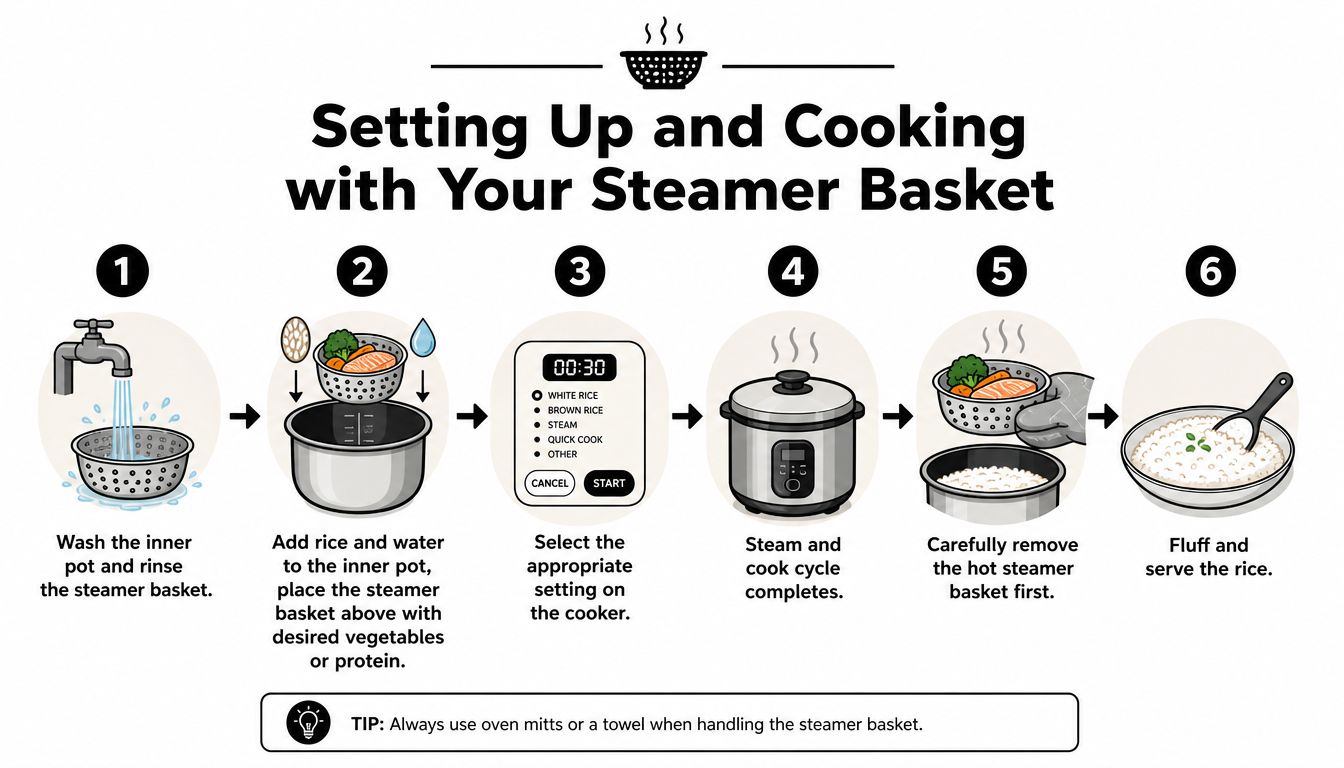
Wash the inner pot and rinse the steamer basket before first use. Run one plain-water cycle if the manual permits it, then dry every component completely. This removes manufacturing residue and gives you a clean baseline before food enters the cooker.
For daily cooking, use the sequence below:
- Measure and rinse the rice. Remove excess surface starch so the finished grains don't become unnecessarily gummy.
- Add water to the marked line. Use the line for the rice type you're cooking, rather than guessing from the basket height.
- Start the appropriate cycle. Keep the lid closed so the cooker can build a stable steam environment.
- Add the basket at the right stage. For many compact units, vegetables or protein can be added after the rice has begun steaming. Follow your model's manual rather than relying on a universal timing rule.
- Load food loosely. Keep protein in a single layer and leave visible gaps between pieces. Don't compress vegetables into a solid mound.
- Remove the basket carefully. Steam burns happen quickly. Use mitts, lift the basket away from your face, and place it on a heatproof surface.
- Fluff and serve the rice. Removing the basket first reduces the chance of pooled condensation falling over the grains.
Loading limits and warm-hold decisions
The basket should stay below its practical load limit even if the lid still closes. Overloading blocks steam, leaves the centre or upper layer undercooked, and encourages you to extend cooking longer than the rice needs. Meat and fish deserve particular care because juices can drip into the rice, so use a compatible liner only if it leaves steam holes open and the manual allows it.
For rice texture, a Canadian FAQ advises leaving cooked rice on warm for 15 minutes before serving, allowing residual moisture to redistribute. The same source says warm-hold shouldn't exceed 12 hours, while basket food shouldn't be treated as an all-day holding solution. For food-safety decisions, follow the appliance manual and current Canadian food-safety guidance rather than assuming the warm setting makes every food safe indefinitely.
Remove steamed protein when it's cooked. Keep-warm is a rice feature, not permission to leave fish or chicken in the basket for hours.
Keep the vent unobstructed, close the lid before starting the cycle, and don't fill the inner pot beyond its marked limit. For a visual walkthrough of the daily process, use the rice cooker and steamer cooking demonstration.
Easy Meal Ideas That Use the Steamer Side
Plain rice is only the entry point. The steamer becomes more valuable when you pair foods that can share one cycle without competing for space or taking on unwanted flavour.
Rice and quick vegetables
Put jasmine or basmati rice in the inner pot, then use the basket for bok choy spears, sliced carrots, or green beans. Softer vegetables can go in later, while denser carrots may need the full steam stage. Finish the plate with soy sauce, sesame oil, and scallion.
This is the cleanest introduction because vegetables release little liquid and don't usually overpower the rice. Keep the pieces similar in size so the basket doesn't produce a mix of tender and raw sections.
Rice with fish or chicken
Brown or short-grain rice can sit below salmon or small chicken pieces arranged over aromatics. The basket catches steam from beneath, while some juices may fall towards the rice and become part of the cooking liquid or flavour base.
Use a single layer and avoid thick overlapping pieces. Fish can cook quickly, so add it later when the rice has already developed a strong steam cycle. Chicken needs a reliable doneness check, not just an assumption based on the cooker switching modes.
Weekend batch preparation
A weekend batch can combine rice with barley or quinoa, while the basket handles sweet potato cubes, broccoli florets, or dumplings. Portion the cooked components into containers once they have cooled appropriately, then refrigerate them promptly according to safe food-handling practice.
Hard vegetables belong in the basket early. Dumplings and delicate greens need less exposure, so add them later when the cooker design permits it. Strongly flavoured foods, especially garlic-heavy fish, can perfume the rice. That may be a welcome built-in sauce, but don't use this method when you need completely separate flavours.
The best combinations share similar steam needs and tolerate a little condensation. Foods that require browning, crisp edges, or frequent turning belong in a pan or oven instead.
Cleaning, Care, and Long-Term Maintenance
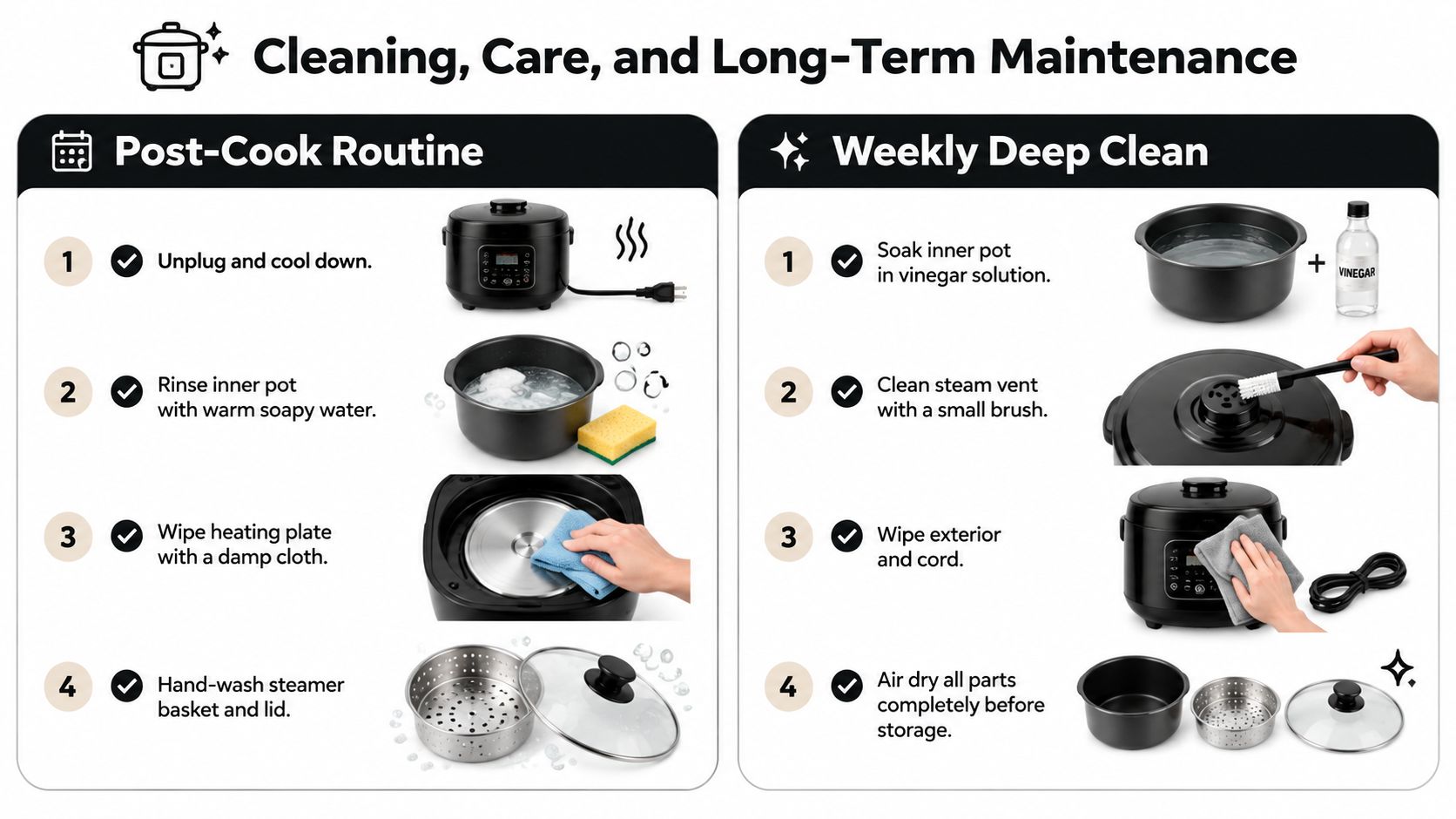
Clean the cooker while residue is still soft. Unplug it, let the housing cool, and rinse the inner pot with warm soapy water. Wipe the heating plate with a damp cloth, then dry it before replacing the pot. Never pour water into the cooker body.
The basket deserves more attention than many owners give it. Starch and food particles can block perforations, reducing steam flow and creating cold spots. Hand-wash the basket regularly, inspect every hole, and use a soft brush rather than a sharp object that could enlarge or damage the openings.
The parts that affect performance
Wipe the lid and condensation channel frequently. Trapped moisture can develop odours, and a blocked vent changes how steam moves through the basket. Check the lid seal for warping, tears, or food buildup before each use.
Mineral residue can collect around the heating plate and sensor area, especially where hard water is common. Use only the descaling method approved by the manufacturer. Some manuals permit a mild vinegar or citric-acid treatment, but you shouldn't pour any solution into the electrical housing or improvise a cycle that the instructions don't support.
The non-stick pot has reached the end of its useful life when the coating flakes or rice sticks despite correct rinsing, water, and handling. Replace the pot if the manufacturer offers one. A damaged gasket also matters because poor sealing changes the steam environment and can make cooking inconsistent.
For storage, dry every part completely, keep the lid slightly ajar, and store the basket separately if space allows. Wrap or route the cord without bending it sharply against the housing. Before cooking, inspect the basket holes, lid seal, vent, condensation area, and heating plate.
Where to Buy and What to Look for in Canada
Canadian shoppers can find rice cookers with steaming baskets through mass retailers, appliance departments, grocers, online marketplaces, and specialty importers. The Canadian Tire rice cooker and steamer selection shows how the format appears in an ordinary small-appliance aisle, while brands such as Dainty and Hamilton Beach Canada continue to promote steaming alongside rice cooking. Dainty Foods describes its rice cooker with a steamer basket, including the ability to steam vegetables or heat chicken while rice cooks underneath.
Canada's small kitchen appliances market generated USD 433.3 million in 2024 and is projected to reach USD 572.0 million by 2030, with a 4.8% CAGR from 2025 to 2030, according to Grand View Research's Canada market outlook. The same source identifies rice cookers and steamers as the fastest-growing product segment within that market. That supports a practical buying conclusion: there are enough mainstream choices to compare basket design, maintenance, and fit instead of buying the first compact cooker you see.
| Channel | Price Range (CAD) | Best For | Warranty Notes |
|---|---|---|---|
| Major retailers and grocers | Varies by listing | Basic household use and easy returns | Check the retailer return period and manufacturer coverage |
| Online marketplaces | Varies by seller | Wider brand selection and compact formats | Confirm who handles warranty service and replacement parts |
| Specialty importers | Varies by model | Japanese or Korean cooking features | Verify North American voltage and Canadian support |
| Restaurant-supply distributors | Varies by capacity | Batch cooking and repeated commercial use | Ask about commercial warranty terms and service access |
| Direct manufacturer orders | Varies by quantity | Multi-unit rental or hospitality purchasing | Confirm parts, shipping, and support before ordering |
Don't treat price tiers as universal facts. Instead, compare the actual specification sheet. Check the inner-pot material and care instructions, Canadian replacement-part availability, basket dimensions, vent position, return policy, and voltage compatibility if the model comes from outside North America.
For a household, prioritise a stable basket, a removable pot, clear controls, and a lid that can be cleaned properly. For a rental, choose simplicity, durable handles, dishwasher-safe components where confirmed, and a replacement path. For a small business, buy for repeatable batch size and service support, not just the lowest purchase cost.
GrifGlo helps shoppers compare practical kitchen essentials, including cookware and small appliances, with decision-friendly guides and sizing advice, and it also supports structured purchasing for rental properties and hospitality operations. Visit GrifGlo to narrow your rice cooker with steamer search by real kitchen needs, then confirm the retailer's specifications and warranty before you buy.

Leave a comment
This site is protected by hCaptcha and the hCaptcha Privacy Policy and Terms of Service apply.