

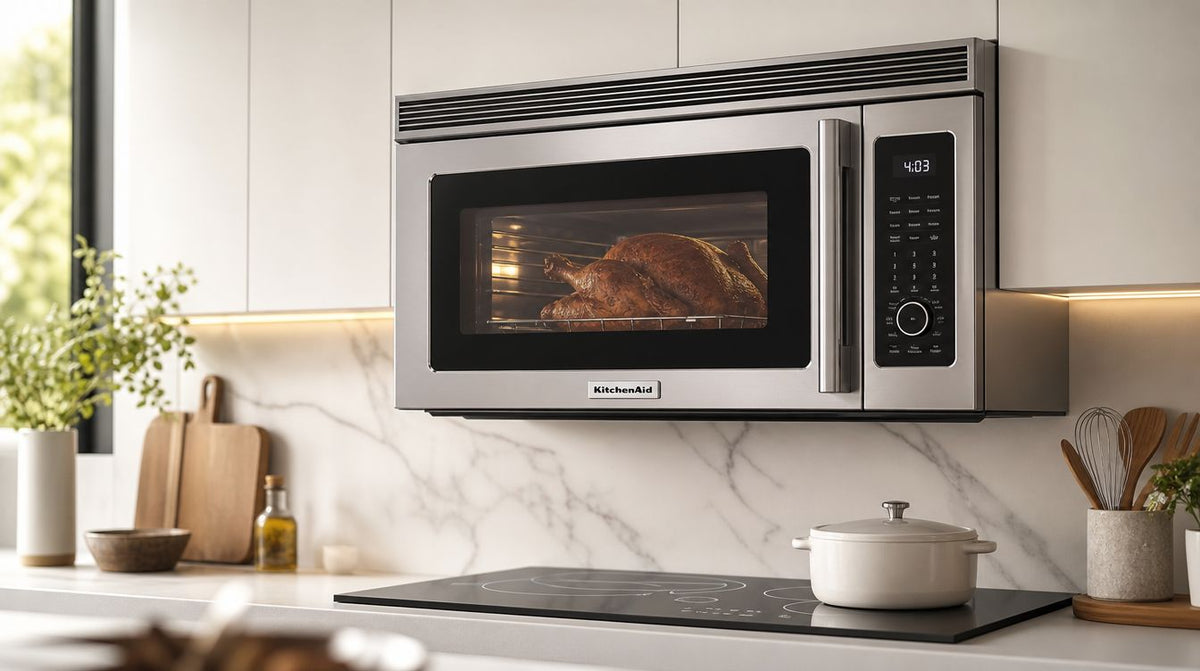
You're standing in a half-finished kitchen, the counter is already crowded, and the old microwave is consuming the one clear stretch of workspace. Replacing it with an over-the-range microwave oven with convection sounds efficient: microwave speed, oven-style browning, and a built-in hood in one appliance. The catch is that this isn't a casual plug-in upgrade. It's a mounted cooking and ventilation system with clearance, electrical, cavity-size, and compliance decisions attached.
Convection can be useful, but it won't turn a compact hood-mounted appliance into a full-size wall oven. The right choice depends on whether you'll bake or roast in it, whether your kitchen can support the installation, and whether you're comfortable trading cavity space and hood performance for a cleaner, more multifunction layout. Buyers in Canada should also pay attention to the 2026 standby-power change, while California shoppers need to treat the appliance as a regulated built-in installation rather than a countertop microwave with extra buttons.
Table of Contents
- Why Over-the-Range Convection Microwaves Are Gaining Traction
- How Convection Mode Actually Works in an OTR Microwave
- Comparing Convection OTR Against Other Microwave and Oven Types
- Installation Requirements and Ventilation Considerations
- Key Features and Performance Signals to Evaluate
- Use-Case Recommendations for Households and Rental Properties
- Making Your Final Purchase Decision with Confidence
Why Over-the-Range Convection Microwaves Are Gaining Traction
A common renovation problem goes like this. The kitchen has limited counter space, the cooktop already sits below a hood, and the household wants fewer separate appliances. A standard over-the-range microwave solves the placement problem, but it only reheats, defrosts, and cooks with microwave energy. A convection model promises more, combining microwave heating, convection baking, and ventilation in one enclosure.
That combination appeals to apartment owners, smaller households, and anyone who wants a tidy kitchen without adding a wall oven. It also suits people who use the microwave daily but occasionally need to brown a casserole, roast vegetables, bake a small dish, or finish food with a crisp surface. For a broader look at multifunction kitchen technology, GrifGlo's guide to smart kitchen appliances places convenience features in the context of actual kitchen routines rather than treating connectivity as a substitute for useful cooking performance.
The real question is oven performance
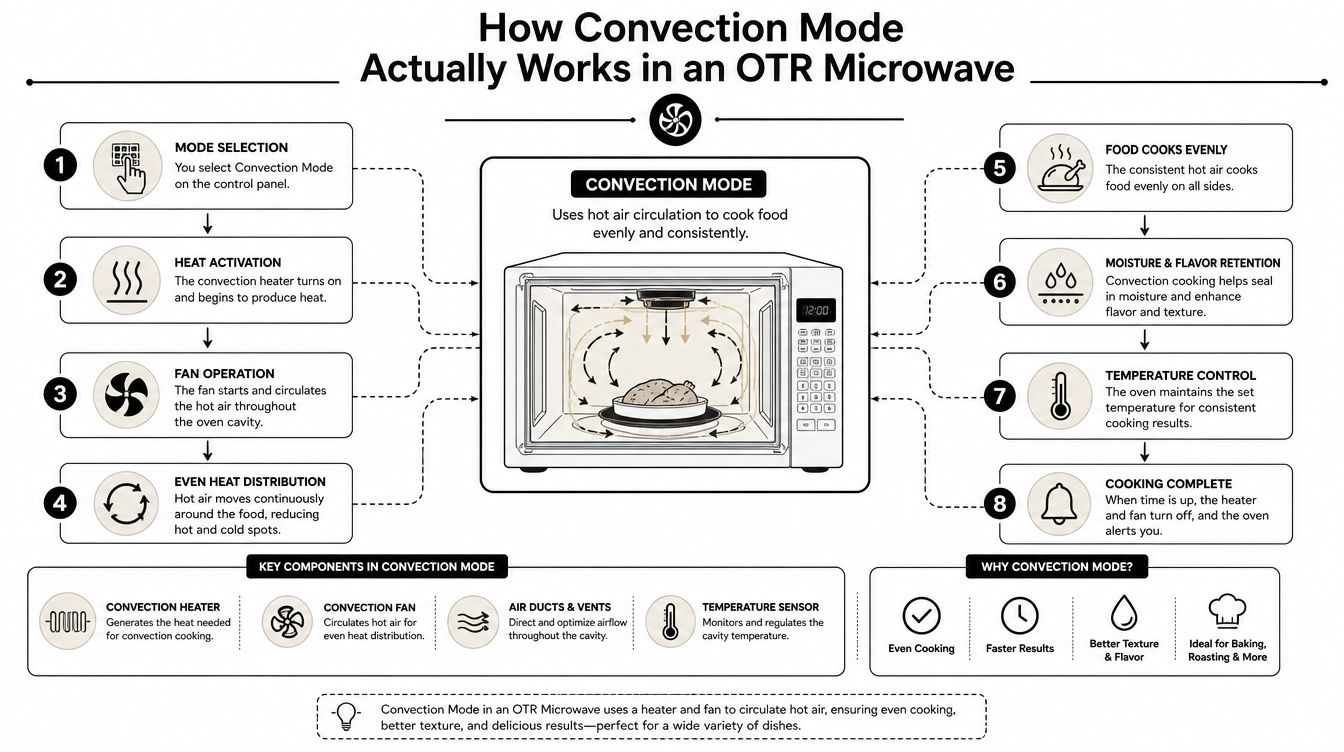
Convection is not merely a fan attached to a regular microwave. A heating element warms the cavity while a fan circulates hot air around the food. That creates the dry heat needed for browning and roasting, something microwave-only cooking cannot deliver in the same way.
Still, an OTR cavity has physical limits. The appliance must fit above the cooktop, leave room for ventilation equipment, and stay compact enough for common cabinet layouts. That usually means less flexibility for large roasting pans, tall dishes, and multiple trays than you'd get from a dedicated oven.
Practical rule: Buy convection because you'll use its baking and browning functions, not because the word “convection” makes the microwave sound more premium.
The other issue is installation. In California, a listed microwave installed over a listed cooking appliance follows the upper appliance's listing and the manufacturer's instructions under the mechanical code, while new construction also requires kitchen exhaust to vent outdoors under the state's energy standards. The usual clearance is 30 inches from the cooking surface to the bottom of the microwave unless the manufacturer permits less, and the installation generally uses a dedicated 120-volt, 20-amp circuit. Those requirements make the category closer to a built-in appliance system than a simple countertop device. California installation guidance explains why the mounting position, upper appliance listing, and manufacturer instructions matter together.
How Convection Mode Actually Works in an OTR Microwave
Microwave-only cooking uses electromagnetic energy to excite water molecules in food. It's excellent for speed, reheating, steaming, and softening, but it doesn't create the same dry surface heat that browns bread, crisps pastry, or caramelises the outside of roasted food.
Convection cooking adds a heating element and a fan. The element heats the air, and the fan moves that air around the cavity so food receives more consistent surface heat. A useful analogy is room heating. Microwave energy is like placing a space heater close to an object and warming it quickly from within. Convection is more like a forced-air furnace, it heats the surrounding air and distributes that heat around the food.
Three modes, three cooking behaviours
Microwave-only is the speed setting. Use it for reheating soup, cooking vegetables, defrosting ingredients, or warming leftovers. The food may become hot quickly, but the surface generally won't brown like it would in an oven.
Convection-only behaves more like a compact fan oven. The appliance preheats, the heating element raises the air temperature, and the fan circulates that heat around the dish. This mode is the one to use for baking, roasting, and browning when you want a dry, oven-like finish.
Combination mode uses microwave energy and convection heat together. The microwave shortens the cooking process, while the hot air improves surface colour and texture. It's useful when you want food cooked faster than conventional baking but don't want the pale or soft exterior that microwave-only cooking can leave behind.
Rack position matters far more in convection mode than it does in ordinary reheating. The rack must sit where the manufacturer intends, with enough space around the food for air to circulate. A crowded dish can block airflow and produce uneven browning, while a tall container may sit too close to the upper element or interfere with the door.
Cookware also changes by mode. Microwave-safe glass and ceramic are common choices for microwave use, but convection mode follows oven-style cookware rules. The rack supplied with the unit must be used as directed, and the cavity and door can become hot enough to require oven mitts. Read the manual before combining microwave energy with metal accessories, because the safe configuration depends on the appliance design.
For a practical comparison of forced-air cooking systems, GrifGlo's air fryer versus convection oven guide can help clarify why airflow, cavity shape, and food quantity affect results. Even an unrelated accessory such as the Camera Bicycle Handlebar Mount Professional Camera follows the same basic buying principle: judge the actual design and use case, not just the headline feature.
Comparing Convection OTR Against Other Microwave and Oven Types
The best appliance depends on what you're replacing. A convection OTR microwave is strong when one space must perform several jobs. It's less convincing if you already have a capable oven and mainly need fast reheating.
A standard OTR microwave costs you less functional space inside the appliance, but it also gives up baking and roasting. A countertop convection oven delivers stronger flexibility in a small footprint, though it occupies the counter you were trying to clear. A built-in wall oven gives the best oven experience, but it requires dedicated cabinetry and a separate microwave solution.
Appliance Type Comparison Matrix
| Appliance Type | Cooking Versatility | Space Impact | Installation Complexity | Best For |
|---|---|---|---|---|
| Over-the-range convection microwave | Microwave, convection, combination cooking, and basic ventilation | Frees counter space and occupies the hood position | High, because clearance, electrical supply, mounting, and venting must align | Small kitchens needing one multifunction appliance |
| Standard over-the-range microwave | Fast microwave cooking and ventilation | Frees counter space with a simpler internal system | Moderate to high, depending on venting and electrical layout | Households that rarely bake in the microwave |
| Countertop convection oven | Stronger access for baking, roasting, and crisping, with microwave functions absent | Uses valuable counter or storage space | Low, usually requiring only a suitable outlet and clearance around the unit | Cooks who prioritise convection performance and can spare counter space |
| Built-in wall oven | Best capacity and oven-style cooking control | Requires cabinet space and usually a separate microwave location | High, with cabinetry, electrical work, and precise fit requirements | Frequent bakers, large households, and serious cooks |
Where the OTR format wins
The convection OTR earns its place through space efficiency. It combines functions that would otherwise require separate locations, and it keeps the counter available for prep. Retail listings in California show the category is established, not theoretical. A KitchenAid model advertises multiple cooking modes and 1600 watts of convection power, while a Whirlpool smart model also lists 1600 watts. The KitchenAid listing provides a concrete example of the premium specification buyers are encountering.
The U.S. Bureau of Labor Statistics' quality-adjustment research also treated convection as a meaningful heating-method attribute in OTR pricing models. The over-the-range model explained about 87.2% of price variation, while the countertop model explained about 90.6%, with the values reported as R² in the research. That supports a practical conclusion: convection-equipped microwaves are evaluated as a differentiated appliance class, not as standard microwaves with decorative features. The BLS research is useful context when comparing feature-driven pricing.
Where it loses
The compact cavity limits large cookware and makes batch cooking awkward. Ventilation also deserves scrutiny. An OTR fan can remove cooking fumes, but it may not match the capture and exhaust performance of a dedicated range hood, especially when the cooktop produces substantial heat, grease, or steam.
For Canadian shoppers comparing categories rather than chasing features, GrifGlo's best microwave ovens in Canada guide is a sensible companion. My recommendation is simple. Choose convection OTR for a compact, multifunction kitchen. Choose a standard OTR if microwave speed and basic exhaust are all you need. Choose a countertop convection oven if baking results matter more than a clear counter. Choose a wall oven if capacity and serious oven cooking come first.
Installation Requirements and Ventilation Considerations
An over-the-range convection microwave should be planned before cabinets are finalised. It has to fit between the cooktop, upper cabinetry, electrical supply, and vent path, and each of those decisions affects the others. Measuring the appliance box alone isn't enough.
Start with clearance and power
The commonly cited installation rule is 30 inches between the cooking surface and the bottom of the microwave, unless the manufacturer's instructions allow a smaller distance. The exact model documentation controls, so don't rely on a generic cabinet drawing when the appliance is going above a gas or electric cooking surface.
The electrical requirement is also more demanding than many buyers expect. California guidance ties these installations to a dedicated 120-volt, 20-amp circuit in virtually all cases, which means the existing outlet behind an old microwave may not be suitable. Have an electrician verify the circuit rather than assuming that a nearby receptacle solves the problem. California mechanical-code guidance reinforces the central point: the listed unit must be installed according to its listing and manufacturer instructions.
Choose the vent path before ordering
Exterior venting is my preference for a convection OTR, especially if you cook with high heat or produce a lot of steam. It sends airborne grease, moisture, and odours outdoors instead of returning them to the room through a filter.
Recirculating installation can work when exterior ducting isn't practical, but it places more responsibility on filter maintenance and room ventilation. It also makes a poor cabinet fit more obvious, because the appliance must preserve its tested airflow path and fan arrangement. A unit designed for an updraft exterior configuration shouldn't be casually adapted to a recirculating setup without following the manufacturer's conversion instructions.
Installation warning: A cabinet can look perfectly aligned while still restricting the fan, blocking the duct, or violating the appliance's tested clearance.
The 2026 standby-power shift adds a timing question. California's efficiency rule caps standby power for covered OTR convection microwave ovens at 2.2 watts for units manufactured on or after June 17, 2016, and sets a tighter 0.6-watt limit for units manufactured on or after June 22, 2026. At those idle levels, continuous operation works out to about 19.3 kWh per year versus 5.3 kWh per year, a reduction of roughly 72%. California's Section 100 approval notice contains the applicable rule and dates.
If your purchase is urgent, a compliant older model remains a practical option if it fits and performs well. If you're renovating slowly, waiting for newer compliant inventory can reduce persistent standby draw. Don't delay a necessary kitchen installation solely for the future standard, but don't ignore the manufacturing date when comparing otherwise similar units.
Use the manufacturer's instructions for the exact duct direction, mounting plate, cabinet depth, and circuit. This over-the-range microwave installation guide can help you organise the project, but it shouldn't replace local electrical, building, or appliance requirements.
Key Features and Performance Signals to Evaluate
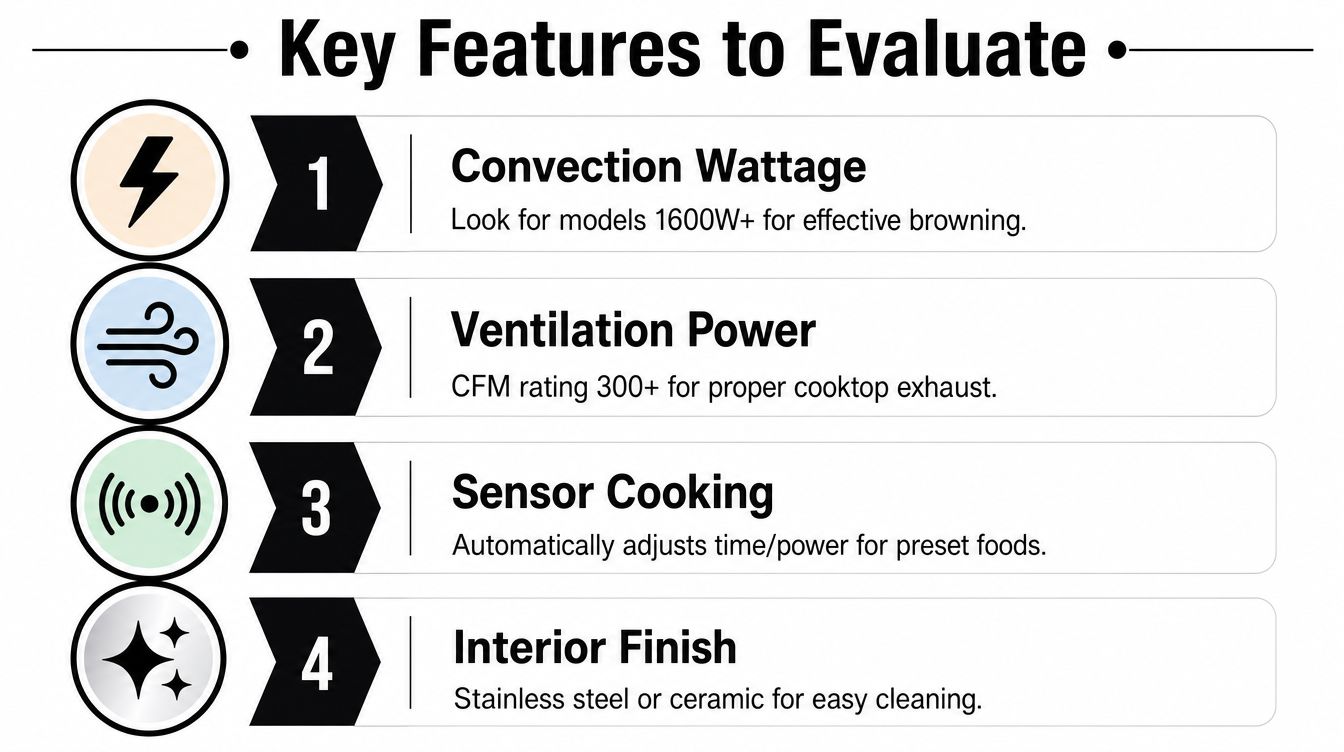
Start with convection power, not smart connectivity. California-facing listings from KitchenAid and Whirlpool show 1600 watts of convection power, which is a useful premium-tier signal when you're comparing models intended to bake and brown rather than merely warm food. Wattage alone doesn't guarantee even results, but a serious convection system needs enough heating capacity to bring the cavity up to temperature and recover after the door opens.
Cavity size creates the main compromise. Canadian listings show new models arriving in 2026 with formats such as 1.9 cubic feet and a 30-inch installation width. That can be a sensible footprint, but it doesn't mean the interior accepts every roasting dish or baking tray. Check the usable rack width, door opening, turntable diameter if fitted, and the clearance above the rack, not just the advertised cubic measurement.
Read the rack and cavity details
The supplied rack is part of the cooking system. It establishes food height and airflow, and it may be required for specific convection or combination programmes. A rack that's difficult to remove, poorly supported, or too close to the heating element will make the convection function frustrating even if the headline specifications look impressive.
The cavity and door also become hot during convection cooking. Use oven mitts, keep children away from the open door, and follow the manual's instructions for rack placement and cookware. The over-cooktop position makes this especially important because users reach upward from an active cooking area.
Treat ventilation as a cooking specification
Look for the venting configuration first, then compare the stated ventilation performance within the models that fit your kitchen. A convection appliance generates more oven heat and moisture than a microwave-only unit, so the exhaust arrangement matters to comfort and cabinet protection.
Sensor cooking is useful for reheating and preset foods, but it shouldn't rescue a weak convection design. A turntable can support more even microwave heating, while a flatbed can simplify access for larger dishes, though each design changes usable space and cooking behaviour. Smart connectivity belongs at the bottom of the list. If the unit has poor clearances, an unsuitable vent path, or an inconvenient rack, an app won't fix it.
My buying order is straightforward:
- Convection system: Confirm the heating element, fan arrangement, available modes, and stated convection power.
- Usable cavity: Measure the dishes you already own, especially roasting pans and baking trays.
- Rack design: Verify that the rack is included, stable, removable, and approved for the modes you plan to use.
- Ventilation setup: Decide between exterior and recirculating venting before cabinet work begins.
- Controls and sensors: Choose controls you can operate without a manual every time, then consider sensor programmes.
- Connectivity: Add smart functions only after the cooking and installation fundamentals pass inspection.
Use-Case Recommendations for Households and Rental Properties
For an active household with limited counter space, convection OTR is a strong choice when the microwave runs daily and the convection mode will handle regular small-batch baking or roasting. It works particularly well when you're replacing an old OTR microwave during a planned renovation and can arrange the circuit, clearance, and ducting properly.
I wouldn't recommend it to a household that already owns a good oven and only wants better reheating. In that case, the added installation complexity and smaller convection cavity don't buy enough practical value. A standard OTR microwave plus a separate countertop convection oven can be more flexible if you have a suitable place to store or operate the countertop unit.
Renters and property managers need a stricter filter
For rentals, serviceability matters more than an impressive feature list. A convection OTR can make a small kitchen feel complete, but a failed appliance may be harder to replace because the next unit must match the mounting position, cabinet geometry, electrical circuit, and vent configuration.
Choose straightforward controls, accessible filters, durable interior materials, and clear documentation. Confirm who is responsible for filter cleaning and whether maintenance staff can remove the appliance without damaging the cabinets. Compliance with the applicable standby-power rules also matters when you're standardising appliances across multiple units.
Small homes require honest capacity checks
Multifunction appliances make sense when every square foot matters, but compactness can become a problem if the unit is too deep for the cabinets, too low over the cooktop, or too small for the dishes you regularly use. Canadian coverage has highlighted demand for space-saving multifunction appliances, yet buyers still need to inspect the unglamorous details: maintenance access, heat management, venting, and fit.
For a Canadian apartment or rental, I'd buy convection OTR only when the landlord or installer confirms the mounting and venting arrangement, the circuit is suitable, and the cavity matches the household's cookware. If those conditions aren't met, choose a standard OTR or a countertop appliance that can be removed without altering the kitchen.
The Canadian energy timing question deserves attention too. NRCan's 2026 standard sets a 1.0-watt standby limit for OTR convection microwave ovens manufactured on or after June 22, 2026, down from the earlier 2.2-watt limit. Canadian market coverage identifies the product and compliance gap buyers should investigate before accepting discounted older inventory.
Making Your Final Purchase Decision with Confidence
You can reduce the decision to three questions.
- Can the kitchen support the appliance? Confirm the clearance, dedicated circuit, cabinet fit, and vent path before ordering.
- Will you use convection regularly? If your cooking is mostly reheating and defrosting, standard OTR is the more sensible purchase.
- Does the cavity fit your cookware? Measure the actual roasting dishes and trays you use, not just the advertised capacity.
If you answer yes to all three, buy the convection OTR. If you answer no to the second or third, don't pay for an oven function that will frustrate you. The compact format is valuable, but only when its limits match your cooking habits.
The 2026 standby-power rules may influence timing. Current models remain usable and can be appropriate when the installation is urgent, while newer compliant inventory may lower persistent idle consumption. California buyers should check the manufacturing date against the state's 0.6-watt requirement, and Canadian buyers should check whether a model manufactured on or after June 22, 2026 meets the 1.0-watt NRCan limit.
Use a decision framework rather than scrolling through endless features. GrifGlo's decision-making framework reflects the approach I'd use here: start with fit and purpose, then compare performance signals, maintenance demands, and purchase timing. A reliable appliance that fits the kitchen beats a more connected model that can't vent properly or accommodate your cookware.
GrifGlo brings kitchen appliances and everyday home essentials into decision-friendly guides, comparisons, and sizing advice, including practical help for households, rentals, and structured purchasing. Visit GrifGlo to compare options by real-world fit, cooking use, and installation considerations before you buy.

Leave a comment
This site is protected by hCaptcha and the hCaptcha Privacy Policy and Terms of Service apply.