

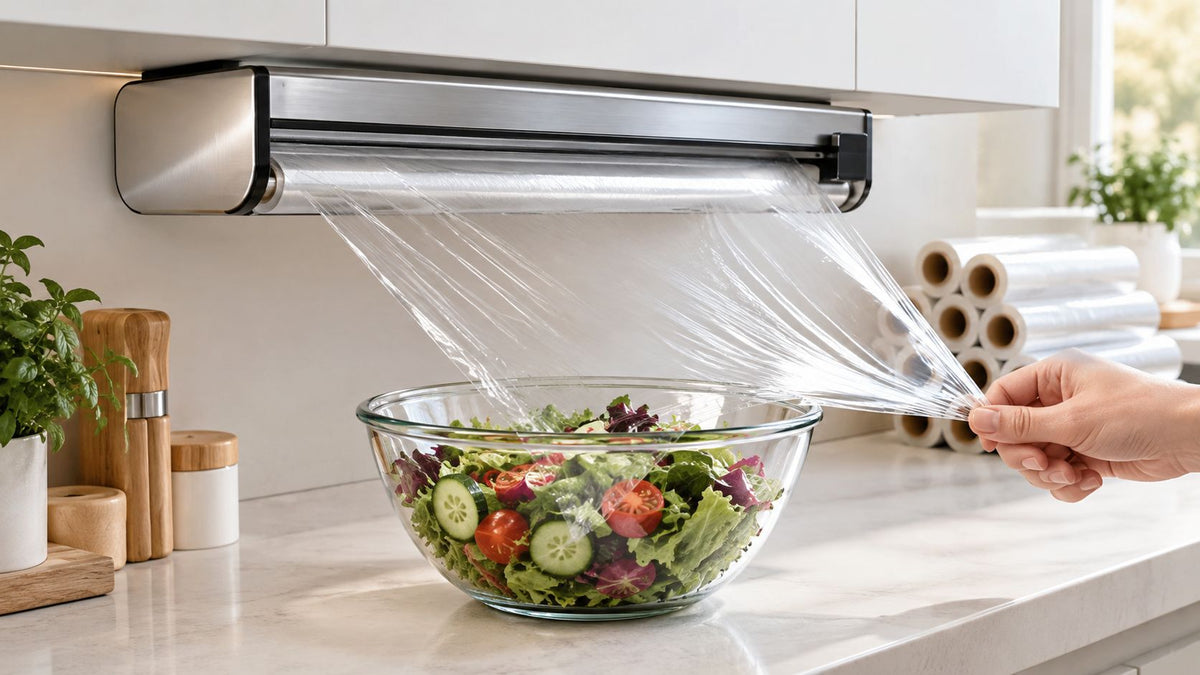
You're holding a bowl of leftovers with one hand, trying to pull plastic wrap with the other. The roll skids across the counter, the film sticks to itself, and the sheet tears at an angle. A plastic wrap dispenser won't change the film, but it can make that everyday job calmer, cleaner, and easier to repeat.
The right choice depends on more than countertop appearance. A household roll, a large food-service refill, a renter's limited installation options, and a small café's prep line all demand different designs. Fit also matters for waste. In Canada, nearly 70% of disposed plastic packaging waste was film in 2019, according to Statistics Canada data discussed by the Canada Plastics Pact. A dispenser can improve control, but it doesn't automatically solve the film's end-of-life problem.
Table of Contents
- What a Plastic Wrap Dispenser Actually Does
- How the Main Dispenser Designs Work
- Sizing and Compatibility That Matter
- Installing and Refilling Without Frustration
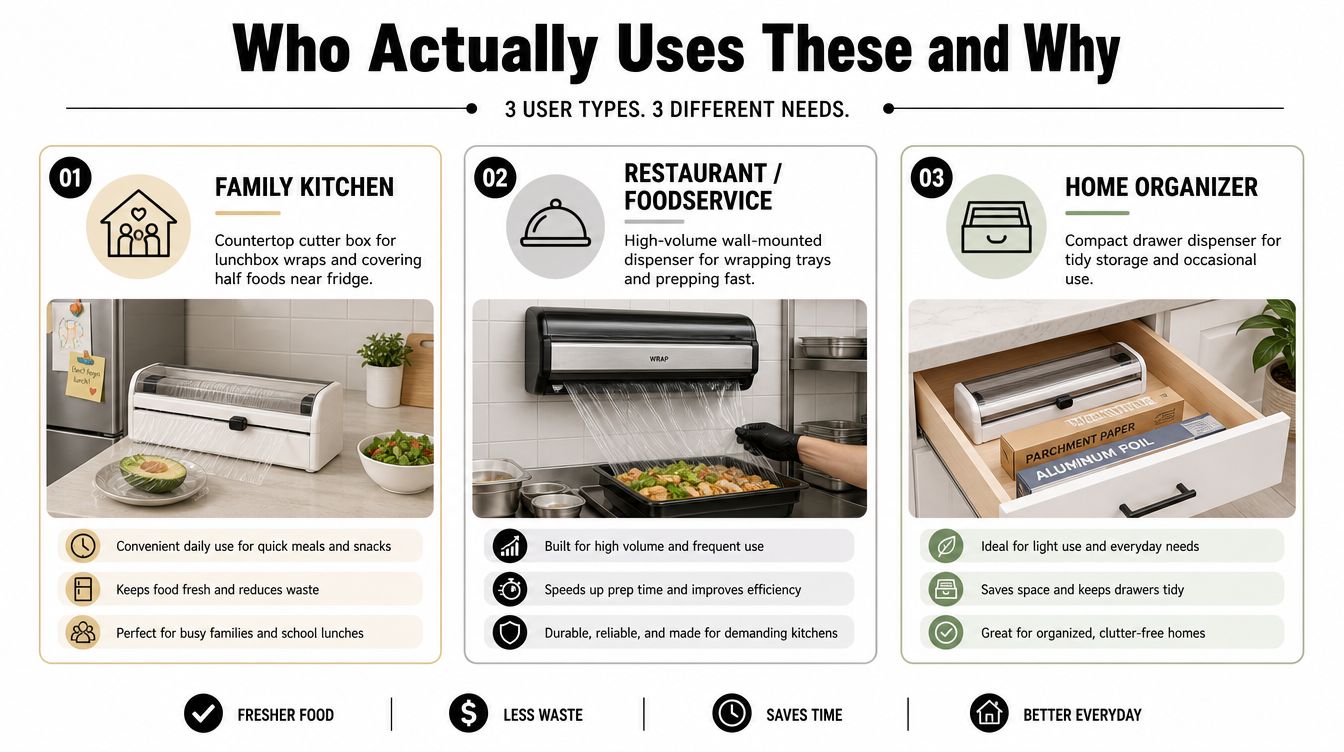
- Who Actually Uses These and Why
- Comparing Wraps, Foil, and Reusable Alternatives
- Waste, Refill Choices, and the Bigger Picture
- A Quick Buying Checklist Before You Order
What a Plastic Wrap Dispenser Actually Does
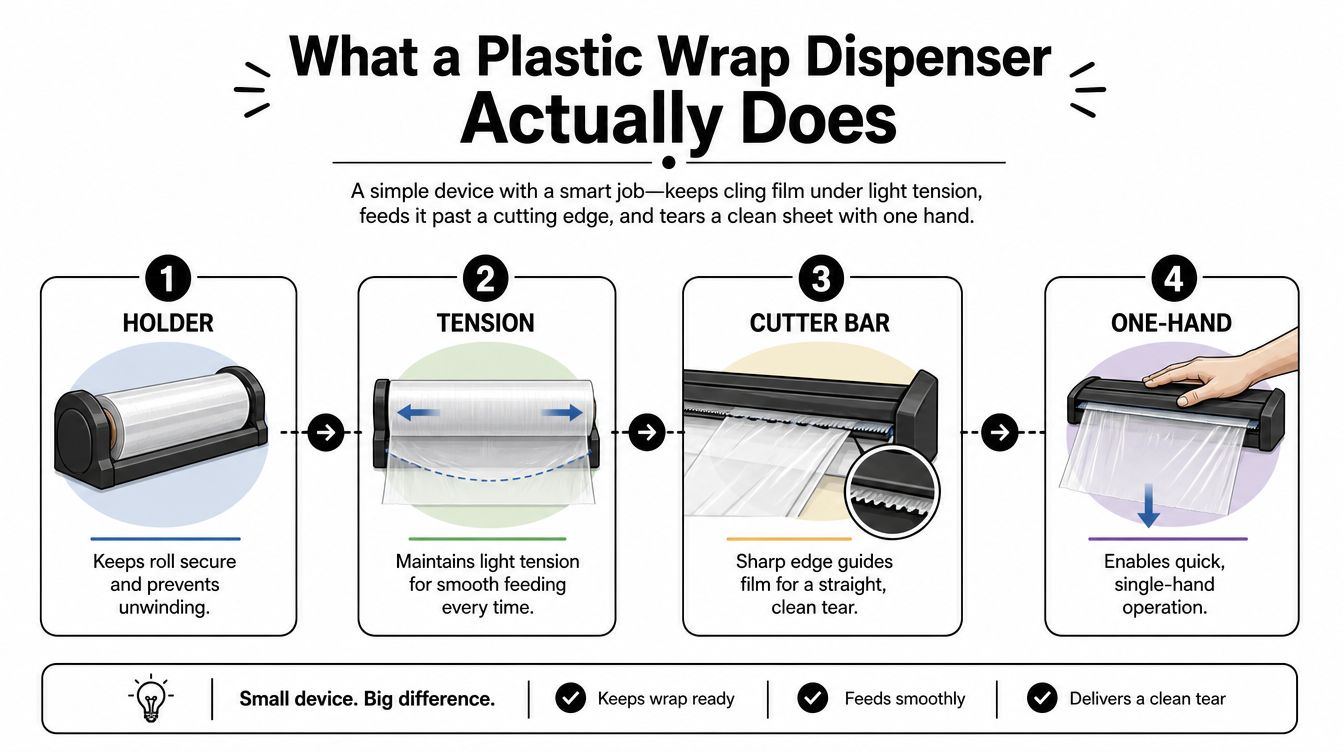
A plastic wrap dispenser is a roll cradle with a controlled cutting edge. It holds cling film, gives the roll a stable point to turn against, and lets you separate a sheet without chasing the box around the counter. Some models sit beside the refrigerator, while others attach beneath a cabinet or to a wall.
The basic sequence is simple:
- Hold the roll: Supports keep the refill centred instead of letting it unwind inside a drawer.
- Add light tension: The frame or brake resists uncontrolled spinning as you pull.
- Guide the film: The film travels across a bar or lip rather than folding back onto itself.
- Tear the sheet: A serrated edge, slide cutter, or tear bar separates the film.
That design replaces several improvised routines: a loose roll in a cupboard, a half-peeled cardboard box, or a cook using both hands and a knife. For a family, the benefit shows up while covering a half melon, wrapping a lunchbox sandwich, or sealing a casserole dish. For a small operator, the same principle matters during repeated prep, when a clean pull and predictable tear are easier to manage than a roll that keeps unravelling.
A dispenser doesn't make plastic film stronger, more recyclable, or suitable for every food. It only controls how the film leaves the roll. The quality of the result still depends on the film, the roll dimensions, the cutter, and the user's technique.
Practical rule: Treat the dispenser and the refill as one system. If the roll is too wide, too heavy, or built around the wrong core, even a sturdy-looking holder can drag and wobble.
The main design differences appear in how each model manages stability, installation, and hand movement.
How the Main Dispenser Designs Work
The same sheet of film feels very different depending on where the roll sits and how you pull it. A cutter box stays on the work surface. A wall-mounted model gives you a fixed anchor. An under-cabinet unit disappears until you need it, while a handheld tool travels around the food instead of keeping the food near the dispenser.
Four formats for four workflows
A countertop cutter box is the easiest starting point. The roll sits in a weighted housing or under a lid, and a serrated edge tears the film. It suits a family kitchen because you can move it beside the fridge or put it away after use. Its common weakness is movement. If the base isn't heavy enough or the film pulls sharply, the box can slide.
A wall-mount dispenser gives the roll a stable pull point and preserves counter space. It works well on a backsplash or a properly supported wall near a prep station, but installation becomes part of the decision. Drilling may not suit a rental, and the fixed position can be inconvenient if you often wrap food elsewhere.
An under-cabinet dispenser keeps the roll beneath a cupboard and can be useful in a compact kitchen. The roll stays out of sight, but the cabinet needs enough clearance for the housing, your hand, and the sheet as it comes forward. A low cabinet or crowded counter can make loading and cutting awkward.
A handheld dispenser uses a compact frame or handle that you grip while pulling film around a tray, sandwich, or parcel. It's practical for catering and sandwich preparation because the operator can move around the item. Repeated use can tire the wrist, especially when the brake creates strong resistance.
| Design | How It Holds the Roll | How It Cuts | Best For |
|---|---|---|---|
| Countertop cutter box | Housing, lid, or weighted base | Serrated edge or slide cutter | Family kitchens and occasional use |
| Wall-mount unit | Fixed arms, flanges, or spindle | Tear bar or integrated blade | Shared prep stations |
| Under-cabinet unit | Mounted cradle beneath cabinetry | Front cutter bar | Small kitchens with limited counter space |
| Handheld tool | Grip frame around the roll | Built-in edge or brake-assisted tear | Catering, sandwich shops, and mobile prep |
The category overlaps with other kitchen organisers, but function matters more than appearance. For example, the Automatic Egg Dispenser Rack – Rolling Storage Holder uses a gravity-fed inclined track to dispense eggs one at a time. That's a storage and access system, not a film holder, so it shouldn't be treated as a substitute for a wrap dispenser.
Choose based on workflow volume, mounting permission, and preferred hand movement. A renter who wraps food occasionally may value portability. A café line may value a fixed pull point and fast refills more than a tidy countertop.
Sizing and Compatibility That Matter
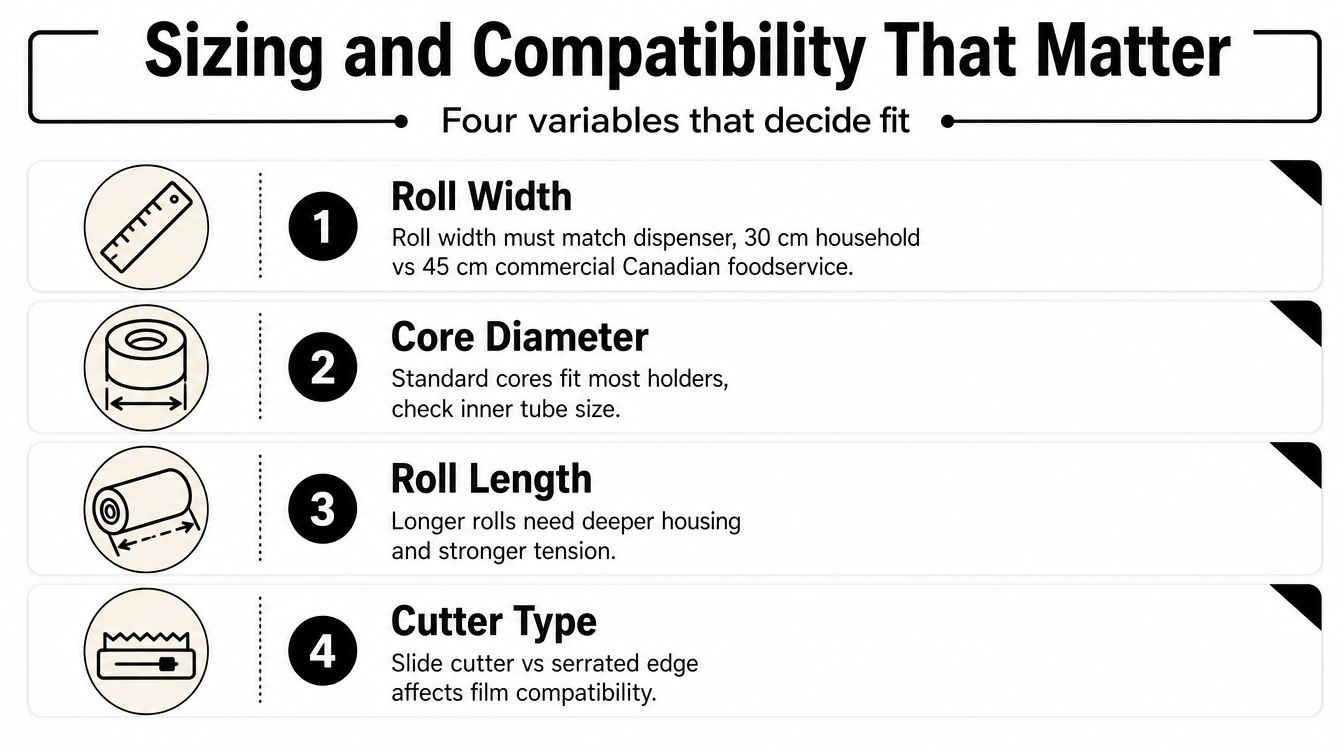
Sizing causes many dispenser failures. Before comparing finishes or cutter styles, write down the roll's width, core diameter, flange diameter, and length. The Canadian commercial market shows why these details matter. One commercial unit uses 6 mm acrylic, accepts flange diameters of 73 mm and 47.8 mm, and is designed for roll lengths from 600 m to 1600 m, according to the manufacturer's Canadian product specifications.
Start with the roll
Roll width determines whether the refill sits fully inside the frame. A narrow household holder may not support a broad food-service roll, while a wide commercial frame can feel excessive for a small kitchen roll. Don't assume that a dispenser's outside width equals its usable film width.
Core diameter is the inside measurement of the cardboard tube. The spindle or end supports need to match it closely. A loose fit lets the roll shift from side to side. A tight fit creates drag and makes one-handed pulling harder.
Flange diameter refers to the end support or roll flange, not the film width. A holder may accept the right core but still fail to clear the roll's outer end structure. Commercial equipment is often built around specific flange geometry rather than universal compatibility.
Roll length affects reload frequency and the physical space needed inside the housing. A long refill can be efficient for a busy prep line, but its mass and rotational inertia demand a rigid frame and controlled brake. A small refill is easier to store in an apartment but may require more frequent replacement.
A separate Canadian stretch-wrap dispenser accepts rolls from 12 in. to 20 in., with 1.5 in., 2 in., and 3 in. core diameters, and has a grip-handle format weighing about 1 lb with an overall length of 7 in., according to Grainger Canada's product listing. Another portable model handles rolls from 10 in. to 70 in. wide on a 3 in. core and uses a two-stage brake. These examples show why “commercial dispenser” isn't a complete specification.
Fit check: Read the dispenser's listed width range and core specification against the actual refill in your cupboard. If either is missing, expect uncertainty rather than universal fit.
For a broader approach to matching products with consistent requirements, see GrifGlo's guide to product standardization. Also consider the surrounding storage area. The HOME AESTHETICS HA-5138 Swing Garbage Bin 15L is described as a 15-litre plastic bin intended for kitchens, offices, or bathrooms, so it may be relevant when planning where used film and other kitchen waste will sit, although it doesn't provide a recycling solution.
Installing and Refilling Without Frustration
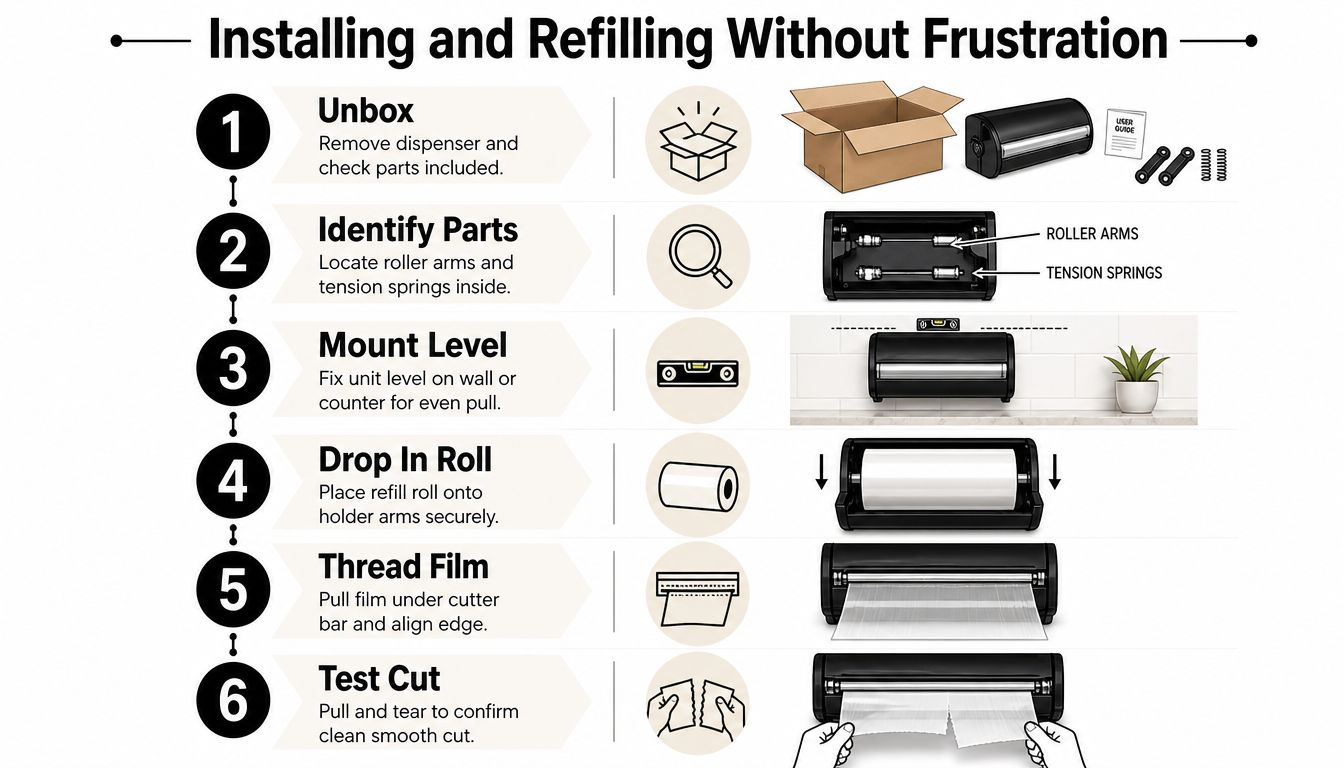
A good installation starts before the first sheet is pulled. Unbox the dispenser, check the included parts, and identify the roller arms, spindle, springs, brake, and blade. If the unit mounts to a wall or cabinet, hold it in position with the roll installed before drilling. This reveals whether the film will clear the backsplash, handles, and nearby appliances.
A repeatable loading sequence
- Mount the unit level. A tilted frame makes one side of the roll pull harder than the other.
- Secure the holder. For a permanent installation, use the specified screws in a cabinet side, solid backing, or suitable wall support.
- Place the refill on the arms. Match the core to the spindle or flanges so the roll can rotate without grinding.
- Find the film direction. Feed the film from the side that lets the loose edge travel smoothly beneath the cutter bar.
- Create a starting tab. Fold the film tail at roughly a 45-degree angle so it remains easy to catch under the cutting edge.
- Test a short pull. Hold the dispenser steady, pull with one hand, and use the cutter with the other until the tear feels predictable.
Renters need a different installation plan. Avoid drilling if the lease or property rules restrict holes. A no-drill option might include a weighted countertop base, an over-the-door hook arrangement designed for the unit, or removable mounting strips that are explicitly rated for the loaded weight of the dispenser. Test any adhesive mount with an empty unit first, then add the roll gradually.
A dispenser should also have a sensible home when it isn't being used. If the roll belongs in a drawer, compare the unit's footprint with the drawer opening and nearby utensils. GrifGlo's guide to a drawer organiser for the kitchen can help you think through that surrounding storage, although the dispenser itself still needs enough clearance for the film to feed.
A short demonstration can make the hand position easier to understand:
If the roll sticks, check the core and flange match first. If it unravels, inspect the brake, the film path, and whether the refill is seated evenly on both sides.
Who Actually Uses These and Why
The same product category can solve very different kitchen problems. The useful question isn't “Which dispenser looks nicest?” It's “What keeps going wrong during the way I wrap food?”
The family kitchen
A household often needs a countertop cutter box beside the refrigerator. Lunchbox sandwiches, a cut melon, leftover pasta, and a casserole dish all require different sheet sizes, so easy access matters more than high capacity. The dispenser's main job is to stop the loose roll from travelling while someone holds a container with the other hand.
The family shopper should prioritise a stable base, an intuitive cutter, and compatibility with the refill already used at home. A large commercial holder may be durable but can consume valuable counter space without adding useful capacity.
The short-term rental
A host may prefer a slim wall unit because guests can see how the wrap is stored and used. A fixed dispenser keeps the roll from disappearing into a crowded drawer and can make a shared kitchen feel more organised. The tradeoff is installation, especially where drilling isn't permitted.
For this setting, mounting method and easy cleaning are more important than the fastest possible tear. The unit should also be simple enough that a guest doesn't need instructions to replace the roll.
The small café or catering line
A sandwich shop or catering team may pull from a broad commercial refill while wrapping trays, sandwiches, or prepared ingredients. A wall-mounted or under-cabinet unit gives the cook a repeatable pull point, while a handheld model lets the operator move around a large item.
The failure mode changes at this scale. A wandering cutter box interrupts the line, while a poor core match can create drag and uneven tearing during repeated use. For sourcing and standardisation, GrifGlo's wholesale kitchen supplies guide is relevant to the wider process, but the dispenser still needs to be checked against the exact film roll.
Comparing Wraps, Foil, and Reusable Alternatives
A dispenser makes plastic film easier to control, but it isn't the only way to cover food. The better choice depends on the shape, temperature, storage time, and cleaning routine involved.
| Option | Best For | Weak At | Care |
|---|---|---|---|
| Plastic wrap with dispenser | Irregular foods, bowls, trays, and short freezer wraps | Reducing single-use material by itself | Replace film roll and wipe the holder |
| Foil with dispenser | Roasting, grilling, and foods that need a rigid barrier | Clinging to smooth containers | Dispose of used foil according to local guidance |
| Beeswax wrap | Sandwiches, bread, fruit, and bowl covers | Hot food, raw meat, and large flat trays | Wash gently and air-dry |
| Silicone stretch lids | Round bowls and frequently used containers | Long casserole dishes and irregular shapes | Wash and dry after each use |
| Reusable plastic or glass containers | Liquids, leftovers, and stackable meals | A half fruit or awkwardly shaped food | Wash, dry, and store lids with bases |
Aluminium foil fits a similar cutter-box format, but it tears and folds differently. It's often a better tool for roasting or shielding food from heat, while cling film conforms more easily to a bowl or cut produce. Neither material is a universal replacement for the other.
Beeswax wraps work well for sandwiches, bread, and some produce because they mould around the item. They're less convenient for raw meat on a cutting board or a wide casserole dish, and they add washing and drying to the routine. Silicone lids are excellent for bowls that match their sizes, but a long rectangular dish can expose the limits of a stretch lid.
Reusable containers are practical for liquids and planned leftovers. They can feel excessive for covering half a cantaloupe or a plate that will be used again soon, especially if the container doesn't fit the shelf.
Retail prices vary by material, size, brand, and Canadian retailer, so compare cost per use, not just the shelf price. A reusable option may cost more at purchase but serve repeatedly. A dispenser may make disposable film easier to portion, yet it doesn't remove the need to buy and discard refill material.
For households building a more organised storage system, GrifGlo's guide to pantry storage containers can help with the container side of the decision. Many kitchens land on a hybrid: containers for planned leftovers, silicone lids for compatible bowls, foil for heat, and plastic wrap for irregular shapes or quick coverage.
Waste, Refill Choices, and the Bigger Picture
A cleaner tear doesn't make every film environmentally equivalent. The dispenser controls the sheet, but the film substrate, refill packaging, and local collection rules determine what happens afterward.
California's category-level data illustrates the scale of the broader material stream, even though the state doesn't publish product-level disposal data specifically for plastic wrap dispensers. CalRecycle estimated that 8,457,149 tons of covered material were disposed of in California landfills in 2024, with 3,123,797 tons of plastic, equal to 21.1% of statewide disposal. The same source estimated that, in 2023, more than 2.9 million tons of plastic were used in single-use plastic packaging and food-service ware, representing 171.4 billion plastic components. Those figures describe broad categories, not the impact of one dispenser or one household.
Canada's film problem makes refill decisions worth examining. The Canada Plastics Pact estimated 1,961,374 tonnes of plastic packaging were generated in 2024, up 4% since 2019, while Statistics Canada reported that film made up nearly 70% of disposed plastic packaging waste in 2019 in the source cited earlier. Film is often difficult for collection and sorting systems to handle, so a dispenser should be viewed as a tool for controlled use, not proof that the waste has been resolved.
Refill tradeoffs
A long commercial refill can reduce the amount of packaging around each metre of film, but it needs a compatible holder and a place to store the roll. A smaller refill may fit an apartment kitchen and its storage bin more easily, while creating more frequent cardboard turnover.
Film labels also matter. PVC cling film, LDPE film, and compostable products may have different disposal requirements, and a municipal programme may not accept any of them in the same way. Never assume that “compostable” means home-compostable or accepted in your local green-bin system. Check the package and municipal guidance.
The practical question is whether your kitchen should reduce, reuse, or switch materials for each job. A dispenser can help prevent over-pulling and failed tears, but the strongest waste reduction may come from using a container for food that doesn't need film at all.
A Quick Buying Checklist Before You Order
Keep this checklist open while comparing products. Start with the constraints that can make a dispenser unusable, then move toward convenience and appearance.
- Confirm roll width: Measure the film you already buy and compare it with the dispenser's usable width, not just its outer dimensions.
- Check core diameter: Make sure the cardboard tube fits the spindle or side flanges without slipping or grinding.
- Verify flange clearance: The roll's end supports must fit inside the holder and clear the refill's outer structure.
- Consider roll length and mass: Longer refills need enough housing depth, a rigid frame, and controlled resistance.
- Choose the mounting style: Pick countertop, wall-mounted, under-cabinet, or handheld based on where wrapping occurs.
- Inspect the cutter: Decide whether a serrated edge or slide cutter suits your film and hand position.
- Plan the refill supply: Confirm that compatible rolls are available through the Canadian retailers or suppliers you already use.
- Review cleaning access: Look for surfaces that can be wiped without removing the entire unit.
- Think about end of life: Check the film material and local disposal instructions before treating a refill as interchangeable with another.
- Compare total use, not just price: Include refill size, reload frequency, installation hardware, and the cost of failed tears.
- Match the workflow: A household needs easy access for occasional leftovers, while a café needs dependable tension during repeated prep.
- Plan the surrounding storage: Leave room for spare rolls and a waste container so the system stays organised after installation.
This is the same kind of practical filtering used in a broader decision-making framework: identify the essentials first, then compare the features that affect daily use.
A dispenser earns its counter or wall space when people wrap food often, share a prep station, use inconsistent roll formats, or regularly fight runaway film. If wrapping is occasional and your current cutter box works, a basic replacement may be enough. If washing is acceptable and your use cases suit them, beeswax wraps or reusable containers may cover more jobs with less disposable film.
GrifGlo offers curated guidance and practical product categories for kitchens, organisation, and structured household or business purchasing. Visit GrifGlo to compare fit-for-purpose kitchen essentials, review sizing advice, and build a wrap and storage setup that suits your actual routine.

Leave a comment
This site is protected by hCaptcha and the hCaptcha Privacy Policy and Terms of Service apply.