

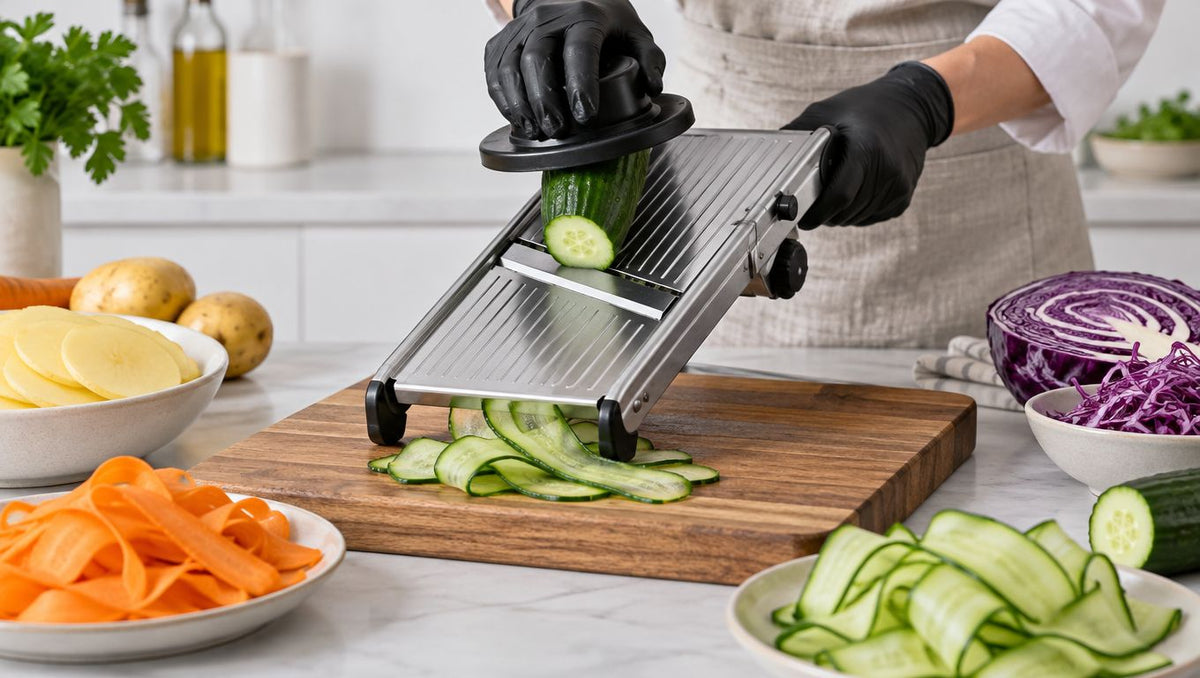
A mandoline slicer is a mechanical thickness-control tool used to produce fast, highly uniform slices, julienne strips, shreds, and diced pieces from firm fruits and vegetables. In Canada, 28.6% of people aged 12 and older, approximately 8.3 million Canadians, consumed fruits and vegetables five or more times per day in 2017, making repeatable produce preparation a practical concern for many kitchens (Statistics Canada).
You notice its value when dinner involves a pile of potatoes, a bowl of cabbage, or enough cucumbers for a batch of pickles. A knife can handle all of those jobs, but maintaining the same thickness across every piece takes concentration and practice. The mandoline removes much of that variation, while its exposed blade introduces a risk that no cook should minimise.
The right question isn't just whether a mandoline is faster. It's whether consistent thickness, repeatable portions, and cleaner presentation justify using a sharp sliding blade for the ingredient in front of you. Often they do. Sometimes a knife or enclosed food processor is the better decision.
Table of Contents
- The Core Purpose of a Mandoline Slicer
- Essential Cuts and Ideal Ingredients
- Critical Safety Rules and Handling Hazards
- Mandoline Slicer Versus Knives and Processors
- Scaling Up for Meal Prep and Hospitality
- Cleaning and Storing Your Slicer Safely
The Core Purpose of a Mandoline Slicer
A mandoline's main job is to control thickness mechanically. You set the blade height, place the produce on the sliding platform, and move the food holder across the blade in controlled strokes. Each pass follows the same path, producing rounds, strips, or julienne pieces with far less variation than repeated knife cuts.
That consistency matters because thickness affects what happens next. Thin potato slices soften sooner in a gratin, similarly sized cucumber slices take on brine more predictably, and evenly cut cabbage and carrot strips give a slaw a more balanced texture. The mandoline isn't just a chopping shortcut. It's a way to make the raw material more predictable before cooking, drying, pickling, or plating.
Why uniformity matters
Canadian households handle substantial quantities of vegetables. Historical Statistics Canada food data recorded 183 kilograms of vegetable consumption per person in 2001, including potatoes, compared with 179 kilograms per person in 2000 (Statistics Canada food consumption data). Those figures describe national consumption, not mandoline ownership, but they show why a repeatable preparation tool can be useful when produce is handled frequently.
The benefit becomes clearer during batch cooking. If one potato slice is paper-thin and the next is noticeably thicker, the thinner piece may soften or brown before the thicker one is ready. A mandoline helps reduce that mismatch, provided the produce is stable and the user maintains a controlled stroke.
Practical rule: Use a mandoline when thickness is part of the recipe, not merely when you want to finish cutting sooner.
The tool works particularly well for firm, broad produce that can sit securely on the platform. It works less well when the ingredient is soft, tiny, irregular, or difficult to keep stable. That boundary is central to safe use.
Essential Cuts and Ideal Ingredients
The most useful mandoline settings are straightforward. A plain blade creates slices, while julienne blades cut narrow strips. Some models also offer thicker julienne, shredding, or dicing functions. The Canadian Cuisinart PrecisionSlice instruction manual describes plain slicing, thin julienne, thick julienne, and dicing, with dicing produced by placing julienne strips upright and guiding them through the slicing mode.
Match the cut to the job
- Plain slices: Use potatoes for gratins, zucchini and eggplant for roasting or layered dishes, onions for sandwiches, and apples or pears for drying and desserts.
- Thin julienne: Choose carrots, cucumbers, or zucchini when you need narrow strips for salads, garnishes, or noodle-like vegetable preparations.
- Thick julienne: Use firmer vegetables for stir-fries, slaws, and preparations where a little bite matters.
- Shreds: Cabbage and similar firm produce can be prepared for slaw, salads, or fermented preparations.
- Dicing: Make julienne strips first, then position them upright for the cross-cutting step described in the manual.
Uniform cross-sectional dimensions help food cook, dehydrate, and pickle more evenly. A thin piece reaches tenderness or loses moisture sooner than a thick one, so inconsistent cuts can leave small pieces overdone while larger pieces remain firm.
Prepare the ingredient before slicing
Trim produce so it fits the feed path without rocking. Cut a potato or cucumber into a stable shape, remove awkward ends, and avoid forcing an oversized piece through the platform. A smooth, controlled stroke is more reliable than pressure, which can crush food or make the holder catch.
A vegetable peeler has a different role. It removes skins and creates ribbons, while a mandoline controls the thickness of slices and strips. If peeling is the first step, use these vegetable peeler options to prepare the produce before placing it on the slicer.
For a separate slicing task, the KALORIK AS45493BK Professional Style Food Slicers is described as a home-use food slicer with a 200-watt motor and a 7.5-inch, 190 mm food slicer, intended for slicing cheese. It isn't a substitute for a mandoline's adjustable vegetable cuts, but it illustrates why the cutting mechanism should match the ingredient and preparation goal.
Critical Safety Rules and Handling Hazards
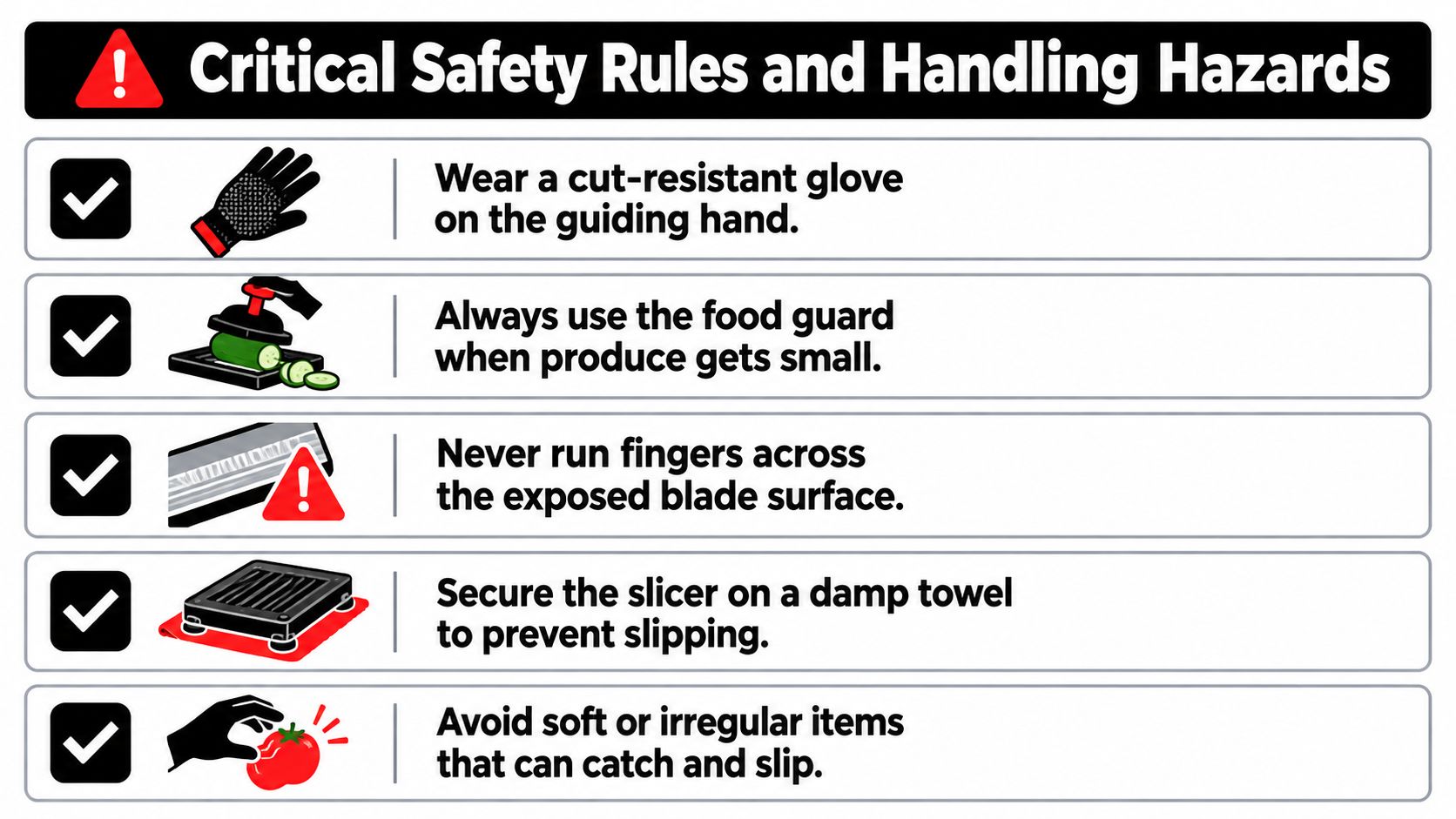
A mandoline is riskier than a chef's knife in one specific way: the blade is exposed along a fixed sliding path, and your hand can move repeatedly toward it as the food gets smaller. The danger increases when the ingredient becomes soft, irregular, or difficult to grip. A device that feels controlled at the start can become hazardous near the final stub.
The food holder is therefore part of the operating system, not an optional accessory. Keep the guiding hand behind it, maintain a secure grip, and never run bare fingers across the blade surface. Cut-resistant gloves can add protection, but they don't make careless contact safe and shouldn't replace the guard or controlled technique.
Stop before the final piece
The last portion is where cooks often take an unnecessary risk. Trying to recover every small fragment can turn a useful batch-prep tool into an injury hazard. Stop when the remaining piece no longer sits securely in the holder, then discard the stub, save it for stock if appropriate, or finish it with a knife on a stable board.
Set the slicer on a secure, non-slip surface before starting. If the base shifts, your hand may compensate suddenly, sending the produce or holder toward the blade. Keep the work area clear, and don't slice while distracted by another task.
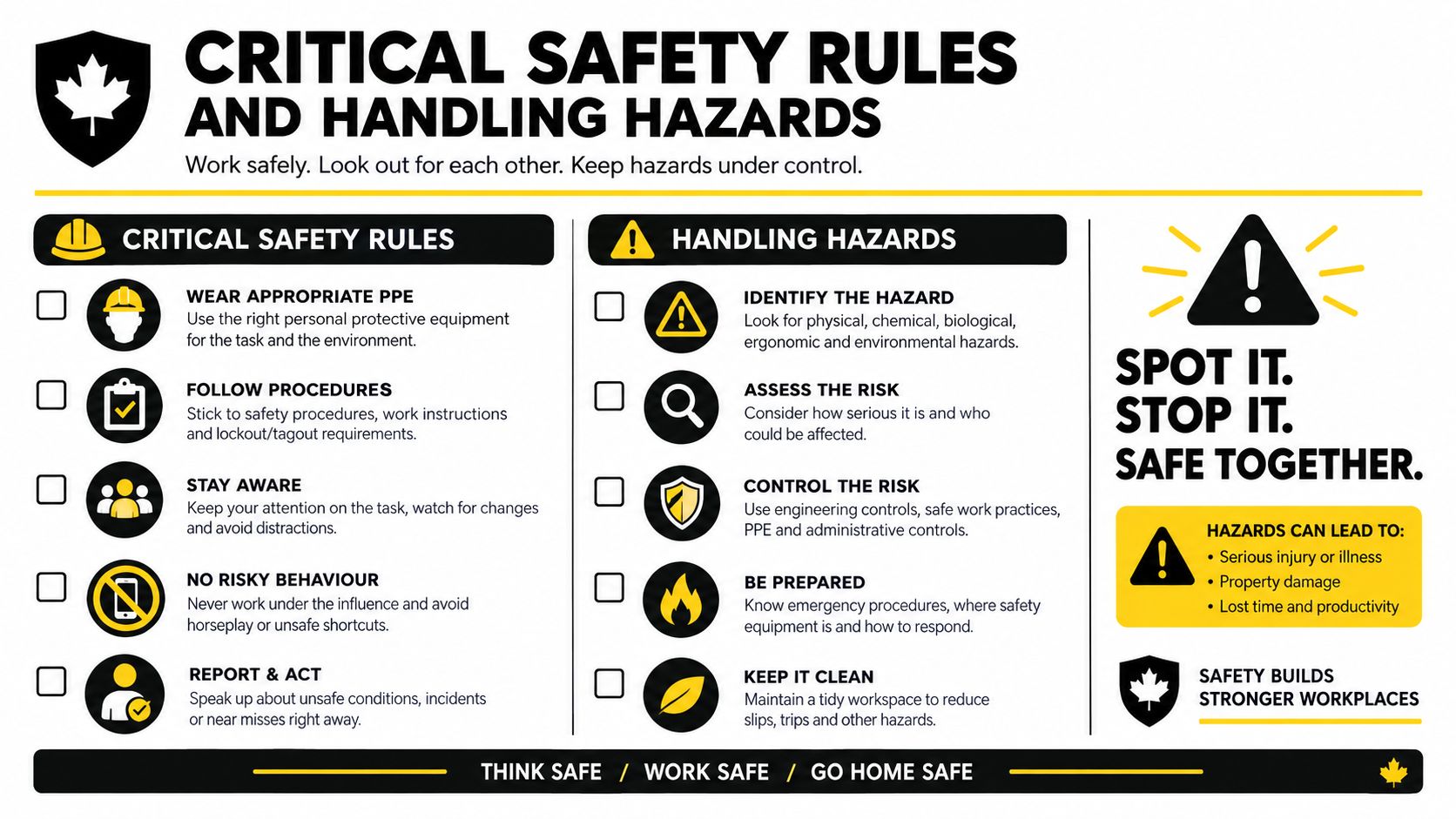
A cut-resistant glove is supplementary protection. The food holder, stable setup, attention, and willingness to stop early do the real safety work.
Families, renters, and short-term-rental hosts should also consider storage. A mandoline left loose in a crowded drawer can expose someone to a sharp blade while they search for another utensil. Store it with the blade protected and away from casual access. A magnetic knife strip may suit some kitchens for compatible tools, but the slicer should only be stored that way if its blade is fully protected and the mounting arrangement is secure.
There isn't a Canada-specific injury rate for mandoline slicers in the available material, so an exact local risk figure would be misleading. The practical conclusion is simpler: use the tool for broad, stable produce when consistency matters, and abandon it when control starts to deteriorate.
Mandoline Slicer Versus Knives and Processors
The best cutting tool depends on the ingredient's shape, firmness, and required finish. A mandoline is the specialist for repeatable thickness. A chef's knife gives you control over awkward pieces and lets you stop without working around a fixed exposed blade. An enclosed food processor is often more suitable when you need to process a larger volume or handle ingredients that are difficult to hold safely.
| Tool | Best Used For | When to Avoid |
|---|---|---|
| Mandoline slicer | Uniform slices, julienne, shreds, and presentation-focused cuts from firm produce | Tiny, soft, frozen, slippery, or irregular ingredients |
| Chef's knife | Odd shapes, small finishing pieces, herbs, trimming, and cuts requiring judgement | Large batches where identical thickness is central and knife control would become inconsistent |
| Enclosed food processor | Batch shredding, slicing with a covered feed path, and ingredients that need containment | Jobs requiring a specific visible thickness when the attachment doesn't provide the needed setting |
Use the mandoline for potatoes, cucumbers, carrots, cabbage, apples, or zucchini when the pieces need to look and cook alike. Use a knife for the last small section, a soft tomato that collapses under pressure, or a frozen ingredient that won't travel smoothly across the platform.
A food processor can be the better choice for repeated shredding or slicing when its feed tube and attachment keep hands away from the cutting mechanism. It may not give you the same tactile control over thickness, and it introduces more parts to clean, but containment can outweigh the mandoline's precision for difficult or high-volume work.
Choose the tool that keeps the ingredient stable throughout the entire cut, not the tool that promises the shortest first pass.
Knife quality also affects the comparison. A properly maintained chef's knife reduces the force needed for manual cutting, so knife sharpening tools are relevant when a knife is the safer alternative. A dull knife can slip, but a mandoline isn't automatically safer just because it appears faster.
Scaling Up for Meal Prep and Hospitality
The overlooked value of a mandoline is operational consistency. A home cook preparing potatoes for a family meal, a host assembling a large salad, and a small café preparing pickles all benefit when slices have a repeatable thickness. Consistent pieces support cooking, texture, presentation, and portioning without requiring every person on the team to cut in exactly the same way.
That doesn't make every mandoline suitable for commercial work. A basic manual model may be practical for occasional batches, but repeated service raises different questions:
- Throughput: Can the tool handle the required volume without forcing rushed strokes?
- Durability: Will the blade and adjustment mechanism remain reliable under frequent use?
- Cleaning: Can staff disassemble and wash it thoroughly without exposing themselves to the blade?
- Training: Does every user understand the guard, stopping point, stable setup, and storage routine?
- Waste: Does the speed advantage justify the end pieces and trimming created by the cutting method?
Canadian foodservice coverage identifies labour shortages, automation, consistency, and multifunction equipment as priorities for 2025, while Canadian market coverage connects equipment decisions with speed, food safety, energy efficiency, and varied menu requirements (foodservice equipment trends in Canada). Those priorities don't prove that a mandoline is the right purchase. They show why managers should assess it as part of a workflow rather than as an isolated gadget.
A small hospitality team should document a simple operating procedure. Specify which produce is approved, how it must be trimmed, when the holder is mandatory, where the slicer is cleaned, and how the blade is protected after use. Keep batch output in labelled containers, such as those described in this guide to commercial food storage containers, so consistent cuts remain useful after preparation.
Uniform cuts can improve presentation and cooking, but they don't eliminate waste. The final stub may be unusable for the intended dish, and aggressive trimming can offset some of the time saved. Evaluate the complete process, including preparation, cleaning, storage, training, and yield.
Cleaning and Storing Your Slicer Safely
Cleaning should begin as soon as the mandoline leaves the cutting board. Food residue can dry around the blade and adjustment track, making later cleaning more difficult and increasing the chance that you'll reach into an unsafe area.
Follow the manufacturer's instructions first, then use a routine that keeps your hands away from the edge:
- Set the blade to zero. The Cuisinart manual specifies returning the thickness dial to zero for storage. A closed or minimised setting gives the blade a more secure storage position.
- Remove detachable parts carefully. Hold plastic components by their safe edges, not near the cutting surface. Put the food holder in a separate place so it doesn't get lost.
- Rinse and wash from the blunt side. Direct water and a soft brush along the blade rather than pushing a sponge toward the edge. Never wipe across the exposed blade with bare fingers.
- Inspect the grooves and platform. Food caught in the feed path can affect the next batch and may encourage forceful pushing during use.
- Dry completely. Moisture left near a metal blade can contribute to corrosion and unpleasant odours. Let components air-dry in a safe position before reassembly.
- Protect and store. Use the supplied blade cover if available, return the dial to zero, and place the slicer where children and guests won't handle it casually.
Sanitation matters when the tool moves between raw and ready-to-eat ingredients. A practical cutting-board sanitising routine can help establish the same separation and cleaning discipline around the rest of the prep area.
Don't put a sharp mandoline loose beneath heavy utensils. Store it in a dedicated location, keep the holder with it, and check the blade and adjustment mechanism before the next use. A clean, protected slicer is easier to trust, but the safety rules remain necessary every time.
GrifGlo organises kitchen essentials and decision-friendly guides for home cooks, renters, hosts, and hospitality teams, including tools related to cutting, storage, and food preparation. Visit GrifGlo to compare practical options and build a safer, more consistent kitchen workflow.

Leave a comment
This site is protected by hCaptcha and the hCaptcha Privacy Policy and Terms of Service apply.