

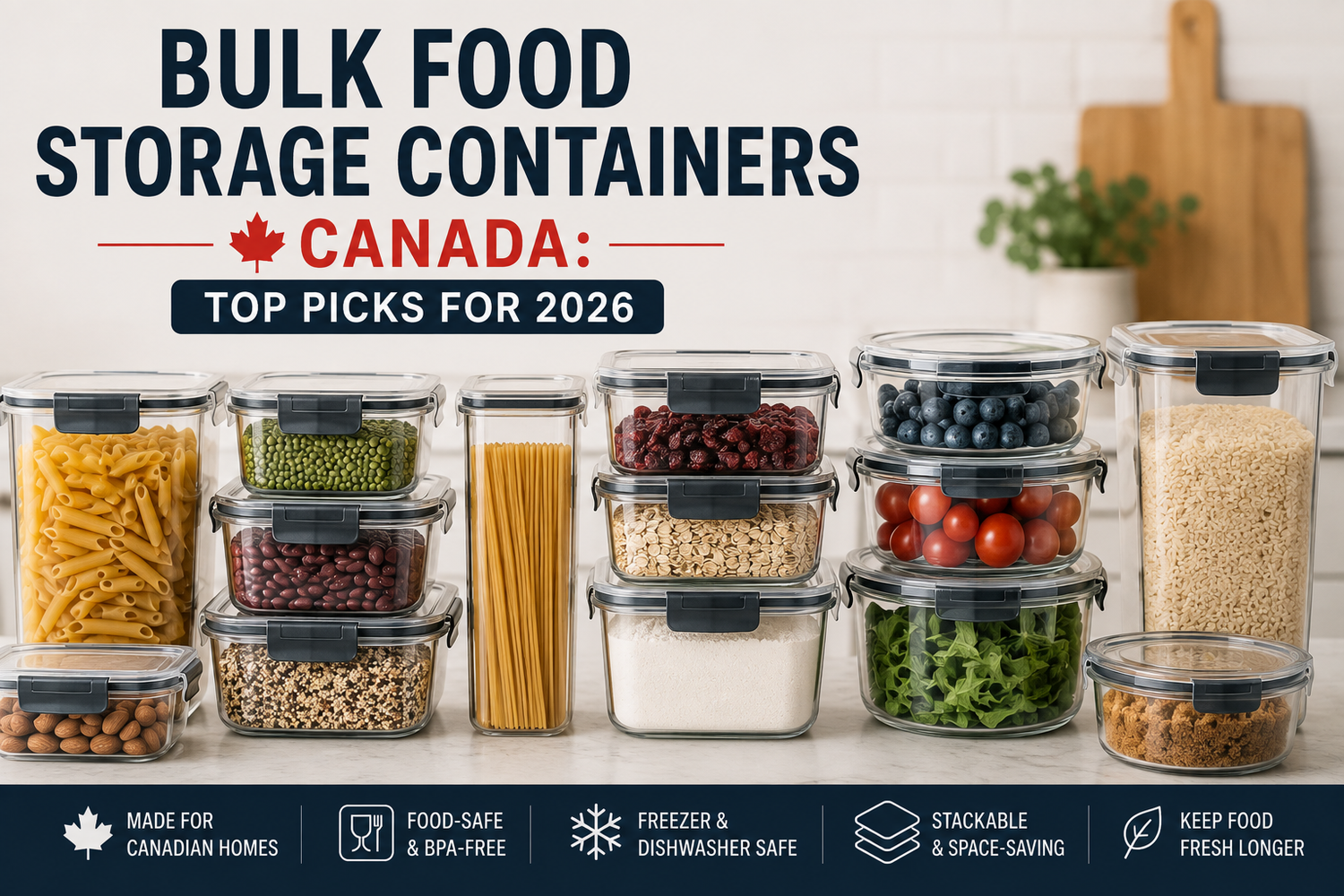
Every Canadian pantry has the same breaking point. A few bags of rice lean against the back wall, a 5 kg sack of flour sits in its shipping bag, and the “temporary” pasta pile has migrated from cupboard to counter because there's nowhere else for it to go. In winter, that mess gets worse, because the garage isn't a neutral holding zone, it's a test of whether your storage system was designed for Canadian life.
Bulk food storage containers Canada buyers need a system, not a pile of random tubs. The right setup matches container geometry, seal type, and rotation pattern to how you shop, refill, and store food, whether that's weekly pantry top-ups, seasonal reserve stock, or overflow for a rental property or small kitchen. Canada's broader food storage container market is still expanding at a steady pace, with forecasts pointing to sustained demand rather than a fad, which fits the reality that durable, reusable storage is becoming normal in homes and operations across the country. You can see the same logic in pantry planning advice like these storage tips, because good organisation starts with the system, not the lid.
If you buy containers the wrong way, you end up with mismatched shapes, wasted shelf depth, and lids that fail long before the contents do. Buy them as a system, and you get cleaner shelves, faster rotation, and less food spoilage from sloppy handling.
Table of Contents
- Why Bulk Storage Deserves a Real System in Canadian Homes
- Container Materials and Seal Types That Actually Hold Up
- Sizing Containers to Household and Business Bulk Volumes
- Canadian Food Safety and Labelling Essentials
- Where to Source Bulk Containers in Canada
- Maintenance and Shelf-Life Practices That Pay Off
- Decision-Ready Picks by Buyer Type
Why Bulk Storage Deserves a Real System in Canadian Homes
A February pantry failure is a very Canadian kind of annoyance. The family buys a big bag of flour, a club-size pasta pack, and a backup bag of oats, then finds the cupboard was built for one package at a time, not a rotating reserve. By the time the groceries are unpacked, the counter has become storage, and that is usually the moment people start shopping for “better” containers without addressing the core problem.
The mistake is buying containers by brand, not by role
A pantry works when each container has a job. One bin should handle weekly refills, another should hold reserve stock, and a third should keep overflow items from drifting into random corners. If all three jobs get dumped into the same kind of container, you either waste space or create a maintenance headache.
The Canadian market backdrop supports that practical approach. The food storage container category in Canada is growing at a mid-single-digit pace. One report estimates more than 4% CAGR from 2024 to 2029. Another projects 5.03% CAGR from 2025 to 2032 for the category, and the supplied reference also places the market at USD 15,279.72 billion by 2032. That figure needs scope-checking before anyone treats it as a planning number. The broader reusable packaging market in Canada was valued at USD 11.7 billion in 2025 and is forecast to exceed USD 20.57 billion by 2035 at 5.8% CAGR, which points to a steady shift toward reusable storage systems instead of disposable stopgaps.
Practical rule: if the container does not match the rotation pattern, do not buy it.
A real system beats a bag pile-up
Bulk storage is a planning problem. The first question is not “Is it airtight?” It is “How often will this get opened, and where will it sit?” Weekly-use foods need easy access and fast scooping. Seasonal reserves need stackability and better sealing. Pantry overflow needs clear labelling so older stock does not disappear behind newer purchases.
That is why the container system matters more than the brand name. Geometry and seal type should follow use, not the other way around. Square containers make better use of tight pantry shelves, while taller formats suit reserve stock that stays put for weeks or months. A flip-top lid makes sense for daily refill jars. A tighter gasket lid makes more sense for a bin that sits in a garage or basement and gets opened less often.
For a practical setup guide, see these pantry storage tips. The same idea applies in households, rental units, and small hospitality storage rooms. Canadian homes and small operators do not need more storage hype. They need a setup that survives real shelves, real temperature swings, and real human habits.
Container Materials and Seal Types That Actually Hold Up
The material and the seal do different jobs. Material decides whether the container behaves like a workhorse tote or an archive box. The seal decides whether the container is built for a quick pour from shelf to bowl, or for long-haul storage in a cold garage, a basement, or a pantry that gets opened every day.

Four material families worth caring about
Polypropylene is the light-duty plastic you see in everyday pantry containers. It is useful because it is light, stackable, and easy to handle. It works well for foods you open often and refill fast.
HDPE is tougher and more impact-resistant, so it handles bumps and rougher storage conditions better. It holds up better in rooms that are not gentle on containers.
Glass is the archive box. It does not absorb odour the same way plastic can, and it gives you a clean view of contents, but it is heavier and less forgiving when shelves get crowded.
Stainless steel is the premium workhorse for dry goods where durability matters more than visibility. It is harder to see through, but it stands up well to repeated use and rough handling.
Use plastic for everyday access, glass for cleaner long-term visibility, and stainless steel when you want durability without fuss. For smaller prep-storage use, a product like Ceramic Food Storage & Lunch Box with Lid shows how material choice can be specialised, with ceramic and bamboo wood construction and compact sizing that suits fridge or counter use rather than bulk pantry stock. The catalog snapshot lists 6 variants across option1, option2, option3, so there is no reason to overstate specific capacity values.
Seal types matter more than most shoppers think
A snap-lock seal works for short trips and frequent opening. It is convenient, but it is not the seal I would trust for serious long-term storage.
A gasket seal is better for longer storage and better at resisting everyday air exchange. If a container is meant to sit for weeks or months, that is the seal type I would choose first.
A screw-top seal is the mason jar approach. It is proven, simple, and forgiving, especially when the container will be opened and closed often.
My rule for Canadian conditions: if the container may live in a garage, porch, or basement, buy for cold tolerance and seal stability, not just for a pretty pantry photo.
For a closer look at how airtight construction affects real storage choices, see airtight food storage containers.
BPA-free and food-grade in plain English
Food-grade means the material is intended for food contact. BPA-free is a useful label, but it does not automatically tell you whether the container is sturdy, odour-resistant, or built for temperature swings. In Canadian homes, the bigger issue is whether the plastic gets brittle in cold storage and whether the lid keeps its shape after repeated use.
That is why I care more about build quality, seal design, and how the container behaves in real storage conditions than about marketing language. A good container should be boring in the best possible way, it should open, close, stack, and survive without drama.
Sizing Containers to Household and Business Bulk Volumes
Sizing is where most buyers guess wrong. They either buy containers that are too small and create clutter, or they oversize everything and turn one bag of rice into a giant half-empty tower that wastes shelf depth. The right move is to map what you buy to how fast you use it.
Match the container to the rotation pattern
A small household usually needs one or two everyday workhorse containers, not a wall of matching bins. A family household needs a mix of mid-size containers for fast turnover and one or two reserve pieces for pantry overflow. Rental properties need containers that are labelled, stackable, and easy to replace if a guest treats them badly. Small hospitality and office pantries need standardisation first, aesthetics second.
The right footprint matters too. Square and rectangular containers beat cylinders because they pack tightly on shelf runs, especially when you're trying to make use of standard pantry depths and wider shelf spans. Cylinders waste corners. Corners are where Canadians keep losing usable space.
Container sizing reference for common Canadian bulk purchases
| Bulk Item | Typical Purchase Size | Recommended Container Volume | Best Footprint |
|---|---|---|---|
| Rice | 10 kg bag | Large square reserve bin | Square |
| Flour | 5 kg bag | Mid-size stackable tub | Square or rectangular |
| Dry pasta | Multi-pack club bundle | Tall rectangular pantry container | Rectangular |
| Oats | Family-size bag | Medium square container | Square |
| Pet food | 25 L bag | Large lidded bin | Square |
| Coffee or tea reserve | Bulk bag or canister refill | Compact canister | Rectangular |
This table is the practical starting point, not a luxury wishlist. If you buy mostly dry staples, one large reserve bin and several smaller access containers usually outperform a full matching set. The reason is simple, you don't refill everything at the same pace.
Don't size by package alone
Package size and container size are not the same thing. You need room for scooping, lid clearance, and the shape of the shelf it'll sit on. That matters even more for operators who buy from a wholesaler or run a pantry stockroom, because the container has to work with inventory rotation, not against it.
For a deeper look at commercial ordering logic, the guide on commercial food storage containers is the right lens. The biggest mistake in business settings is buying one size for everything. The smarter setup uses a few standard sizes and repeats them.
Canadian Food Safety and Labelling Essentials
Canadian buyers get flooded with vague labels. “Food safe.” “Non-toxic.” “Premium.” Those words do not tell you much unless the container is built for the job it needs to do. Home users need containers that keep food clean, do not hold onto odours, and stand up to normal washing. Regulated operators need to think about classification, documentation, and the container standard that matches the contents.

Household use and commercial use are not the same thing
A homeowner does not need to build a compliance binder to store flour or rice. What they do need is a container that is clearly intended for food contact, seals well, and can be cleaned without warping or leaving odour behind. In plain terms, choose sensible materials and clear labelling over marketing copy.
Commercial users have more to watch. A container used for resale, food handling, or transport may need different documentation and labelling than a pantry bin at home. That gap between a casual home purchase and a business purchase shows up fast.
When transport rules apply
Transport Canada's CAN/CGSB-43.146 standard applies to UN-standardized intermediate bulk containers up to 5,000 L for dangerous goods classes 3, 4, 5, 6.1, 8, and 9, as set out in the Transport Canada reference at CAN/CGSB-43.146 standard. That matters when the contents are regulated goods, not normal pantry staples. If the material triggers TDG classification, the container has to match the certification pathway, not just the food-safe label.
If the product is for pantry staples, stop at food-contact suitability. If the product is for regulated goods, move straight to the transport standard.
Labelling that helps
For ordinary bulk storage, the most useful labelling is simple. Mark the contents, date it, and keep the label readable from the front of the shelf. In rentals and small kitchens, that stops accidental cross-use and makes restocking faster.
The wholesale kitchen supplies approach also depends on labeling discipline, because a shelf full of similar-looking bins is useless if nobody can tell what needs to be rotated first. If the container cannot be labelled clearly, it is already losing usefulness. A good system cuts guesswork, and guesswork is what creates waste.
Where to Source Bulk Containers in Canada
Where you buy matters because shipping, returns, and fit can turn a decent container into a poor purchase. A bin that looks cheap online is no bargain if it arrives damaged, the lid does not match, or the order shows up after your stock cycle has already moved on. Canadian buyers should choose by channel, not just by product.
Retail, wholesale, and direct all solve different problems
Big-box retail is the fastest route for households. Canadian Tire, Costco, and Walmart work when you need a few containers now, want straightforward returns, and care more about convenience than unit pricing. You pay for access and speed.
Restaurant-supply wholesalers make sense once the order is large enough to absorb minimums and freight. That is where small businesses usually find better per-unit pricing, especially when the goal is to standardize pantry, prep, or storage rooms instead of buying one bin at a time. The trade-off is simple. Returns are usually harder, and the cartons are often larger than shoppers expect.
Direct-from-manufacturer or curated storefronts fit buyers who want a tighter selection and more guidance on size and system design. GrifGlo fits that model as a curated essentials platform that routes shoppers to trusted third-party retailers, which helps when you want fewer choices and clearer sizing guidance. Some links may earn commissions at no extra cost to the buyer, so the model still relies on recommendation rather than inventory pressure.
For buyers comparing wholesale routes, a supplier page for wholesale kitchen supplies can be useful when the container order sits inside a larger kitchen reset. That matters for operators who are matching bins to shelves, refill frequency, and storage zones instead of buying one style for every job.
Watch shipping realities before you place the order
Oversized containers ship in oversized cartons, and that drives cost. A shallow pantry bin, a tall flour tub, and a lidded tote do not all move through freight the same way, even if the product photos make them look interchangeable. U.S. wholesalers can also bring border brokerage delays, which is a poor fit for operators who need stock on a schedule. If you are outfitting a property, café, or office pantry, a late shipment is not a minor annoyance, it is a service problem.
The shape of the order matters as much as the price tag.
A compact weekly-refill system can go through retail with little friction. Seasonal reserves and overflow storage are where wholesale or direct sourcing starts to pay off, because the container system has to match how the goods rotate. Paying premium pricing for the wrong geometry just gives you expensive clutter.
Buy locally when the order is small, buy wholesale when the container count is high enough to justify freight, and never assume a cheap unit price survives shipping.
The rough break-even logic
Once you are ordering enough pieces to standardize a room, wholesale becomes more attractive. Before that point, retail wins because it is simpler, faster, and easier to return. If you only need a few bins, do not overcomplicate it. If you are ordering in volume, the whole decision changes.
The source should fit the job, not the other way around. A household refilling dry goods every week needs a different buying channel than a rental operator building backup pantry stock, and a small hospitality team needs a different one again. That is the Canadian reality, plain and simple.
Maintenance and Shelf-Life Practices That Pay Off
Most containers do not fail all at once. The lid loosens a bit, the gasket starts holding smell, a clear tub gets parked in sunlight, and the bin that once held flour or cereal stops feeling reliable. That is how pantry systems drift out of service in Canadian homes and in small operations. A short maintenance routine keeps them in rotation.

Treat seals like wear parts
Seals need inspection, not optimism. If a gasket is flattened, cracked, or warped, it will not seal the way it did out of the box. That applies in a home pantry, and it matters even more in a rental turnover bin or an office snack system that gets opened and closed all day.
Hand-washing is the safer default for gasketed lids because it avoids extra stress on the seal. If you do put polypropylene through a dishwasher, keep heat in check and do not treat every cycle the same. High heat can soften or distort the lid over time, which leads to creep, poor closure, and a container that no longer belongs in a serious storage setup.
Rotate stock before it turns into mystery food
First in, first out is the habit that preserves shelf life. Old stock goes to the front, new stock goes behind it. That is simple, and it works, until someone shoves a fresh bag of oats behind two older ones and forgets it exists.
Sunlight matters too. A clear container sitting on a bright counter will age faster than the same container kept in a shaded pantry. For long-term reserves, choose the darker, cooler spot and stop giving your best storage location to the prettiest bin.
Use a monthly audit
Once a month, check three things. Are the lids still closing properly? Are the seals still flexible? Are any containers holding onto odour or residue after cleaning?
For a practical cleaning workflow, the guide on how to clean food storage containers is a useful companion. The point is not to turn maintenance into a project. The point is to keep the system useful through more than one Canadian season.
Decision-Ready Picks by Buyer Type
The smartest purchase is the one that fits your rotation pattern and your shelf layout. That's the whole game. Don't buy a beautiful set first and hope it becomes a system later.

Small household
Go with one everyday workhorse container for flour or oats, plus one reserve bin for backup staples. Keep the shapes square or rectangular so they sit neatly in standard cupboards. Buy from retail if you only need a few pieces and want easy returns.
Your main constraint is overbuying. Small homes get cluttered fast, and a giant container set usually becomes shelf waste.
Family household
Use a mixed system. Keep smaller access containers for daily foods, then one or two larger reserve pieces for seasonal or stock-up purchases. Geometry matters most in this setup, because family pantries usually fail at shelf efficiency before they fail at capacity.
Choose a source that lets you repeat sizes. A mixed set with random dimensions is a headache every time someone restocks the cupboard.
Property manager or short-term rental host
Standardise hard. Use labelled containers, repeat the same lid type, and make sure every piece can survive rough handling during turnover. If the property gets bulk pantry items, keep one reserve location and one guest-access location.
Your constraint is replacement friction. If a lid disappears, the system should still function.
Small hospitality or office operator
Buy for routine and traceability. You need containers that fit a backroom shelf, work with rotation, and hold up under constant access. Wholesale can make sense here once the order size justifies it, especially if you're standardising several pantry stations.
Your constraint is inconsistency. Don't let every staff member choose a different container shape for the same ingredient.
Carry this checklist: decide the rotation pattern, choose the shape that fits the shelf, pick the seal that matches storage time, and label every container from day one.
For buyers who want a curated starting point, GrifGlo's selection model is built around practical comparison and routing to trusted retailers, which keeps the decision focused on fit instead of endless browsing.
If you're ready to stop stacking grocery bags on the counter, choose a container system this week. Measure the shelf, list the foods you buy in bulk, and order for the rotation you live with, not the pantry you wish you had. Then build from there with a single repeatable size per job, and your pantry will hold up through the next Canadian winter.

Laisser un commentaire
Ce site est protégé par hCaptcha, et la Politique de confidentialité et les Conditions de service de hCaptcha s’appliquent.