

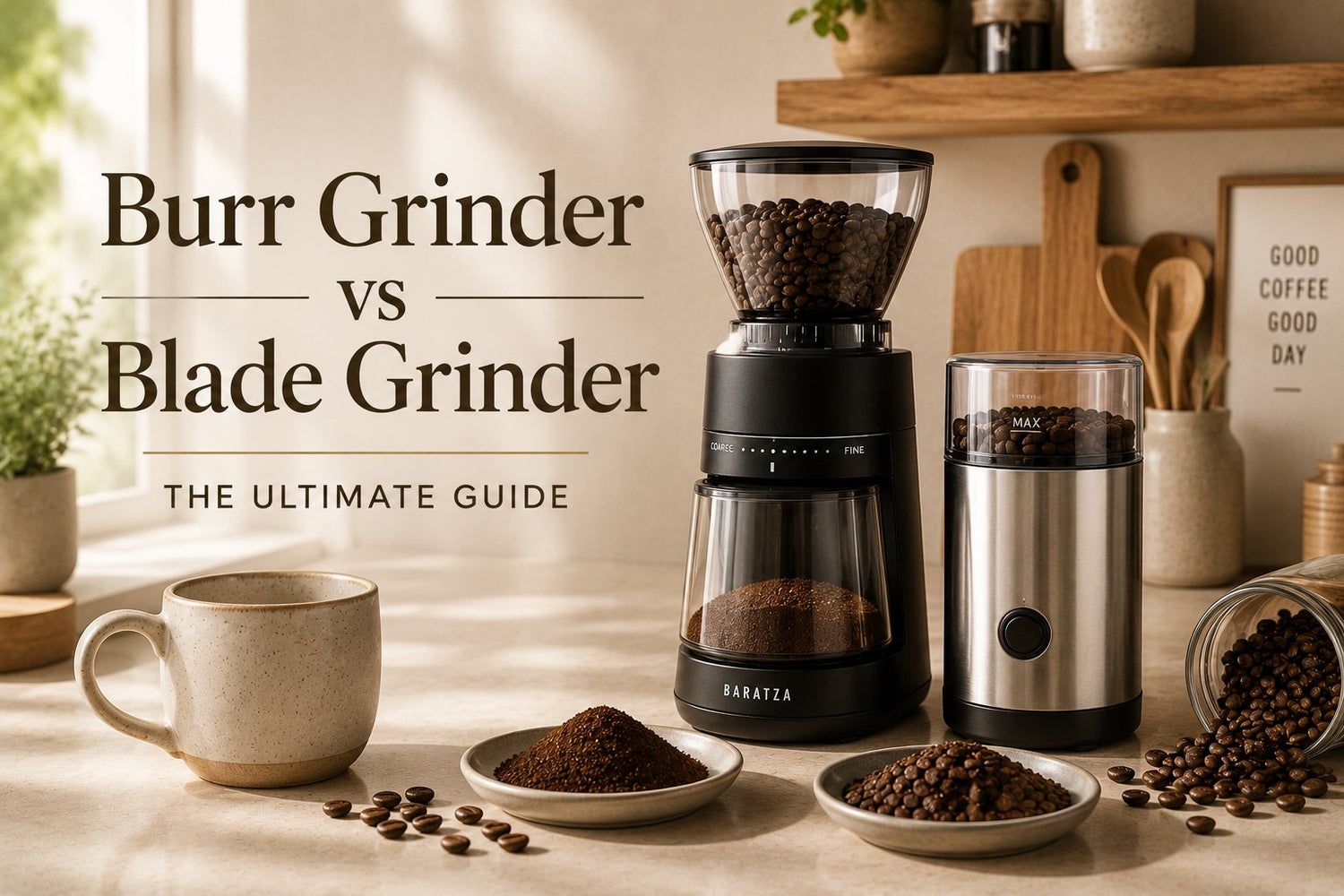
You're probably in the exact spot where most home coffee drinkers get stuck. You've started buying better beans, maybe you've tweaked your pour-over routine or upgraded your drip machine, and now you're staring at two grinder options that seem simple on the surface but lead to very different mornings.
One grinder has burrs, costs more, takes up more room, and gets recommended constantly. The other has blades, costs less, looks straightforward, and seems good enough until you start asking what “good enough” really means. That's the fundamental burr grinder vs blade grinder question. Not which one wins in theory, but whether the extra cost and bulk are worth it for the way you brew.
For some people, the answer is easy. For others, it depends on brew method, kitchen space, how often they make coffee, and how much inconsistency they'll tolerate before it starts to annoy them. If you're also sorting out the rest of your setup, this kind of decision fits right alongside other practical home bar essentials that change daily use more than they change appearance.
Table of Contents
- The Coffee Grinder Dilemma
- How Each Grinder Actually Works
- The Impact on Grind Consistency and Flavour
- Matching Your Grinder to Your Brew Method
- Comparing Practical Trade-Offs and Cost
- Your Decision Checklist for Home and Business
-
Frequently Asked Questions
- What's the difference between conical and flat burrs
- Can a blade grinder make decent coffee
- Is a burr grinder worth it for drip coffee
- Can I use a blade grinder for espresso
- Are blade grinders only for beginners
- How often should I clean my grinder
- Can I use my coffee grinder for spices
- What's the simplest buying advice
The Coffee Grinder Dilemma
Walk into a kitchen store or browse online for five minutes and the decision gets strangely muddy. Blade grinders look simple. Burr grinders look serious. One promises affordability. The other promises control. Both claim to grind coffee.
That's why so many people buy the cheaper machine first, then wonder why their coffee still tastes uneven even after switching beans. The grinder often decides whether your brewing recipe behaves the same way from one cup to the next. If the grounds aren't consistent, the rest of your routine can be careful and still produce mixed results.
The practical mistake is treating this like a winner-takes-all debate. It isn't. A blade grinder can be the right tool for a casual drinker who makes basic coffee a few times a week and doesn't want another bulky appliance. A burr grinder makes more sense when repeatability matters, especially if you change brew methods, dial in recipes, or notice when a cup tastes harsh one day and flat the next.
Practical rule: Buy the grinder that matches your brewing habits, not the grinder that wins the loudest internet argument.
A good decision usually comes down to a short list of questions:
- How often do you brew: Daily use exposes grinder weaknesses fast.
- What method do you use most: Espresso, pour-over, drip, French press, and cold brew don't ask for the same level of precision.
- How sensitive are you to inconsistency: Some people are happy with “pretty good.” Others want the same cup every morning.
- What's your real budget: Not just purchase price, but whether you'll feel the need to upgrade again soon.
- How much space do you have: Countertop footprint matters more in small kitchens than coffee forums like to admit.
Those trade-offs matter more than brand hype. The best grinder is the one that suits your routine well enough that you enjoy using it.
How Each Grinder Actually Works
The difference starts inside the machine. One grinder sizes coffee by forcing beans through a fixed gap. The other keeps chopping until you stop it.

Burr grinders mill coffee
A burr grinder uses two hard surfaces called burrs. One or both burrs rotate, the beans feed between them, and the distance between those burrs sets the grind size. That mechanical control is the whole point.
In practice, that means the grinder is doing the sizing for you. You choose a setting, the burrs hold that gap, and the grounds come out within a narrower range than they do from a blade grinder. That matters most for brew methods that react badly to mixed particle sizes, but even for everyday drip coffee it makes the routine easier to repeat.
A home model such as the HAMILTON BEACH PROFESSIONAL 80405 Conical Burr Digital Coffee Grinder, priced at $64.99 and currently in stock, shows what entry-level burr grinding is trying to deliver at home: more even grinding, automatic operation, and measured dosing with a built-in scale and digital display.
There are trade-offs. Burr grinders cost more, take up more space, and usually make more sense for households that brew often enough to notice inconsistency. They also reward a little maintenance. Old grounds and oil buildup affect performance, which is why storing beans well and keeping the grinder clean matters. If you already care about freshness, proper airtight food storage for coffee beans helps the grinder do its job.
Blade grinders chop coffee
A blade grinder uses a fast-spinning metal blade in the bottom of a chamber. Drop in beans, press the lid, and the blade strikes whatever pieces happen to land in its path.
That is cheaper to build, and it keeps the machine small. It also means the grinder has no fixed reference for particle size. Some pieces get hit again and again until they turn powdery. Others dodge the blade and stay coarse. Time becomes your only control, so the result depends on how full the chamber is, how long you run it, and whether you stop to shake it between pulses.
This short video gives a useful real-world view of that difference in action.
That is why blade grinder users often pulse, shake, check, and repeat. You can get acceptable coffee that way, especially for basic drip machines, cold brew, or occasional French press. You usually cannot get the same level of control from one morning to the next.
A burr grinder sets particle size with hardware. A blade grinder approximates particle size with time.
For some kitchens, that is a fair trade. If coffee is occasional and the budget is tight, a blade grinder can be good enough. If the goal is repeatable coffee across different brew methods, the burr design earns its higher price because the mechanism itself solves the problem a blade grinder leaves to trial and error.
The Impact on Grind Consistency and Flavour
Grind quality shows up fastest on rushed mornings. Same beans, same brewer, same water, yet one cup tastes clean and sweet while the next tastes flat or oddly bitter. In home setups, that inconsistency often starts at the grinder.

What consistent grounds do in the cup
Coffee extraction rewards even particle size. If most of the grounds are close to the same size, water extracts them at a similar rate. That gives you a better shot at sweetness, clearer flavour separation, and a cup you can repeat tomorrow.
That is the practical reason burr grinders cost more. They do not just make coffee grounds. They narrow the range between the smallest and largest particles, which gives you more control over brew time and taste.
For a daily drip drinker, that can mean fewer muddy cups and less guesswork. For pour-over, it usually means cleaner acidity and better balance. For espresso, it means the difference between a workable shot and a frustrating sink shot.
Why blade-ground coffee tastes less predictable
Blade grinders create a wider mix of fines and larger pieces. The fines give up flavour fast and can push bitterness. The larger pieces lag behind and can leave the cup thin or slightly sour. Brew those together and the result often tastes muddled, even if the beans themselves are good.
That uneven extraction is why people describe blade-ground coffee as both harsh and weak. Those two problems can happen in the same brew.
Storage still matters, just for a different reason. Keeping beans in airtight food storage containers for pantry organisation helps preserve freshness, but fresh beans cannot compensate for an uneven grind. Good storage protects flavour potential. Grind consistency decides how much of that potential reaches the cup.
A quick caution on product labels helps here. A grinder made for food prep is solving a different problem than a coffee grinder. The Hamilton Beach Stand Mixer Grinder Attachment, priced at $49.99 and currently in stock, is built for meat and other foods, not for the particle control coffee brewing needs.
The cost-benefit question depends on what you brew and how much inconsistency bothers you:
- Espresso and pour-over: grind inconsistency is easy to taste and hard to correct later.
- Drip coffee: a burr grinder improves repeatability, but a blade grinder may be acceptable for households that value convenience and low cost over precision.
- French press and cold brew: the penalty is smaller, so a blade grinder can be a reasonable compromise for occasional use.
If your coffee swings from good to disappointing without an obvious change in recipe, grind consistency is one of the first things to check.
Matching Your Grinder to Your Brew Method
You taste this difference fastest on a rushed weekday morning. One grinder gives you a brew that behaves the same way it did yesterday. The other asks you to accept a little guesswork.

The right grinder depends less on coffee ideology and more on what you brew, how often you brew it, and how much inconsistency will annoy you over time.
Brew methods that justify a burr grinder
If you make espresso, a burr grinder is required. Espresso is sensitive to small grind changes, and a blade grinder cannot give the level of control needed to dial in shot time, flow, and taste with any repeatability. If espresso is part of your daily routine, the upgrade pays for itself in fewer wasted shots and less frustration.
Pour-over sits close behind. Methods like V60 and Chemex reward even extraction and punish uneven particle size quickly. With a blade grinder, one cup may run too fast and taste thin, while the next stalls and tastes harsh, even when you use the same beans and water. A burr grinder does not guarantee a great pour-over, but it gives you a stable starting point.
Drip coffee is where the main value question starts. For a household brewing several cups every morning, a burr grinder usually makes sense because repeatability matters more when you use it daily. For someone making a casual pot on weekends, the case is weaker. The coffee can still be enjoyable without spending heavily on gear.
Moccamaster makes a useful point in its discussion of burr versus blade grinders. The better choice often comes down to brewing frequency, available counter space, and whether the person makes espresso or filter coffee, not just whether one grinder type is technically better (Moccamaster on burr vs blade grinder decisions).
Brew methods where a blade grinder can be enough
For French press and cold brew, a blade grinder can be a workable budget choice. These methods are more forgiving, especially for households that care more about convenience, compact size, and low upfront cost than flavour precision.
There are still trade-offs. French press brewed with too many fines gets muddy and silty. Cold brew made from an uneven grind can come out muddled rather than smooth and chocolatey. The cup may still be good enough for many people, but the gap narrows only if expectations stay realistic.
Here is the practical framework I use:
- Daily espresso drinker: buy a burr grinder.
- Regular pour-over brewer: buy a burr grinder.
- Busy drip coffee household: a burr grinder is often worth the money.
- Occasional French press or cold brew drinker: a blade grinder can be acceptable.
- Very infrequent coffee drinker: buy fresh pre-ground coffee from a good shop instead of settling for a weak grinder.
Kitchen setup matters too. A larger burr grinder can be hard to justify in a small apartment if the coffee routine is simple. In that case, the decision sits alongside the same storage and space trade-offs people make with airtight vs stackable vs modular pantry storage options.
If your brew method rewards precision every day, a burr grinder usually earns its place. If coffee is occasional and forgiving, a blade grinder may be good enough.
Comparing Practical Trade-Offs and Cost
A grinder has to earn its spot on the counter. Cup quality matters, but so do noise at 6 a.m., how much mess it leaves behind, and whether the price makes sense for the way you brew.
Burr vs Blade Grinder at a Glance
| Feature | Burr Grinder | Blade Grinder |
|---|---|---|
| Grind consistency | More uniform | Less uniform |
| Grind control | Adjustable and repeatable | Managed mostly by timing and pulsing |
| Best fit | Espresso, pour-over, drip, serious daily use | Casual use, occasional brewing |
| Flavour clarity | Better suited to even extraction | More prone to mixed extraction |
| Upfront cost | Higher | Lower |
| Counter footprint | Often larger | Often smaller |
| Cleaning | More parts, more involved | Simpler chamber cleaning |
| Learning curve | Slightly higher at first | Very simple to start |
Where the money goes
The cost difference usually comes down to what you are paying for. A blade grinder is a simple motor-and-blade setup that chops beans quickly. A burr grinder adds a calibrated grinding mechanism, grind adjustment, and better repeatability from one batch to the next.
That does not mean every home should spend more.
If coffee is an occasional habit, a cheap blade grinder can be the sensible purchase. It keeps the upfront spend low, stores easily, and asks very little from the user. If coffee is part of the daily routine, the math changes. Paying more once for a burr grinder often feels cheaper than buying a blade grinder, getting frustrated with inconsistent results, and replacing it later.
The practical trade-offs look like this:
- Blade grinder keeps the entry price low: Good fit for occasional use, tight budgets, and simple coffee routines.
- Burr grinder gives better repeatability: Helpful for anyone who wants the same cup on Monday that they liked on Sunday.
- Blade grinder keeps operation simple: Fewer settings and less temptation to tweak.
- Burr grinder usually holds value longer in daily use: Especially in homes where several people brew coffee and the grinder gets used hard.
There is also the cost you feel after checkout. Some grinders are loud enough to wake the house. Some scatter chaff and grounds. Some are easy to brush out, while others hold onto old coffee oils and need more attention. Those details matter in small kitchens, shared homes, and office setups where convenience decides whether people use the grinder or avoid it.
For shared kitchens, rentals, and breakrooms, replacement planning matters too. Buying through a more organized source for wholesale kitchen supplies for repeat-use spaces can make more sense than treating the grinder as a one-off gadget purchase.
For many households, the right question is not which grinder is better. It is whether better coffee, better control, and better consistency will show up often enough to justify the extra cost. If the answer is yes, buy the burr grinder. If the answer is no, a blade grinder can still be the practical call.
Your Decision Checklist for Home and Business
A good grinder decision usually gets made in the kitchen at 6:30 a.m., not in a spec sheet. If one person wants fast drip coffee before work, another uses a French press on weekends, and nobody wants to troubleshoot a fussy machine, the right answer depends on how often grind quality will change the result.

For the everyday household
For home use, the simplest test is this: will better grind control save you money or frustration often enough to pay for itself?
A burr grinder is usually the better buy if your household brews most days, rotates between brew methods, or notices when one bag of beans tastes great and the next cup from the same bag falls flat. It also makes sense for espresso, pour-over, and anyone trying to correct a bad cup with a small grind change instead of trial and error.
A blade grinder still has a real place in some homes. It fits occasional coffee drinkers, student kitchens, guest rooms, and households where coffee is more about convenience than precision. If the goal is a quick morning cup from an automatic drip machine and nobody is chasing flavor notes, the money saved may matter more than the performance gap.
Storage habits matter too. Fresh beans keep their quality better when the rest of the kitchen routine is organized, which is one reason broader choices like glass versus plastic food storage containers end up affecting coffee quality more than people expect.
For small businesses and shared spaces
Shared coffee setups need equipment that gives a predictable result even when the person using it changes every day.
That shifts the value calculation. In a one-person home, a mediocre grinder may only disappoint one person. In an office, rental, studio breakroom, or small hospitality setting, inconsistent grinding creates repeated complaints, wasted beans, and a setup people stop trusting. The clearer choice in those spaces is usually a burr grinder, not because it is fancy, but because it reduces guesswork for everyone.
Use these questions to make the call:
- Does more than one person use the grinder? If yes, choose the option that is easier to repeat successfully.
- Are you brewing espresso, pour-over, or anything sensitive to grind size? Burr is usually required for consistent results.
- Is coffee part of the guest or client experience? Better consistency is part of what people notice.
- Will the grinder run every day or several times a day? Frequent use exposes the weak points of cheaper blade models faster.
- Is replacement cost more painful than buying once at a higher price? For shared spaces, that is often the primary budget question.
For a casual back office with one coffee drinker and low expectations, a blade grinder can still be enough. For any setting where several people rely on the grinder or where coffee quality reflects on the space, spending more on a burr grinder is usually worth it.
Frequently Asked Questions
What's the difference between conical and flat burrs
Both are burr grinders. The key point for most buyers is that both are built around controlled grinding rather than random chopping. If you're deciding between burr and blade, that difference matters much more than the difference between burr shapes.
Can a blade grinder make decent coffee
Yes, but usually within limits. It can make drinkable coffee for casual brewing, especially if you mostly use forgiving methods and don't expect tight consistency. It becomes frustrating when you want repeatable results or need a very specific grind.
Is a burr grinder worth it for drip coffee
Often, yes. Not because drip coffee is automatically high-precision, but because daily drip drinkers benefit from more even extraction and easier repeatability. If you brew drip coffee often and care whether one pot tastes better than the next, a burr grinder is easier to live with over time.
Can I use a blade grinder for espresso
In practical terms, no. You may get coffee ground finely enough sometimes, but you won't get the control and consistency espresso depends on.
Are blade grinders only for beginners
Not necessarily. They're also for people who value low cost, compact size, and simplicity more than precision. That's a legitimate use case. The problem starts when someone expects blade results from a burr-style workflow.
How often should I clean my grinder
Clean it often enough that old grounds and oils don't build up. If you use your grinder daily, quick routine cleaning goes a long way. Burr grinders usually need more deliberate cleaning because they have more parts involved in the grinding path. Blade grinders are simpler, but they still collect residue.
Can I use my coffee grinder for spices
You can, but it's usually a bad idea if you want your coffee to taste like coffee. Spices leave behind strong aromas and oils. If you need a grinder for multiple kitchen jobs, keep coffee separate from strongly scented ingredients.
What's the simplest buying advice
Buy a burr grinder if you make espresso, pour-over, or coffee every day and you care about consistent flavour. Buy a blade grinder if your budget is tight, your standards are relaxed, and convenience matters more than precision.
If you're comparing coffee grinders alongside other real-world kitchen buys, GrifGlo publishes decision-focused guides across appliances, pantry systems, and home essentials so you can choose tools that fit how you use your space.

Laisser un commentaire
Ce site est protégé par hCaptcha, et la Politique de confidentialité et les Conditions de service de hCaptcha s’appliquent.