

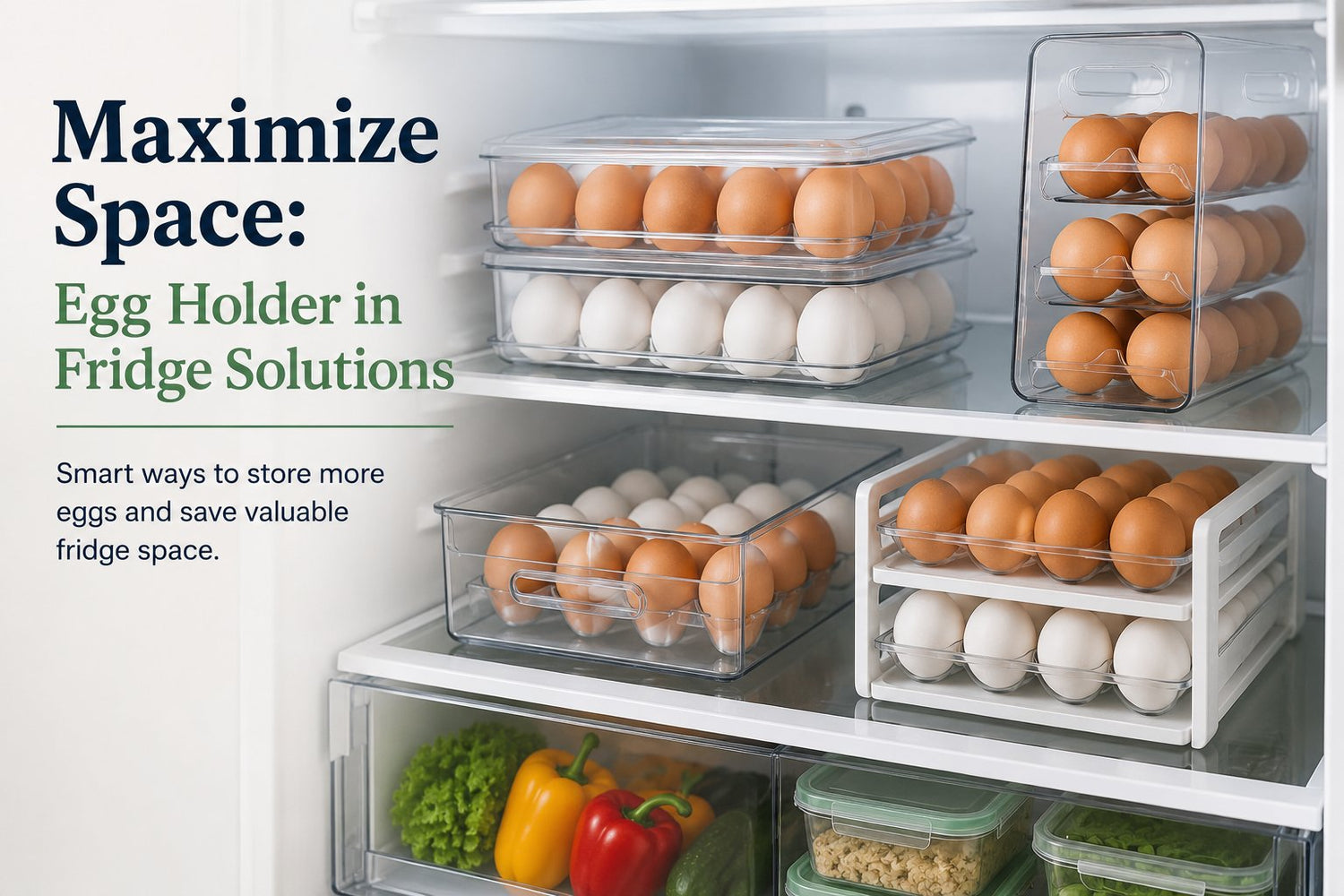
You open the fridge to put away groceries, and the egg carton is wedged between leftovers, a bag of spinach, and a bottle that tips forward every time the door swings shut. That's usually the moment people start looking for an egg holder in fridge storage. They want less clutter, fewer cracked shells, and something that looks more organised than a soft carton slumping on the shelf.
That instinct makes sense. But eggs aren't just another item to decant into a prettier container. Where and how you store them affects freshness, handling, and whether the system reduces waste. In a well-organised fridge, a dedicated holder can help. In plenty of homes, the original carton is still the smarter choice.
Table of Contents
- Why Your Egg Storage Strategy Matters
- Comparing Egg Holder Materials and Designs
- Choosing the Right Size and Capacity
- Smart Placement for Optimal Freshness
- The Case for Keeping the Original Carton
- Final Buying Criteria for Your Home or Business
Why Your Egg Storage Strategy Matters
Many individuals start with the wrong question. They ask which egg holder looks neatest, or which one fits the most eggs. The better question is whether your storage setup keeps eggs cold, stable, and easy to track.
In Canada, that matters immediately. The CFIA advises that eggs should be kept refrigerated at 4°C or below and protected from temperature fluctuations, which makes door storage a poor default even though many organisers are designed for that exact spot, as noted in this egg storage product page that summarises the Canadian guidance.
That shifts the whole conversation. An egg holder in fridge storage isn't just about tidiness. It's a food storage decision.
Looks matter less than temperature stability
A sleek clear tray can make a fridge look better. It can also push you into storing eggs in the warmest, most frequently disturbed part of the appliance if the tray is door-mounted or shaped for door bins. That's the kind of upgrade that feels organised but works against the product you're storing.
Practical rule: If an egg holder only works well on the fridge door, skip it.
A good system protects the eggs from knocks, lets you see what you have, and keeps them in a cold, consistent zone. Sometimes that's a dedicated holder on a main shelf. Sometimes it's the carton you already brought home.
Better systems reduce friction
The right setup should make daily use easier in small ways:
- Less reshuffling: You shouldn't have to lift three items to reach a carton.
- Better visibility: You should know quickly whether you need more eggs.
- Lower breakage risk: Eggs shouldn't roll, slide, or get crushed by taller items.
- Simpler routines: The storage method should fit how you already cook and shop.
If you're rebuilding your fridge layout more broadly, GrifGlo's guide to practical kitchen essentials for everyday routines is useful because it frames tools by actual use, not trend value.
The strongest egg setup is the one you'll keep using after the novelty wears off. That usually means stable shelf placement, easy handling, and no extra faff when you unload groceries.
Comparing Egg Holder Materials and Designs
Material changes more than appearance. It affects how easy the holder is to clean, how much protection it gives, and whether it feels practical after a few months of use instead of just looking tidy on day one.

What the material changes in daily use
Plastic is still the most common choice for an egg holder in fridge use because it's light, easy to move, and often transparent enough to show inventory at a glance. That makes it practical for busy households. The downside is that some lighter plastic models flex too much when full, especially if they're long and narrow.
Ceramic looks better on an open shelf and feels substantial, but it's heavy. In a crowded fridge, that weight can become annoying fast. It also tends to be less forgiving if bumped against a glass shelf edge or sink while washing.
Wire or metal baskets allow airflow and suit a more rustic kitchen style, but they don't cradle eggs as securely as moulded cups. I don't usually recommend them for homes where the fridge gets opened hard or shelves get rearranged often.
Silicone is less common, but it has a practical advantage. It has some give, and that can absorb minor knocks. Still, softer formats don't always stack cleanly, and they can feel floppy when loaded.
| Material | Pros | Cons | Best For |
|---|---|---|---|
| Plastic | Lightweight, easy to clean, often stackable, usually easy to see through | Can scratch or flex, quality varies a lot | Most households |
| Ceramic | Attractive, weight helps it stay put | Heavy, breakable, uses more effort to move and wash | Style-focused kitchens with stable shelf space |
| Metal | Good airflow, simple shape | Less cushioning, less shell protection | Low-volume use and open shelf aesthetics |
| Silicone | Flexible, easy wipe-down, some impact absorption | Less rigid, not always easy to stack | Small setups needing a softer tray |
If you're comparing fridge containers more broadly, this guide on choosing produce storage containers for your fridge uses the same practical lens that applies here: cleanability, shape, footprint, and actual handling matter more than matching sets.
How the main designs behave in a real fridge
The simplest design is a flat tray. It's easy to wash, easy to load, and usually the least annoying in daily use. The trade-off is that it takes a fixed amount of shelf width.
Lidded containers add protection and let you stack something lightweight on top if the lid is sturdy. They can work well in compact fridges, but only when the lid opens cleanly without colliding with the shelf above.
Tiered and gravity-fed designs solve a different problem. They improve access and can reduce the shelf footprint by building upward instead of outward. One market example uses two rows of 7 eggs per tier to increase storage density, but that concentrated load means the holder needs a stable base and good balance so it doesn't tip when eggs are removed unevenly or the fridge is opened quickly, as described in this large egg holder design example.
That's why I treat gravity-fed organisers as layout-dependent, not automatically better. They work best when the shelf is level, the holder has room to sit flat, and the surrounding items won't knock the track out of alignment.
Some of the worst-performing organisers aren't badly made. They're just the wrong shape for the fridge they ended up in.
A concrete example is the Automatic Egg Dispenser Rack – Rolling Storage Holder. It uses a gravity-fed inclined track, dispenses eggs one at a time, has a 2-tier layout with a small footprint, and includes an anti-slip bottom. That kind of design can be useful when shelf width is limited but vertical clearance is available. It's less useful if your shelf height is tight or if your household prefers to grab several eggs at once while cooking.
Choosing the Right Size and Capacity
A lot of egg organisers fail before they ever reach the fridge. The buyer checks the egg count, likes the look, and never measures the shelf.
That's how people end up with a holder that technically stores more eggs but steals the exact strip of shelf space they needed for milk, leftovers, or produce.

Measure the shelf before you buy
GE describes a traditional refrigerator egg bin as roughly 14.5 in × 4.25 in and able to hold two dozen eggs, which is a useful benchmark because it shows how much shelf length a high-capacity tray can consume in exchange for separation and protection, according to this GE refrigerator egg bin reference.
For many Canadian homes, especially apartment kitchens, that's a meaningful footprint. Long, low trays often look efficient in product photos because they spread eggs neatly in a row. In a real fridge, they can block flexible use of the shelf.
Use this check before you buy:
- Measure shelf depth so the holder won't overhang or press into other items.
- Measure width available after essentials are in place, not on an empty fridge shelf.
- Check vertical clearance if the holder has a lid or stacked tiers.
- Notice shelf lip and drawer movement so the holder won't snag when you slide crispers or reach underneath.
If you want a practical framework for sizing other containers too, GrifGlo's guide to food storage container sizes helps build the habit of measuring for real shelf use rather than buying by label alone.
Match capacity to how your household uses eggs
Bigger isn't always better. Capacity should match buying habits and cooking routines.
A smaller household that buys one carton at a time often does better with a compact tray or no dedicated holder at all. A larger family that cooks eggs daily may prefer a format that makes quick access easier and prevents one carton from getting buried behind other groceries.
I also look at retrieval style. If you usually take one or two eggs at a time, a dispenser can feel efficient. If you bake often or prep breakfast for several people, a wide tray may be faster because you can scan and grab multiple eggs at once.
Buy for your normal week, not your holiday baking week.
One practical side note. If you're reorganising a small kitchen, it helps to separate cold-storage planning from hot-zone tools. Something like the HOME AESTHETICS HA-4121 2pc Oven Mitt & Pot Holder Set belongs near cooking areas, not inside the fridge discussion, but it's a good reminder that each tool works best when stored near the task it supports.
Smart Placement for Optimal Freshness
Where you place eggs matters more than which holder you choose. A mediocre tray on the right shelf will usually serve you better than a stylish organiser in the wrong zone.

Why the door is the wrong spot
The fridge door is convenient. It's also the place that gets the most frequent temperature swings because it warms every time someone reaches for milk, condiments, or snacks.
Research shared by Washington State University says properly refrigerated eggs maintain quality for about five weeks after the pack date when stored on the middle or lower shelf, where temperature is more stable, and that guidance appears in this Washington State University egg storage summary. For home organising, that's the key point. Shelf placement helps preserve quality over time.
That's why I don't recommend door-mounted egg racks, even when they free up a shelf. They solve a space problem by creating a storage problem.
What works better on a main shelf
A main shelf gives you three advantages at once:
- More stable cold storage
- Less movement when the fridge opens
- Better support for heavier or stacked organisers
The middle or lower shelf usually works best. If you use a holder, keep it toward the back half of the shelf without pushing it so far back that eggs get forgotten. If you keep eggs in the carton, give the carton a defined zone so it doesn't migrate behind jars and leftovers.
A simple zone-based layout helps. Put dairy and eggs in one repeatable area, produce in another, ready-to-eat items at eye level, and bulky drinks where they won't force smaller items into the door. This kind of setup is easier to maintain than category chaos, and GrifGlo's guide on organising your fridge with bins and zones is useful if your whole fridge needs that reset.
Here's a quick visual overview of the larger waste-and-storage question:
What I've seen in practice is simple. People are more likely to use eggs in time when they can see them on a stable shelf and trust the setup. They forget them more often when they're hidden in the door behind sauces or moved into a novelty container that doesn't fit the rest of the fridge.
The Case for Keeping the Original Carton
Sometimes the smartest egg holder in fridge strategy is no extra holder at all. That answer disappoints people who were hoping for a product recommendation, but it's often the most useful one.
The original carton already does several jobs. It groups the eggs, cushions them, and keeps them in a format that's easy to move from the grocery bag to the shelf.
Why the carton still does several jobs well
Cartons support inventory control in a way many clear trays don't. You can keep the purchase information with the eggs, you can see quickly whether the carton is nearly empty, and you don't create an extra transfer step every time you shop.
That matters because household food waste remains a major issue in Canada, and the simpler approach is often the one people keep up with. Keeping eggs in their original carton on a stable shelf helps reduce spoilage confusion and supports easier inventory tracking, which is one of the practical points raised in this video discussion on food waste and simple storage habits.
The best organiser is often the one that removes decisions, not the one that adds another routine.
There's also the matter of odour management and handling. A carton gives eggs some separation from the rest of the fridge, and it's designed specifically for transport and storage. A decorative bowl or open rack may look cleaner, but it usually protects less.
When a dedicated holder isn't worth it
I'd be cautious about buying a separate holder if any of these sound familiar:
- You're a renter with a compact fridge: Every centimetre of shelf space matters, and fixed-format organisers can make the layout less flexible.
- You buy eggs occasionally, not constantly: A specialty holder may spend more time half-empty than useful.
- You already forget what's in the fridge: Decanting eggs into another container can disconnect them from their purchase information and make them easier to overlook.
- You're trying to spend less on accessories: A carton already performs the basic job well.
That doesn't mean dedicated holders are pointless. They can help if your carton collapses, if your household buys larger quantities, or if a clear tray makes stock easier to manage for the way you cook.
But if your real problem is fridge chaos, the answer may be zoning and visibility, not an egg-specific gadget. I'd rather see someone create a reliable shelf area for eggs in the carton than buy a trendy organiser that adds one more object to wash and one more shape to work around.
Final Buying Criteria for Your Home or Business
If you're deciding whether to buy an egg holder in fridge storage, narrow the choice to function first. Ignore styling until you know the holder fits your shelf, your routine, and your tolerance for maintenance.

For home use
A household organiser should make eggs easier to store and easier to use. If it doesn't do both, it's clutter.
Use this checklist:
- Fridge fit: Check width, depth, and height with your usual groceries in place.
- Stable placement: Choose a design that works on a main shelf, not one that pushes you toward door storage.
- Cleaning effort: Prefer shapes with smooth surfaces and easy access to corners.
- Handling style: Pick a tray if you grab several eggs at once. Pick a dispenser if you usually take one or two.
- Realistic capacity: Match the holder to how your home shops and cooks, not the biggest format available.
- Visual clarity: Make sure you can tell quickly when stock is low.
For shoppers comparing containers across categories, GrifGlo's guide to choosing food storage containers is useful because the same principles apply here: fit, ease of use, and cleaning matter more than novelty.
For business use
Small businesses, rental hosts, and hospitality setups have a different priority. They need storage that stays consistent across repeated resets.
Look for:
- Durability: The holder should tolerate frequent handling without cracking or warping.
- Fast cleaning: Staff or hosts should be able to wipe it down quickly and inspect it easily.
- Shelf stability: Avoid models that wobble when partially emptied.
- Clear presentation: Guests or team members should understand the system immediately.
- Replaceable simplicity: If one breaks, it should be easy to swap without redesigning the whole fridge setup.
For shared or high-turnover kitchens, the simplest system usually wins because it reduces training, confusion, and breakage.
One more maintenance rule applies in every setting. Wash the holder regularly, dry it fully, and don't overload it beyond the shape it was designed to support. A well-sized organiser that stays clean is useful. An oversized one that's awkward to wash becomes shelf clutter with a short life.
GrifGlo helps shoppers cut through that kind of clutter by focusing on practical fit, comparison advice, and decision-friendly kitchen organisation guidance. If you're building a fridge setup that works for real routines, explore GrifGlo for straightforward product guidance and home storage recommendations.


Laisser un commentaire
Ce site est protégé par hCaptcha, et la Politique de confidentialité et les Conditions de service de hCaptcha s’appliquent.