

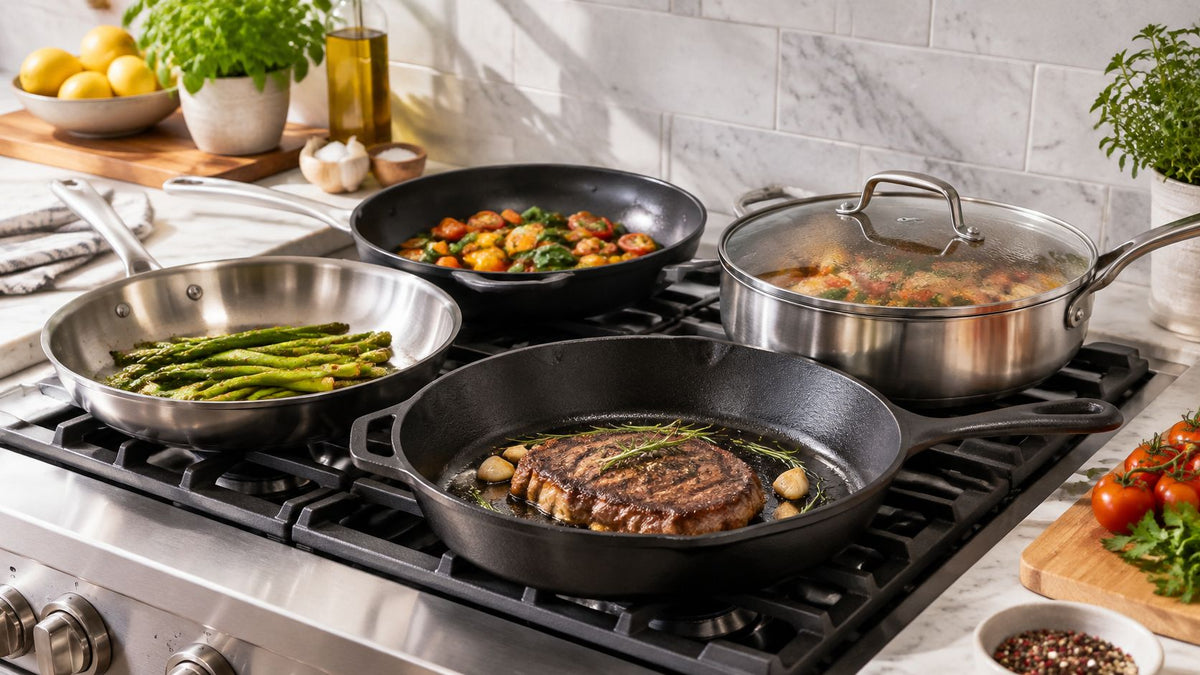
Buying the biggest fryer pan set you can afford is bad advice. Extra pieces don't help if the bases won't work on your stove, the coating can't handle your cooking habits, or the handles crowd an already cramped hob. Buy for burner fit, controlled heat and safe storage first. Piece count comes last.
A useful set should let you cook breakfast, brown dinner and shallow-fry a batch without improvising with the wrong pan. That doesn't mean every household needs every available diameter. It means each piece you buy needs a clear job.
Table of Contents
- What a Fryer Pan Set Actually Includes
- Pan Size and Stove Compatibility
- Coatings and Metals Worth Paying For
- Fire Risk When Oil Meets a Crowded Set
- Matching the Set to Household and Habits
- How to Maintain Each Pan in the Set
- Confirm the Set Before You Check Out
What a Fryer Pan Set Actually Includes
A fryer pan set is matched frying and sauté cookware for stovetop cooking, including shallow frying. It isn't an air fryer, and it isn't a countertop deep fryer. Start with the jobs you need covered, then decide which pieces deserve cupboard space.
For a worked buying example, consider a small egg pan, an everyday skillet, a family skillet and a deeper pan with a fitted lid. The dimensions and portions below are illustrative shopping targets, not standard capacities or guaranteed serving counts. A thick chicken breast takes up space differently from chopped vegetables.
Minimum fryer pan set and what each piece does
| Piece | Typical size in this example | Main job | Serves |
|---|---|---|---|
| Small skillet | 8 in / approximately 20 cm | Eggs, toasting spices, one side | A single portion or a side |
| Everyday skillet | 10 in / approximately 25 cm | Daily sauté and pan-fry | A couple's meal or modest portions to share |
| Family skillet | 12 in / approximately 30 cm | Proteins and one-pan meals | A family meal, with food kept in a single layer |
| Deep sauté or fry pan | Approximately 28–30 cm across and 6–10 cm deep | Shallow frying with headroom and a lid | Batches, not a full pot of oil |
| Fitted lid | Matches the deep pan | Steam finish and some splash control | The deep pan only |
| Splatter screen | Matches the largest diameter | Splash control during shallow frying | Optional accessory, not a fire cover |
These are familiar shopping sizes: MetaStat Insight valued Canada's medium skillets and frying pans measuring 8–12 inches at USD 27.7 million in 2023. That market category doesn't establish what your household needs. Your largest regular meal does.
Count cooking jobs, not carton contents
The deeper pan is useful for breaded cutlets, batches of vegetables and dishes that finish under a lid. Use a shallow layer of oil appropriate to the recipe, leaving generous space above the food for bubbling and splashing. Don't interpret tall sides as permission to fill the pan with oil.
A splatter screen and clip-on thermometer are useful additions, but neither compensates for a missing lid. Check the carton contents carefully: a lid pictured beside the cookware may fit a saucepan rather than the deep frying pan.
Buying rule: Count usable cooking vessels separately from lids, screens and utensils.
If you're unsure whether a pot-shaped piece fills the same role, the saucepan versus frying pan comparison helps distinguish boiling and simmering equipment from cookware designed for browning. Choose the working shapes first, then judge their construction, stove fit and suitability for hot oil.
Pan Size and Stove Compatibility
Put a magnet against the exterior base before accepting an induction-ready claim. Natural Resources Canada explains that induction requires ferromagnetic cookware, such as cast iron or suitable steel, or a magnetic bottom layer; plain aluminium or copper won't activate the element without that engineered layer. Magnetic attraction is a useful screening test, not proof of even heating.
The word stainless isn't enough. Some stainless-steel grades are magnetic and others aren't, so a polished pan can look perfectly suitable while failing on an induction stove. Look for an explicit compatibility statement for every cooking vessel in the set.
Which pan base works on each cooktop
| Cooktop | Base that works | Quick check | Main failure |
|---|---|---|---|
| Gas | Stable, flat base suitable for the grate | Flame stays beneath the base | Flames climbing the sidewall |
| Coil electric | Flat, reasonably thick base | No rocking on a flat counter | Hot spots from a warped base |
| Smooth ceramic electric | Flat, clean base with manageable weight | No wobble; lift rather than drag | Scratches and uneven contact |
| Induction | Cast iron, suitable steel or a magnetic layer | Magnet sticks to the exterior base | Plain aluminium or copper won't activate it |
| Mixed rental or hospitality | Magnetic stainless, steel or cast iron | Magnetic base plus flatness and appliance approval | Cookware selected only for gas fails on induction |
Measure the base, not just the rim
The advertised diameter usually describes the top opening, not the flat cooking surface underneath. Sloped sides can make a generous-looking skillet surprisingly cramped when you lay food flat. Use the guide to measuring frying-pan size to distinguish rim diameter, cooking area and base diameter.
For a hypothetical comparison, small, everyday and family skillets might have contact bases around 15 cm, 18 cm and 21–23 cm respectively. Treat those as example measurements to verify, not universal specifications. The actual base must suit the appliance's permitted cookware dimensions.
A base much smaller than an electric element wastes useful alignment and can expose more heated surface around the pan. On induction, an undersized magnetic base may couple poorly or fail the appliance's detection requirement. A thick, flat base helps distribute heat, but it doesn't rescue a poor size match.
Gas brings a different problem. If the flame climbs the sidewall, turn it down or move to a smaller burner rather than accepting a hot handle as normal. On glass or coil surfaces, reject a pan that rocks instead of sitting securely.
For renters and hosts, magnetic cookware with stated gas and conventional-electric compatibility is the sensible default. At delivery, check magnetic attraction, place each pan on a flat counter and compare its measured base with the stove's cookware guidance. Do this before washing away packaging details or discarding the box.
Coatings and Metals Worth Paying For
Buy material for the cooking job, not the adjective on the carton. A coating helps food release; the metal underneath governs much of the heating behaviour. A matching finish tells you little about either.
A mixed set is usually more useful than an entirely coated collection. Keep easy-release cookware for delicate food and give browning jobs to a surface you don't need to protect from normal searing technique.
Fry pan materials compared
| Material | Heat behaviour | Induction | Key limit | Best job |
|---|---|---|---|---|
| Clad stainless | More even with a well-designed conductive core or thick base | Only with a magnetic exterior or base | Needs controlled preheating and enough fat | Searing and acidic pan sauces |
| PTFE nonstick | Often responsive at moderate heat; construction matters | Only with a magnetic base | Observe the temperature guidance below; no empty preheat | Eggs, fish and delicate foods |
| Ceramic nonstick | Suitable for moderate cooking; release can fade | Requires a compatible magnetic base | Avoid high heat, abrasive tools and thermal shock | Light frying |
| Cast iron | Holds heat well and changes temperature slowly | Yes, subject to appliance requirements | Maintain seasoning; avoid long soaks | Browning and controlled shallow frying |
| Carbon steel | Usually lighter and more responsive than heavy cast iron | Bare steel is magnetic | Maintain seasoning and dry promptly | Fast sautéing and browning |
For non-stick cookware, Health Canada advises not cooking above 260 °C (500 °F), not preheating an empty pan and ventilating while cooking. The agency identifies PTFE as the most common PFAS used in non-stick coatings and says PFOA, formerly used in their manufacture, has been phased out because of health and environmental concerns.
That distinction matters when reading packaging. A PFOA-free statement doesn't mean a pan is free of every PFAS, and it doesn't make overheating acceptable. Read the actual coating description and safe-use instructions.
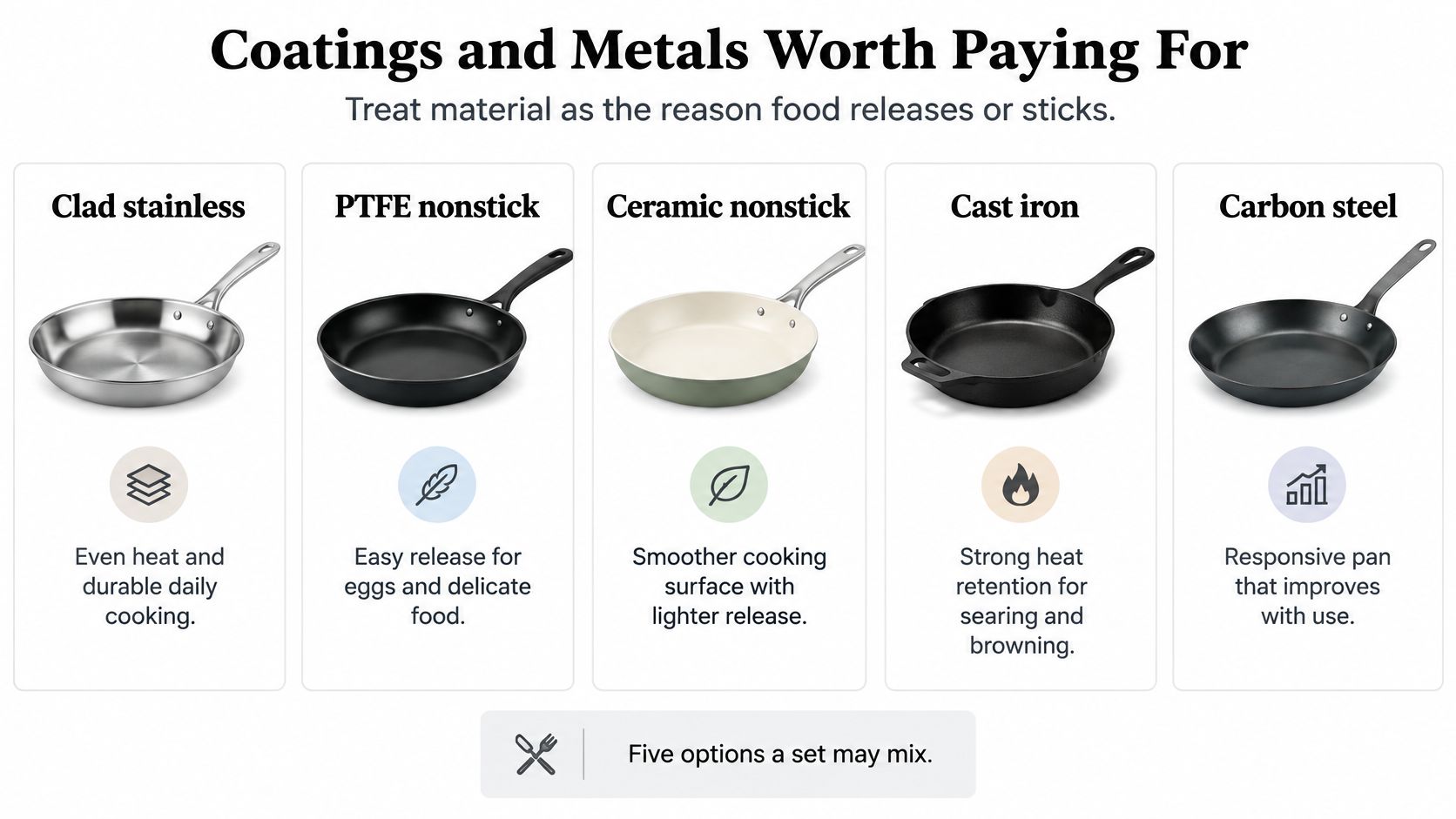
Where to spend your money
Choose stainless when you want a durable browning surface and intend to make sauces from the browned residue. A substantial conductive core or encapsulated base is more useful than a thin pan bought for its shine. Let food develop a crust before trying to release it, rather than forcing a spatula underneath immediately.
Choose PTFE for eggs and delicate fish when easy release is the priority. Ceramic-coated cookware also suits gentle frying, but don't assume its smooth new surface will tolerate metal utensils, aggressive heat or abrupt cooling.
Cast iron rewards cooks who want retained heat and accept the weight. Carbon steel suits someone who wants a seasoned surface with easier handling, although construction and thickness still matter. Both require drying and occasional seasoning maintenance.
A fully coated set doesn't fail all at once because a single pan overheats. It does expose every essential cooking job to the same coating-care limitations.
For most homes, combine a nonstick pan for delicate food with stainless or carbon steel for browning. Add cast iron only if you'll use and maintain it. The stainless-steel versus nonstick comparison can help resolve that everyday trade-off without buying duplicate skillets.
Fire Risk When Oil Meets a Crowded Set
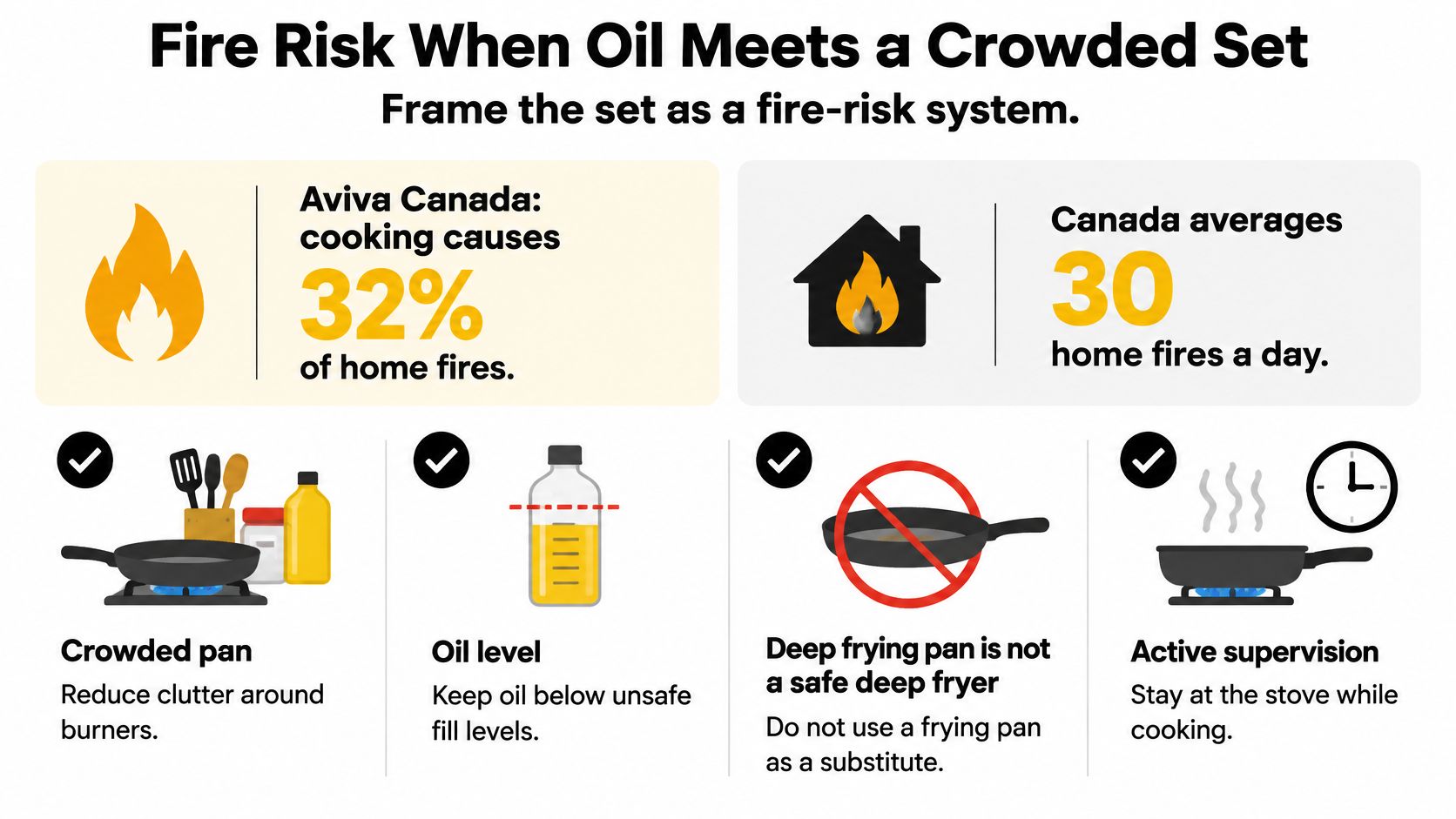
Aviva Canada reports that cooking causes 32% of home fires and that Canada averages 30 home fires per day. Those are reasons to judge a fryer pan set as cooking equipment with fire consequences, not as a bargain bundle.
A deep frying pan is not automatically a safe deep fryer. It lacks the dedicated controls and cooking arrangement of a purpose-built appliance. For shallow frying, use only the oil the recipe needs, preserve generous headroom and add food carefully rather than filling the vessel to exploit its capacity.
Choose equipment you can control
A stable base and securely attached handle matter more than decorative matching utensils. Test whether you can lift the empty pan comfortably, then consider the extra weight of food. A helper handle can be useful, but no handle should be assumed cool without checking its design and the cooking conditions.
- Fitted cover: Keep a proper lid within reach before heating oil. A splatter screen isn't a substitute.
- Temperature control: Heat gradually and use a suitable thermometer, with its sensing area in the oil rather than resting against the metal.
- Clear surroundings: Remove packaging, towels and spare cookware from the cooking area.
- Safe handling: Turn handles away from walkways without positioning them over another active burner.
- Controlled pouring: A spout can help with cooled oil, but it isn't permission to carry or drain a dangerously hot pan.
A larger set isn't unsafe by itself. The problem starts when extra cookware encourages simultaneous oily cooking on a crowded stove or gets stored with handles protruding into the working area. Stay at the stove while frying and cook in manageable batches.
Know the response before heating oil
If oil catches fire, turn off the heat if you can do so safely. Cover the pan with its fitted lid or a metal baking sheet only if that can be done without approaching flames or risking burns. Leave the pan where it is and keep it covered until completely cool.
Never use water and never move a flaming pan. If the fire isn't immediately controlled or you're unsure, leave, close the door if safe and call emergency services from outside.
The minimum safe arrangement is straightforward: a suitable deep pan, a real lid, a splatter screen where useful, an uncluttered adjacent surface and active supervision. Have the cover ready before the oil goes on.
Matching the Set to Household and Habits
Choose a set around the meals you cook most often and the space your kitchen can safely spare. These household examples show how routine, stove type and cooking area should shape the pieces you buy.

Everyday households
A couple cooking eggs and vegetables can start with a small nonstick skillet and a medium stainless pan. The egg pan suits gentle cooking, while the stainless piece handles sautéing and browned dinners. Check the handle comfort and usable cooking area before choosing; skip a large duplicate skillet unless leftovers or batch cooking are regular habits.
A family regularly cooking chicken or fish needs enough flat cooking area to keep food from piling up. A broad family skillet helps, while a deeper lidded pan suits covered finishes and shallow-fried meals. Choose the diameters to match the burners you use.
A renter facing an unknown future stove should favour clearly marked induction-compatible bases and compact storage. Removable handles can help, provided the locking mechanism feels secure and the cooking limitations are clear. A vertical rack may be simpler than a new nesting system.
Choose the smallest set that handles your largest regular meal comfortably, with enough room to cook without crowding.
Hosts and food-service buyers
A short-term rental host standardizing several kitchens should choose a compact, induction-safe selection with replacement pieces that can be matched where possible. Keep the correct lid with each deep pan and put clear heat and cleaning instructions inside the cupboard. Familiar, consistent cookware is easier for guests to use.
A small café or hotel breakfast operation may prefer stainless or carbon steel for repeated service, depending on the menu and staff skills. Domestic set packaging alone does not show whether cookware suits commercial duty. A household frying pan also does not replace a commercial deep fryer or the premises' fire-safety arrangements.
Use this video as a supplementary cookware reference, then judge the actual pieces against your stove and routine.
Give every pan a storage position
Measure the cupboard opening, internal height and hinge clearance before ordering an organizer. A rack that fits an empty cabinet may still leave too little room to lift out a wide skillet.
- Store vertically where practical: A plate-style rack or pan organizer can make individual pieces easier to retrieve.
- Keep oil-cooking equipment accessible: Store the deep pan and its cover where you can reach them without dismantling a heavy stack.
Leave cupboard capacity for the pieces you use. For coated-pan storage and care, follow the guidance in “How to Maintain Each Pan in the Set.” A pan that is awkward to retrieve is more likely to sit unused, while a well-chosen daily skillet earns its space.
How to Maintain Each Pan in the Set
Treat the set as several materials sharing a cupboard, not as cookware with a single cleaning rule. A dishwasher-safe claim on a stainless piece doesn't extend to a seasoned steel pan beside it.
Tape this routine inside the cupboard and make it part of clearing the stove.
A practical cleaning routine
- Let the pan cool before washing. Don't plunge hot cookware into a cold sink. Abrupt temperature changes can damage coatings or distort a base, and hot oil makes washing hazardous.
- Clean stainless without immediately attacking it with abrasives. Use hot water, washing-up liquid and a non-scratch pad. For stuck browned residue, gently simmer a little water in the pan, loosen it with a suitable utensil, then cool and wash.
- Hand-wash coated pans gently. Use a soft sponge and keep metal utensils away from the cooking surface. Nylon, silicone or wooden tools are better choices. Retire peeling or flaking cookware rather than continuing to cook over exposed patches; the nonstick frying-pan cleaning guide provides a focused cleaning reference.
- Dry seasoned cookware promptly. Wash cast iron and carbon steel as needed, dry thoroughly and use gentle burner warmth to remove remaining moisture. Wipe on a very thin film of oil. If sticking persists after cleaning, renew the seasoning rather than burying the surface under a thick, sticky oil layer.
- Put away clean, dry cookware only. Old oil and food residue don't belong in a stack. Separate coated interiors with protectors so the base of another pan can't scrape them.
- Inspect handles during routine cleaning. Look for movement, damaged fasteners and cracks around attachment points. Stop using a loose handle until it's correctly repaired; don't keep cooking while hoping the rivet holds.
- Return the lid to its designated place. Keep it with or immediately beside the pan it fits. Consistent storage prevents hurried searching while food is already cooking.
Replace the failed piece
A warped base, unreliable handle or flaking coating is a reason to remove that piece from service. A repairable fastening may be fixable according to the maker's instructions, but an unstable pan shouldn't stay in rotation meanwhile.
You don't need to replace sound cookware just because its partner has worn out. Keeping durable uncoated pieces and replacing the specialist coated pan separately is a practical reason to avoid buying everything solely for a matching finish.
Confirm the Set Before You Check Out
Make the product page prove that the set fits your kitchen. Attractive photography isn't a specification, and a long contents list isn't evidence of useful coverage.
Your final purchase check
- Distinct cooking jobs: Each vessel should fill a need rather than duplicate a diameter you already own.
- Complete contents: Confirm that the deep pan's matching lid is included.
- Explicit compatibility: Look for the intended cooktops, not just a metal name.
- Clear limitations: Check coating instructions, handle construction and any restrictions on oven use.
- Usable storage: Confirm that the largest pan and its handle fit your cupboard or rack.
If you finish food in the oven, establish the limit for the whole assembly, including the lid and handle. The guide to identifying oven-safe pans helps you check those components rather than assuming a metal body settles the question.
Keep specialty cookware separate
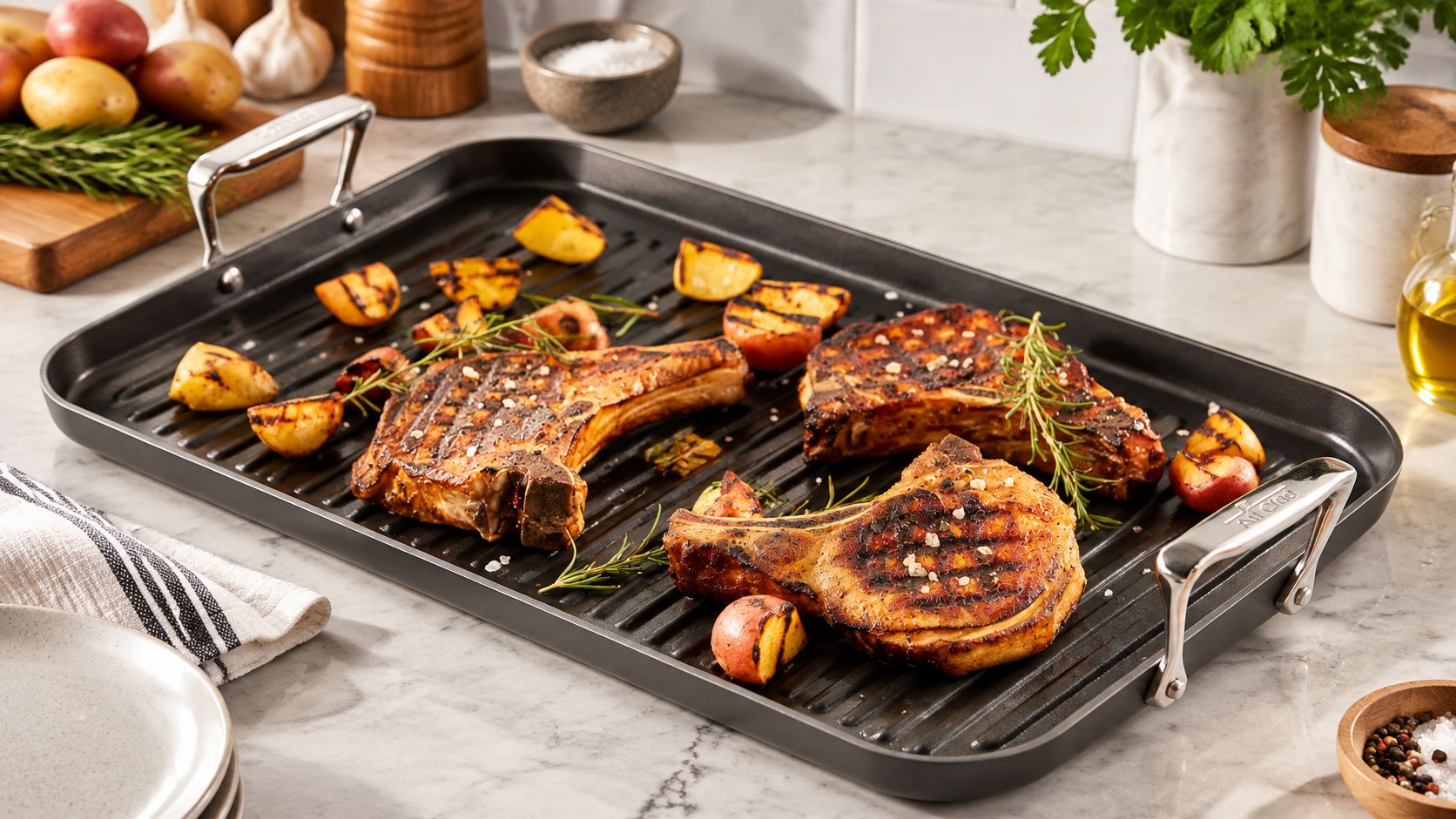
The All-Clad HA1 Double Burner Grill Pan – 13×20-Inch Nonstick has an open cooking surface spanning adjacent burners and low walls for turning food. That makes it a specialty grilling piece, not a substitute for a deep, lidded shallow-frying pan.
On delivery, verify the promised compatibility, stability and dimensions before putting the cookware into service. Reject unexplained mismatches instead of adapting your cooking around them.
Order the minimum safe configuration first. Add specialty cookware only after your regular meals reveal a genuine gap.
Our Kitchen collection groups cookware with racks, food storage and kitchen tools, so you can plan the cooking setup and its storage together. Visit GrifGlo to compare practical options and choose a fryer pan set that fits your stove, meals and available space.


Laisser un commentaire
Ce site est protégé par hCaptcha, et la Politique de confidentialité et les Conditions de service de hCaptcha s’appliquent.