

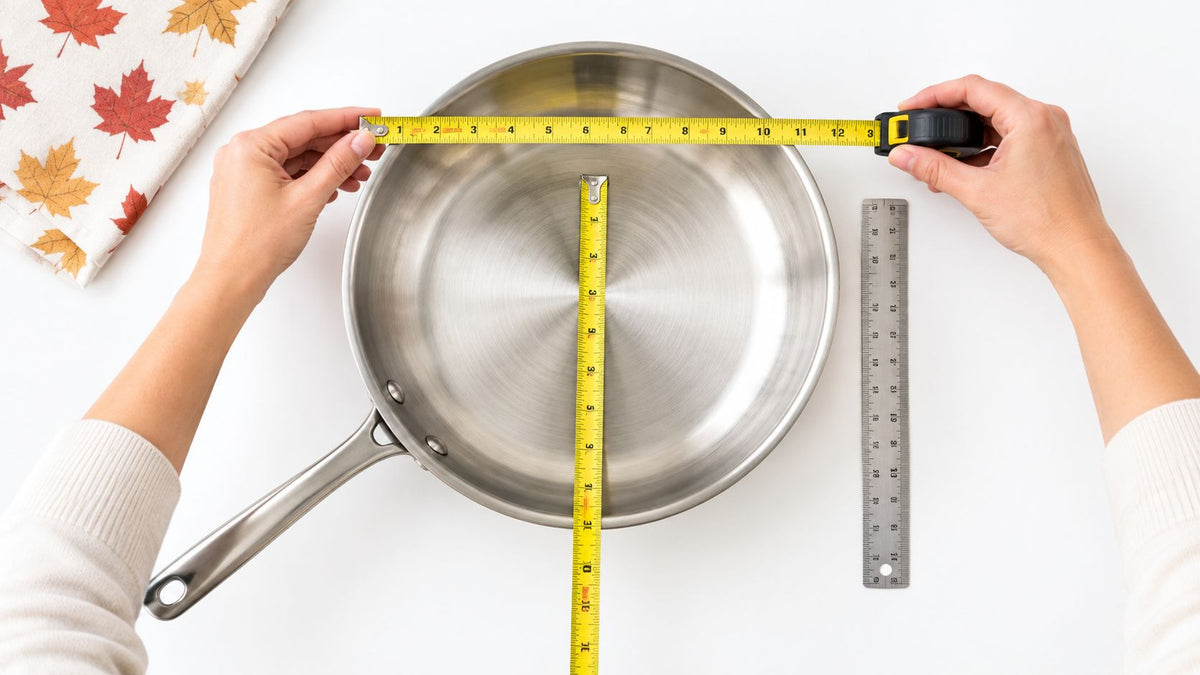
You've found a lid that looks right, but it rocks on the rim. Or you've bought a pan labelled 12 inches and discovered that the cooking surface feels much smaller than expected. The problem usually isn't the cookware. It's that “pan size” can refer to several different measurements, and each one answers a different kitchen question.
For Canadian shoppers, the reliable approach is to record the rim diameter, flat cooking surface, and underside base diameter. Add wall height and water capacity when depth matters. This turns how to measure frying pan size from a vague ruler exercise into a practical check for lids, burners, storage, and cooking space.
Table of Contents
- The Two Essential Measurements You Need to Record
- Understanding Rim Diameter Versus Cooking Surface
- Measuring Pan Depth and Liquid Capacity
- Converting Metric and Imperial Pan Sizes
- Matching Pan Base Diameter to Your Burner
- Creating a Quick Reference Sizing Chart
The Two Essential Measurements You Need to Record
You only need two readings to make a frying pan size useful in practice, and each one answers a different buying question. Measure the wrong part and you end up with a lid that rattles, a pan that crowds food, or a size label that tells you less than you expected.
Set the pan empty on a flat counter and use a rigid ruler or metal tape. A soft sewing tape tends to follow curves and rolled edges, which can add error where you need a straight line.
Start with the outside rim-to-rim diameter. Run the ruler straight across the centre of the upper rim and read from one outside edge to the opposite outside edge, leaving the handle out of it. This is the size most shoppers see in listings and packaging, and it is the measurement that usually matters when you are comparing lids or checking the pan's overall footprint. Canadian product listings commonly use this convention, as outlined in this Canadian frying-pan sizing guide.
Then measure the flat cooking-surface diameter inside the pan. Read only the level area where food sits. Stop at the point where the wall begins to slope upward. If the boundary is subtle, lay the ruler across the interior and find the widest flat section.
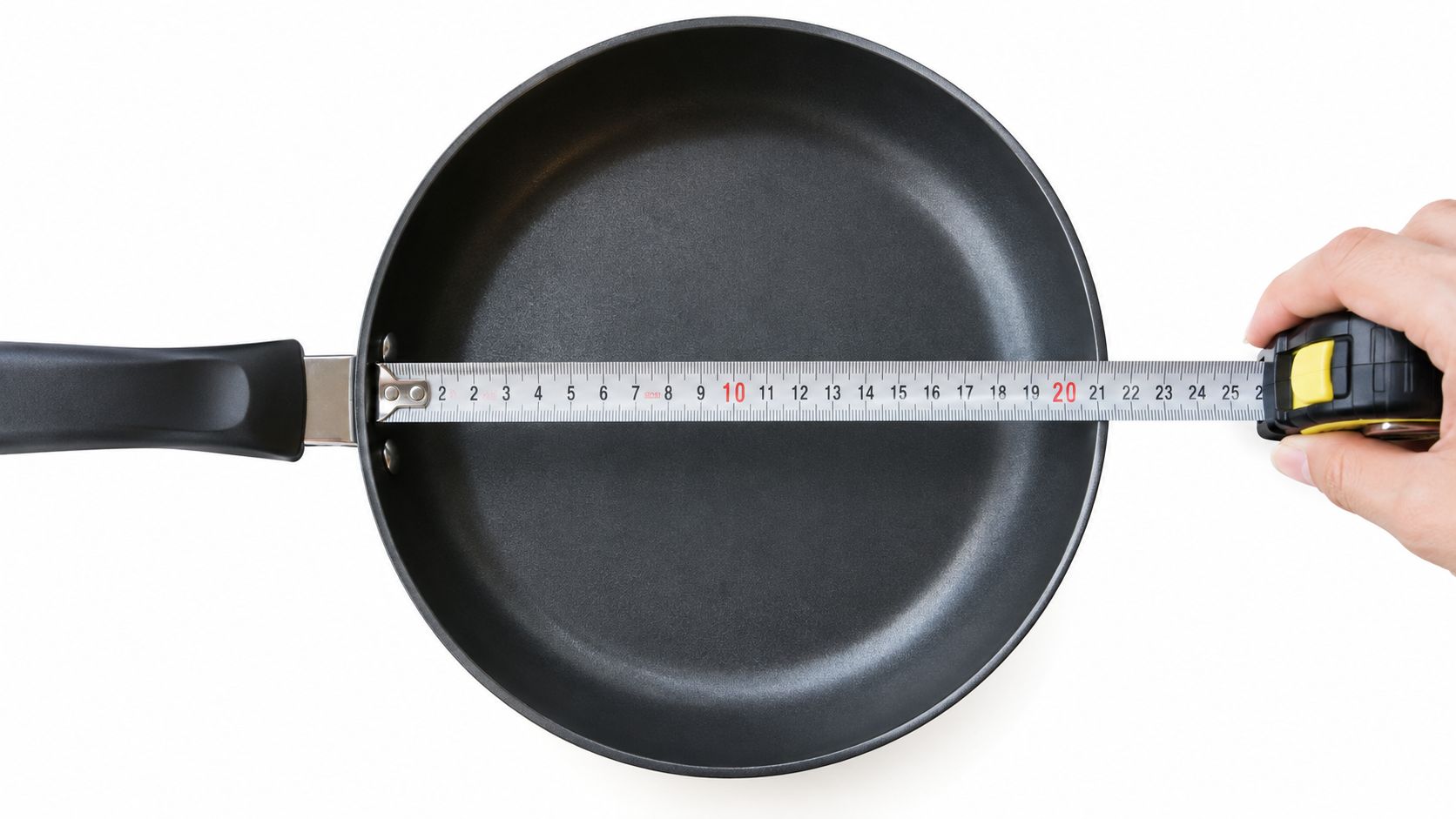
Record the measurements separately
Write both numbers down in centimetres and inches. Canadian cookware specs switch between systems often enough that keeping both saves time when you compare products, replacement lids, or storage clearances. The exact conversion is simple: 1 inch equals 2.54 centimetres.
Keep the two readings separate because they solve different problems. The advertised diameter helps you place the pan in a size class. The cooking surface tells you how much room you have for browning, sautéing, or frying without steaming the food.
| Measurement | Where to measure | What it helps you decide |
|---|---|---|
| Rim diameter | Outside edge to outside edge across the upper rim | Replacement lids and general size matching |
| Cooking surface | Flat interior base only | Food quantity and browning space |
| Base diameter | Underside flat contact area | Burner or induction-zone compatibility |
If you also organize cookware by cabinet or rack space, the same rule used for measuring cutting board dimensions applies here. Measure the part that has to fit, not just the label on the product.
Understanding Rim Diameter Versus Cooking Surface
You bring home a pan labeled 12 inches, set it on the stove, and the usable flat area looks smaller than expected. That usually comes down to one thing. The number on the box describes the pan's broad upper size, while the food cooks on the flatter surface lower inside the pan.
A frying pan with sloped sides can have a wide opening and a tighter area for actual browning. Two pans sold under the same diameter can still behave differently once you add vegetables, cutlets, or pancakes. In practice, one 12-inch pan may give you about 9.5 inches of flat cooking surface, while another gives you about 9.25 inches. That gap is small on paper and noticeable in the pan, especially when you need space between pieces so moisture can escape.
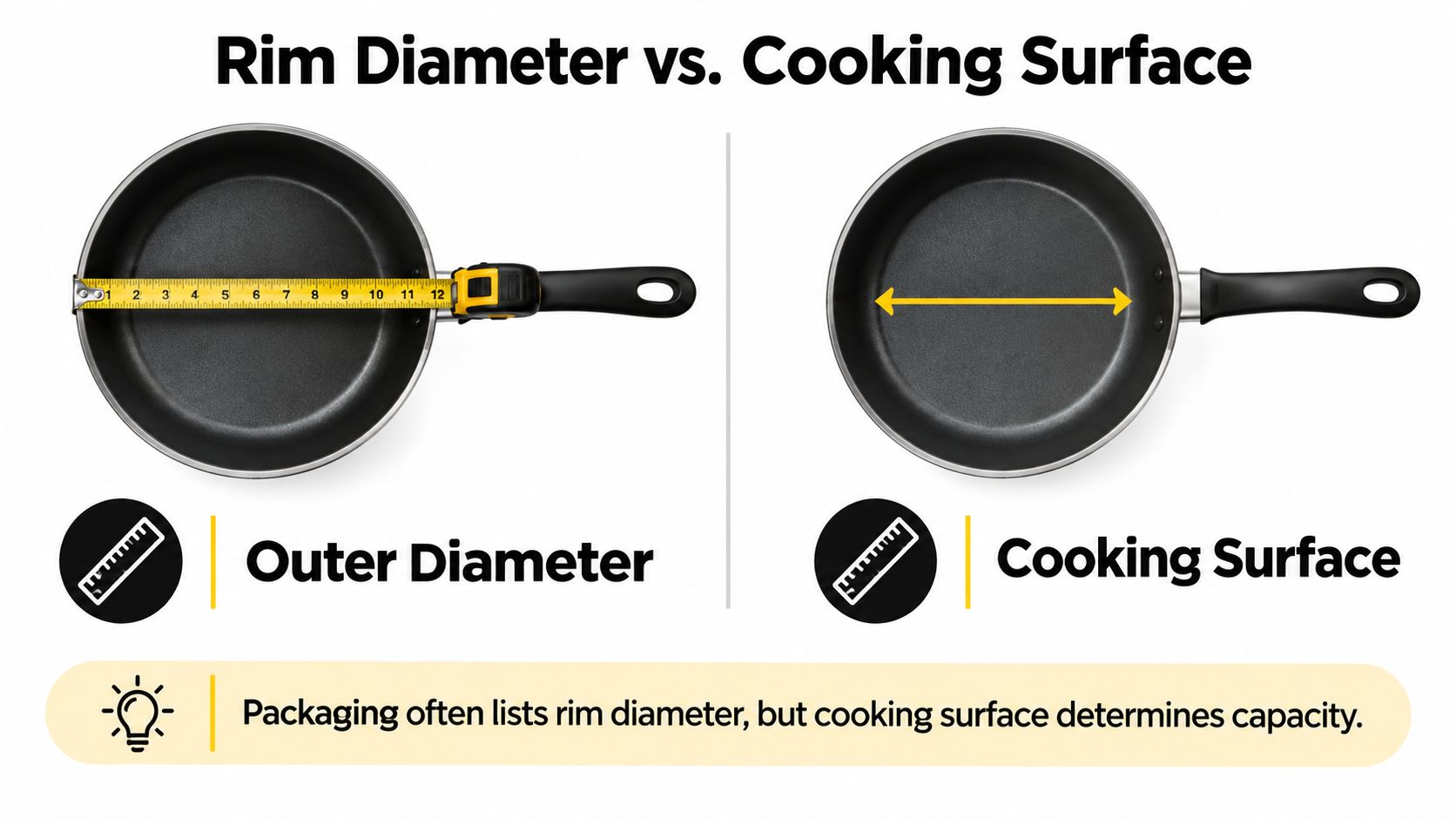
Three diameters, three decisions
The rim diameter matters when you are buying a lid or checking whether a pan matches a listed size class. Lids seat at the top edge, not on the interior floor, so this is the measurement that solves the fit problem. It also explains why two brands can both claim the same nominal size and still feel slightly different at the top edge.
The cooking-surface diameter is the one I use to judge day-to-day usefulness. It tells you how much room you really have for searing, sautéing, and frying in a single layer. A broad rim does not help if the outer area is all slope and the food crowds the centre.
The base diameter on the underside answers a different buying question. It tells you how well the pan will sit over a burner or induction zone, which affects how evenly the usable centre heats.
That distinction also helps when comparing different cookware shapes. A pan and saucepan handle similar stated diameters very differently because wall angle and depth change the usable area, as shown in this saucepan and frying-pan comparison. The same principle carries over after prep work with tools such as the HAUTE CUISINE Stainless Steel Garlic Press - 80710-HC, because chopped or pressed aromatics still need enough flat space to cook evenly instead of piling up.
Practical rule: Use the rim number for lids, the flat interior number for cooking room, and the underside number for burner fit.
Measuring Pan Depth and Liquid Capacity
A frying pan's diameter tells you about spread, but it doesn't tell you how much sauce or liquid the vessel can hold. Wall height matters when you're reducing a braise, cooking a wet mixture, or trying to prevent splashes during stirring.
Measure wall height from the lowest point of the flat interior base to the top of the rim. Keep the ruler vertical rather than following the slope. If the base curves into the wall, note where the flat cooking area ends and measure consistently from that point. This gives you a useful comparison between a shallow skillet and a deeper sauté pan, even when their rim diameters are similar.
Use water to measure actual capacity
For a more complete record, measure capacity rather than estimating it from diameter and depth:
- Place the empty pan on a stable, level surface.
- Fill it with water using a measuring jug.
- Stop at the level you want to evaluate, such as below the rim for normal cooking.
- Record the total in millilitres or litres.
Canadian metric guidance expresses pan dimensions in centimetres and capacity in litres or millilitres. It also recommends determining an existing pan's capacity by filling it with water and measuring the volume, a method described in this Canadian government kitchen-metrics publication.
Capacity supplements, rather than replaces, the cooking-surface measurement. A deep pan may hold more liquid but provide less space for browning. That distinction matters for simmering, deep frying, and sauces, while a broad flat base remains more useful for searing and spreading ingredients.
Store the result as a small specification: rim diameter, flat-base diameter, wall height, and water capacity. This is more useful than relying on a label when choosing a replacement or comparing a deep skillet with another vessel. For related capacity decisions, the same measured approach helps when deciding what size Dutch oven you need.
Converting Metric and Imperial Pan Sizes
You find a pan labeled 30 cm, then spot what looks like the same pan listed elsewhere as 12 inches. Sometimes that is close enough. Sometimes it is the reason a lid misses, a burner heats unevenly, or a pan no longer fits the drawer you bought it for.
Canadian cookware listings often show both centimetres and inches, but labels are usually rounded. The fixed conversion is 1 inch equals 2.54 centimetres. If fit matters, convert the number yourself and keep the exact result in your notes before comparing listings.
Common retail labels often look like this:
| Nominal size | Approximate Canadian metric label |
|---|---|
| 8 inches | 20 cm |
| 10 inches | 25 to 26 cm |
| 12 inches | 30 to 31 cm |
| 32 cm | Approximately 12.5 inches |
These pairings reflect common Canadian retail labelling conventions. They help you scan listings quickly, but they do not tell you which part of the pan was measured. A pan sold as 32 cm, for example, may be listed as about 12.5 inches, while the rim, cooking surface, and base still differ because of wall angle and construction.
That distinction matters more than the unit.
Use the measurement that matches the buying decision. For a lid, compare the rim diameter in the same unit on both products. For weeknight browning and usable cooking room, compare the cooking surface. For stove performance, compare the base diameter against the burner or induction zone, not the headline size on the label.
Rounding also causes trouble in small kitchens. A difference that looks minor on paper can stop pans from nesting cleanly or fitting a tight cabinet slot. I record both units when I am replacing a pan, then note the location of each number. “30 cm” by itself is too vague to trust.
A useful shopping note is short and specific: outer rim, cooking surface, base, depth, and capacity. Once each number is tied to a location, metric and imperial listings become much easier to compare without guessing what the seller measured.
Matching Pan Base Diameter to Your Burner
A pan can have the right rim size and still heat poorly on your stove. The base diameter is the flat underside area that contacts the burner grate or induction zone, and it's the dimension that matters for stovetop fit.
Turn the cooled pan upside down and measure straight across the flat contact area. Don't include the curved wall, raised edge, or any surrounding metal that doesn't sit against the cooking surface. If the underside has a distinct circular plate, measure that plate. For induction cookware, this base is especially important because the compatible magnetic area is beneath the pan, not around its upper rim.
Compare that measurement with the burner or induction zone you intend to use. A very wide rim over a smaller contact base may leave the outer food area cooler, while a base that extends beyond the usable burner area may heat unevenly. The pan should also sit securely without rocking on the grate.
Use the measurement for the actual appliance
A replacement pan decision should follow the intended fit:
- Lid: Match the upper rim diameter, not the cooking surface.
- Browning: Compare the flat interior cooking surface.
- Gas or electric burner: Compare the underside base with the burner area.
- Induction: Confirm the base is compatible and measure its contact diameter.
- Cabinet or oven: Measure the pan's maximum exterior width, including the handle when clearance matters.
- Stacking: Compare wall shape, handle position, and total exterior width, not just the label.
The induction cookware selection guide is useful background, but your own stove remains the final test. Fixed burner positions in rental kitchens make this particularly important. A pan that looks appropriately sized on a shelf may not sit over the zone you have available.
The video below provides a visual reference for checking cookware dimensions and fit.
Measure the burner separately if its usable heating area isn't obvious. Then keep both figures in your kitchen notes. Rim, cooking surface, and base measurements answer different questions, so substituting one for another is what creates most fitting errors.
Creating a Quick Reference Sizing Chart
You only need one chart if it helps you make the right buying decision fast. A useful pan chart separates rim diameter, cooking surface, and base diameter, because each one answers a different question at the point of purchase.
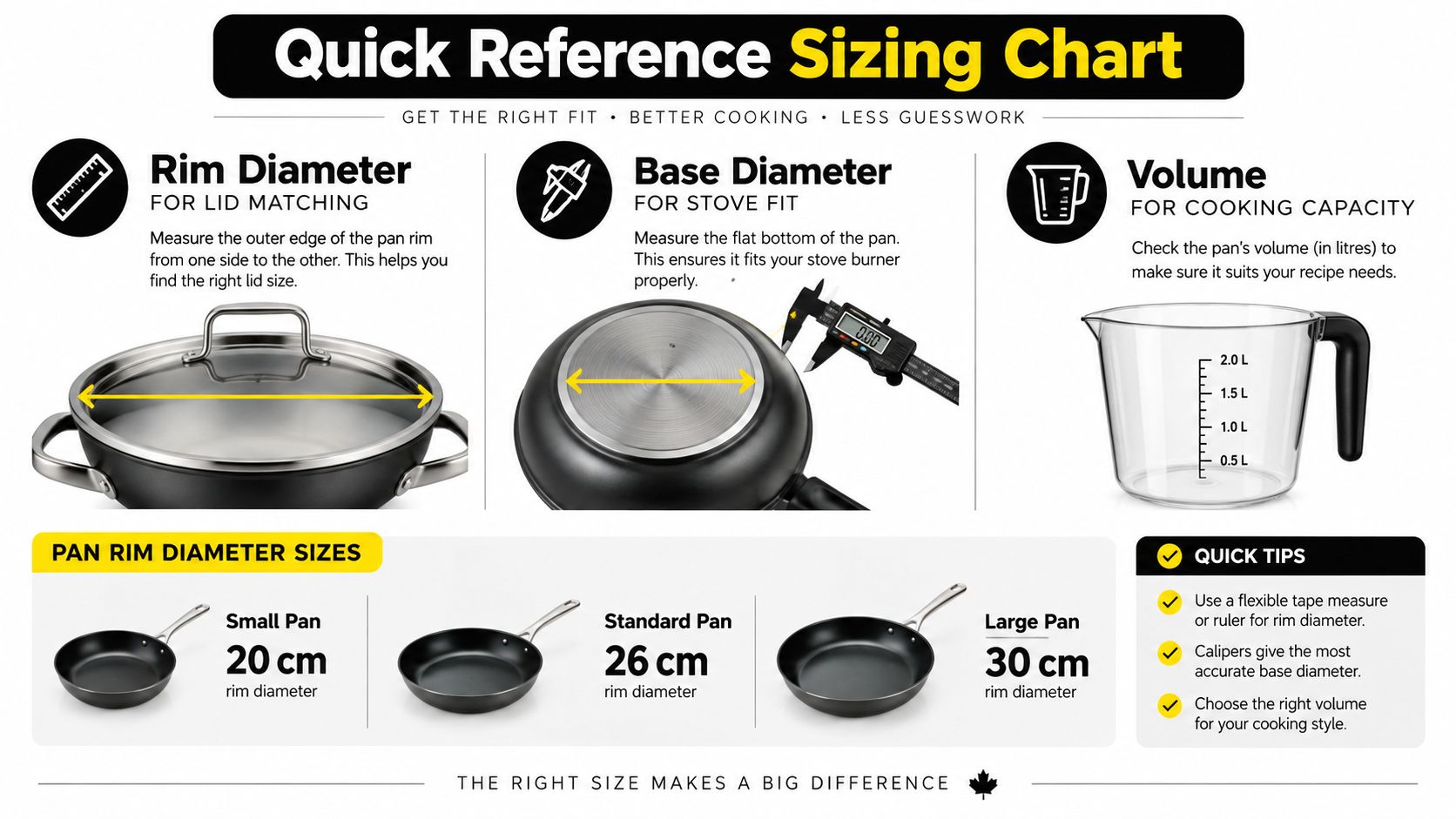
Keep a kitchen measurement record
| Your purpose | Priority measurement | Check before buying |
|---|---|---|
| Replace a lid | Upper rim diameter | Whether the listing uses inner or outer rim |
| Cook larger quantities | Flat cooking surface | Wall slope and available browning area |
| Match a burner | Underside base diameter | Burner or induction-zone dimensions |
| Fit a cabinet or oven | Maximum exterior width | Handle, pouring lip, and clearance |
| Compare deep pans | Wall height and capacity | Water volume in millilitres or litres |
| Stack cookware | Exterior shape and height | Whether handles and rims interfere |
A quick chart also helps cut through size labels. Pans sold in Canada are often labelled around 20 cm for 8 inches, 25 to 26 cm for 10 inches, and 30 to 31 cm for 12 inches, as outlined in this Canadian pan-size reference. Use those numbers as label ranges. They do not guarantee the same flat cooking area from one pan shape to another.
Keep your own record simple and specific. Measure the outer rim, the flat interior cooking surface, the underside base, the wall height, and the capacity of the pan you already use. Then add one more note beside each pan: the metric you will shop by next time. That might be the rim for a replacement lid, the cooking surface for better browning, or the base for a stubborn burner that runs small.
Storage matters too. If you keep several skillets in rotation, a method for organising pots and pans makes it easier to store those measurements where you can find them again, instead of remeasuring every time you replace a lid or compare a new pan.
Here is the practical check I use. If a new pan feels cramped, compare the cooking surface first. If it sits poorly on the hob, compare the base. If the lid rattles or rocks, recheck the rim. A chart built around those three measurements is far more reliable than the size printed on the box.
GrifGlo brings cookware, kitchen organisation, and sizing guidance together so you can compare practical fit details before purchasing. Use the GrifGlo guides to organise your measurements, evaluate kitchen essentials, and choose products that suit your available space and routine.

Leave a comment
This site is protected by hCaptcha and the hCaptcha Privacy Policy and Terms of Service apply.