

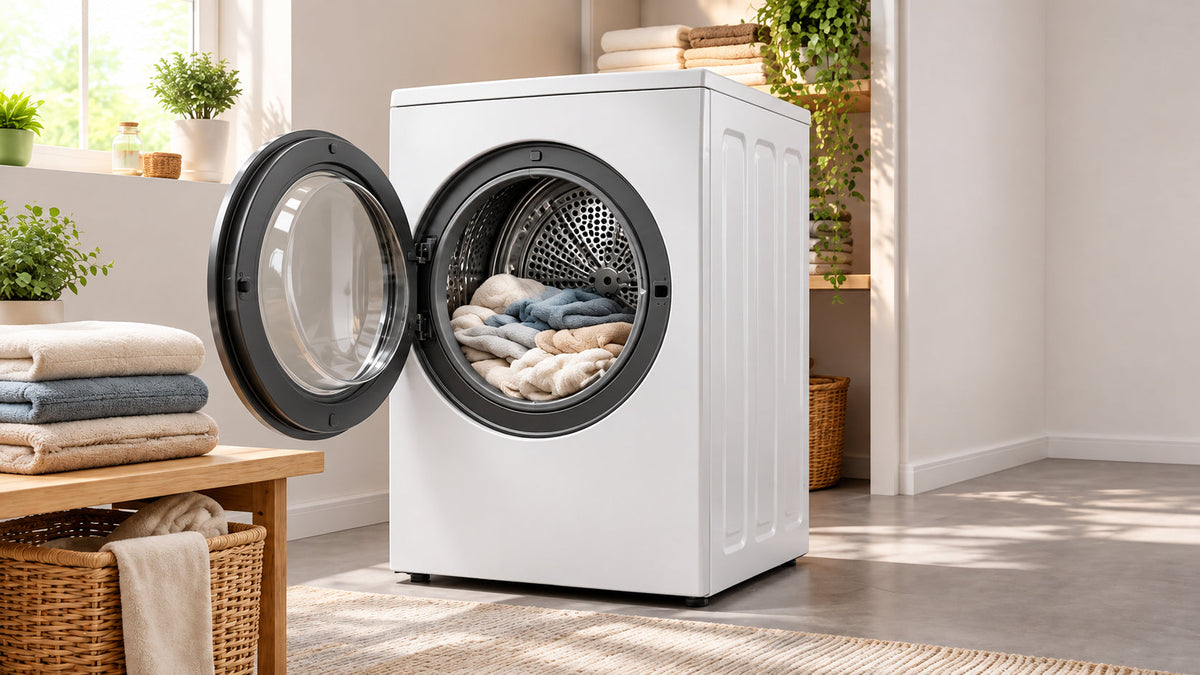
A heat pump dryer recirculates warm air and removes moisture through a refrigeration system. Its main attractions are lower electricity use compared with conventional electric resistance drying and, for ventless models, avoiding an exterior exhaust duct. Longer programmes and a higher installed price can offset those benefits for some households.
That doesn't automatically make it the best purchase. The useful way to weigh heat pump dryer pros and cons is to separate operating savings, installation value and laundry throughput. A machine that solves an impossible venting problem may justify its premium even when electricity savings alone don't.
Heat Pump Dryer Pros and Cons at a Glance
Heat pump dryer vs conventional vented dryer at a glance
The energy figures below are illustrative assumptions for the same hypothetical load, not certified ratings or a promised saving. Compare the exact models’ labels and programmes before estimating your own bill.
| Factor | Heat pump dryer | Conventional vented dryer |
|---|---|---|
| Energy per hypothetical 9 lb load | Assumed 1.5 kWh for this example | Assumed baseline of about 3 kWh |
| Venting | No exterior exhaust duct for a ventless model | Requires an exterior vent |
| Drying temperature | Lower | Higher |
| Cycle time | Generally longer; check the selected programme | Generally shorter |
| Upfront price | Potentially higher; compare delivered quotes | Often the lower-cost replacement |
| Installation | Condensate drain or tank, plus model-specific electrical supply | Vent duct, plus the appropriate electric or gas connection |
| Model choice | Narrower selection | Broader conventional selection |
Treat the table as a screening tool. The selected model's energy label, usable capacity and installation manual matter more than a category average. In particular, don't assume every heat pump dryer requires the same outlet.
Main advantages
- Lower electricity use per load: The strongest direct operating-cost comparison is against a conventional electric resistance dryer.
- Ventless placement: An exterior wall opening isn't necessary for many installations.
- Lower drying heat: Useful when you prefer less aggressive temperatures, although that isn't a guarantee of longer clothing life.
- Lower peak power: Potentially valuable when laundry overlaps with cooking, vehicle charging or other electrical loads.
Main disadvantages
- Longer cycles: A household may save electricity while spending more elapsed time on laundry.
- Purchase premium: Lower running costs don't necessarily recover a higher installed price quickly.
- Fewer choices: Capacity, dimensions and service availability can narrow the shortlist further.
- Water and electrical planning: Condensate still needs somewhere to go, and the supply must match the appliance.
The plain verdict: heat pump drying is especially attractive where venting is difficult, the existing dryer is electric and the household can accept slower turnover. A working vented dryer remains a stronger financial competitor than a failed machine that already needs replacing.
For a broader approach to comparing operating efficiency with everyday usefulness, our guide to eco-friendly kitchen appliances uses the same fit-first buying principle. Efficiency is valuable only when the appliance also suits the job.
How a Heat Pump Dryer Works Without a Vent
Instead of repeatedly heating fresh air and exhausting it outdoors, a heat pump dryer recirculates air, removes moisture and reuses heat. ENERGY STAR explains the closed-loop system. The next steps describe the basic process; the maintenance and connections still depend on your model.
Think of it as using refrigerator technology to recover and reuse warmth. Unlike a refrigerator, however, the useful outcome isn't a cold compartment. It's air that can collect more moisture from your clothes without discarding most of its heat outside.
The air and water paths
- Warm air collects moisture. Air circulates through the tumbling clothes, carrying evaporated water away from the fabric. The drum needs space for that airflow, which is why packing it tightly is counterproductive.
- A cold coil removes water. The humid air passes across an evaporator, where cooling causes moisture to condense. Water separates from the circulating air.
- Recovered heat warms the air again. The condenser reheats the drier air before it returns to the drum. The compressor uses electricity to move heat through this cycle.
- Condensate leaves the machine. Collected water goes to a removable tank or through a drain hose, according to the model's design.
A conventional vented electric dryer generates heat with a resistance element and exhausts moisture-laden air outdoors. The heat pump design instead retains and recovers much of that energy. That's the fundamental efficiency difference, not a cooler version of the same heating element.
Practical rule: ventless describes the exhaust arrangement. It doesn't mean the dryer needs no airflow clearance, cleaning access or water management.
Don't assume the laundry room will become cooler or more humid. Room conditions depend on the appliance and installation, so check the permitted ambient conditions rather than treating the machine as room-conditioning equipment.
Before ordering, locate the tank access or drain connection on the installation drawing. Make sure you can empty the tank without dismantling a stacked arrangement, or route the hose without kinks and within the manufacturer's drainage requirements.
Running Costs, Energy Use and Emissions Compared
Estimated running cost by dryer type
This hypothetical Canadian-dollar example assumes 300 loads annually, electricity at CAD $0.15 per kWh and the illustrative energy inputs below. These are assumptions for arithmetic, not measured performance or a quoted local tariff.
| Dryer type | Energy per hypothetical 9 lb load | Annual cost at 300 loads |
|---|---|---|
| Conventional electric vented | Assumed 3 kWh | Calculated $135 |
| Heat pump electric | Assumed 1.5 kWh | Calculated $67.50, about $68 |
| Gas vented | Gas per load plus auxiliary electricity | Calculate both fuels using your bill |
Under those assumptions, the conventional electric dryer costs $0.45 per load, while the heat pump model costs $0.225 per load. The calculated annual difference is $67.50. These are arithmetic outputs from the example, not measured appliance results.
A gas dryer needs a separate calculation. Multiply gas consumed per load by the applicable gas rate, then add its electricity use. Comparing only the electricity line would omit its main fuel.
Calculate your household's cost
- Estimate annual loads. Count a representative week, then multiply by the weeks you expect to use the dryer annually. Include seasonal bedding and household changes.
- Calculate cost per load. Multiply the model's energy consumption per cycle by your applicable electricity rate. Check whether the label's load and programme resemble your routine.
- Compare annual totals. Multiply each cost per load by the same annual load count. Use equivalent dryness and load sizes so you're comparing the same service.
A home energy monitor can help you understand appliance consumption, but monitoring equipment must be suitable for the circuit. Don't connect an ordinary plug-in meter to an incompatible dryer supply.
Payback needs the installed price gap
Simple payback = additional installed cost ÷ annual operating saving.
For a hypothetical $800 premium, the example's $67.50 annual saving produces a calculated payback of approximately 12 years. That excludes financing, repairs and changes in utility rates. It also shows why an efficient replacement isn't automatically a sensible reason to discard a functioning dryer.
Compare the heat pump premium with another replacement when your dryer has failed. Compare the entire new purchase cost with keeping the current machine when it still works.
Emissions require a different calculation from the electricity bill. Consider your electricity supply and the fuel being replaced rather than assuming one universal carbon saving.
Replacing gas drying removes combustion at the appliance, but electricity generation still matters. Replacing electric resistance drying primarily reduces electricity demand. Your utility mix and operating schedule affect the emissions outcome, so lower energy use and lower emissions aren't interchangeable calculations.
Drying Time and Fabric Care Trade-Offs
Elapsed time is the main practical price of efficiency. Lower-temperature, recirculating drying generally means longer programmes, but the available evidence doesn't justify applying one cycle-time multiplier to every machine.
A load's starting moisture, fabric mix, selected dryness and usable drum capacity all affect completion time. Ask for programme-specific performance rather than accepting an unqualified claim that a dryer is fast or slow.
Judge complete laundry sessions
For a busy household, the important question isn't whether a single load finishes before dinner. It's whether the dryer can keep pace with the washer across the whole laundry session. If wet loads queue up, the household may have to spread washing across more days.
- Towels and heavy cottons: Group similar items so a thick towel doesn't determine the drying time for lightweight shirts.
- Elastic, synthetics and prints: Lower heat may suit your care preferences, but garment labels still govern whether tumble drying is appropriate.
- Bulky bedding: Confirm the usable drying capacity, not just whether an item fits through the door.
- Mixed loads: Select an appropriate sensor programme and remove finished lightweight items if the appliance instructions recommend doing so.
Lower-temperature drying can be useful for compatible fabrics, but care labels still apply. Do not assign a guaranteed extension of clothing life or a financial value to avoided replacements without evidence for your actual use.
Improve the conditions before judging the dryer
Use an appropriate washer spin setting where the fabric permits, avoid overloading and select the correct sensor programme. Clean lint filters and maintain accessible heat-exchanger parts using the maker’s method. Those habits help the dryer work as intended.
Judge the complete laundry session: can the dryer keep up with your washer without wet loads waiting? Compare programme-specific load limits and completion information.
Installation Needs for Your Home Setup
Heat pump dryer fit by home situation
| Home situation | Fit | Main check |
|---|---|---|
| Apartment or condo without an exterior vent | Strong fit | Confirm model-specific electrical supply and drainage |
| House with an existing vent and dryer outlet | Mixed | Compare the installed premium with operating savings |
| Rental or shared laundry room | Assess usage first | Throughput, maintenance responsibility and tenant wait times |
| Small or sealed room with no air exchange | Use caution | Permitted room conditions and ventilation clearances |
Check local stock, installation feasibility and repair support early. A model that fits the floor space may still have unsuitable electrical, drainage or room-condition requirements.
Checks to complete before ordering
- Electrical compatibility: Read the exact voltage, current and circuit requirements. An existing electric-dryer receptacle isn't automatic approval, and a gas-dryer location may need electrical work. Have a qualified electrician confirm compatibility rather than relying on an adapter.
- Condensate disposal: Choose a drain connection or a workable tank-emptying routine. Verify hose routing, permitted drain height and access to the collection tank.
- Room conditions: Check the specified ambient-temperature range, minimum enclosure requirements and ventilation openings. Don't block grilles with shelving, laundry baskets or doors.
- Physical access: Measure the delivery route, appliance depth, open-door clearance and service space. Stacking requires an approved kit and a compatible washer, not merely matching widths.
A condo closet without a vent can be a strong candidate when its electrical supply and drainage match the selected appliance. A damp, enclosed closet needs more investigation, even if the dryer physically fits. Ventless does not mean install anywhere.
Use a tape measure and the manufacturer's dimension drawing together. Our laundry room organisation guide can help separate storage space from the access needed to operate and maintain the machine.
For a rental, secure approval before changing plumbing, electrical connections or the old vent opening. For shared laundry, assign responsibility for filters and condensate before installation. A technically compatible appliance can still be a poor operational choice if nobody owns those tasks.
Who a Heat Pump Dryer Suits Best
The strongest buyer isn't necessarily the household with the largest electricity bill. It's the household that gains useful installation flexibility, can accommodate the programme times and expects enough use to make the premium reasonable.
Strong candidates
- Residents without a practical vent route: Ventless drying may make in-home laundry feasible rather than merely cheaper to run.
- Electric households replacing a failed dryer: The relevant expense is the premium over another suitable replacement, not the entire appliance price.
- Homes managing competing electrical loads: Lower demand may help the household's operating strategy, subject to proper circuit design.
- Buyers comfortable with lower-temperature care: Programme choice and patience matter more than getting laundry out as quickly as possible.
Weaker candidates
- Owners of a functioning gas dryer with low running costs: Electrification may be a personal priority, but don't assume an attractive financial payback.
- Households with tightly scheduled laundry: Frequent back-to-back loads can make completion time more important than cost per cycle.
- Buyers with little upfront flexibility: A premium can be difficult to justify when the savings arrive gradually.
- Homes with unsuitable enclosed spaces: Resolve installation limitations before choosing a model on efficiency alone.
Buying threshold: choose the machine that meets your actual laundry schedule, then compare the cost of delivering that service.
Canadian incentives, where available, depend on the programme, property, appliance and purchase date. Deduct only a confirmed eligible rebate from an installed quote, and check whether approval is needed before purchase.
If the current dryer works, compare the cost of keeping it with the complete installed replacement cost. If it has failed, compare suitable replacement options on capacity, programme performance, service access and net price.
Before shortlisting, answer these questions: How many loads do you run weekly? What fuel does your current dryer use? Can an exterior vent be installed? Together, those answers are more useful than a generic recommendation to switch.
Confirm Fit and Cost Before You Buy
Complete the space, electrical and drainage checks before requesting final quotes. Then compare machines in the order that exposes expensive mismatches early.
- Match capacity to your normal laundry. Check the rated drying load and programme restrictions. A drum that accepts a bulky load isn't necessarily rated to dry it effectively in your preferred programme.
- Compare completion time at a useful load. Request programme information for the fabrics you wash. Don't compare an economy cycle on one appliance with a speed cycle on another.
- Read warranty and service terms. Check parts and labour coverage separately, exclusions, local repair availability and access requirements. Don't infer repairability from the brand name or efficiency label.
- Calculate payback using net installed quotes. Include delivery, required electrical or plumbing work, stacking hardware and disposal. Apply only confirmed incentives, then compare the result with how long you expect to keep the appliance.
- Obtain written retailer comparisons. Ask competing retailers to itemise the same scope, including installation and haul-away. Confirm what happens if the appliance arrives but the installer finds an incompatible connection.
Our kitchen appliance buying guide offers a broader framework for comparing fit, operating expense and purchase terms. The same discipline applies here: an efficient appliance is only good value when it suits your home and routine.
No reliable category-wide payback period replaces your own calculation. Your tariff, load count, existing fuel and installed premium determine whether the savings are meaningful.
GrifGlo publishes buying guides alongside its store collections. For nearby laundry essentials, browse Garment Care; check current stock rather than assuming a full-size dryer is offered.
Visit GrifGlo for decision-friendly guides, comparisons and sizing advice that help you assess appliances against your space and routine. Our Home Appliances category includes Air Purifiers, Heaters & Cooling, Garment Care and Vacuums, with organised browsing for the everyday essentials around your laundry setup.


Laisser un commentaire
Ce site est protégé par hCaptcha, et la Politique de confidentialité et les Conditions de service de hCaptcha s’appliquent.