

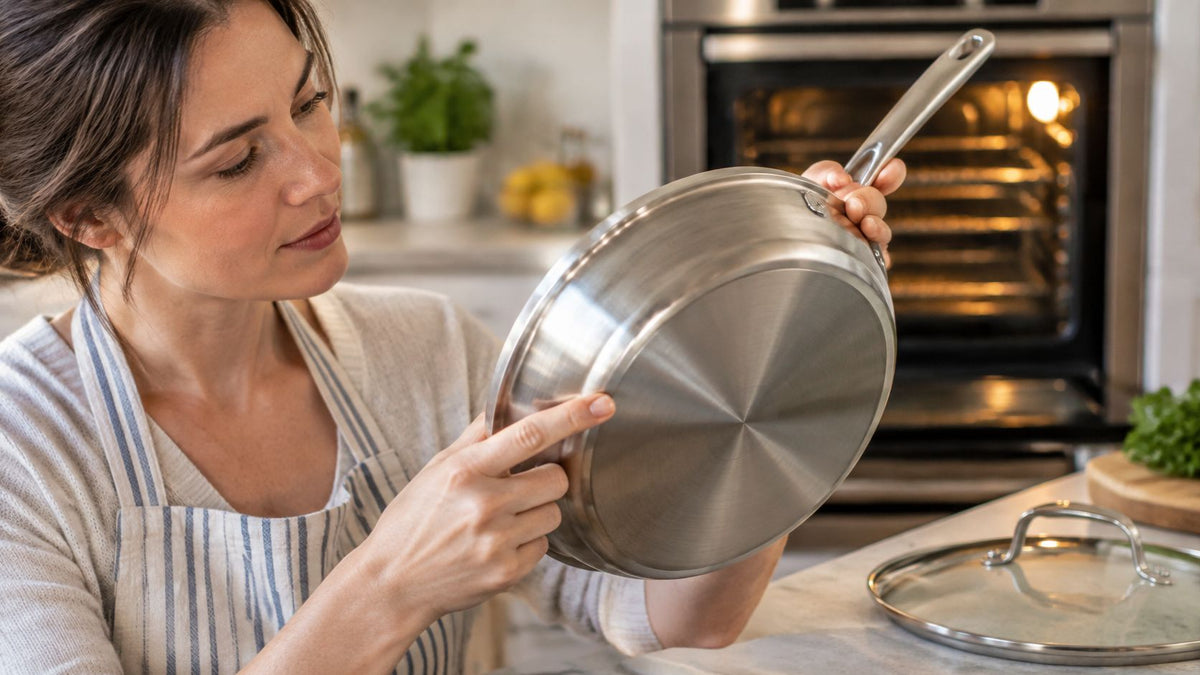
You've browned chicken in a skillet, the oven is ready, and the recipe says to transfer the whole pan. Then you notice the soft-grip handle and the glass lid. A pan is oven safe only when its maker confirms an oven limit for the configuration you're using, including the parts attached to it.
The metal body is rarely the whole question. To work out how to tell if a pan is oven safe, check the weakest component, then match its rating to the cooking method.
Table of Contents
- The Lowest Rated Part Sets the Oven Limit
- How to Read the Markings and Maximum Temperature
- How to Check Handles, Lids and Coatings
- Special Cases That Change the Answer
- Unmarked Pans and the Pre-Bake Check
The Lowest Rated Part Sets the Oven Limit
Start with the material, but use it to guide your checks rather than approve the pan. A cast iron skillet with an integral iron handle is a different proposition from one fitted with a wooden grip. They may have similar cooking surfaces, yet different oven restrictions.
Typical oven limits by pan material
| Material or component | Typical oven guidance | Limit to confirm |
|---|---|---|
| Bare cast iron | Usually tolerates high oven heat; an added handle can restrict use | Handle material and rating |
| Fully metal stainless steel | Generally suitable for high oven heat when the whole assembly is rated | Handle attachment and whole-pan rating |
| Carbon steel | Usually suitable for high oven heat, much like bare cast iron | Handle material and rating |
| Uncoated aluminum | Use only within the maker's documented oven limit | Manufacturer's stated maximum |
| Nonstick coated pan | Never exceed the coating ceiling or a lower manufacturer limit | Coating rating and empty-preheating restrictions |
| Silicone bakeware | Use within its stated rating and the material's safety ceiling | Maximum temperature and melting risk |
| Glass or glazed ceramic | Requires an explicit oven rating for the particular piece | Glaze condition and thermal-shock restrictions |
The table helps narrow the search. It doesn't supply a temperature rating for an unidentified pan.
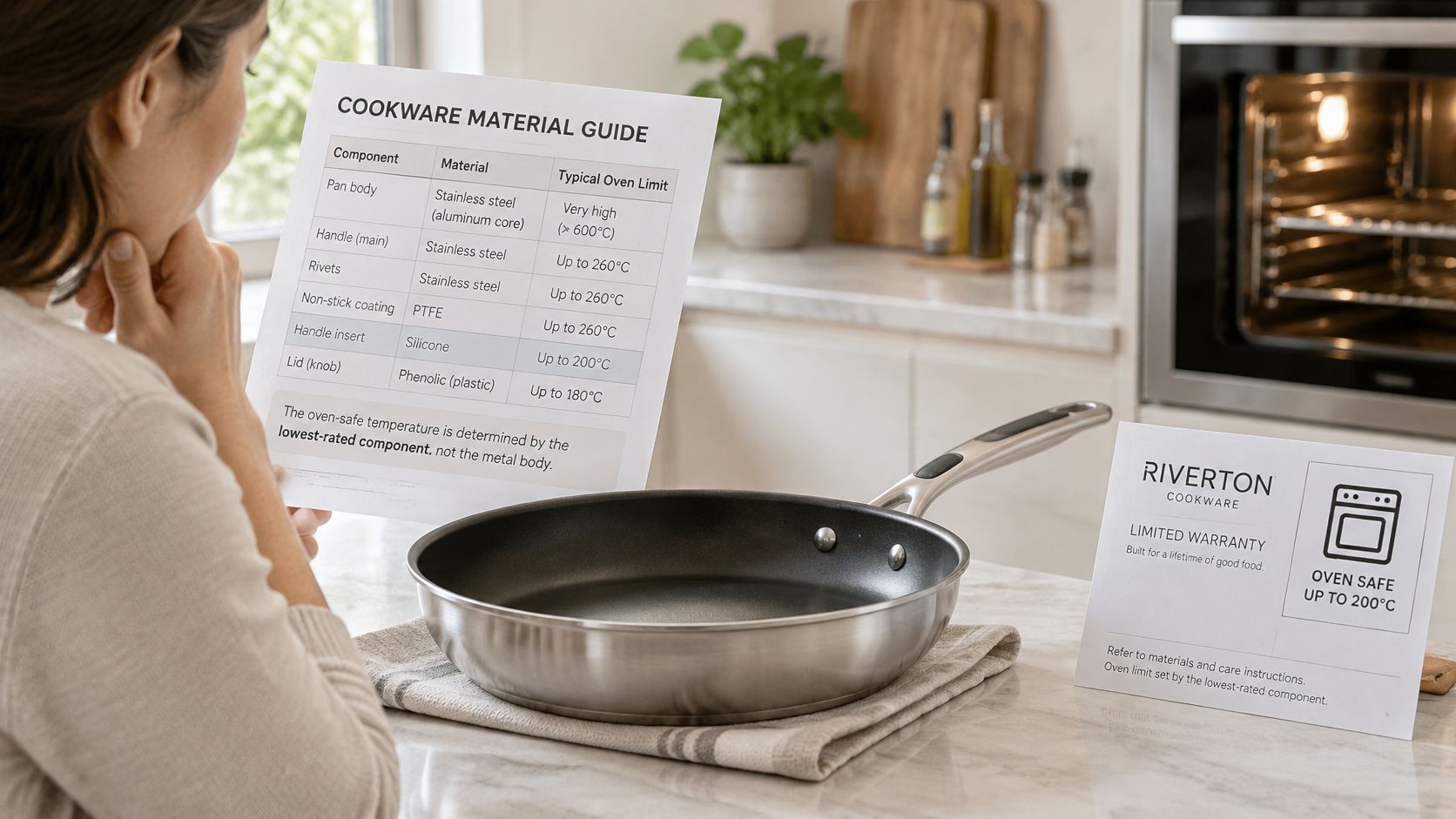
Keep the cookware guide and care card beside the pan while you inspect its construction.
Separate the body from the accessories
Bare metal cookware is often the simpler choice for stove-to-oven cooking because there's no synthetic cooking coating to protect. The trade-offs remain: cast iron is heavy to lift, carbon steel needs seasoning care, and stainless steel requires more attention to prevent sticking.
Accessories can remove that simplicity. A silicone sleeve, replacement lid or detachable grip may have instructions separate from the pan's care manual. Even an apparently all-metal handle can conceal a plastic insert underneath or around its attachment.
Don't assume the lid shares the body's rating just because they came in the same box. Check the glass, rim and knob as an assembly, especially if the knob has been replaced.
Practical rule: Approve the pan you'll actually put in the oven, not just the material named on its packaging.
Find the maximum temperature, preferably expressed in both Celsius and Fahrenheit; whether that limit includes the lid; and whether broiling is permitted. Self-cleaning is a separate oven function, not an ordinary cooking setting. The lowest documented rating among the parts going into the oven is the limit for that setup.
How to Read the Markings and Maximum Temperature
A pan's oven limit depends on the instructions for its exact model and the parts being used. Evidence that counts is a manufacturer instruction naming the model, allowing oven use and stating the restrictions.
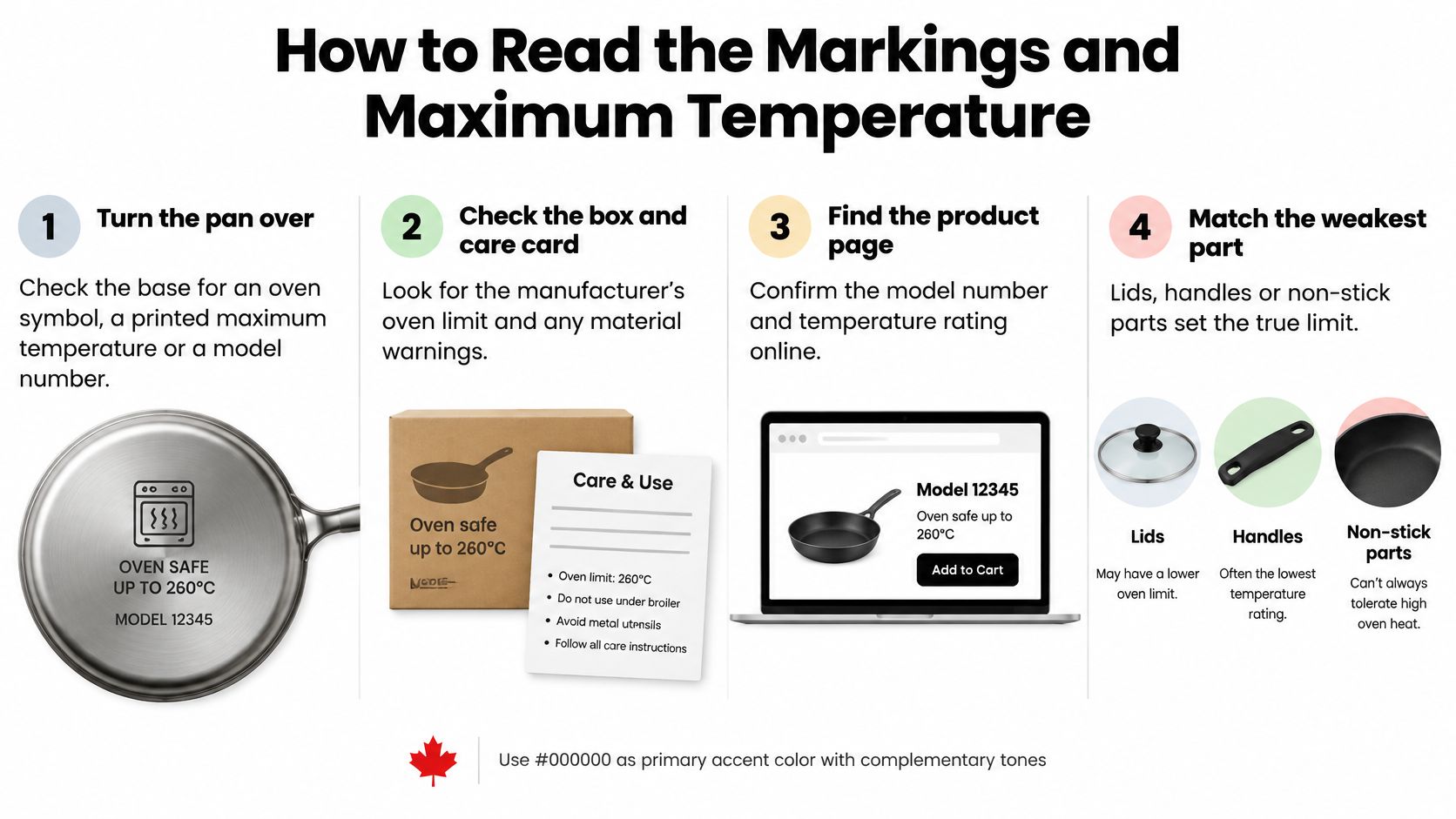
Use this visual checklist to organise the label search.
Follow the label trail
- Turn the cool pan over. Check the base for an oven symbol, maximum temperature, brand and model number. Engraved or stamped markings often last longer than stickers, but a symbol may not show restrictions.
- Check the box, care card and manual. The temperature limit may appear in the paperwork rather than on the pan. Read the care instructions alongside any oven-safe claim on the packaging.
- Find an explicit oven-use statement. Look for permission to cook in the oven and a maximum temperature, ideally in both Celsius and Fahrenheit. Dishwasher-safe, induction-compatible and heat-resistant describe different properties.
- Read the exceptions. Check whether the rating covers the handle and lid, and whether broiling is allowed. If instructions require removing a detachable handle, follow that condition.
- Match the model online if paperwork is missing. Search the brand and model number, prioritising the manufacturer's product page or manual. Similar-looking pans may differ in coating, grip or lid, so a photograph alone cannot confirm a match.
One successful bake does not establish a pan's temperature limit. A pan may show no visible damage after a recipe yet still lack approval for hotter cooking.
Understand the safety ceilings
Health Canada's safe-use cookware guidance advises following the manufacturer's instructions. It says nonstick cookware and bakeware should not be used above 260 °C (500 °F) on the stovetop or in the oven, and silicone bakeware should not be used above 220 °C (428 °F) because it may melt.
Treat these as safety ceilings, not as ratings for every nonstick pan or silicone accessory. The maker may set a lower limit, and an unspecified limit does not establish permission for oven use.
For products described as ceramic, check whether the item is a ceramic-coated metal pan or a glazed ceramic dish. The ceramic cookware safety guide explains the distinction, which helps when reading the care instructions.
The video offers another visual reference for checking cookware before oven use.
Keep the manual available for the next time you use the pan. The rating should connect the exact model to its oven maximum and state any exceptions for accessories or cooking methods.
How to Check Handles, Lids and Coatings
Start at the handle. It's easy to focus on the cooking surface and overlook the grip, yet that's where mixed materials and attachment problems often hide.
Inspect the pan while it's cool and empty. Hold the body steady and gently check the handle for movement; don't stress it by twisting hard.
Component checks before the oven
| Component | What to look for | Red flag |
|---|---|---|
| Metal handle | Whole-pan rating covering the riveted, welded or screwed attachment | Loose rivets, cracked welds or an undocumented plastic insert |
| Silicone or plastic handle | Its own stated maximum and compatibility with this pan | No oven rating or an unverified replacement grip |
| Wooden handle | Explicit oven permission from the maker | Missing rating or split, scorched wood |
| Glass lid | A rating suitable for the intended cooking temperature | Cracks, chips or no documented oven limit |
| Plastic lid knob | Documented oven rating for the knob or complete lid | Melting, warping, softening or an unidentified replacement |
| Nonstick coating | Manufacturer's oven limit within the applicable safety ceiling | Flaking, peeling or deep scratches exposing the substrate |
| Bonded or clad base | Confirmation that the complete assembly is oven safe | Separation, bulging or a loose base |
Look behind the obvious surfaces
A metal handle doesn't guarantee an all-metal attachment. Look underneath the grip and around the rivet heads for inserts, washers or decorative pieces, then check whether the manual covers them. Loose fasteners are a lifting hazard even when their materials tolerate heat.
A wooden handle isn't automatically disqualified if the maker explicitly permits oven use within a stated limit. That permission must apply to the actual model, not another pan from the same brand.
On a glass lid, pay attention to the knob's underside. A metal-looking cap may conceal plastic, and a replacement knob can invalidate assumptions based on the original lid specifications.
A sound pan body can't make an unidentified replacement handle or lid oven safe.
Check the cooking surface and base
Inspect nonstick under good light after washing away food residue. Flaking, peeling or deep damage is a reason to stop using the pan for oven cooking, not an invitation to test it at a gentler temperature. Don't scrape away a failing finish to turn it into an uncoated pan.
Clad cookware and bonded bases aren't necessarily unsuitable for the oven. What matters is the maker's approval of the assembly and whether it remains intact; gaps, lifting edges or a newly unstable base need attention.
For regular oven finishing, compare the maintenance trade-offs in the stainless steel versus nonstick cookware guide. Easy food release is useful, but it doesn't compensate for a coating that can't handle the cooking method you need.
Special Cases That Change the Answer
An oven rating covers only the conditions the manufacturer allows. Empty preheating, broiler exposure, self-cleaning and abrupt temperature changes can each exceed what a pan or dish is designed to handle.
Empty pans and direct heat
Don't preheat empty nonstick cookware or bakeware. Without food to absorb heat, the pan can heat rapidly. Add ingredients as directed rather than treating it like a bare-metal bread baker.
A broiler exposes cookware to intense radiant heat from the upper element. An oven-safe label doesn't confirm broiler suitability, and turning down the oven setting doesn't make an unapproved coating or lid suitable for broiling. Remove cookware before running a self-cleaning cycle. That cycle isn't a way to strip seasoning or clean stubborn residue.
For chicken seared in a skillet and finished under the broiler, check each part of the setup before proceeding:
- Confirm broiler approval. Use the broiler only if the manufacturer explicitly permits it.
- Remove unapproved accessories. Take off any lid or grip not approved for broiler use.
- Switch vessels if needed. Transfer the food to broiler-rated cookware rather than risk the original pan.
Glass, glaze and sudden temperature changes
A ceramic dish's glaze can conceal fine cracks, while a glass casserole may have chipped edges that are easy to miss. Health Canada reports testing 41 glazed-ceramic and glassware products during fiscal year 2023–2024, with all samples identified as imported products, in its glazed ceramics and glassware compliance report. The results don't establish that a particular dish is oven safe. Check its intended use, glaze condition and instructions for handling temperature changes.
If a casserole is coming straight from the freezer, use it for freezer-to-oven cooking only when the maker explicitly allows that transition. Otherwise, follow the food's thawing instructions rather than warming it on the counter. Once hot, set the dish on a dry trivet, not a cold, wet surface. Don't add cold liquid unless the instructions allow it.
For a stove-to-oven option, cast iron and carbon steel have different handling and care requirements. Choose between them with those trade-offs in mind, and confirm the specific pan is approved for your cooking method.
Unmarked Pans and the Pre-Bake Check
A pan without an oven rating needs a model-specific answer before it goes in the oven. Measuring the oven temperature or choosing a gentle setting won't show what an unknown handle, coating or lid can tolerate.
Set the pan aside while you identify it. If you need to cook now, use cookware with clear oven instructions. An unmarked pan may still be useful on the stovetop if its condition and intended use support that; an unidentified glass or ceramic vessel should not be put on the stovetop, and decorative ware is not cooking equipment.
Identify it before experimenting
- Search the brand and model. Check the base, the underside of the handle and any packaging for identifying details. Search the manufacturer's website. If the model is still uncertain, send customer service clear photographs of the pan, its markings, handle attachment and lid.
- Ask the retailer for documentation. A store may retain product sheets or care manuals for cookware it sold. Request oven instructions for the exact model, rather than relying on a general assurance about pans made from the same material.
- Stop if the answer remains unclear. Keep an unidentified frying pan to stovetop use only when its condition and intended use support that. Don't use an unknown glass or ceramic vessel on the stovetop.
Appearance, weight and material names can help with identification, but they cannot confirm the oven limit. A heavy cast iron pan may still have a restriction from an attached grip, lid knob or other component.
Give older nonstick cookware extra scrutiny. A worn finish may shed flakes, and overheating can produce fumes. An oven trial cannot establish whether a damaged coating is safe to use.
Buying recommendation: For straightforward oven finishing, choose an uncoated, fully metal pan with published temperature limits and instructions for its accessories.
Anodized aluminum also needs a check tied to its exact model. The anodized aluminum cookware guide explains the difference between a treated metal body and an added nonstick cooking surface, which may have its own restrictions.
Run the pre-bake checklist
Before filling the pan, use the earlier checks to confirm the setup:
- Complete configuration. Make sure instructions cover every part that will go into the oven, including the handle, sleeve, lid and knob. If any component has its own lower limit, that sets the limit for the assembled pan.
- Recipe compatibility. Keep the oven temperature within the lowest applicable rating, including any hotter finishing stage.
- Safe handling. Prepare dry oven mitts and a stable landing surface. A handle described as stay-cool on the stovetop will not stay cool in the oven.
For example, a rated cast iron skillet may have a silicone handle sleeve with a lower oven limit. The sleeve restricts the setup if it is rated for less heat than the skillet. If its instructions say it is only for gripping hot cookware outside the oven, remove it before baking.
Do not use a silicone bakeware rating to judge the sleeve. Follow the sleeve's own instructions, then protect your hand with dry oven mitts when handling the exposed iron. Confirm that every part left attached is approved for the roast.
GrifGlo offers cookware comparisons and kitchen guides that cover material, care and everyday usability. Its guides can help narrow options for stove-to-oven cooking, but confirm the exact manufacturer rating before buying.


Laisser un commentaire
Ce site est protégé par hCaptcha, et la Politique de confidentialité et les Conditions de service de hCaptcha s’appliquent.