

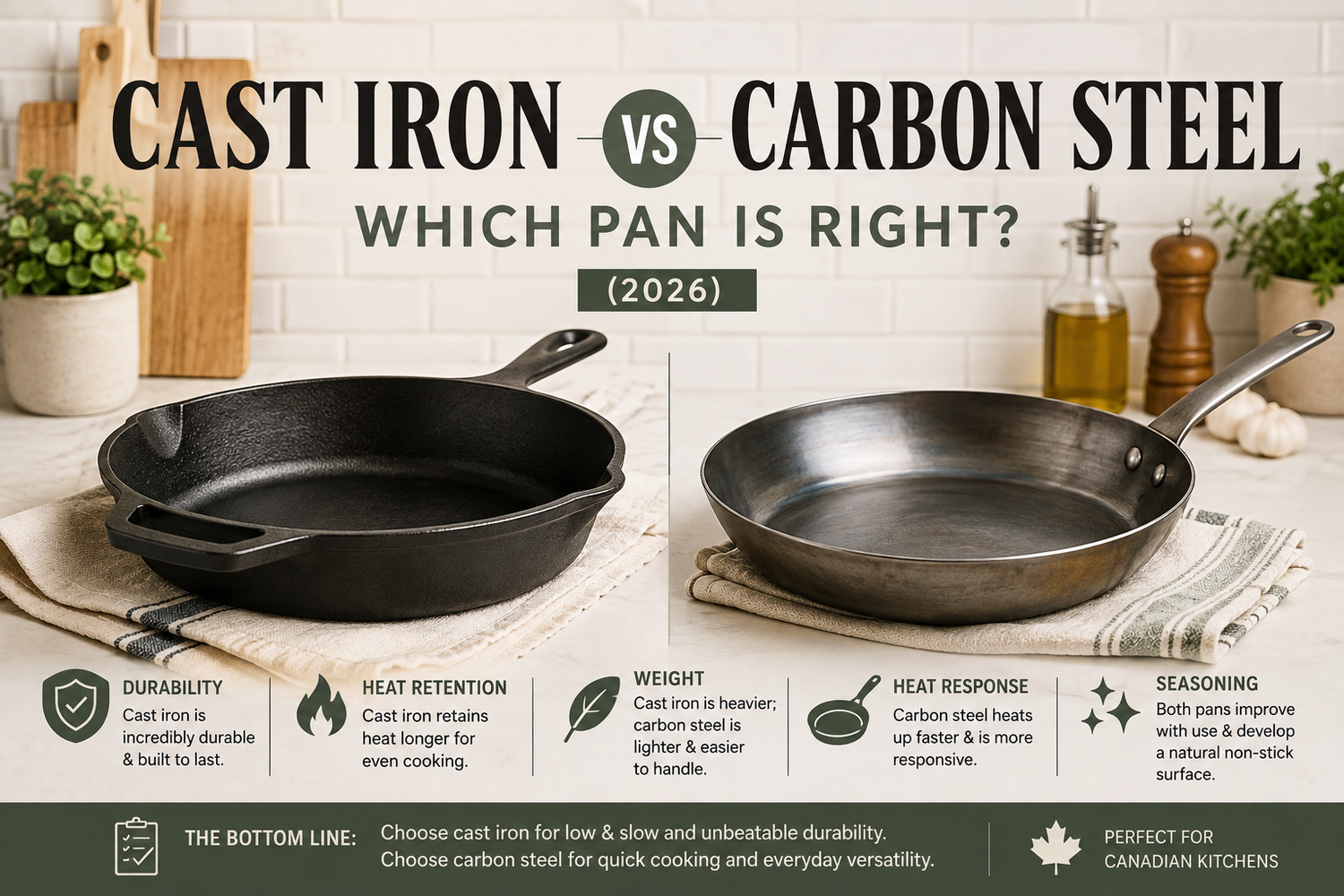
You can be standing at the stove with dinner half planned, one pan in each hand, and still not feel sure which one belongs in your kitchen. The cast iron feels like it could survive a dropped pot, but it asks for patience and two hands. The carbon steel feels easier to move and quicker to heat, yet it can leave you wondering whether you're giving up some of that old-school cooking power.
That's the cast iron vs carbon steel decision in a Canadian home, not a spec sheet, but the daily reality of lifting, drying, seasoning, storing, and cooking in a kitchen that gets used hard. If you're comparing them because you want one pan that fits your life, the useful question isn't which one is “better” in the abstract, it's which one makes more sense for your stove, your wrists, your storage, and your climate. For readers who are also thinking about alternatives to coated pans, this guide to non-stick cookware alternatives sits in the same decision space.
| Category | Cast Iron | Carbon Steel |
|---|---|---|
| Carbon content | More than 2.1% carbon in the broad material definition | Less than 2.1%, typically about 0.05% to 1% for cookware |
| Feel in hand | Heavier, denser, steadier | Lighter and easier to manoeuvre |
| Heat behaviour | Slower to heat, strong heat retention | Heats faster and responds more quickly |
| Durability style | Very tough, but more brittle | More pliable and impact-resistant |
| Best fit | Slow cooking, baking, steady searing | Quick searing, tossing, frequent stove movement |
Table of Contents
- Introduction
- Understanding the Material Differences
- Heat Performance and Cooking Behaviour
- Weight, Durability, and Seasoning Maintenance
- Cooking Use Cases and Real-World Scenarios
- Compatibility, Cost, and Sizing Guidance
- Choosing the Right Pan for Your Kitchen
Introduction
One winter evening, the kind where wet boots are piled by the door and the kitchen windows fog up from simmering food, a lot of people reach the same fork in the road. They want a pan that lasts, browns well, and doesn't feel disposable after a year or two, but they also don't want something awkward to lift, dry, and store every night. That's where cast iron vs carbon steel stops being a materials debate and turns into a practical home-cooking choice.
The difference shows up immediately in real use. Cast iron feels like a fixture, built for steady heat and patient cooking, while carbon steel feels like a tool you can move around the kitchen without treating it like furniture. That contrast matters even more in Canadian homes, where damp seasons, indoor condensation, and limited drying space can make maintenance as important as performance.
A lot of comparison pages repeat the same talking points about seasoning and searing, but those are only part of the story. The harder question is what happens after dinner, when the pan has to be cleaned, dried, oiled, and put away in a room that may not be dry or warm for long. That maintenance reality is one of the main reasons the better pan for your kitchen isn't always the one with the bigger reputation.
Practical rule: choose the pan that matches your weeknight routine first, then judge the cooking performance second.
This is also why the choice isn't just about taste at the stove. If you cook more at home to save money, reduce waste, or avoid buying another replacement pan later, the value question matters just as much as the sear.

Understanding the Material Differences
Carbon content changes everything
The cleanest way to separate these two materials is by carbon content. In the broad material definition, cast iron contains more than 2.1% carbon, while steel contains less than 2.1% carbon; cookware-grade carbon steel is typically around 0.05% to 1% carbon. That gap is why cast iron tends to be harder and more brittle, while carbon steel is stronger and more pliable. Those differences are not abstract chemistry, they show up in how the pan feels, how it handles impact, and how forgiving it is when you're cooking fast.
The higher carbon and graphite content in cast iron also make it easier to cast into more complex forms. That is part of why it has such a long history in cookware and structure, and why it still shows up in heavy skillets and Dutch ovens. Carbon steel, by contrast, is more closely tied to later steelmaking and the rolled, thinner pans that many home cooks now prefer.
History explains the modern split
The industrial story helps explain the shopping story. Cast iron became a major structural material in the late 18th century, with the Iron Bridge completed in 1779 as the first bridge built entirely of cast iron, and technical histories place the Cast Iron Period from about 1780 to 1850 before steel took over. Steel production accelerated after the Bessemer process in 1855, and historical sources note a major drop in steel prices over the following decades. Cast iron still remained dominant in manufacturing for a long time, which is part of why its reputation stayed so strong even after steel rose.
That history still shapes how people think about the pans today. Cast iron carries the reputation of being thick, traditional, and heat-heavy. Carbon steel carries the reputation of being later, lighter, and more responsive.
In the kitchen, material structure is not a technical footnote. It is the reason one pan feels planted and the other feels nimble.
For a gas stove setup, that difference can matter even more because a thinner pan can react faster to flame changes. A useful overview of that kind of stovetop fit appears in this gas-stove cookware guide, especially if your cooking happens on open burners more than in an oven.
The HAUTE CUISINE Stainless Steel Garlic Press - 80710-HC, for example, is built around a durable stainless steel body and easy cleanup, which is the kind of small kitchen tool that fits the same practical mindset as choosing a pan that will not create extra fuss.

Heat Performance and Cooking Behaviour
Responsiveness versus inertia
A pan's heat behaviour shows up the moment the burner goes on. Carbon steel is usually 2 to 3 mm thick, while cast iron is typically 5 to 7 mm thick. That extra mass in cast iron takes longer to come up to temperature, but once it is hot, it stays there with a kind of stubborn steadiness. Carbon steel, being thinner and lighter, warms faster and settles faster when you turn the flame up or down.
In a busy kitchen, that difference changes how the pan feels in real use. Carbon steel is easier to preheat for a quick weeknight meal, and it recovers faster after cold food hits the surface. Cast iron asks for more patience at the start, then keeps its heat through a longer cook without dropping off as quickly.
Canadian kitchens make that trade-off more noticeable. In winter, a cool pan can pull heat away from food fast, and a slow preheat becomes more obvious. If you cook more often at home, that means the pan you choose has to fit your routine, not just your ideal cooking style.
Matching heat behaviour to the food
Thin cuts of protein, eggs, vegetables, and deglazing tend to suit carbon steel because the pan reacts quickly. If the heat runs a little high, you can correct sooner. If you need to tilt, toss, or shift the pan around, the lighter build makes that easier too.
Cast iron suits a different kind of cooking. It works well for oven finishes, baking, and long sears on larger cuts, where the pan should stay steady instead of changing temperature every time you move it. People who make cornbread, skillet bakes, or stove-to-oven meals often keep using cast iron for those jobs even after buying lighter pans.
| Heat characteristic | Carbon Steel | Cast Iron |
|---|---|---|
| Heat retention | Good | Excellent |
| Heat responsiveness | Fast | Slow |
| Preheat behaviour | Shorter, more nimble | Longer, more gradual |
| Best cooking style | Quick stovetop work | Steady searing and baking |
The weight difference is part of that cooking feel too. A 12-inch carbon steel pan weighs about 4.8 lb, compared with a 12-inch cast iron pan up to 6.6 lb. That changes how confidently you lift it to check the underside of food, and how much effort it takes to move the pan from stove to oven.
For households building a practical cookware setup, the question is often not which pan is better in theory. It is which one fits the way you cook on a weeknight. If you are deciding how a skillet fits beside deeper pots and everyday saucepans, this saucepan versus frying pan comparison helps place each piece in the right job.
Kitchen rule of thumb: if the task needs quick correction, choose carbon steel. If the task needs stable heat, choose cast iron.
Weight, Durability, and Seasoning Maintenance
The first thing you feel is the weight
Weight is not a minor comfort issue, especially if you cook nightly. As noted above, the gap between carbon steel and cast iron changes how often you lift the pan, how easily it fits into a crowded cupboard, and whether one-handed control feels natural or clumsy.
| Specification | Carbon Steel | Cast Iron |
|---|---|---|
| Typical thickness | 2 to 3 mm | 5 to 7 mm |
| Feel in use | Easier to lift and tilt | More planted and heavy |
| Handling in small kitchens | More manageable | More demanding |
That difference shows up in ordinary kitchen work. A lighter pan is easier to check, tip, and move from burner to oven without thinking about it. A heavier one stays put, which can be a benefit for steady searing, but it also asks more from your wrists, your storage space, and your drying routine after washing.
Durability is high, but the failure modes differ
Cast iron is famous for lasting generations, and that reputation is deserved. Its weak point is brittleness, so a hard drop or a severe thermal shock can crack it. Carbon steel is less likely to fracture, and it handles bumps and movement more gracefully, though its thinner walls can be more vulnerable to warping if it is abused under very high heat.
My practical bias: for apartments, shared kitchens, and people who cook fast, the pan that is easier to handle usually gets used more often, and the pan that gets used more often ends up being the better buy.
Seasoning in a damp climate is not the same as seasoning in a dry one
Both pans rely on seasoning, but the maintenance burden feels different in real homes. Carbon steel's smoother surface and lighter build often make it easier to build and refresh that slick layer. Cast iron usually wants more deliberate oiling and longer curing, and that is where Canadian climate becomes a real factor.
Most cast-iron-vs-carbon-steel advice skips over what happens in humid apartments, coastal homes, and places where indoor drying is not effortless. Canada's wet regions and repeated condensation cycles make it more likely that you will need to dry thoroughly and store carefully rather than rely on seasoning theory alone. In day-to-day use, that makes carbon steel feel less fussy after dinner.
For cast iron, a practical cast iron cookware care guide is useful because the job is less about mystique and more about consistency, drying, and light oiling.
Seasoning also changes the value question for households that are cooking at home more often. A pan that is cheap to buy but annoying to dry, oil, and store can cost more in attention than money. A pan that is easier to keep in rotation may fit better into a busy week, especially when the kitchen is already full of other tools competing for counter space and cupboard room.
Cooking Use Cases and Real-World Scenarios
The pan should match the meal you actually make
A lot of people buy cast iron because they picture a dramatic steak sear or a skillet cornbread moment, then find out their weekday reality is eggs, vegetables, fish, and quick pan sauces. That is where carbon steel usually starts looking more sensible. It heats fast, turns fast, and doesn't make every small movement feel like weight training.
Carbon steel is strongest when you want the pan to keep up with you. It works well for quick-seared proteins, omelettes, sautéed vegetables, and dishes that need deglazing while the food is still moving. The lighter build makes it easier to shake, tilt, and pour, which matters more than people expect when dinner is on a timer.
Cast iron suits slow, steady, and oven-heavy cooking
Cast iron is the right tool when the heat needs to stay put. It shines in baking cornbread, roasting chicken, finishing dishes in the oven, and holding a hard sear on a thick steak without losing momentum. If you cook outdoors, over coals, or at a cabin where the pan may double as both stove and serving piece, cast iron also feels right at home.
The trade-off is that cast iron asks you to accept its pace. It's not the pan you pick when you want immediate heat correction. It's the pan you pick when staying hot matters more than changing temperature quickly.
The easiest way to decide is to look at the last five dinners you actually cooked, not the ones you imagine cooking on a perfect weekend.
A useful way to sort your habits
- Choose carbon steel if you cook lots of quick stovetop meals, move the pan often, or want something easier to handle in a compact kitchen.
- Choose cast iron if you roast, bake, or sear often and care more about long heat stability than quick handling.
- Keep both in mind if you split your cooking between weeknight speed and weekend oven work.
If your kitchen routine leans toward high-heat versatility across different pots and pans, the broader cookware logic in this Dutch oven article helps show where cast iron belongs and where another vessel makes more sense. The goal is not to own more metal, it's to use the right metal less grudgingly.
Compatibility, Cost, and Sizing Guidance
Stovetop fit is broad, but the details still matter
Both cast iron and carbon steel work on gas, electric, and induction stovetops, and both can move into conventional ovens and onto outdoor grills. The primary difference is how they handle heat once they are on the burner. Induction compatibility depends on magnetic properties, and some coated or enameled cast iron versions will not behave as predictably as bare carbon steel on a magnetic cooktop.
For people choosing cookware in Canada, size and weight often matter as much as compatibility. A smaller pan is easier to store, dry, and lift, especially if your kitchen has limited counter space or you are cooking in a rental with cramped cupboards. That practical reality matters even more in damp weather, where a pan that is awkward to dry tends to get used less often.

Size should follow the household, not the hype
A 10-inch pan usually suits individual cooks and smaller households, while a 12-inch pan fits families and more frequent entertaining. That sounds obvious until you bring home a pan that is too heavy for your wrists or too large for the burner you use. Carbon steel also comes in a wider range of specialised shapes, including wok-style pans and flattop griddles, while cast iron remains most common in classic skillet and Dutch oven forms.
In a real kitchen, the best size is the one you will reach for after a long day. A pan that feels manageable in the sink and on the rack is more likely to stay in rotation than one that looks impressive but becomes a storage problem.
The value question looks different in Canada
Cost is where a lot of shoppers overthink and underthink at the same time. Entry-level carbon steel pans tend to be more affordable than quality cast iron skillets from recognised manufacturers. Price alone does not decide value, though, because a cheaper pan that rusts, feels awkward, or gets left in the cupboard has already become the expensive choice.
Canadian households that cook at home more often usually care less about showroom appeal and more about whether a pan fits the routine. A good pan should survive repeated washing, dry quickly enough to avoid rust in a humid kitchen, and feel like a help instead of a burden. That is the part many buyers miss, especially when they compare only the tag and not the upkeep.
Value check: if the pan is too heavy, too fussy, or too slow for your routine, the purchase is not really inexpensive.
For a more structured way to think about kitchen purchases, practical product guides can still help shoppers sort by real-life use without adding more clutter to the decision.
Choosing the Right Pan for Your Kitchen
If you rent, live in an apartment, or cook in a small kitchen, carbon steel usually makes more sense. It's lighter, quicker to dry, and less annoying to move from sink to rack to cupboard, which matters when your kitchen setup doesn't make room for bulky maintenance. It also feels better for people who cook most nights and don't want every pan cleaning to turn into a chore.
If you love oven-heavy cooking, rustic presentation, or food that benefits from a heavy, steady thermal presence, cast iron earns its place. It's the better call for cornbread, long sears, and meals that stay in the pan from stove to oven to table. If you cook outdoors or want one pan that feels almost indestructible in regular use, cast iron still has a strong case.
For many Canadian households, the answer comes down to everyday convenience. Carbon steel fits the cook who wants speed, easier handling, and less maintenance friction in a damp climate. Cast iron fits the cook who values heat retention enough to accept the extra weight and drying routine.
If you want practical cookware guidance that cuts through the noise, explore GrifGlo for clearer kitchen comparisons, useful buying advice, and product picks that are built around how real households cook and store things.

Leave a comment
This site is protected by hCaptcha and the hCaptcha Privacy Policy and Terms of Service apply.