

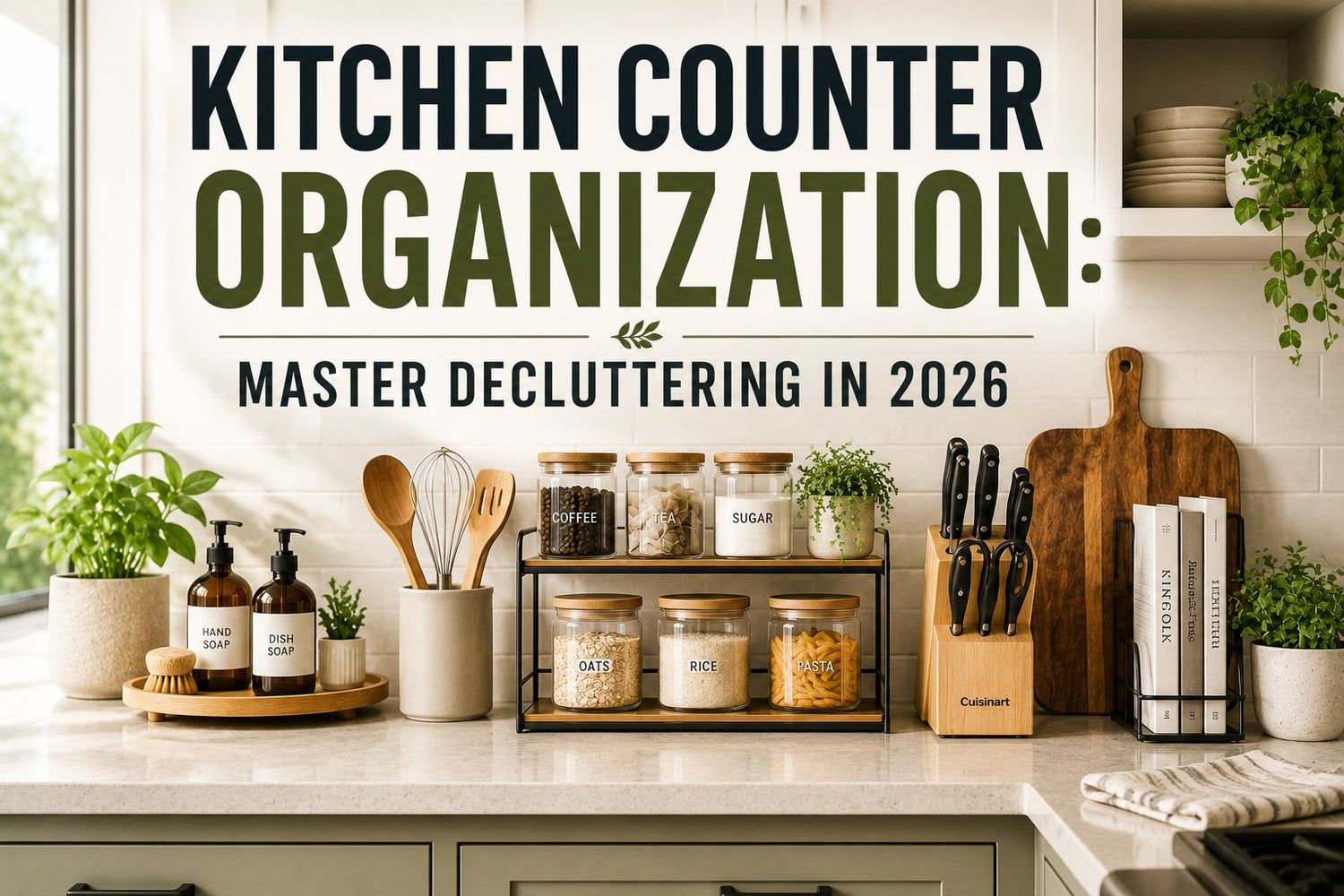
You wipe a patch of counter to make breakfast, then move the toaster so you can set down a chopping board, then shift a stack of post, then realise the coffee machine cord is tangled behind the fruit bowl. By dinner, the same stretch of counter has turned into prep space, storage shelf, drop zone, and apology.
That's why kitchen counter organization matters. Not because a spotless kitchen looks nice in photos, but because an organised counter changes how the room works when you're tired, rushed, sharing space, or cooking in a kitchen that was never designed for modern life.
Generic advice usually says “keep nothing out” or “only keep daily essentials”. That works for some homeowners with deep cabinets and flexible layouts. It falls apart for many renters. Over 55% of California households are renters, and many live in units with limited built-in storage, which leaves them needing systems that work even when appliances and daily items have nowhere else to go, according to this California renter storage discussion. Small businesses face a similar problem in shared kitchenettes and break rooms, where counters have to stay functional for multiple people all day.

If your kitchen is also carrying overflow dish duty, a compact appliance setup matters too. Guides like this one on a compact dishwasher in Canada are useful because counter organization often improves only when the entire workflow improves.
Table of Contents
- Reclaim Your Counters and Transform Your Kitchen
- Start with a Counter Assessment Not a Shopping Spree
- Design Your Countertop for How You Actually Cook
- Maximize Space with the Right Organizers
- Arrange Your Counter for Flow and Style
- Build Habits to Keep Your Counters Clear
Reclaim Your Counters and Transform Your Kitchen
You set down groceries and there is nowhere to sort them. The coffee maker claims one corner, the dish rack takes another, and the only clear stretch of counter is beside the sink where dishes keep piling up. That is usually the moment people decide the kitchen has a storage problem, but the counter is often the first place where a layout problem shows up.
A crowded counter adds small points of friction all day. Prep gets slower. Cleaning takes longer. Shared kitchens become harder to use because no one can tell what belongs where. I see this in studio rentals with one short run of counter, in family kitchens where appliances have multiplied over time, and in office break rooms or short-term rentals where different people need the space to make sense at a glance.
The right setup depends on the constraints.
Renters usually work around fixed cabinets, limited drawers, and lease rules that rule out drilling or built-in storage. Homeowners have more freedom to add permanent solutions, but that freedom can turn into overfilling the surface with stand mixers, knife blocks, and decorative canisters that rarely move. Small businesses need something else entirely. Their counters have to be clear enough for repeat use, simple enough for staff or guests to maintain, and flexible enough to scale when volume changes.
A useful counter makes the next task easier.
That standard is more helpful than copying a staged kitchen photo or forcing every appliance into a cabinet. In a small apartment, a coffee maker may deserve permanent counter space because it gets used twice a day. In a rental with no dishwasher, a compact dish setup can justify its footprint, especially if you are comparing options like a compact dishwasher for small Canadian kitchens and trying to reduce sink backup. In a staff kitchen, the microwave and sanitizing supplies may need priority over anything decorative.
A few decisions drive the whole result:
- Keep only active functions on the counter. Daily prep, coffee, dish drying, and frequently used cooking tools usually earn space. Backup storage does not.
- Match the system to the property. Renters need removable fixes. Homeowners can add shelves, outlets, or built-ins. Small businesses need labeled, repeatable stations that hold up under shared use.
- Protect open work surface. Even a small clear area changes how the kitchen feels and how fast it works.
Good kitchen counter organization is not about owning less for the sake of appearances. It is about assigning limited surface area to the jobs that matter in your kitchen, with your budget, your storage limits, and the people who use the space every day.
Start with a Counter Assessment Not a Shopping Spree
Monday morning in a small rental kitchen often looks the same. Coffee gear is crowding one corner, yesterday's mail is near the fruit bowl, the toaster never got put away, and there is barely enough room left to make breakfast. In a larger home, the clutter usually spreads because there is more surface to fill. In a shared office kitchen or small business prep area, the problem is different. Too many people leave out items that belong to different tasks.

The fix starts with assessment, not storage products.
Clear the whole counter first. Remove everything so you can see the actual work surface and the choke points around outlets, corners, and the sink. Kitchen counters are built to a standard working height in many homes, so flexibility often stems from what stays on the surface, what moves below it, and what can shift to the wall or inside a cabinet. Renters may be limited to removable options. Homeowners can add shelves or under-cabinet features. Small businesses need setups that several people can follow without guessing.
Once the surface is empty, sort each item with a few blunt questions:
- How often is it used? Daily items get different treatment than once-a-week gadgets.
- What job does it support? Prep, cooking, cleaning, serving, or a daily habit like coffee.
- Where would it go if it left the counter? A real storage spot counts. A crowded junk drawer does not.
- Does it slow cleaning down? Anything that turns a quick wipe into a 10-minute shuffle needs stronger justification.
If you have to move a cluster of bottles, cords, and canisters just to wipe one area, the counter is overassigned.
I use four decision categories because they are fast and hard to argue with.
| Category | What goes here | Common examples |
|---|---|---|
| Keep on counter | Items used daily and tied to a specific station | Coffee maker, dish soap, knife block if no wall option |
| Store nearby | Weekly-use items that need easy access | Mixer, blender, larger spice backups |
| Store away | Rare-use items | Holiday platters, specialty gadgets |
| Discard or donate | Duplicates, broken tools, things you never reach for | Extra mugs, novelty gadgets, chipped containers |
Real-life constraints significantly influence counter organization. In a studio apartment, a drying rack may deserve permanent space because there is no dishwasher and limited cabinet room. In a house with a walk-in pantry, backup appliances can leave the counter completely. In a small business kitchen, the rule should be even stricter. Only equipment tied to daily service stays out, and each item needs a defined home so staff can reset the space quickly.
Avoid pushing the mess into nearby drawers without a plan. That creates a different problem, especially in shallow rental kitchens where one overstuffed drawer becomes a daily frustration. If the storage beside your counter is part of the problem, this guide on how to organize kitchen drawers can help you sort what should move off the surface.
The same logic applies beyond the counter. If eggs, produce, or snack overflow keep migrating into your prep area, the answer is usually to improve storage where those items belong. For example, the Automatic Egg Dispenser Rack – Rolling Storage Holder is priced at $22.99 and comes in 2 variants. Its gravity-fed, 2-tier design keeps eggs contained in the refrigerator instead of letting cartons take up prep space. That is the right principle to follow throughout the kitchen. Put items where they are used, not where they happen to fit for the moment.
Design Your Countertop for How You Actually Cook
Dinner prep in a small rental often starts with a compromise. The only open stretch of counter may sit beside the sink, while the toaster, coffee setup, and dish rack already claim the rest. In a larger home, the problem is usually different. There is more surface area, but it turns into overflow space unless each section has a job. In a business kitchen, the implications are more serious because unclear placement slows service and makes reset harder for the next person.

Build zones around movement
A workable counter layout follows the order of real tasks. Wash. Prep. Cook. Plate. Clean. If the layout fights that sequence, clutter returns because people start setting things down wherever there is room.
Start by watching one normal cooking session. Note where produce gets washed, where chopping happens, where oil and salt are grabbed, and where finished food waits for serving. Those points usually reveal the zones your kitchen already wants, even if the current setup is messy.
The core zones are simple:
- Prep zone: The clearest stretch of counter, usually closest to the sink. Keep boards, knives, mixing bowls, and the space itself available.
- Cooking zone: Near the hob or stove, with only the oils, seasonings, and utensils used several times a day.
- Cleaning zone: Around the sink, with soap and scrub tools contained so they do not spread into prep space.
- Serving zone: A short-term area for plating, lunch packing, or staging groceries that are about to be put away.
- Specialty zone: Coffee, toast, smoothies, or baking. Group the appliance with its small accessories so the setup stays contained.
- Storage edge: The outer edge of the counter for items that need access but should not sit in the main work path.
In shared kitchens and small food businesses, labels can help more than people expect. A simple bin or tray for portion cups, lids, or backup utensils gives staff a repeatable reset point. If your operation also struggles with overflow pantry items, these commercial food storage containers for bulk kitchen supplies can help move stock off the counter and into stackable storage.
Match the layout to your constraints
Renters usually need flexible zones because the kitchen has to do more with less. A dish rack may need to stay out. The microwave may live on the counter because there is nowhere else for it. In that case, protect one prep surface first, even if it is modest. A clear 18 to 24 inches of usable workspace beats a larger counter chopped into awkward fragments.
Homeowners often have more freedom to spread out, but that can create dead zones that collect papers, unopened packages, and backup appliances. Give those areas a defined purpose or clear them completely. Extra space only helps if it supports the way you cook.
Small businesses need tighter rules. A coffee station, packaging area, or expo corner should be obvious at a glance so new staff can work without asking where things belong.
The landing zone most kitchens miss
Many counters get crowded by items that were never part of cooking. Keys, receipts, chargers, post, and sunglasses end up beside the cutting board because there is no better stopping point.
Set a landing zone outside the main prep area. That can be a tray near the entrance, a narrow shelf just beyond the kitchen, or a bowl on a side console. In a studio apartment, even one small container at the far end of the counter is better than letting daily carry-in items mix with food tools.
A good counter plan controls what enters the space, not only what stays on it.
For renters, that often means using one removable tray instead of adding furniture. For homeowners, it keeps an island from becoming the household drop spot. For offices, cafés, and short-term rentals, it gives guests and staff an obvious place for shared odds and ends so the food-prep area stays usable.
Maximize Space with the Right Organizers
Organisers work when they solve a specific problem. They fail when they add bulk, block cleaning, or create one more thing to work around. Good tools reclaim surface area, sharpen zones, or shift storage vertically.

In dense California kitchens, vertical storage specs are unusually practical. Recommendations include magnetic knife strips mounted inside cabinets at 15 to 18 inches above prep zones, under-cabinet hooks for mugs at 12-inch vertical spacing, and tiered corner organisers with 8 to 10 inch depth for L-shaped counters. Those setups reduced visible counter item counts by 40 to 55%, according to this vertical kitchen storage guide for urban kitchens.
Renters need reversible solutions
Renters usually need storage that works without drilling tile, replacing cabinets, or risking a deposit dispute. The strongest options are removable, magnetic, freestanding, or tension-based.
Try these first:
- Magnetic storage: Good for fridges and metal surfaces. It moves frequently used small items off the counter without permanent installation.
- Under-cabinet hanging pieces: Useful when leases allow non-destructive mounting or existing lips and rails can support accessories.
- Tiered risers and slim shelves: These increase vertical capacity on the counter while keeping the footprint controlled.
- Lazy Susans: Best for oils, condiments, and coffee supplies that would otherwise scatter.
One practical example is the Magnet Shelf Rack for Refrigerator from GrifGlo. It's the kind of tool that shifts light, frequently used items onto unused vertical space on the fridge rather than asking the counter to store everything.
For shared kitchens and break rooms, the same principle applies. A freestanding organiser that anyone can understand is usually better than a hidden cabinet fix that only one person remembers.
Before choosing a product, it helps to see how storage choices scale in busier settings. This guide to commercial food storage containers is useful because businesses need systems that stay legible across multiple users and repeated restocking.
Homeowners can build storage into the room
Homeowners can do more, but they also need restraint. Permanent upgrades should target repeated friction points.
A few worth considering:
- Mounted knife strips inside cabinets or on splashbacks: These free drawer and counter space at once.
- Under-cabinet rails or mug hooks: Effective when the mugs or utensils are used constantly.
- Corner shelving: Especially helpful in L-shaped layouts where dead corners swallow usable space.
- Appliance garages or dedicated shelves: Better for people who want visual calm without hiding daily essentials too far away.
Here's a practical look at how others use vertical and layered storage in real kitchens:
Shared kitchens and small businesses need repeatable systems
A household can rely on memory. A small business can't. In office kitchens, staff rooms, holiday rentals, and hospitality prep corners, counter systems have to survive different users and variable routines.
That means choosing organisers that are:
- Easy to decode: A labelled tea tray beats five loose boxes.
- Simple to wipe around: Open bases and trays are easier than fiddly compartments.
- Stable under repeated use: Nothing should slide when several people reach for it each day.
The mistake I see most often is overfitting a system to one person's preferences. If the coffee pods, kettle, mugs, and sweeteners don't clearly belong together, the counter slowly dissolves back into loose piles.
Arrange Your Counter for Flow and Style
An organised counter shouldn't look accidental. It should feel settled. The quickest way to get there is to place for function first, then tighten the visual noise.

Place the largest items first
Start with the biggest core items. Usually that means the coffee machine, toaster, dish rack, or stand mixer. Put them in their correct zones before you style anything smaller.
Then work in layers:
- Anchor the station: Place the main appliance where it's typically used.
- Add the support items: Mugs near the coffee machine, oil near the hob, soap by the sink.
- Contain the loose pieces: Use a tray for salt, pepper, oils, or sweeteners.
- Leave clear working gaps: Don't fill every open patch just because it exists.
A tray does more than make things look neat. It turns several small objects into one visual unit, which makes the counter easier to clean and easier to read.
Grouping beats scattering. Three items on a tray usually look calmer than the same three items spaced across the counter.
Make functional items look intentional
You don't need a showroom kitchen. You need a counter that looks cared for while staying usable.
A few styling choices help without creating more clutter:
- Repeat materials or finishes: Wood, matte black, stainless steel, or glass. Consistency calms a busy counter.
- Decant selectively: Dish soap and hand soap often look better in matching dispensers. Don't decant anything that becomes harder to identify or refill.
- Use one soft element: A small plant, herb pot, or framed piece near a dead corner can warm the space.
- Hide cord chaos: Clip, route, or shorten visible cords so appliances don't look like they're sprawling.
If you keep a visible countertop appliance, choose one that sits neatly within a zone instead of overpowering it. A compact composter in a prep area, for example, can feel integrated if the surrounding items are minimal and the drop-off point is clear.
The same discipline applies to adjacent appliances. If your air fryer is a daily fixture, it needs a real station, not leftover space. This guide on how to clean an air fryer is worth keeping in mind because appliances that are hard to clean often become visual and functional clutter faster than expected.
Build Habits to Keep Your Counters Clear
A good reset routine beats a perfect setup that nobody maintains. Most counter clutter returns in tiny increments. A receipt left out after lunch. A spice jar not put back. A bag dropped near the kettle because there isn't time to deal with it properly.
Use a reset instead of marathon tidying
In California households, the most effective anti-clutter habit is a documented 5-minute daily reset after dinner, where items return to their designated zones and surfaces get wiped down. That routine prevents 60 to 70% of daily clutter accumulation from migrating onto counters, according to this daily kitchen reset report.
That reset works because it's short enough to repeat. It doesn't ask you to reorganise the room every night. It asks you to restore the system before drift becomes buildup.
Keep the reset sequence fixed:
- Return first: Put coffee items back in the coffee area, cooking tools back near the hob, cleaning supplies back by the sink.
- Clear outsiders: Remove post, keys, packaging, and anything that belongs somewhere else.
- Wipe surfaces: A fast wipe gives you immediate visual feedback and makes the habit feel finished.
Protect the system when new items arrive
Counters often get re-cluttered after one purchase or one change in routine. A new espresso grinder appears. You start meal prepping. The office kitchenette adds protein powder tubs and extra mugs. If there isn't a rule for new arrivals, the system weakens.
Use two rules:
- One in, one out: If a new countertop item arrives, something else needs to leave the surface.
- Review by season: Rarely used appliances and decorative pieces should be reconsidered regularly, not granted permanent residency.
For households trying to hold the line beyond the counter, zoning principles work best when pantry storage supports them. This guide on how to organize your pantry with bins and zones is a practical next step because counters stay clearer when backup stock and overflow have an obvious home.
Kitchen counter organization lasts when the routine is lighter than the mess it prevents. That's the whole point. You shouldn't need a weekend overhaul every month just to find space to make tea.
If you're building a more workable kitchen, GrifGlo is a useful place to compare practical home, kitchen, and organization tools with decision-friendly guides that focus on fit, everyday use, and scalable options for households, rentals, and shared spaces.

Laisser un commentaire
Ce site est protégé par hCaptcha, et la Politique de confidentialité et les Conditions de service de hCaptcha s’appliquent.