

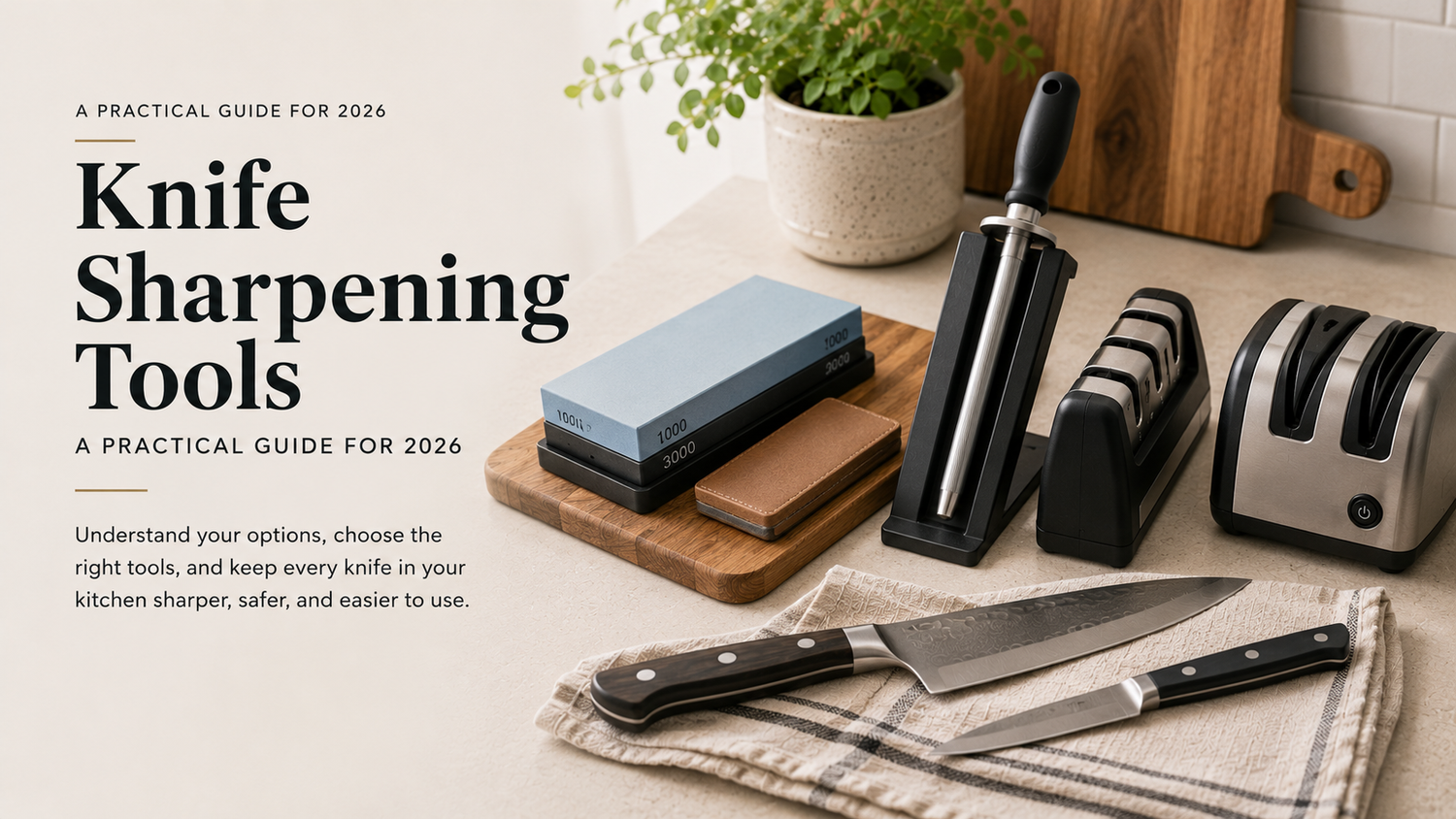
You're probably here because one knife in your kitchen glides through onions while another crushes tomatoes, and the bread knife somehow feels fine even though the chef's knife feels tired. That's a common mixed-kitchen problem. Many homes don't have one style of knife. They have a sturdy German chef's knife, a thinner Japanese prep knife, a utility knife nobody can identify, and maybe a paring knife that's seen better days.
That mix is exactly why choosing among knife sharpening tools gets confusing. A tool that feels acceptable for a heavy Western blade can be too rough for a thinner, harder edge. A method that gives beautiful results on a Japanese knife may demand more time and patience than one might typically want on a Tuesday night.
Knife sharpening has been around for a very long time. Historical overviews note that sharpening practice dates back more than 3 million years globally, with rotating grindstones appearing by the Middle Ages and watermill-powered and steam-powered grinding systems arriving later during the Industrial Revolution. The same basic ideas still apply today: abrasive surfaces, angle control, and honing. That long history helps explain why modern sharpeners in Canada focus so much on consistency and ease of use rather than brute force alone, as noted in this history of knife sharpening.
Table of Contents
- Why a Dull Knife is More Than an Inconvenience
- The Core Concepts of Knife Sharpening
- Exploring Manual Sharpening Tools
- Understanding Assisted and Electric Sharpeners
- How to Choose the Right Sharpening Tool for Your Kitchen
- Essential Safety and Maintenance Practices
- Making a Confident Choice for a Sharper Kitchen
Why a Dull Knife is More Than an Inconvenience
A dull knife usually announces itself with a tomato. You press down, expecting a neat slice, and instead the skin caves in. Then the knife slips sideways. You press harder. The cutting board gets noisy, the slice gets ragged, and your mood changes with it.
That small annoyance spreads through the whole prep session. Carrots take more force. Herbs bruise instead of cutting cleanly. Onion cuts wander off line. You slow down because you don't trust the blade, or worse, you rush and let frustration steer your hands.
Dull knives change how you move
A sharp knife does one important thing well. It starts the cut where you place it. A dull one resists the food, so your wrist compensates, your shoulder adds force, and the knife becomes less predictable.
In practical kitchen terms, that means:
- More pressure: You push harder to get through skins and fibres.
- Less control: The edge can skate before it bites.
- Messier prep: Soft produce tears, herbs crush, and proteins don't portion cleanly.
- More fatigue: Repetitive force adds up fast during batch cooking.
A dull knife doesn't just cut poorly. It makes you work around the tool instead of with it.
The real question isn't which tool is best
People often search for one winner among knife sharpening tools, as if there's a single answer for every kitchen. There isn't. The right choice depends on the knives you own, how much time you'll give the task, and whether you want full control or quick repeatability.
A home cook with one inexpensive chef's knife may be happy with a simple maintenance routine. A household with both German and Japanese knives needs a little more judgement. The aim isn't to chase a perfect edge in theory. It's to keep each knife useful, safe, and suited to its job.
The Core Concepts of Knife Sharpening
Before comparing tools, it helps to know what's happening at the edge. Most confusion comes from three words people hear all the time and rarely get explained clearly: sharpening, honing, and grit.

Sharpening, honing, and stropping
Sharpening removes metal so the two sides of the blade meet again in a clean apex. If the edge has become rounded from use, sharpening rebuilds it.
Honing is different. It mainly realigns an edge that has bent or rolled slightly during normal cutting. A honing rod is maintenance, not a full reset.
Stropping is the finishing step. Think of it as tidying up microscopic roughness after sharpening. It can refine the feel of the edge and help remove the last trace of burr.
A simple way to remember it:
- Sharpening rebuilds
- Honing straightens
- Stropping refines
Angle is the shape of the edge
The bevel angle is the angle at which the blade narrows down to the edge. If you imagine sharpening a pencil, a long slender point feels sharper but can break more easily. A shorter, sturdier point lasts longer but won't feel quite as fine. Knives behave in much the same way.
That's why thin Japanese-style edges often feel laser-like on vegetables, while thicker Western-style edges usually tolerate heavier work better. Neither is automatically better. Each suits a different job.
Practical rule: Don't judge a sharpening setup by grit alone. If you can't hold or guide the right angle, the edge won't form consistently.
Grit is like sandpaper for steel
Grit tells you how coarse or fine the abrasive is. The easiest analogy is sandpaper. Coarser grits remove material faster and help restore a dull edge. Finer grits smooth and polish.
You don't need to memorise a giant chart. For kitchen use, the useful mental model is:
- Coarser grit: For repair or edge restoration
- Medium grit: For regular sharpening and refinement
- Fine grit: For polishing and finishing
A burr is the tiny curled bit of metal that forms when you've sharpened enough to reach the edge. Beginners often miss this part. If you never form and remove the burr, the knife may feel better for a moment but won't stay sharp for long.
Exploring Manual Sharpening Tools
Manual knife sharpening tools give you the most direct control. They also ask the most of your hands. For some cooks, that control is satisfying. For others, it's one more skill they don't want to practise after dinner.

Whetstones
A whetstone is the classic choice because it lets you control pressure, angle, and finish. That's why many cooks and sharpening enthusiasts still treat stones as the benchmark. You can tailor the edge to the knife rather than forcing every knife through the same slot.
For a mixed kitchen, stones make sense when you want to treat different blades differently. A German chef's knife can keep a sturdy working edge, while a thinner Japanese knife can be refined more delicately. That flexibility is hard to beat.
One example is the King Japanese Whetstone – #800/#6000 Dual Grit, a double-sided stone made in Japan with #800 grit for restoring and sharpening dull blades and #6000 grit for polishing. That combination suits cooks who want one stone that can both correct and refine.
The trade-off is skill. Stones reward steady angles and patience. If your angle wanders, the edge shape wanders with it.
For readers who want a hands-on walkthrough, GrifGlo's guide on how to sharpen kitchen knives gives a useful process overview.
Diamond stones
Diamond stones cut fast and stay effective for a long time. In plain language, they feel quicker and more direct than many traditional stones. If you have a very dull knife or a harder steel that feels slow on other abrasives, diamond can be appealing.
They're especially useful for people who don't enjoy long sharpening sessions. You get feedback quickly. A few passes can make obvious progress, which helps beginners trust the process.
The downside is that fast cutting can become heavy-handed sharpening if you're not careful. On a delicate blade, speed without control can remove more material than you intended.
Honing rods and steels
Honing rods confuse people because they look like sharpening tools and are often stored with knives. But their main job is upkeep between sharpenings. They help straighten an edge that has drifted out of line through normal use.
That makes them useful in almost every kitchen. If you cook often, a rod can keep a working knife feeling lively between proper sharpening sessions. But if the edge is significantly worn down, a rod won't rebuild it.
A quick way to think about manual options:
| Tool | What it does well | What to watch for |
|---|---|---|
| Whetstone | Precise edge shaping and finishing | Takes practice and time |
| Diamond stone | Fast material removal and strong cutting action | Can be aggressive on finer knives |
| Honing rod | Quick maintenance between sharpenings | Doesn't replace real sharpening |
If you enjoy tools and technique, manual sharpening feels like tuning an instrument. If you don't, it can feel like homework.
Understanding Assisted and Electric Sharpeners
You come home after work, dinner needs to happen fast, and the knife block holds a little of everything. There is a thick German chef's knife for squash, a thinner Japanese prep knife for herbs, and a cheap utility knife that handles boxes and snack duty. That kind of mixed kitchen is exactly where assisted sharpeners can help, but only if you choose the type that matches the blade.
Assisted sharpening tools trade some flexibility for repeatability. They reduce the amount of hand skill needed, which is useful if you want a dependable edge without learning freehand stone work. The catch is simple. The more a machine decides for you, the more carefully you need to check whether its angle and abrasives suit your knives.
Pull-through sharpeners
A pull-through sharpener works like a track that guides the knife through a fixed path. That makes it easy to use on everyday Western-style knives that just need a quick working edge.
It can also be rough on thinner blades.
Many pull-through models remove metal quickly and leave a coarser finish than a careful stone or guided system. For a budget household knife, that may be a fair trade. For a Japanese knife with a thinner geometry, repeated passes can shorten the blade's life and thicken the edge behind the bevel, which makes cutting feel less clean over time.
If your drawer looks more like a mixed home cutlery set for everyday cooking than a single-brand collection, a pull-through sharpener is usually best treated as a limited tool, not a one-size-fits-all answer.
Electric sharpeners
Electric sharpeners solve a different problem. They are built for speed, consistency, and low effort. If you have several kitchen knives that all need attention before the weekend, an electric model can get the job done with less concentration than stones require.
The main question is compatibility. Some electric machines are designed around Western-style edges and remove metal in a way that suits sturdier German knives better than thin Japanese blades. Others offer separate stages or angle options that make them safer for a broader range of knives. Grit helps explain why. Coarse stages reshape the edge, much like sandpaper that cuts fast and leaves visible scratches. Finer stages smooth and refine, closer to switching from rough sandpaper to a finishing sheet before paint.
That staged approach is helpful in a household where one knife needs repair and another only needs a touch-up. Still, an electric sharpener is only a good fit if its settings match the knives you use.
Guided systems
Guided systems sit between freehand sharpening and machine sharpening. They hold a set angle for you, or limit how much your angle can drift, while still letting you control pressure and progression through different abrasives.
For many home cooks, this is the most practical middle ground.
Angle is easier to understand with a simple comparison. A lower angle is like a thinner pencil point. It feels sharp and precise, but it can wear faster. A wider angle is like a blunter pencil point. It gives up some finesse, but usually stands up better to tougher work. Guided systems help you keep those choices consistent, which matters in a kitchen with both a durable Western chef's knife and a more delicate Japanese slicer.
A good guided setup lets you sharpen each knife for its job instead of forcing every blade into the same edge profile.
- Choose a pull-through sharpener for quick upkeep on basic, tougher knives where convenience matters more than edge refinement.
- Choose an electric sharpener if speed and repeatable results matter most, especially for several Western-style household knives.
- Choose a guided system if you want more control for a mixed kitchen and want to protect thinner knives without learning full freehand sharpening.
How to Choose the Right Sharpening Tool for Your Kitchen
Many guides become overly abstract at this stage. They explain angles correctly, then leave you standing in the aisle wondering what to buy for a drawer full of mixed knives. That's the critical decision.
A common household setup includes a sturdy Western chef's knife, a thinner Japanese-style prep knife, a paring knife, and maybe a serrated blade. Guidance around sharpening angles often notes 15° for Japanese knives and about 20° for Western knives, but many buyers don't want separate systems for every blade. Recent product positioning has increasingly highlighted adjustable angle ranges such as 15° to 25° for broader versatility, as discussed in this knife sharpening angle guide.

Start with the knives you actually own
If your kitchen is mostly Western knives used for everyday chopping, an electric sharpener or a guided system often makes more sense than a fine polishing stone. Those knives usually benefit from a durable working edge more than a delicate showpiece finish.
If you own a thinner Japanese knife and care about preserving its feel, a whetstone or guided system gives you more control. That matters because a coarse one-size-fits-all tool can be rough on a fine edge.
If your kitchen is mixed, don't ask, “What's the sharpest tool?” Ask:
- Do I need one system for multiple blade styles?
- Am I maintaining expensive knives or just keeping tools serviceable?
- Will I use this tool regularly?
Match the tool to your routine
Some kitchens need a craft solution. Others need a habit-friendly one.
The busy home cook usually benefits from something simple and repeatable. A guided system or electric sharpener is often the sensible answer because it lowers the skill barrier.
The culinary hobbyist tends to enjoy stones. That person notices edge feel, likes control, and doesn't mind slower work in exchange for precision.
The small business owner or host often values consistency across multiple users. If different people reach for the same knives, a predictable setup is safer than relying on one person's freehand skill. For broader kitchen planning around sets and use cases, GrifGlo's guide to a cutlery set in Canada can help frame what you're maintaining.
Here's a quick visual summary before the table below.
In a mixed-use kitchen, the best tool is often the one that gives enough precision for the delicate knife and enough speed for the everyday one.
A practical comparison
| Tool Type | Best For | Skill Level | Speed | Edge Precision |
|---|---|---|---|---|
| Whetstone | Cooks who want control and custom edges | Higher | Slower | High |
| Diamond stone | Fast manual sharpening and harder steels | Medium | Medium | Medium to high |
| Honing rod | Day-to-day edge maintenance | Medium | Fast | Low for sharpening, useful for upkeep |
| Pull-through sharpener | Quick refresh on basic knives | Low | Fast | Lower |
| Electric sharpener | Busy kitchens wanting repeatable results | Low | Fast | Medium |
| Guided system | Mixed kitchens needing consistent angles | Medium | Medium | High |
Essential Safety and Maintenance Practices
A sharpening tool only helps if you use it without rushing and care for it properly afterward. Most mistakes come from impatience, not bad equipment.

Use the tool safely every time
Sharpening asks you to put your hands near an exposed edge while applying pressure. That means small habits matter.
Keep the tool on a stable, non-slip surface. Move the blade in a controlled way, away from your body where the method allows. Don't sharpen when the counter is cluttered or when you're distracted.
A short safety checklist helps:
- Secure the setup: Wobbly stones and sliding machines cause bad angles and bad surprises.
- Use steady pressure: Force isn't the goal. Consistency is.
- Clean the blade after sharpening: Metal particles and abrasive residue shouldn't end up in food.
- Store the knife properly afterward: A fresh edge deserves better than a crowded drawer.
Maintain the tools so they work properly
Sharpening tools wear too. Stones can dish in the centre. Rods collect residue. Electric units can accumulate debris in places people forget to inspect.
If a stone no longer sits flat or cuts evenly, your edge won't be even either. If a rod is slick with build-up, it won't contact the blade properly. Maintenance isn't glamorous, but it protects the result.
For kitchens that already think in terms of upkeep and surfaces, some of the same habits apply to prep gear more broadly, including items like wooden pizza boards, where cleaning, drying, and proper storage matter just as much as the initial purchase.
Know when to sharpen and when to stop
A common mistake is assuming the sharpest possible angle is always the right one. It isn't. Guidance on sharpening angles warns that under 10° to 15° can be delicate, while angles over 30° trade sharpness for durability. That same discussion also points out a more useful truth for everyday kitchens: a slightly wider bevel can reduce chipping and lower the need for frequent regrinding, especially on harder or thinner Japanese steels, as explained in this detailed discussion of knife sharpening angles.
That matters if you care about preserving knife life. A too-aggressive pull-through routine may keep producing a quick edge, but it may not be the kindest long-term maintenance choice for fine knives.
Use this simple rule of thumb:
- Hone when the knife still cuts but feels slightly less crisp.
- Sharpen when honing no longer restores performance.
- Pause and reassess if you find yourself grinding often. The angle, tool, or technique may be too aggressive for the knife.
A durable, sensible edge you maintain well is better than a delicate edge you keep repairing.
Making a Confident Choice for a Sharper Kitchen
Dinner prep goes smoothly until one knife crushes tomatoes, another slips on onion skin, and the thin Japanese blade you love feels risky to run through the same sharpener as your heavier German chef's knife. That is the moment many home cooks realize they do not need just any sharpening tool. They need one that fits the knives they have.
A confident choice starts with a simple question: what are you trying to maintain? A sturdy German-style knife usually tolerates a little more abrasion and a slightly wider edge. A harder, thinner Japanese knife often rewards a gentler approach and better angle control. One household can easily need both. That is why the "best" sharpener on paper can still be the wrong pick for a mixed-use kitchen.
If you enjoy hands-on maintenance, whetstones give you the most flexibility across different steels and edge styles. They work like choosing the right sandpaper for wood. Coarser grits reshape the edge, finer grits refine it. The trade-off is practice. You are responsible for holding a steady angle and removing only as much metal as the knife needs.
Guided systems sit in the middle. They help you keep a consistent angle, which matters a lot when your kitchen drawer holds both workhorse Western knives and thinner Japanese ones. For many home cooks, that balance of control and repeatability is what makes sharpening feel manageable instead of fussy.
Electric and assisted sharpeners make the most sense when convenience matters more than versatility. They can be a reasonable fit for durable everyday knives, but they are not automatically the safest match for every blade shape or hardness. If your collection is mixed, look closely at whether the tool supports different angles or is designed mainly for one style of edge.
The goal is not chasing the sharpest possible edge. The goal is building a setup you will use correctly and consistently.
If you are outfitting more than one kitchen, replacing prep tools in a rental, or comparing gear across categories, GrifGlo's guide to wholesale kitchen supplies for practical kitchen buying can help you compare options with the same right-tool-for-the-job mindset.
GrifGlo helps shoppers sort through practical kitchen decisions without turning every purchase into a research project. If you're comparing knife sharpening tools, cutlery, prep gear, or other everyday kitchen essentials, explore GrifGlo for decision-friendly guides and curated options built around real use.

Laisser un commentaire
Ce site est protégé par hCaptcha, et la Politique de confidentialité et les Conditions de service de hCaptcha s’appliquent.