

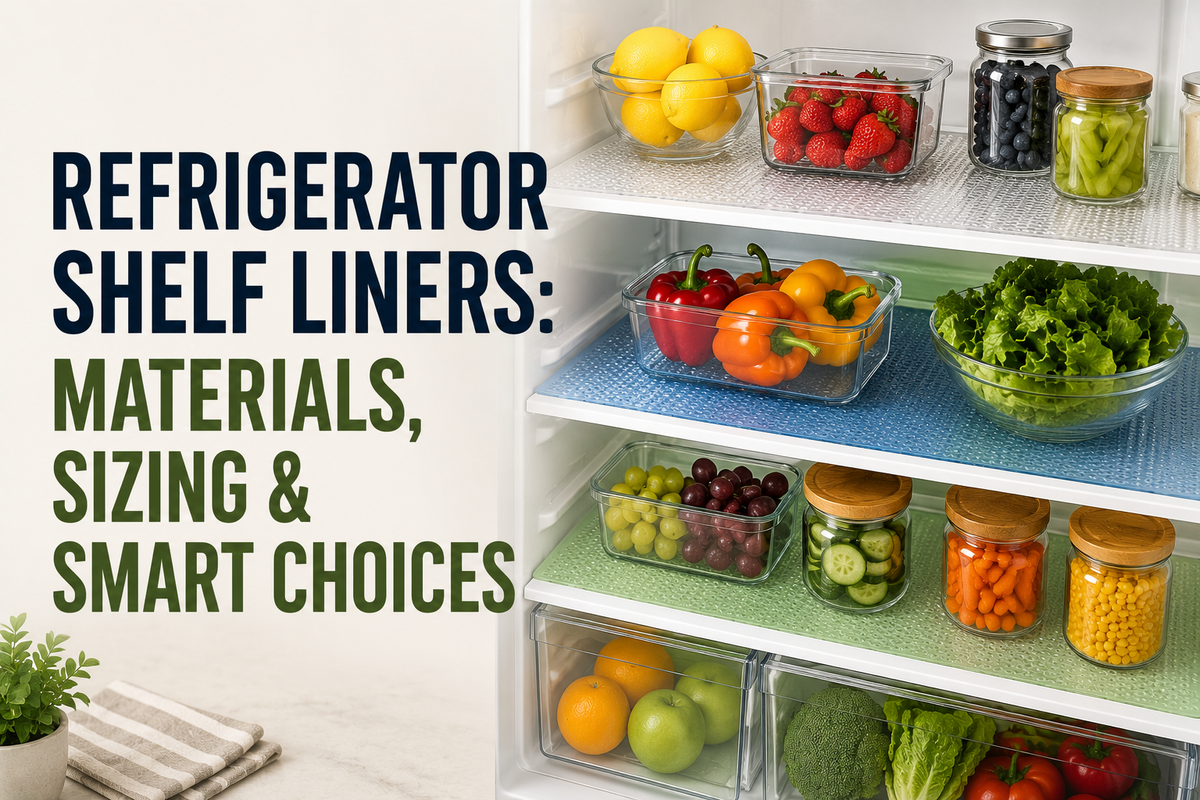
You pull a sticky shelf from the refrigerator and find the source of the problem: a curry jar has leaked, the glass is tacky, and the spill has reached the shelf's front edge. Or perhaps you're moving out of a rental and trying to remove a yellow stain from a plastic drawer before inspection. A liner looks like an easy answer, but the right question isn't whether it looks tidy. It's whether it can handle cold, condensation, food contact, odours, and repeated cleaning without lifting or trapping moisture.
Refrigerator shelf liners are working surfaces, not decorative shelf paper. This guide focuses on the four decisions that matter: material safety, accurate fit, hygiene, and whether a liner is worthwhile for your refrigerator at all. You'll learn when EVA or silicone makes sense, why adhesive products can create problems, how to measure awkward shelves, and when bare glass is the smarter choice.
Table of Contents
- The Sticky Shelf Moment That Starts the Search
- What Refrigerator Shelf Liners Do
- Comparing Liner Materials for Cold and Wet Conditions
- Sizing and Measuring Your Fridge Shelves
- Installing Liners So They Stay Put
- Cleaning and Maintenance That Lasts
- Best Uses for Households, Renters, and Small Businesses
- The Four Questions to Answer Before You Buy
The Sticky Shelf Moment That Starts the Search
Refrigerator shelf liners are often searched for after a spill has dried around a shelf rail or a container has leaked beneath the crisper drawer. The mess is usually small, but the awkward shape of refrigerator shelves makes it unpleasant to clean. Glass shelves can be heavy, plastic edges can collect residue, and fixed shelves leave you reaching around bottles and produce.
A removable liner changes the cleanup surface. Instead of scrubbing the refrigerator shelf immediately, you can lift the liner, wash it, dry it, and return it. That convenience matters most in homes where spills are frequent or where several people open the refrigerator without checking whether lids are secure.
But a liner can also create a new problem. If it curls at the back, slides under a heavy container, or holds condensation against the shelf, it becomes another surface that needs attention. A porous, strongly textured, or poorly fitted liner may retain odours and residue more readily than a smooth bare shelf.
The practical test: A liner earns its place only if it makes cleaning easier than wiping the shelf itself.
The useful buying questions are straightforward. Is the material suitable for food-adjacent use? Will it remain flexible in a cold, wet compartment? Can you cut it without leaving raised edges? Will it come out cleanly when you move, wash, or replace it? If the answer to those questions is no, skip the liner and improve the cleaning routine instead.
What Refrigerator Shelf Liners Do
A refrigerator shelf liner is a removable sheet or mat for a shelf, drawer, or door bin. It places a washable layer between stored food and the refrigerator's original surface. Current Canadian listings commonly show EVA, or ethylene vinyl acetate, in reusable cut-to-fit rolls, including 10, 15, 20, and 25 feet options. The current product listing reflects the shift toward flexible rolls instead of fixed-size mats.
A liner earns its space by handling four specific fridge problems:
- It catches small spills. Drips from berries, sauces, milk cartons, and jars stay on a removable surface instead of spreading across the shelf.
- It protects the original shelf. The liner absorbs some abrasion from sliding containers and helps limit stains.
- It adds controlled grip. Light texture can reduce jar movement when the refrigerator door closes.
- It simplifies washing. Remove the liner and clean it at the sink, rather than emptying and dismantling more of the refrigerator interior.

A liner does not solve every refrigerator problem. A Magnet Shelf Rack for Refrigerator - Kitchen Organizer provides side storage with a tray, middle hook position, and bottom wooden rail. It helps use vertical space, but it cannot protect a shelf from a leaking container.
The liner also doesn't replace cleaning. It will not repair a damaged door gasket, control condensation throughout the appliance, or meaningfully insulate food from cold air. It only manages moisture, residue, and minor spills on the surface beneath it. Poor fit can create edge lift, trapped condensation, and odour transfer, while an unsuitable material raises food-contact concerns.
Use one where spills are frequent and removal makes washing easier. Leave the shelf bare when the liner curls, holds moisture, or adds more maintenance than it removes. Placement and fit matter as much as the material.
Comparing Liner Materials for Cold and Wet Conditions
A refrigerator liner faces conditions that shelf paper in a cupboard does not. Cold temperatures, damp surfaces, repeated wiping, leaking containers, and condensation all test whether the material stays flat and hygienic. Judge each option by cold flexibility, moisture handling, odour retention, and food-contact suitability, not by colour or thickness.
| Material | Cold-flex performance | Moisture handling | Food-contact safety | Best use |
|---|---|---|---|---|
| EVA | Generally flexible and practical for cut-to-fit use | Smooth, waterproof versions resist surface moisture | Prefer products explicitly labelled food-grade or BPA-free | Everyday shelves, drawers, and bins |
| Silicone | Highly flexible and easy to wash | Non-porous when properly made | Prefer documented food-contact suitability | Premium washable mats and high-spill areas |
| PEVA | Often flexible and water-resistant | Usually easy to wipe, but product quality varies | Check the exact product description rather than assuming | Light-duty, budget-friendly protection |
| PVC | Can be firm and stable | Smooth versions wipe clean, textured versions may hold residue | Requires careful review of food-contact claims | Non-food storage or products with clear documentation |
| Textured non-slip polymer | Grip can be useful under jars | Deep texture can retain moisture and residue | Depends entirely on the polymer and finish | Door shelves or areas where containers slide |
EVA is the sensible default for most households. Canadian listings commonly describe food-grade EVA, waterproof construction, and reusable formats, but seller language is not independent performance testing. Treat “food-safe” and “BPA-free” as screening terms. Then check for a smooth, washable surface and clear temperature information. A Canadian refrigerator-mat listing illustrates the details shoppers may see, including a stated range of -30°C to 80°C and pieces near 45 cm by 29 cm.
Silicone is the strongest premium choice when you want a soft, stable mat that can be lifted and washed repeatedly. Use it in a crisper drawer or beneath open containers where spills are common. Its drawbacks are practical: silicone can weigh more and cost more than a thin EVA roll, while a thick mat may reduce shelf clearance.
PEVA sits in the middle. It can work well for light protection, but the label alone does not show whether the liner will remain flat or resist odours. PVC is not my first choice for a food-adjacent shelf when the listing gives no clear compliance information. Decorative paper and fabric liners are poorer choices. Moisture and condensation can stain them, keep them damp, and make sanitising difficult.
Texture also deserves scrutiny. A shallow grip can steady jars, but deep grooves collect liquid, crumbs, and residue. In a cold, wet compartment, a smooth surface is easier to inspect and clean.
For technical screening, look beyond thickness. A food-adjacent liner should use a non-porous polymer such as polypropylene or polyethylene, and a commonly cited technical benchmark is a water-vapour transmission rate at or below 0.5 g/m²/day at 38°C/90% RH. McMaster-Carr's food and beverage shelf-liner selection offers technical context for liners used in food environments. Household listings rarely provide this measurement, so focus on low permeability, a washable finish, and reliable flatness rather than a thick appearance.
For related refrigerator organisation, compare liner placement with advice on choosing produce storage containers for your fridge. Containers and liners should work together without trapping moisture beneath food.
Sizing and Measuring Your Fridge Shelves
A spill has already dried under a shelf liner, and the corners are curling into the cold, damp space. The problem may not be the material. It may be a poor fit. An oversized liner catches on the back wall, presses against shelf rails, and creates channels where condensation and crumbs remain. Measure before shopping, especially with tapered shelves, raised edges, or fixed glass panels.
Measure the usable surface
Empty the shelf completely. Measure the width from the inside edge of one side rail to the inside edge of the other, then measure usable depth from the front edge to the back stop. If the liner must sit inside a raised lip, measure within the lip rather than across it. Record each shelf separately. Refrigerator compartments often differ slightly.
Check the vertical clearance too. A liner can match the shelf footprint and still block a drawer, interfere with lifting the shelf, or reduce space for a tall container below. Leave the rear circulation path clear. A liner pressed tightly against the back wall can interfere with the compartment's cold-air movement and hold moisture against the surface.

Choose the right format
A continuous roll suits shelves with unusual dimensions. Cut separate pieces for shelves, drawers, and door bins, and keep leftover material for replacing a stained section. Canadian listings commonly offer cut-to-fit rolls in 10, 15, 20, and 25-foot formats, giving you more control than a fixed mat.
Pre-cut mats save time and look tidy when the shelf closely matches the listed dimensions. They become awkward around hinge notches, curved fronts, and fixed supports. Use a paper template first, then transfer its outline to the liner. A rectangular mat forced into a shaped compartment will lift sooner and give spills a route underneath.
Remove drawers before tracing their bases when the design allows it. For door bins, measure the bottom at its narrowest usable point and account for the slope. Smooth every cut edge. Jagged corners become lifting points, particularly after the liner cools and contracts.
If you are comparing refrigerator dimensions before buying, this guide to counter-depth 33-inch refrigerators explains how cabinet depth relates to internal layout. Use it to assess the appliance, but measure each shelf directly. A liner is worth the effort only when it fits without blocking airflow, trapping moisture, or creating another cleanup task.
Installing Liners So They Stay Put
A liner fails before the first spill if it goes onto a damp, dirty shelf. Remove the shelf when the refrigerator allows it, wash the surface with mild soapy water, rinse away residue, and dry every corner. Crumbs and condensation prevent a flat fit and can create an odour pocket beneath the liner.
Cut the liner slightly shy of the back and side walls. Do not force it into every edge or try to seal the shelf. Leave enough clearance to lift it out without scraping the compartment. This keeps the layer removable and gives trapped moisture somewhere to escape.
The reliable installation sequence
- Dry-fit the piece. Set it on the shelf before final trimming. Open and close the door, slide drawers, and check that containers do not catch the edges.
- Round the corners. Sharp corners curl first. A small radius removes common lifting points.
- Load from the centre. Place heavier jars and containers near the middle rather than along the perimeter. The weight helps hold the liner flat.
- Use grip selectively. Light texture can steady jars on a door shelf, but deep grooves collect condensation and residue.
- Recheck after chilling. Cold changes flexibility. If an edge rises after the liner cools, trim it instead of adding adhesive.
For produce drawers and bins, confirm the liner will not obstruct vents or interfere with containers. This guide to choosing produce storage containers for your fridge can help you check the available space before you commit to a liner shape.
Adhesive liners are a poor default for removable refrigerator shelves. They may hold firmly at first, then leave residue on glass or plastic and turn replacement into a scraping job. Choose a non-adhesive product unless the manufacturer or liner instructions clearly support adhesive installation.
A curling corner needs removal, cleaning, drying, and a fresh trim. A liner that slides under load needs a slightly shorter cut or a finer-grip surface. If adhesive has left residue, follow the maker's removal instructions and test any cleaner in an inconspicuous area first.
For a nearby kitchen task involving heat and grip, HOME AESTHETICS HA-4122 Neoprene Oven Mitts 2pc is a separate product category, described as heat resistant up to 500°F with a non-slip grip. It is not a refrigerator accessory, so its material claims do not demonstrate shelf-liner performance.
Cleaning and Maintenance That Lasts
A liner earns its place only when it reduces cleanup without hiding moisture. Wipe spills promptly. Lift the sheet as soon as liquid or residue reaches its underside. For EVA or silicone, use mild dish soap, warm water, and a soft cloth. Skip abrasive pads, which can roughen the surface and give residue more places to cling.
A simple care rhythm
- After a spill: Remove the liner, rinse off food residue, wash it with mild soap, and dry both sides before replacing it.
- During regular fridge cleaning: Lift every piece and inspect the shelf beneath it for trapped moisture.
- After washing: Let the liner dry completely. Never return a damp sheet to a cold shelf.
- When odour persists: Wash it again, then replace it if the smell remains.
The hidden failure is moisture underneath. A liner pressed against a damp shelf can hold condensation, creating a reservoir for odours and residue. Choose a sheet with a stable fit and a surface that cleans easily. Thickness alone does not solve moisture retention or edge lift.

Check condensation points, corners, and the areas beneath produce containers during each cleaning. Replace a liner with persistent odour, deep discolouration, damaged edges, or a shape that no longer lies flat. Rewashing cannot fix material that has begun holding smells or curling into the shelf.
For broader context on damp, contaminated appliance areas, Aquastar Cleaning Services Kennesaw advice reinforces the same practical rule: do not leave moisture hidden beneath a removable surface.
Use the same wash-and-dry routine for cleaning food storage containers. Containers and liners both become odour sources when people clean only the visible side and ignore trapped moisture. If a liner adds another damp surface to manage, remove it and use the bare shelf instead.
Best Uses for Households, Renters, and Small Businesses
A refrigerator shelf liner earns its place when spills, moisture, or awkward shelf access create a recurring cleanup problem. Families with young children, frequent snack spills, or crowded shelves benefit from removable coverage. Renters may also want protection during a tenancy, but only if the liner lifts cleanly and does not hide condensation or existing shelf damage.
Small businesses, office pantries, short-term rentals, and shared staff refrigerators can use liners to standardise cleaning. A smooth, washable, food-contact-suitable surface gives cleaners a clear routine for inspecting and wiping shelves. It does not replace sanitation, and it can create another damp surface if staff leave spills underneath.
A careful single-person household with smooth glass shelves and few leaks may be better off with bare shelves. Glass usually wipes clean quickly, while a liner adds removal, washing, drying, and refitting. Buy one for a defined problem, not because it makes the refrigerator look more organised.
Liners also cannot compensate for poor storage. Keep wet foods in sealed containers, contain raw items, and leave enough space to spot leaks. If the problem is access or container organisation, a Fridgestore large storage option may help more than shelf coverage. Use organising your fridge with bins and zones to make contents visible and reduce forgotten spills.

Before buying, check:
- Food-contact suitability: Choose explicit food-grade or food-contact wording.
- Cold flexibility: Look for stated low-temperature performance, not a vague “all-purpose” label.
- Low moisture retention: Select a smooth, non-porous surface without deep grooves that collect condensation.
- Non-adhesive construction: Removable sheets are easier to wash, dry, and replace.
- Accurate fit: Measure width, depth, edges, and clearance.
The practical verdict is simple. Use a liner where it reduces repeated cleanup or protects a difficult-to-replace surface. Keep the shelf bare where the liner would only add another chore.
The Four Questions to Answer Before You Buy
Start with the shelf itself. If spills are rare and glass wipes clean, leave it bare. A liner earns its place when moisture, odor transfer, or repeated spills create a recurring cleanup problem. It should reduce work, not add another surface to wash.
Which material fits your routine? Choose smooth, food-grade EVA for cut-to-fit coverage or silicone for a softer mat. Reject products that avoid clear answers about food contact, cold flexibility, or washing. In a damp refrigerator, deep grooves can hold condensation, so favor a smooth, non-porous surface.
Do you need a roll or pre-cut pieces? Pick a roll for unusual shelves, drawers, and door bins. Choose pre-cut mats when the dimensions already match and you want faster installation. Measure width, depth, edges, and clearance before ordering. A poor fit invites edge lift and trapped moisture.
Can you remove and replace it easily? Avoid adhesive that leaves residue on glass. The right liner lifts out, washes clean, dries quickly, and returns flat. If it curls, shifts, or holds odors, it has failed its job.
For commercial or shared refrigerators, review commercial food storage containers with the liner choice. Storage containers control leaks and odor transfer; the liner only protects the shelf and simplifies cleanup.
The verdict is direct: buy refrigerator shelf liners for recurring messes or vulnerable shelves, and skip them when bare glass is easier to clean.
GrifGlo offers guidance on fridge organisation, storage tools, sizing, and kitchen essentials. Visit GrifGlo to compare options by fit, material, and use.


Laisser un commentaire
Ce site est protégé par hCaptcha, et la Politique de confidentialité et les Conditions de service de hCaptcha s’appliquent.