

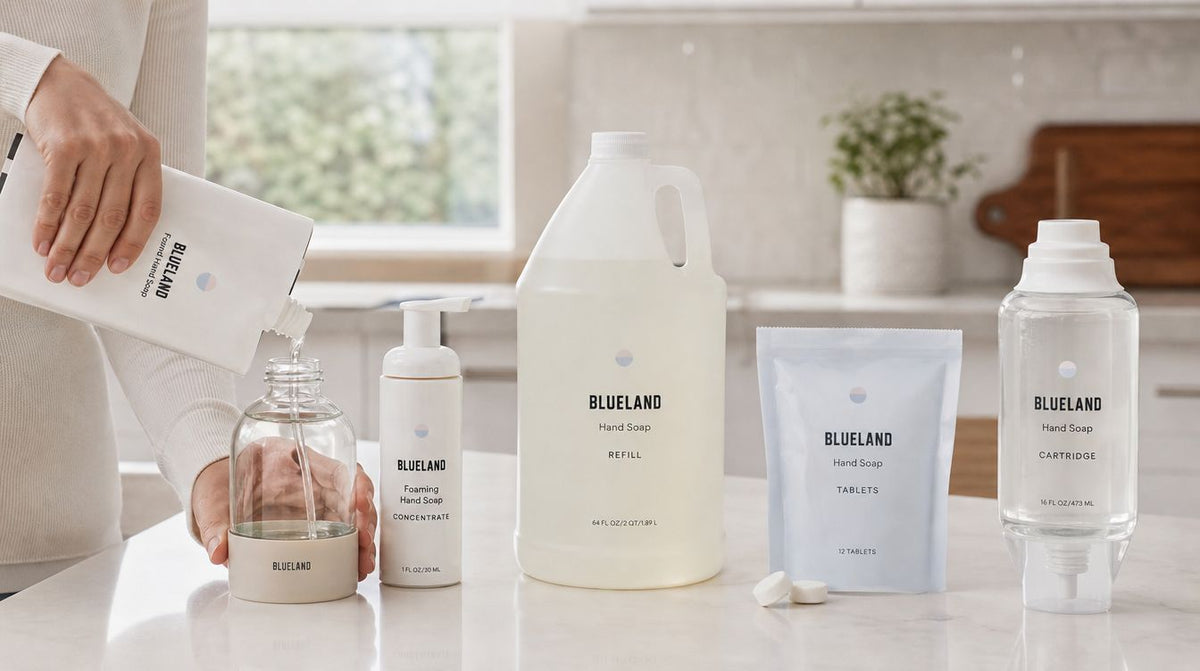
You're standing in the cleaning aisle with a nearly empty soap dispenser at home or a restroom dispenser at work. One option is a single-use bottle, another is a foaming cartridge, a third is a bulk jug, and a fourth promises low-waste tablets. The package on the eye-level shelf looks convenient, but convenience disappears when the refill doesn't fit the pump, the container is too large to store, or the dispenser starts leaking.
The right soap dispenser refill is a packaging and hardware decision before it's a soap decision. You need a refill that matches the dispenser mechanism, delivers a sensible cost per use, meets the needs of the people using it, and can be stored and reordered without creating a new problem. The shortcut below is designed for that real-world decision, not for browsing a list of attractive bottles. If you're building a broader purchasing habit, the decision-making framework is a useful companion for evaluating products consistently.
Table of Contents
- The Refill Decision Most Shoppers Get Wrong
- Refill Formats and How Each Dispenser Actually Works
- Cost, Sustainability, and Reliability Compared
- Sizing and Supply Planning for Home or Business
- Refilling Without Clogs, Leaks, or Residue
- What to Check on the Label Before You Buy
- Subscriptions and Bulk Buying Through Trusted Retailers
- A Repeatable Rule for Every Future Refill
The Refill Decision Most Shoppers Get Wrong
The mistake happens before anyone reads the ingredients. A shopper sees a pouch labelled “refill,” assumes it should work with any pump, and buys it because the package appears to contain more soap for less packaging. At home, the pouch turns out to be intended for a proprietary dispenser, while the existing pump accepts only a standard bottle neck. The refill may be a good product, but it's the wrong component for that system.
A different shopper chooses a bulk jug for a small household. The unit price looks attractive, yet the container occupies valuable under-sink space and takes too long to use. Another chooses a foaming refill for a conventional liquid pump, then blames the soap when the pump delivers weak, watery output. In each case, the buyer selected by format and shelf appearance, not by dispenser compatibility.
Practical rule: Identify the pump mechanism first. Select the soap format second.
Treat every refill purchase as a small operations decision. The system has an input, a dispensing mechanism, a cleaning routine, a storage requirement, and a reorder point. A low-waste pouch that cannot connect cleanly is not an efficient purchase. A concentrate that requires dilution but has no clear ratio is not automatically economical. A cartridge that fits perfectly may still create more packaging than a controlled bulk system.
The four questions to answer in the aisle
Ask these questions before comparing scents or eco badges:
- What does the dispenser accept? Look for a cartridge slot, open reservoir, standard bottle thread, foaming mesh pump, or solid-refill chamber.
- Does the refill need dilution? Concentrates and tablets require a controlled mixing process. Ready-to-use liquid does not.
- Can the container be stored and handled cleanly? A large jug is only useful if staff or household members can pour it without spills.
- What happens at the next reorder? A refill program fails when the replacement format is unavailable or the buyer forgets which dispenser version is installed.
That's why “universal refill” should never be accepted at face value. Universal may describe the bottle opening, not the pump's viscosity tolerance, nozzle design, or dilution reservoir. The reliable purchase is the one that matches the whole dispensing path.
Refill Formats and How Each Dispenser Actually Works
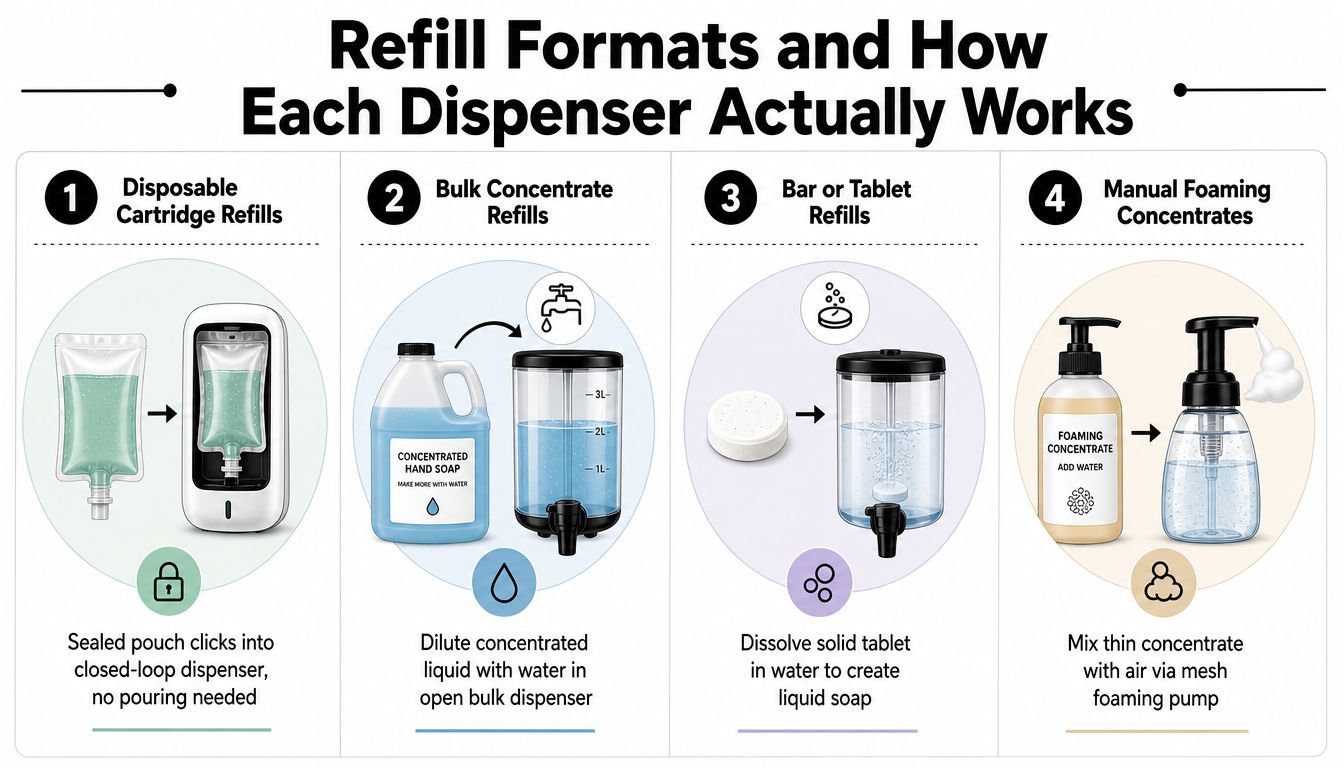
Refill formats look similar on a shelf, but they behave differently once they reach the pump. Disposable cartridge refills use a sealed pouch or bottle that clicks into a closed-loop dispenser. The dispenser is designed around that cartridge's shape, connector, nozzle and pump stroke, so pouring the contents into another container can defeat the system.
Bulk concentrate refills are intended for an open reservoir or a mixing bottle. The buyer adds water according to the manufacturer's instructions, then uses a liquid pump with an aperture designed for the resulting viscosity. This format can reduce container turnover, but it demands accurate mixing and a clean transfer process.
Four mechanisms, four buying decisions
Bar or tablet refills change the system entirely. A solid product is dissolved or processed with water inside a compatible dispenser, rather than pumped straight from a liquid bottle. These systems can reduce the need for repeated liquid containers, but they require a dispenser designed to hold and release the solid format.
Manual foaming concentrates depend on a thin liquid and a foaming pump. The mesh or air-mixing chamber combines liquid with air during the pump stroke. A regular liquid soap can be too thick for that mesh, while a foaming mixture in a standard pump can produce poor output and leave residue.
The pump matters more than the marketing name. Pump stroke length, nozzle aperture, dip-tube design and reservoir geometry determine whether a refill dispenses smoothly. A small mismatch can produce drips, air-only pumping, weak foam or a pump that sticks.
CalRecycle's source-reduction work evaluates refill and dispensing formats alongside single-use alternatives, including refill approaches for dish soap and surface cleaner in its material-management publication. That comparison supports a useful principle: a refill bottle placed in the bin still represents packaging waste. The reduction comes from the complete system, including container turnover, refill concentration and controlled dispensing.
Even an unrelated storage item can illustrate the same systems thinking. The Automatic Egg Dispenser Rack – Rolling Storage Holder uses a gravity-fed, inclined track to dispense eggs one at a time, with a two-tier footprint and an anti-slip bottom. The point isn't that it belongs beside soap. It's that good household equipment works because the storage and dispensing mechanism are designed together.
Cost, Sustainability, and Reliability Compared
The cheapest-looking refill often isn't the cheapest way to wash hands. A Canadian pricing example puts a 1.5-litre Softsoap or Dial refill at about $12 CAD, or roughly $0.80 CAD per 100 mL, while a 295 mL foaming bottle at about $8 CAD works out to about $2.70 CAD per 100 mL. Those figures come from the Canadian hand-soap comparison, and they show why buyers should normalise price by delivered soap volume rather than compare shelf prices.
The foaming bottle may still be the right choice for a small sink, a compact dispenser or a user who values the foam experience. It shouldn't be called economical without accounting for its higher unit cost. Concentrates and tablets can change the equation, but only when the finished volume, dilution accuracy and usable output are clear.
| Format | Approx. Cost per mL of Use | Primary Packaging Avoided | Reliability Notes |
|---|---|---|---|
| Disposable cartridge refill | Varies by proprietary system | Replaces a full dispenser cartridge rather than a new dispenser | Usually reliable when the cartridge, connector and dispenser version match |
| Bulk concentrate refill | Can be economical after dilution | Can reduce repeated ready-to-use bottle turnover | Depends on correct dilution, clean pouring and reservoir compatibility |
| Bar or tablet refill | Must be calculated from finished usable volume | Can avoid repeated liquid packaging | Requires the correct solid-refill chamber and complete dissolution |
| Manual foaming concentrate | A Canadian foaming example is about $2.70 per 100 mL, based on the cited retail comparison | Can reduce liquid volume used per pump, depending on the system | Sensitive to mesh clogging, viscosity and residue |
Which option wins each axis
Cost: Bulk concentrate usually deserves the first calculation, especially for an office or busy household. The Canadian comparison makes the case against assuming that a smaller foaming bottle costs less.
Packaging reduction: Concentrate, tablet and cartridge systems can reduce packaging intensity, but the result depends on the refill container and how often it is discarded. California's waste-analysis work treats refill dispensing as a distinct material-management model rather than assuming every refill is automatically low-waste.
Reliability: A matched cartridge is often the least troublesome because the hardware and refill are designed together. An open bulk system offers flexibility, but it also creates more opportunities for contamination, overfilling and viscosity mistakes.
For a small business, the right choice should fit the maintenance routine, not just the purchasing spreadsheet. A workplace that tracks supplies alongside other facility needs can use the commercial cleaning supplies guide as a broader purchasing reference. For home clean-up around the sink, a BLACK+DECKER DUSTBUSTER HLVC320J01 AdvancedClean™ Slim Cordless Hand Vacuum is a separate example of matching equipment to a specific task, with an extra-wide nozzle and a removable dustbin described in the product snapshot. It doesn't solve refill compatibility, but it reinforces the same buying discipline: judge the mechanism, not the headline.
Sizing and Supply Planning for Home or Business
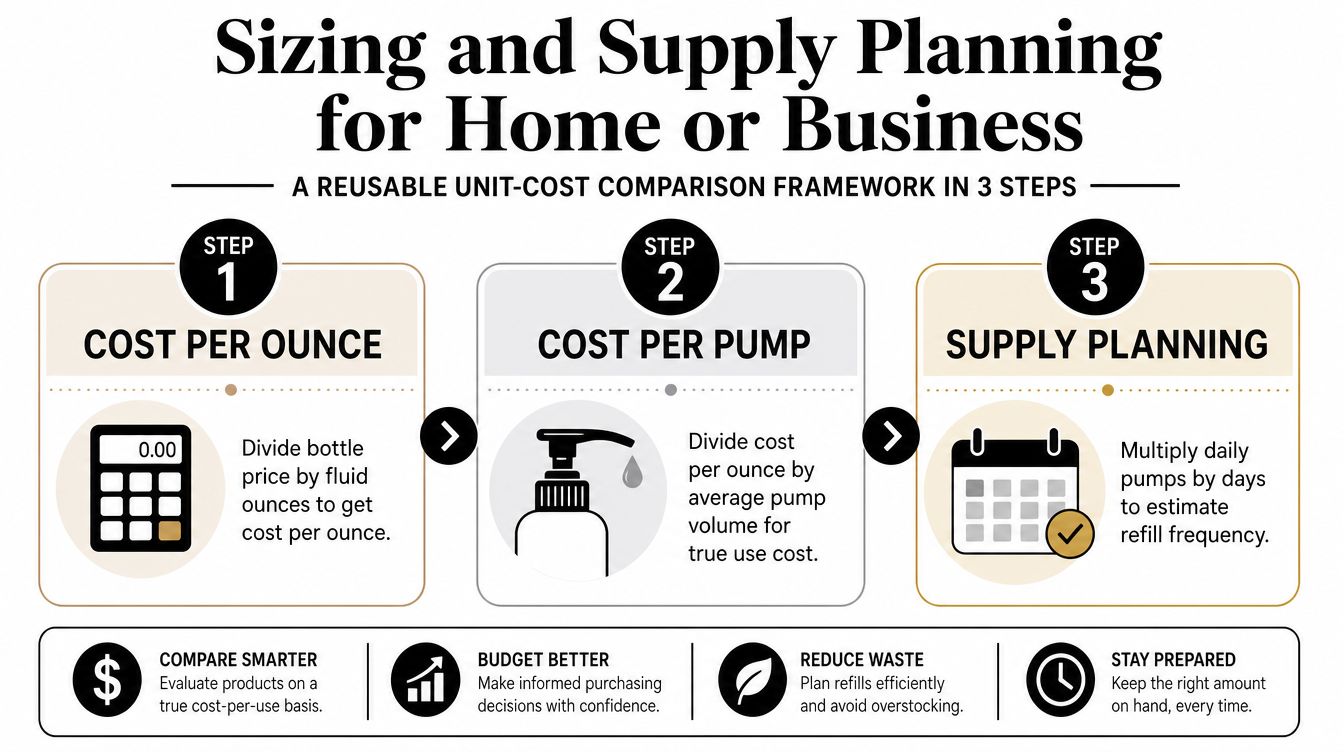
A refill program becomes easier once you stop buying by bottle shape and start buying by pump count and refill interval. Use this formula whenever you compare products:
- Divide the listed price by the container's fluid ounces to find cost per fluid ounce.
- Convert that amount to a cost per millilitre if you're comparing products sold in different units.
- Divide the finished refill cost by the estimated number of usable pumps.
- Multiply daily pumps by the number of days you want the container to last.
The planning figures supplied for this guide use an average pump output of roughly 0.5 mL for liquid and 0.7 mL for foam, and a 32-ounce refill covering roughly 1,900 pumps. Treat those as planning assumptions, not promises. Pump output varies with the dispenser, how far users press the pump and whether the formula is liquid or foaming.
Match volume to the place of use
For a household of three washing hands six to eight times daily, the cited planning model suggests that a 32-ounce refill can cover roughly a month. A workplace with 40 people and about 30 uses per person needs a much faster replenishment cycle, so a single household-size bottle is a poor operating choice even if its unit price appears attractive.
Those office figures are planning scenarios supplied for this guide, not universal usage data. The correct approach is to observe your own dispenser for a week, record how often it's pumped, and then choose a container that gives you a manageable reorder interval.
Buy to the refill interval, not the jug size. A container is too small if it creates emergency orders, and too large if it sits open long enough to collect residue or becomes difficult to handle.
Storage also matters. Bulk buyers should reserve a clean, dry area away from heat and direct sunlight, label opened containers, and set a reorder point before the final container is opened. Businesses can apply the same spatial discipline used for commercial food storage containers, keeping supplies organised without blocking access or mixing incompatible products.
Refilling Without Clogs, Leaks, or Residue
Most refill failures come from switching formats without cleaning the hardware. Foaming soap poured into a liquid dispenser can clog the foaming mesh, while thick liquid soap placed in a foamer may produce flat foam and leave residue on the stem. A pump that leaks is often signalling a mismatch or dried product, not a mysterious defect.
Use this routine whenever you change formula or refill type:
- Empty the reservoir completely. Don't top up old soap with new soap. The remaining product can alter viscosity and carry residue into the pump.
- Flush the pump with warm water. Run warm water through the reservoir, dip tube and nozzle for several cycles until the output is clear.
- Inspect the label and hardware together. Confirm that the product is designed for liquid, foam, cartridge or solid dispensing. Check the stated dilution ratio before adding water.
- Wipe the threads and collar. Dried soap around the bottle neck can prevent a proper seal and cause slow leaks.
- Refill and prime slowly. Pump until air clears and the output becomes consistent. Fast pumping can create splashing and make it harder to identify a seal problem.
Use viscosity as a compatibility check
The plan for this guide identifies a typical liquid viscosity range of 1 to 100 cP, with foaming concentrates lower than that range. Treat viscosity information as a technical check, not a decorative specification. If the label doesn't provide a range, use the dispenser maker's compatibility guidance and avoid assuming that a similar-looking product will behave the same way.
Don't dilute concentrate beyond the maker's stated ratio. Too much water can weaken performance and change the way the pump primes, while too little can overload the nozzle or foaming mesh. A Canadian refill FAQ gives one part soap to four parts water as an example mix while also warning that the ideal ratio isn't exact, so start with the product's own instructions rather than copying a generic recipe.
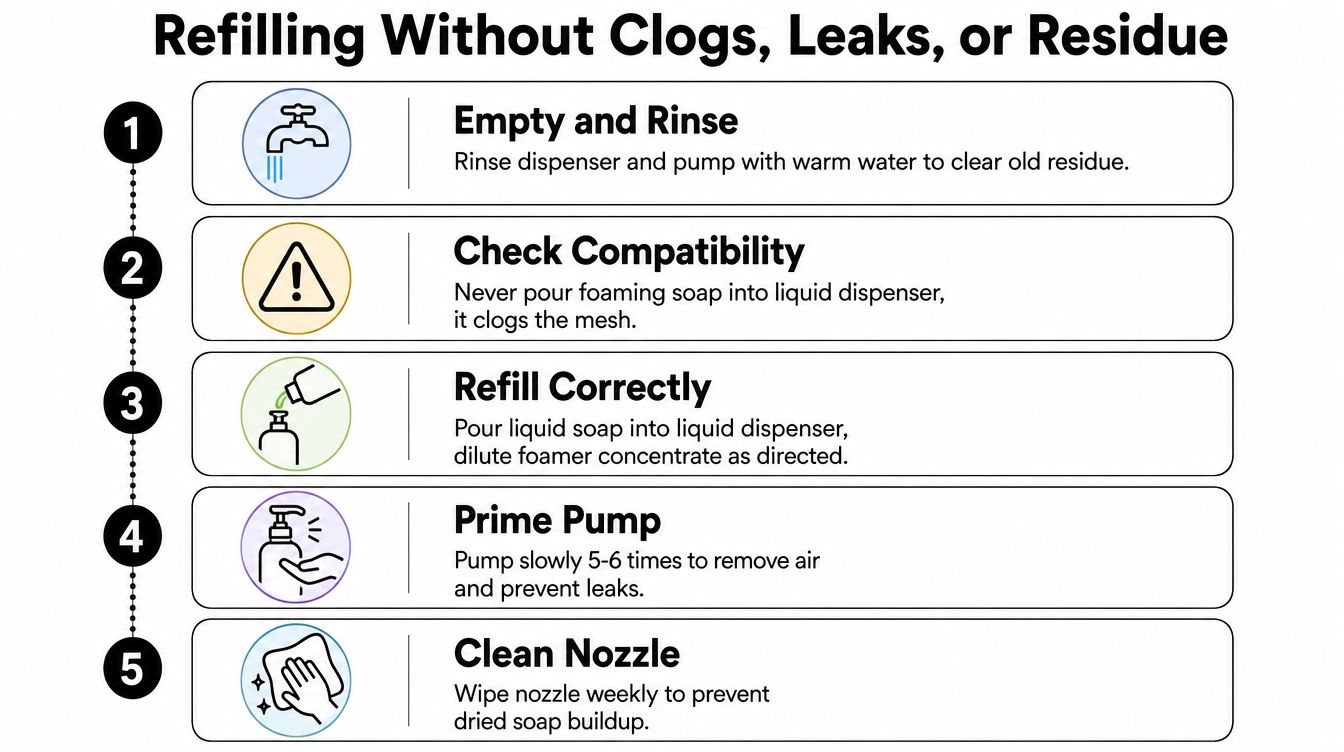
Wipe the nozzle regularly so dried droplets don't narrow the opening. For a deeper clean, disassemble the nozzle and removable pump parts quarterly, soak them in warm water with a drop of dish soap, rinse thoroughly and let them air-dry before reassembly. That routine helps prevent the sticky residue that causes pumps to drip or remain depressed.
A visual demonstration can help you identify the difference between an airlock, a clogged nozzle and a failed seal:
What to Check on the Label Before You Buy
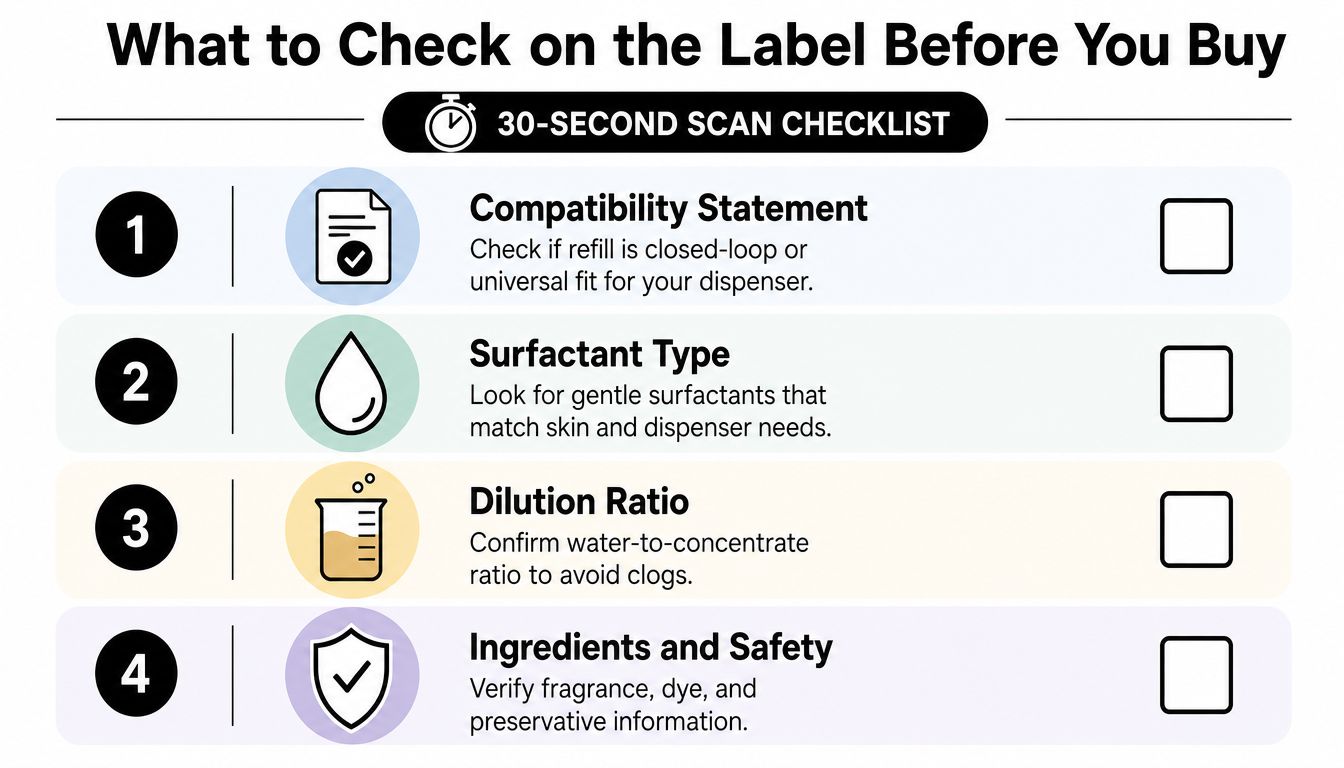
A refill label should answer four questions in about 30 seconds. Ignore the large fragrance image until you've checked the technical information. A pleasant scent won't fix a cartridge that doesn't connect or a concentrate that clogs the pump.
The scan that prevents expensive mistakes
Compatibility statement: Look for wording such as closed-loop, proprietary cartridge, universal fit, foaming dispenser or liquid pump. If a product claims compatibility, confirm whether that means the refill connects directly or can merely be poured into an open reservoir.
Surfactant information: Plant-based surfactants such as decyl glucoside may appeal to buyers seeking a particular formulation, while SLS or SLES may appear in conventional products. The important question is whether the formula suits the user's skin needs and the dispenser's design. Dish and hand soaps aren't interchangeable by default. Enzymatic dish detergents can irritate skin and may be unsuitable for a hand-soap pump.
Dilution ratio: A concentrate without clear mixing instructions belongs on the shelf, not in your procurement cart. Confirm the water-to-concentrate ratio, whether the water should be warm or room temperature, and whether the finished product can be stored in the dispenser.
Ingredients and safety: Check fragrance, dye and preservative disclosures if sensitive users will rely on the dispenser. Businesses should also request safety documentation and confirm that the formula is appropriate for the intended setting.
California's regulatory framework shows why labels deserve this attention. California Health and Safety Code Section 113953.4 requires hand antiseptic soap used in food-service settings to meet specified FDA or monograph-based safety requirements. It also addresses hand antiseptic solution used as a hand dip, including maintenance at a strength equivalent to at least 100 mg/l chlorine. California's Air Resources Board has also established a 1% VOC standard for heavy-duty hand cleaner or soap, nonaerosol, sold after December 31, 2013, and prohibited certain alkylphenol ethoxylate surfactants after that date. These are compliance considerations for regulated operations, not a reason to treat every household refill as a chemical audit.
Subscriptions and Bulk Buying Through Trusted Retailers
A subscription only saves effort when the product, format and timing remain stable. Set the cadence from your observed pump use and refill interval, then subscribe only if the same dispenser will continue using the same refill. A locked subscription can become a nuisance when a hardware upgrade changes the cartridge design or when a household switches from liquid to foam.
Retailer type matters because each channel solves a different problem.
| Retailer Type | Bulk Threshold | Subscription Discount | Format Availability | Trust Signal |
|---|---|---|---|---|
| National grocer | Often suited to individual bottles or smaller refill purchases | May be available on selected household products | Broad consumer selection, but compatibility details can be limited | Clear product pages, returns and consistent local stock |
| Janitorial distributor | Usually structured around cases or commercial quantities | May use account-based pricing rather than household subscriptions | Stronger selection of cartridges, dispensers and institutional refills | Published SDS sheets, lot information and compatibility documents |
| Direct-to-consumer brand | Often tied to the brand's own dispenser system | Commonly offers recurring delivery | Focused format range, sometimes proprietary | Transparent refill instructions, ingredient disclosure and damage policy |
| Bulk retailer | May require a minimum case or mixed order | Subscription terms vary | Larger containers and concentrates are more common | Visible shipping terms, container details and product documentation |
What to verify before committing
Ask whether the advertised bulk price applies to one container or a minimum case. Confirm shipping damage procedures before ordering liquids, and check whether the retailer can provide documentation for proprietary dispensers. A supplier that won't explain which cartridge fits which hardware version is not ready to support a workplace program.
Look for published safety data sheets, lot traceability, ingredient disclosures and clear packaging claims. California's compliance environment makes chemical transparency especially relevant for organisations operating there, but the same documentation helps any buyer compare products responsibly.
Canadian institutional purchasing illustrates why hardware changes matter. The University of Waterloo's 2024/2026 dispenser refill catalogue lists separate refill SKUs for older and newer foam dispensers, showing that a building can need different products after a dispenser update. That's a strong argument for recording the dispenser model and refill code at the point of installation.
For broader sourcing, a wholesale kitchen supplies guide can help buyers think about case quantities and supplier structure. The retailer you trust is the one that stays in stock, explains compatibility, handles damaged deliveries fairly and doesn't force you into a format you can no longer use.
A Repeatable Rule for Every Future Refill
Use one four-step rule at the shelf or checkout page.
First, match the mechanism. Identify whether your dispenser is a standard liquid pump, foaming pump, closed cartridge, open bulk reservoir or solid-refill system. Confirm the nozzle, neck, cartridge connector and viscosity requirements. If the refill doesn't clearly match, stop there.
Second, calculate the use cost. Divide price by finished volume, then estimate the cost per pump using the dispenser's actual output or the planning assumptions provided earlier. Compare like with like. A small foaming bottle shouldn't be judged against a bulk liquid jug by sticker price alone.
Third, scan the label. Check compatibility, surfactant type, dilution instructions, fragrance and dye disclosures, and any relevant safety or environmental documentation. For commercial operations, review the regulatory fit rather than relying on an eco badge or a front-of-pack claim.
Fourth, order for the interval. Choose enough product to avoid emergency purchases, but don't stockpile containers that your household or office can't store and use cleanly. Subscribe only when the dispenser, refill format and consumption pattern are predictable.
This rule would have prevented the opening aisle mistakes. The shopper would have rejected the cartridge that didn't fit, avoided the oversized jug, and tested the bar adapter for leakage before committing. They'd leave with a compatible format, a defensible cost per use, a label that meets their requirements and a supply plan that won't run dry.
For offices and hospitality teams, standardising compatible products is easier when purchasing records capture the dispenser model, refill format and reorder point. The product standardisation guide offers a useful way to turn that information into a repeatable buying system instead of relying on memory.
GrifGlo organises practical household and business essentials with decision-friendly guides, comparisons and sizing advice, including considerations that matter for soap dispenser refill systems. Visit GrifGlo to compare fit-for-purpose products and build a more reliable purchasing routine.

Laisser un commentaire
Ce site est protégé par hCaptcha, et la Politique de confidentialité et les Conditions de service de hCaptcha s’appliquent.