

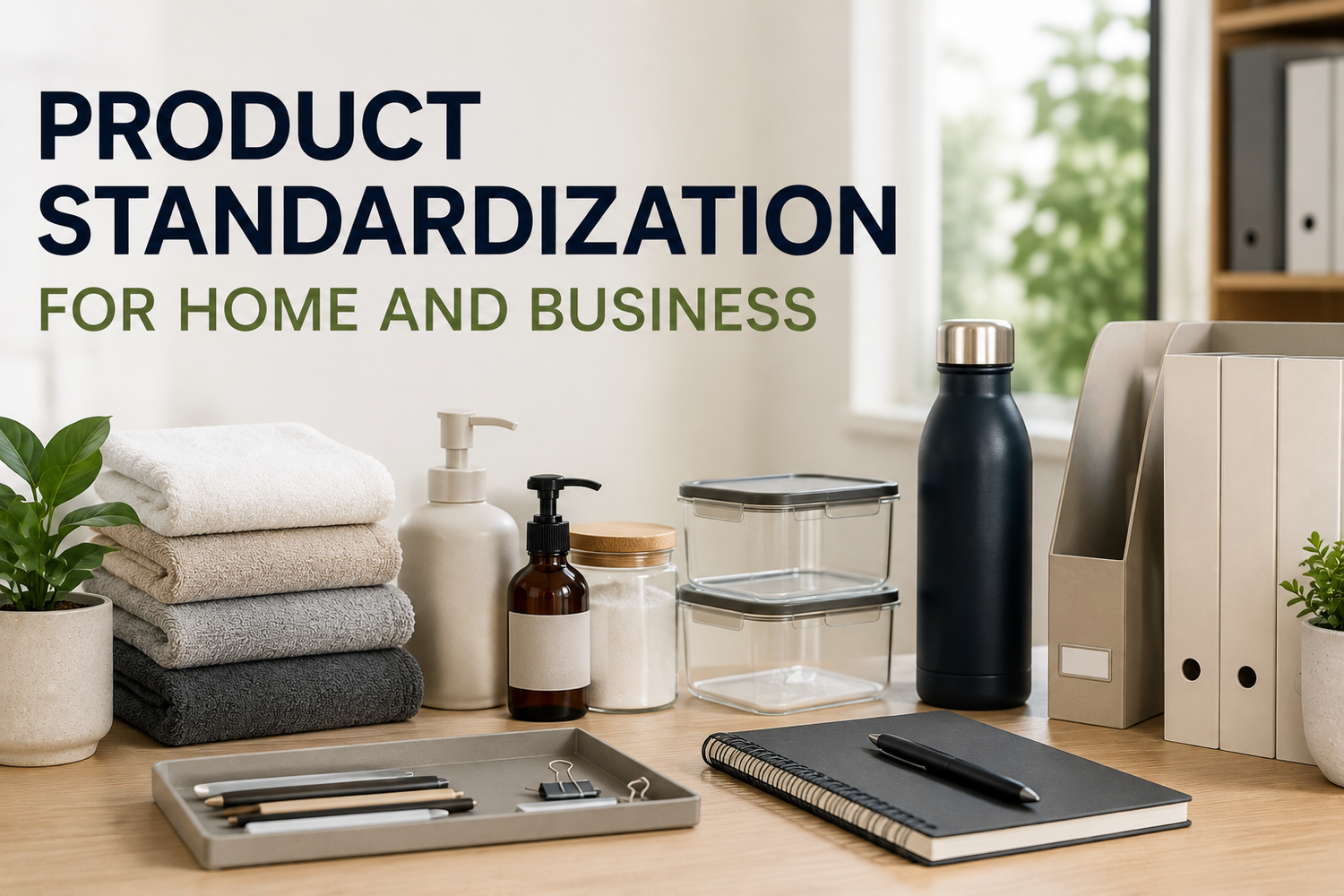
A drawer full of food containers rarely stays organised for long. One lid fits only one base, three jar shapes compete for the same pantry shelf, and the office kitchen has a different kettle in every department. When someone needs a replacement, they must start the buying decision again, check compatibility again, and hope the new item won't create another exception.
That pattern appears in homes, offices, rental properties, hospitality spaces, and purchasing departments. Product standardization replaces repeated guesswork with shared rules for the physical item, its information, its suppliers, and the way those rules are maintained. The result isn't a home or business where every object looks identical. It's a system where common needs have clear, repeatable answers.
Table of Contents
- Why Everyday Purchasing Becomes Harder Without Shared Rules
- Understanding Product Standardization and Its Core Idea
- The Essential Parts of a Product Standardization System
- A Practical Framework for Implementing Product Standardization
- Product Standardization Examples for Home and Business
- Measuring Performance and Governing Product Standards
- Common Misconceptions and Product Standardization Mistakes
- A Clear Starting Plan for Better Purchasing Decisions
Why Everyday Purchasing Becomes Harder Without Shared Rules
A kitchen drawer with three different sizes of glass food containers creates more than visual clutter. Each lid needs a matching base, each stack takes a different amount of space, and a missing lid can make an otherwise useful container impractical. In the pantry, jars with narrow, wide, and irregular openings prevent shelves from working as a coordinated storage system.
The same problem appears in a workplace. One department buys a compact kettle, another chooses a larger model, and a third orders a different brand because its preferred supplier had stock. Nobody has necessarily made a bad choice. The organisation has allowed every purchase to become an isolated decision.

The hidden cost of repeated decisions
Without shared rules, people spend time comparing products that perform the same basic role. They also accept inconsistent quality because the purchasing process gives them no agreed definition of acceptable materials, dimensions, capacity, or performance.
The costs show up in ordinary work:
- Reordering takes longer: Staff must search old invoices, ask colleagues, or identify an item from a photograph.
- Storage becomes inefficient: Different footprints leave unused gaps in drawers, shelves, refrigerators, and supply rooms.
- Quality varies: One purchase may be durable and easy to clean, while the next is difficult to use or replace.
- Training becomes harder: People must learn different controls, parts, or handling instructions for similar products.
- Supplier management fragments: Buyers deal with more product records, more exceptions, and more opportunities for catalogue errors.
The underlying issue isn't poor taste. It's the absence of a decision rule. A household can agree that food storage containers should share a compatible footprint. A business can decide that shared kitchen appliances must meet the same dimensional and electrical requirements. Once that rule exists, the next purchase becomes a check against a known standard instead of a fresh debate.
Understanding Product Standardization and Its Core Idea
Product standardization means agreeing on common specifications, sizes, information fields, and supplier requirements for products bought or used repeatedly. Those rules can cover a container's footprint, a kettle's capacity and wattage, a pan's lid compatibility, or the product attributes a supplier must provide before an item enters a catalogue.
Standardization doesn't require strict sameness. It creates a shared basis for choosing products that work together. Two approved food containers may come from different suppliers, but they should still meet the agreed dimensions, material requirements, and closure expectations. A home may allow several colours, while a workplace may limit colour choices to simplify replacement and presentation.
A simple compatibility analogy
Think of a modular shelf system. The useful rule isn't “buy the exact same box forever.” The rule might be that every approved box fits a shared footprint, accepts the same label position, and stacks safely within the shelf height. That one set of specifications allows different products to serve different uses without turning the cupboard into a collection of incompatible parts.
This distinction matters for households and organisations. A standard can preserve choice where choice adds value, while removing variation that creates friction. A household might standardize container footprints but keep separate requirements for freezer storage and dry goods. A property manager might approve two kettle models, provided both meet the same footprint, safety, and replacement criteria.

The information layer matters as much as the physical item. Unify product information with this guide to see why consistent names, attributes, images, and categories help different teams work from the same product record. That principle applies to a pantry shelf, a purchasing spreadsheet, and a multi-channel catalogue.
For example, AS SEEN ON TV 8-Piece Green Fresh Food Bags - 80426 can be evaluated using defined fields such as reusable storage design, wide-seal zipper closure, and its stated function of absorbing ethylene gases. A buyer can then compare those fields with the requirements for a food-storage category rather than relying only on packaging language. The same structured thinking helps when choosing smart home devices in Canada, where compatibility, setup, and replacement considerations may matter alongside features.
The Essential Parts of a Product Standardization System
A workable system has more than an approved product list. It connects the physical specification to supplier decisions, product information, and a person responsible for keeping the rule useful.
| Component | What It Covers | Role in the System |
|---|---|---|
| Written specifications | Dimensions, materials, capacity, performance, and tolerances | Defines what an acceptable product must do |
| Sizing rules | Footprints, diameters, openings, clearances, and fit relationships | Makes products compatible with spaces and accessories |
| Supplier criteria | Quality, lead time, certifications, service, and price bands | Controls how approved products enter the system |
| Product data | Names, attributes, images, documentation, and identifiers | Keeps purchasing and replenishment records consistent |
| Governance | Ownership, review dates, exceptions, and update triggers | Prevents the standard from becoming obsolete |
Start with the physical relationship
A cookware standard might define lid diameters across a frypan, sauté pan, and stockpot. A pantry standard might specify jar openings, stackable footprints, and label zones. A small-appliance standard could include maximum footprint, cord storage expectations, colour, and electrical requirements.
The point isn't to measure everything for its own sake. Measure the relationships that affect use. A container that fits the shelf but can't accept the approved lid still creates a broken system.
Add supplier and information controls
Supplier criteria should answer practical questions. Can the supplier provide the required material documentation? Can it maintain consistent dimensions across replenishment orders? Does it offer dependable lead times and clear packaging information? If a supplier changes the product, who reviews the change?
Product data makes those decisions repeatable. A shared catalogue should record the approved name, category, dimensions, material, capacity, supplier, replacement item, and status. For Canadian organisations, GS1 Canada describes Item Centre as a source of standardized, bilingual product content with continually cleansed data and industry-directed attributes, supporting more consistent item records across trading partners. GS1 Canada's Item Centre information is particularly relevant when many suppliers and sales channels use the same catalogue.
Governance closes the loop. A standard needs an owner, a review routine, and a way to record approved exceptions. Without those controls, staff will keep adding one-off items until the original rule becomes difficult to recognise. For storage decisions, a practical comparison of airtight, stackable, and modular pantry containers can help separate the use case from the product label.
A Practical Framework for Implementing Product Standardization
Product standardization works best when the first rollout is small enough to learn from. A household doesn't need to reorganise every cupboard at once, and a business shouldn't rewrite its entire catalogue before testing one category.

Step 1, inventory what already exists
List the current products in one category. Record dimensions, materials, capacities, suppliers, replacement parts, and the problems users experience. In a kitchen, the pain point might be lids that don't interchange. In an office, it might be toner cartridges that require different ordering processes.
Mark duplicates and exceptions rather than deleting them immediately. An old product may still be needed until stock is used, a contract ends, or a compatible replacement is approved.
Step 2, choose the category and assign authority
Select a category with frequent purchasing, visible inconsistency, or a high cost of failure. Define the scope clearly. “Food storage” may be too broad for a first project, while “dry-goods containers for the shared pantry” gives the owner a manageable boundary.
Assign one owner with decision rights. Users should contribute practical feedback, but someone must decide whether a product meets the rule and whether an exception is temporary or permanent.
Step 3, draft a usable specification
Write the requirements in plain language. Include:
- Dimensions: State external and internal measurements where fit matters.
- Material: Identify the required material or acceptable material family.
- Capacity: Define the useful range rather than relying on a vague size label.
- Performance: Describe what the product must withstand or deliver.
- Tolerance: Explain what variation is acceptable during inspection.
- Documentation: List labels, care instructions, certifications, or images required from the supplier.
A specification should help a buyer reject an unsuitable item before it reaches the shelf. If a requirement can't guide a purchase or inspection, it probably needs rewriting.
Step 4, qualify suppliers and run a pilot
Create a short approval list using the criteria that matter for the category. Test a small order before committing to a broad rollout. Check fit, ease of cleaning, packaging, documentation, user handling, and replenishment experience.
A useful pilot record includes the category, owner, specification status, candidate suppliers, test result, unresolved issues, and the condition that triggers renewal. Teams exploring wholesale kitchen supplies can apply the same structure when comparing recurring supply options.
Step 5, formalize and review
After the pilot, publish the approved rule, identify the approved products, define how old items will be handled, and set a review date. Don't allow exceptions to disappear into email threads. Record who approved each deviation, why it exists, and when it will be reconsidered.
This video can provide another visual explanation of implementation planning:
Practical rule: Standardize the decision process before trying to standardize every product.
Product Standardization Examples for Home and Business
The right standard depends on the relationship between the item and its environment. A pan lid, a refrigerator bin, and an office toner cartridge need different specifications, but each benefits from a clear acceptance rule.
Cookware
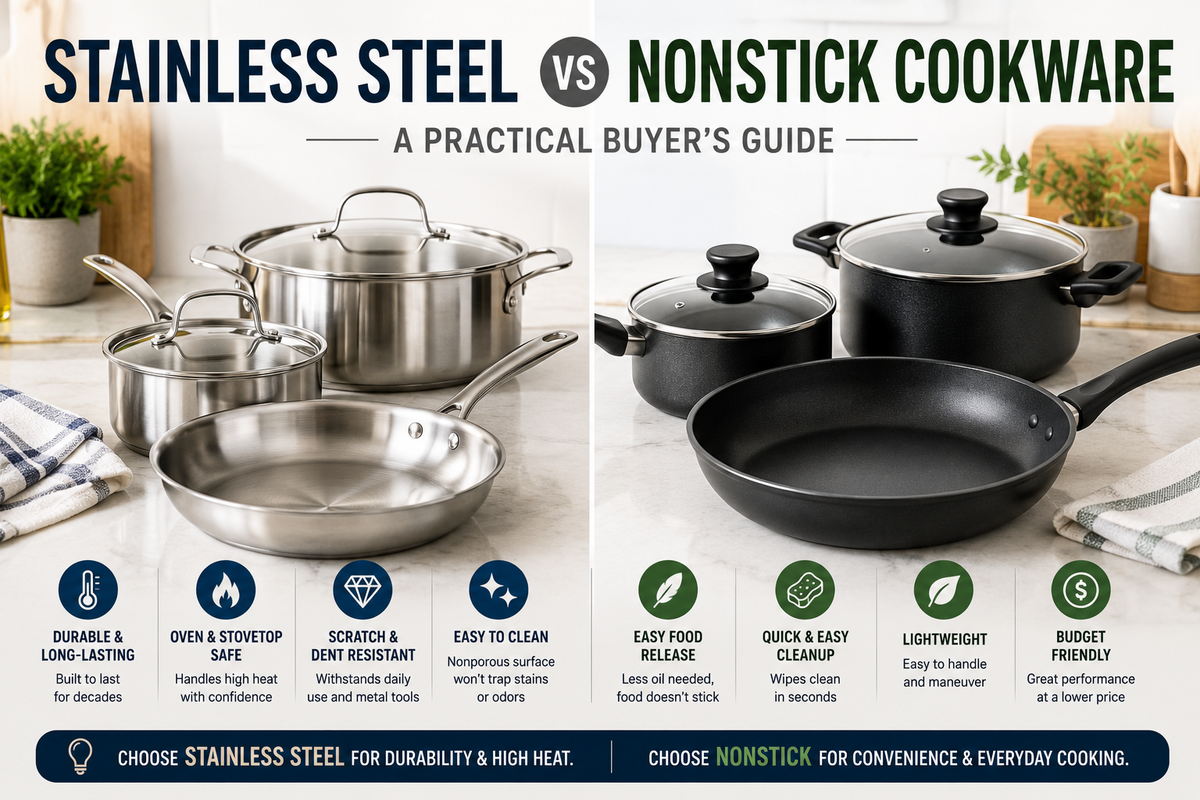
A cookware system might group frypans, sauté pans, and stockpots around compatible lid diameters. The buyer should check the cooking surface, external rim, handle clearance, storage height, material, and heat suitability. The aim is not to make every pan identical. It's to reduce the number of lids, storage arrangements, and replacement decisions.
| Category | Key Specs | Acceptance Rule | Cost Lever |
|---|---|---|---|
| Cookware | Compatible diameters, material, handle clearance, heat suitability | Accept only items that fit the approved lid and storage system | Fewer accessory variations |
| Small appliances | Footprint, electrical requirements, controls, colour, cord arrangement | Accept models that fit the counter and meet the shared operating requirements | Simpler training and replacement |
| Pantry containers | Footprint, height, opening, seal, label position | Accept only containers that align on the shelf and support the label format | Better use of shelf space |
| Bulk staples | Pack format, case dimensions, shelf life, replenishment details | Accept products that meet use and storage requirements at the chosen volume | Fewer urgent purchases |
| Office supplies | Paper, toner, cleaning materials, identifiers, supplier terms | Accept products compatible with the shared equipment and ordering system | Consolidated replenishment |
Small appliances
A shared kitchen can standardize countertop appliances around footprint, controls, colour, cleaning access, and electrical requirements. A kettle that fits under a cabinet but has unfamiliar controls may still be a poor organisational choice if users repeatedly need help or leave it unplugged.
For a household, a standard may allow one compact model and one larger model. For a business with multiple sites, the rule might prioritise a common control layout and an approved replacement path. That balances consistency with the different needs of a staff kitchen, a rental unit, and a hospitality breakfast area.
Pantry and refrigerator storage
Uniform container footprints make labels easier to read and shelves easier to rearrange. The acceptance rule should cover more than “stackable.” Check whether lids stay attached, whether the containers fit the shelf depth, whether users can see the contents, and whether the material suits the storage environment.
A refrigerator organiser needs similar discipline. A narrow bin may fit one shelf but waste space on another, while a rolling egg dispenser may support a particular use without belonging in the standard container family. Standardization doesn't mean forcing every storage aid into one format. It means documenting which products solve which jobs.
Bulk and multi-site purchasing
Bulk buying works best when the pack format matches the storage and consumption pattern. Glass jars, cleaning supplies, paper products, and guest amenities should have defined case dimensions, storage limits, and replenishment points. Organisations planning commercial food storage containers can use the category table as a starting point for comparing capacity, durability, cleaning, and stacking requirements.
An office operating across multiple sites can apply the same logic to paper, toner, and cleaning supplies. One shared product record makes it easier to identify substitutes, compare supplier responses, and prevent a local purchase from creating an unsupported exception.
Measuring Performance and Governing Product Standards
A standard earns its place by making purchasing and use more reliable. Track a small set of indicators that show whether people can follow the rule and whether suppliers can support it.
Specification coverage measures how much of the chosen category has a documented, approved requirement. Repeat-purchase rate shows whether buyers return to approved products instead of creating new variants. Supplier on-time delivery helps identify whether the approved source can support replenishment. Defect or return rate tests product quality. Cost variance versus the benchmark shows whether the standard remains commercially sensible.
Don't turn these measures into a reporting exercise detached from daily work. A monthly owner check-in can review exceptions, stockouts, user complaints, and specification changes. A quarterly supplier scorecard can examine delivery, documentation, quality, and communication. An annual portfolio review can retire obsolete products and approve alternatives.

Watch for change signals
A standard should be reviewed when safety requirements change, technology shifts, a defect repeats, demand changes, or the supplier modifies the product. Canadian procurement guidance says federal buyers should use recognized Canadian standards or specifications where available, and should turn to US or international standards when no Canadian standard exists. The Canadian procurement guidance on standards and quality assurance illustrates why the source of a specification matters when organisations write purchasing requirements.
Before restocking or scaling an approved item, check:
- Dimensional accuracy: Does the item still fit the approved space or accessory?
- Material grade: Does the supplier documentation match the requirement?
- Label clarity: Can users identify the item, capacity, care instructions, and status?
- Packaging integrity: Did the product arrive protected and complete?
- Documentation accuracy: Do product records, images, and instructions match the supplied item?
For energy-related appliances, a product standard may also need a review of actual use and monitoring needs. A guide to a home energy monitor can help households and small teams think about the information required before adding energy-related products to an approved category.
Common Misconceptions and Product Standardization Mistakes
The most damaging misconception is that product standardization ends when the first approved order arrives. The first order only proves that the rule can be tested. The system remains useful only when people maintain the specification, supplier list, catalogue record, and exception process.
Freezing a specification without considering future use creates another problem. A container may fit today's shelf but fail after a shelf is replaced. An appliance may meet current needs but lack a practical service or replacement path. A single supplier may appear convenient until a stock interruption forces an urgent substitute.
Other common mistakes include:
- Building around one person's preference: A standard should reflect the users, space, safety requirements, and purchasing reality, not one person's favourite brand.
- Skipping the pilot: Small tests reveal fit, cleaning, handling, and packaging problems before they spread.
- Keeping legacy products indefinitely: Old items continue to create training and replenishment confusion unless they have a retirement path.
- Treating exceptions as harmless: Each exception adds another product record and another future decision.
- Failing to document deviations: Without a reason and review date, a temporary workaround becomes permanent by accident.
A deviation log and a sunset clause keep the system honest. If a rental property needs a different kettle because of a counter constraint, record that reason and identify whether the exception applies only to that property. If a department must use an existing toner model, record when the transition can be reviewed.
A Clear Starting Plan for Better Purchasing Decisions
Choose one high-frequency category this week. List the products already in use, note the recurring pain points, and write a one-page specification covering size, material, capacity, performance, and supplier criteria. Assign one owner who can approve the rule and record exceptions.
Run a small pilot with two or three suitable options. Define the exit criteria before ordering. The pilot should answer whether the product fits the space, performs the required task, can be cleaned or maintained, arrives as documented, and can be reordered through a dependable channel.
If your category involves recurring supplies for a care setting, a practical resource on bulk patient amenities for clinics can help you think through pack formats, replenishment, and the difference between a product choice and a purchasing system.
Use a simple timeline:
- First 30 days: Inventory the category, document pain points, draft the specification, and choose pilot options.
- By 60 days: Test the options, record results, select approved products, and publish the purchasing rule.
- By 90 days: Review early replenishment, close avoidable exceptions, update product records, and select the next category.
GrifGlo organises practical options across home, kitchen, organisation, smart living, and structured business purchasing, with guides that support fit, comparison, and sourcing decisions. Visit GrifGlo to explore products and category guidance that can help turn everyday purchases into a more consistent system.

Leave a comment
This site is protected by hCaptcha and the hCaptcha Privacy Policy and Terms of Service apply.