

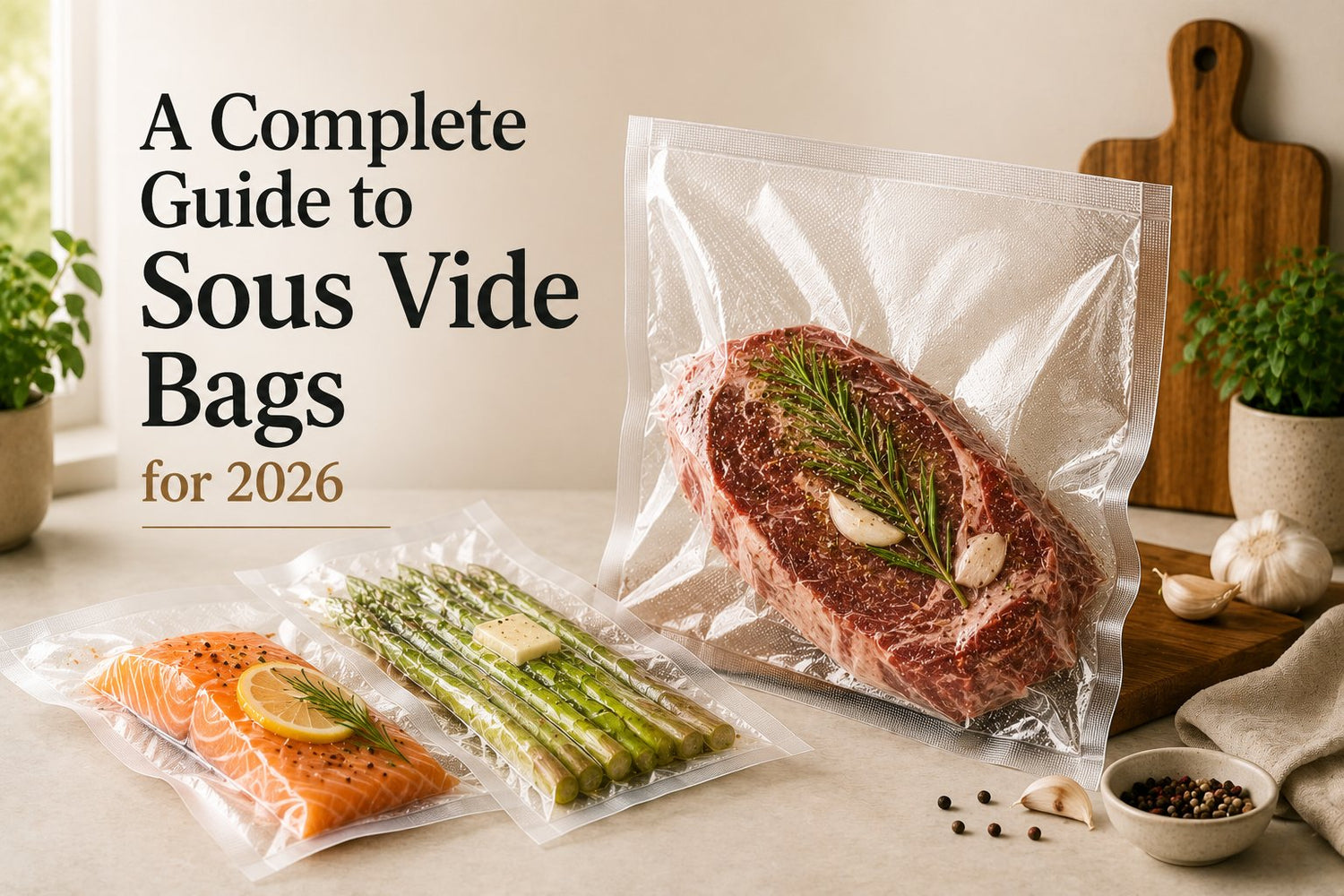
You're probably standing in one of two places right now. Either you've just bought an immersion circulator and realised the machine was the easy part, or you've already cooked a few bags of chicken or salmon and started wondering whether you need to keep buying specialised pouches.
That question matters more than most guides admit. Sous vide bags affect sealing, heat tolerance, cleanup, waste, storage, and cost over time. They also decide whether a long cook stays tidy and airtight or turns into a floating mess with softened seams and diluted seasoning.
I've found the right answer usually isn't “buy the most expensive bag”. It's “match the bag to the job”. For some cooks, a proper vacuum bag is the right call. For others, a freezer bag is perfectly fine. And if you use sous vide often, reusable options can make sense, but only if you're willing to clean and dry them properly.
If your kitchen is already full of small decisions like this, a practical kitchen essentials list helps keep gear choices tied to actual use instead of impulse buys.
Table of Contents
- What Are Sous Vide Bags and Why Do They Matter
- Plastic vs Silicone A Material Showdown
- Food Safety and Temperature Ratings Explained
- Sealing Your Bags for an Airtight Cook
- Reusable Disposable or Just a Freezer Bag
- Cleaning Storage and Buying in Bulk
- Choosing the Right Bag for Your Kitchen
What Are Sous Vide Bags and Why Do They Matter
A sous vide bag does more than hold food. It creates a barrier between the food and the water bath while keeping the food in close contact with controlled heat. That sounds simple, but it's the reason the method works so well.
The bag protects flavour, traps moisture, and keeps aromatics where they belong. If the seal fails, the whole cook changes. Water gets in, seasoning washes out, and the food no longer cooks in a controlled enclosed environment.
Why the bag matters as much as the cooker
Think of the bag as a protective shield. The circulator manages temperature, but the bag preserves the cooking environment around the food itself. Without a suitable bag, precision on the machine side doesn't help much.
This isn't a side detail in sous vide history. Modern sous vide cooking dates to 1974, when French chef Georges Pralus used it for foie gras, and that breakthrough depended on heat-stable vacuum pouches developed in the 1960s. In that early commercial use, the foie gras reportedly lost only about 5% of its weight, which is a useful reminder that the bag was central to moisture retention and yield, not just packaging (history of sous vide and heat-stable pouches).
Practical rule: If a bag can't stay sealed and stable for the full cook, it isn't a sous vide bag for that task, no matter what the label says.
Why any random plastic bag isn't a safe bet
A lot of kitchen bags are fine for storage and poor for cooking. The weak points usually aren't obvious until heat and time expose them.
Common failure points include:
- Softened seams that start to open after a long immersion
- Thin film that punctures when pressed against bones, shells, or sharp seasoning edges
- Poor seals that hold in the fridge but fail in hot water
- Unclear heat limits that leave you guessing whether the bag is meant for cooking
That's why “food-safe” by itself isn't enough. A bag can be suitable for storing leftovers and still be the wrong choice for hours in a heated water bath.
The real function in day-to-day cooking
In practice, the bag affects three things you'll notice immediately:
- Consistency. An airtight bag keeps the food evenly surrounded.
- Yield. A stable bag helps retain juices instead of letting them escape into the bath.
- Cleanliness. Good bags reduce leaks, cleanup, and cross-contamination headaches.
When people struggle with sous vide, the problem often isn't the temperature controller. It's a bag choice that didn't match the food, the cook time, or the sealing method.
Plastic vs Silicone A Material Showdown
Most home cooks end up choosing between two families of bags. Disposable plastic bags for vacuum sealing, or reusable silicone bags with their own closure system. Both can work. Neither is automatically better.

The mistake is judging them by thickness alone. Polymer structure and seal design matter more than people think. Some high-quality bags use tubular film with a single bottom seal, which removes one side seam and can reduce leak risk during long cooks. Some bags are also rated from -40°C to +121°C, which makes them practical for moving from freezer to water bath without failing (bag construction and temperature range details).
If you're already comparing storage materials more broadly, this guide to glass vs plastic food storage containers helps frame the same durability versus convenience trade-off in the rest of the kitchen.
What plastic bags do well
Plastic vacuum bags are still the easiest route to consistent sealing. They're simple to stack, easy to label, and ideal when you're portioning proteins in batches.
They usually make the most sense when you need:
- Tight contact around food for even cooking
- Freezer-to-bath flexibility for prep ahead routines
- Fast portioning for meal prep or small catering runs
- Less cleanup after raw meat cooks
Not all plastic storage bags belong in this category, though. Embossed vacuum bags and purpose-built cooking bags behave differently from generic pantry bags.
A product like AS SEEN ON TV 8-Piece Green Fresh Food Bags - 80426 is a useful example of where categories get blurred. It has a reusable storage design, a wide-seal zipper closure, and is described as helping keep produce fresh longer by absorbing ethylene gases. That makes it relevant for kitchen storage, but those facts alone don't make it a sous vide cooking bag. Storage performance and cooking performance are not the same test.
Where silicone earns its keep
Silicone bags appeal to anyone tired of throwing out plastic after every cook. They're durable, washable, and usually easier to use with marinades, vegetables, and foods that don't need a very hard vacuum.
They also come with trade-offs:
- They cost more up front.
- Their closure systems vary a lot.
- They can be bulkier in the bath.
- Drying them properly takes effort.
A reusable bag only saves waste if you keep using it. If cleaning it feels annoying every time, it won't stay in rotation.
Silicone tends to suit cooks who use sous vide regularly and don't mind a little post-cook maintenance.
Sous Vide Bag Material Comparison
| Feature | Disposable Plastic Bags | Reusable Silicone Bags |
|---|---|---|
| Seal style | Usually vacuum sealed or zipper sealed | Usually integrated zipper or slide seal |
| Best use | Proteins, meal prep, freezer storage, long cooks | Frequent home use, vegetables, liquid-rich prep |
| Leak risk | Depends heavily on seam design and seal quality | Depends heavily on closure design and how carefully it's sealed |
| Cleanup | Minimal after use | Requires washing and thorough drying |
| Upfront cost | Generally lower | Generally higher |
| Waste profile | More waste over repeated use | Lower waste if reused consistently |
| Storage | Flat and compact | Bulkier in drawers and baths |
The practical choice comes down to routine. If you cook once in a while, disposable plastic is often the path of least resistance. If you sous vide every week, silicone can start to make more sense.
Food Safety and Temperature Ratings Explained
The biggest safety mistake with sous vide bags is trusting broad labels instead of checking the actual heat limit. “Food-safe” sounds reassuring, but it doesn't tell you whether a bag is meant for prolonged cooking.
Temperature rating matters more than marketing terms
For sous vide, temperature rating is the most critical benchmark. Some storage bags can fail above 70°C, while proper cooking bags are rated for temperatures up to 120°C or higher. If the bag's maximum temperature is too low, you risk seal softening, delamination, or outright failure before the food is done (temperature limits for vacuum bags).
That's the filter I use first:
- Check the stated maximum temperature
- Confirm the bag is intended for cooking, not just storage
- Match the bag to the full cook time, not only the peak heat
- Treat vague packaging claims with caution
A bag that works well for cold leftovers can still be the wrong choice in a hot water bath.
If the manufacturer doesn't clearly state a cooking temperature, I don't use that bag for sous vide.
Terms like BPA-free or food-grade can still matter, but they're secondary. They don't replace a published cooking rating.
Where eco claims can mislead
“Eco-friendly” can be useful in storage products and still be a poor fit for sous vide. Some compostable vacuum bags have important constraints. The available guidance shows that compostable options can degrade at high and low temperatures, may not be suitable for freezing, and can have cooking limits as low as 85°C for 12 hours (compostable bag limitations and practical constraints).
That doesn't make them bad products. It just means they aren't a universal substitute.
For many kitchens, the safer approach is simple: use a known cooking-rated bag for hot immersion, then reduce waste in other ways, such as cooking larger batches, reusing silicone where it makes sense, and cleaning storage gear properly. A practical routine for cleaning food storage containers helps extend the life of the tools that are designed for reuse.
The same logic applies to cleanup equipment around the cook area. Something like the Eureka Wet & Dry Vacuum Mop – NEW400 Cordless All-in-One is described as a hard floor vacuum mop that vacuums and mops simultaneously with self-propulsion for easier manoeuvrability. That's useful after spills around prep and bath stations, but it doesn't solve the core safety question. The bag itself still needs a verified cooking rating.
Sealing Your Bags for an Airtight Cook
A good bag with a bad seal is still a bad setup. Air pockets reduce contact with the food, floating bags cook unevenly, and weak seals often fail at the point where the bag is folded, crowded, or contaminated with moisture.

If your wider kitchen setup relies on keeping foods tightly sealed after prep, these tips on airtight food storage containers line up with the same principle. Less trapped air usually means better quality retention.
Vacuum sealer methods
An edge sealer is the most common home option. It pulls air from the open end of the bag and then heat-seals it shut. It works well for dry foods and straightforward proteins.
Its weak spot is liquid. Marinades, butter, and raw juices can get pulled toward the sealing strip and interfere with the seal.
A chamber sealer handles that better because the machine changes pressure around the whole bag. If you work with sauces or liquid-heavy foods often, it's the cleaner and less frustrating tool.
Water displacement for everyday cooks
For many home cooks, this is the sensible starting point. You put the food into a sturdy zipper freezer bag, lower it slowly into water, and let water pressure push the air out before sealing the top.
Here's the method that works reliably:
- Use a proper freezer bag. Thin sandwich bags aren't the same thing.
- Keep the zipper track clean. Oil, sauce, or meat juices on the seal line cause leaks.
- Lower the bag slowly. Let the water pressure press air upward.
- Seal just before the zipper meets the waterline.
- Clip the top above the bath if needed to keep the seal dry and visible.
Many cooks find this is enough for ordinary dinners, especially when they're not doing long, demanding cooks.
A short visual helps if you've never done it before:
Reusable bag seals
Reusable silicone bags need more attention at the closure. Their weak point usually isn't the body of the bag. It's whether the top is fully aligned and pressed shut.
Check these before the bag goes in:
- No trapped seasoning on the seal
- No folds near the top edge
- Enough headspace to close it without strain
- A clip or rack position that keeps the opening upright if needed
The best sealing method is the one you'll execute cleanly every time. Fancy equipment doesn't help if the bag leaves the counter half-sealed.
Reusable Disposable or Just a Freezer Bag
Individuals don't need one permanent answer. They need a decision rule. The useful question isn't “which bag is best?” It's “which bag is good enough for this cook without wasting money or creating extra cleanup?”
Independent guidance on sealing methods points out that for short cooks, standard Ziploc-brand freezer bags used with water displacement can be functionally equivalent to specialised bags, which is why cost and sustainability belong in the decision, not just performance (practical trade-offs in sealing food for sous vide).

When a freezer bag is enough
A good freezer bag is often fine when the cook is simple and the food isn't fighting the bag.
That usually means:
- Shorter cooks where the bag isn't under stress for ages
- Soft proteins like fish fillets or boneless chicken breast
- Low-mess prep with little liquid in the bag
- Entry-level setups where you're still deciding how often you'll use sous vide
For this kind of cooking, a freezer bag can be the most rational option. It's cheap, accessible, and doesn't require a separate machine.
When specialised bags are worth it
There are jobs where I wouldn't bother improvising.
Use proper vacuum bags when you're dealing with:
- Long cooks that punish weak seams
- Freezer storage before cooking
- Sharper ingredients that can puncture lighter bags
- Higher-value proteins where a failed bag is more expensive than the pouch
Vacuum bags also make more sense when you batch prep. They stack neatly, label well, and standardise your workflow.
Where reusable bags make sense
Reusable silicone works best when your routine supports it. If you cook vegetables, eggs, simple proteins, and liquid-rich foods often, reusable bags can become the default.
They're a smart fit for:
- Frequent home use
- People trying to cut down on repeated plastic waste
- Cooks who don't mind washing, drying, and storing bulkier gear
They're a poor fit if you hate cleanup. That sounds blunt, but it's true. An “eco” purchase that sits in a drawer because drying it is annoying isn't helping your kitchen or your budget.
Here's the simple version:
| Cook type | Best starting point |
|---|---|
| Trying sous vide for the first time | Freezer bag with water displacement |
| Weekly meal prep cook | Disposable vacuum bags |
| Frequent cook focused on reuse | Reusable silicone bags |
| Small operation doing repeated portions | Standardised vacuum bags |
The smartest setup in most homes is mixed, not pure. Keep freezer bags for quick cooks, vacuum bags for demanding jobs, and reusable bags for the situations where you'll wash and reuse them.
Cleaning Storage and Buying in Bulk
Reusable bags don't stay reusable by accident. If you don't clean and dry them well, they hold odours, trap residue, and become the thing you avoid using.
Keeping reusable bags usable
Turn silicone bags inside out when possible. Wash the corners thoroughly. Dry them completely before folding or stacking them away.

Storage matters for disposables too. Keep rolls and pouches away from sharp tools, heavy pots, and drawer clutter that can crease or puncture them before use.
A few habits help:
- Store flat bags upright or flat in a dry drawer
- Keep reusable bags open while drying
- Separate cooking bags from general storage bags
- Retire any bag with worn seals or visible damage
Why small businesses should standardise
For cafés, meal prep businesses, short-term rentals with guest kitchens, and other organised buying environments, bag choice becomes an operations issue, not just a cooking preference. The sous vide cooking bag market was valued at USD 538 million in 2024 and is projected to reach USD 824 million by 2032, with North America holding 38% of global share and the household segment projected to grow at 7.1% CAGR through 2032 (market size, North American share, and household growth projection).
That growth doesn't tell you which bag to buy. It does support one practical conclusion. Demand for reliable bags is established, and standardising purchases makes sense if your team values consistency.
One bag type, one sealing method, and one storage routine usually beats a drawer full of mixed formats.
For buyers managing repeat orders, a structured source for wholesale kitchen supplies can help narrow options by use case instead of browsing aimlessly.
Choosing the Right Bag for Your Kitchen
The right bag depends on how you cook, not on what looks most specialised.
If you're an occasional weekend experimenter, start with freezer bags and the water displacement method. It keeps the barrier to entry low and works well for many simple cooks.
If you meal prep every week, use disposable vacuum bags. They're easier to portion, freeze, stack, and seal consistently.
If you cook sous vide often and care about cutting repeat waste, reusable silicone bags can earn their place. Just be honest about whether you'll clean and dry them properly.
If you run a small business or prep food in volume, standardise. Choose a bag category that matches your menu and stick with it long enough to make sealing, storage, and ordering predictable.
The best sous vide bag isn't universal. It's the one that matches your cook time, your food, your cleanup tolerance, and your budget.
GrifGlo helps shoppers compare practical kitchen tools, storage options, and bulk-buying choices without turning every purchase into a research project. If you're building a more organised cooking setup, browse GrifGlo for decision-friendly guides across kitchen essentials, home organisation, and structured household buying.


Laisser un commentaire
Ce site est protégé par hCaptcha, et la Politique de confidentialité et les Conditions de service de hCaptcha s’appliquent.