

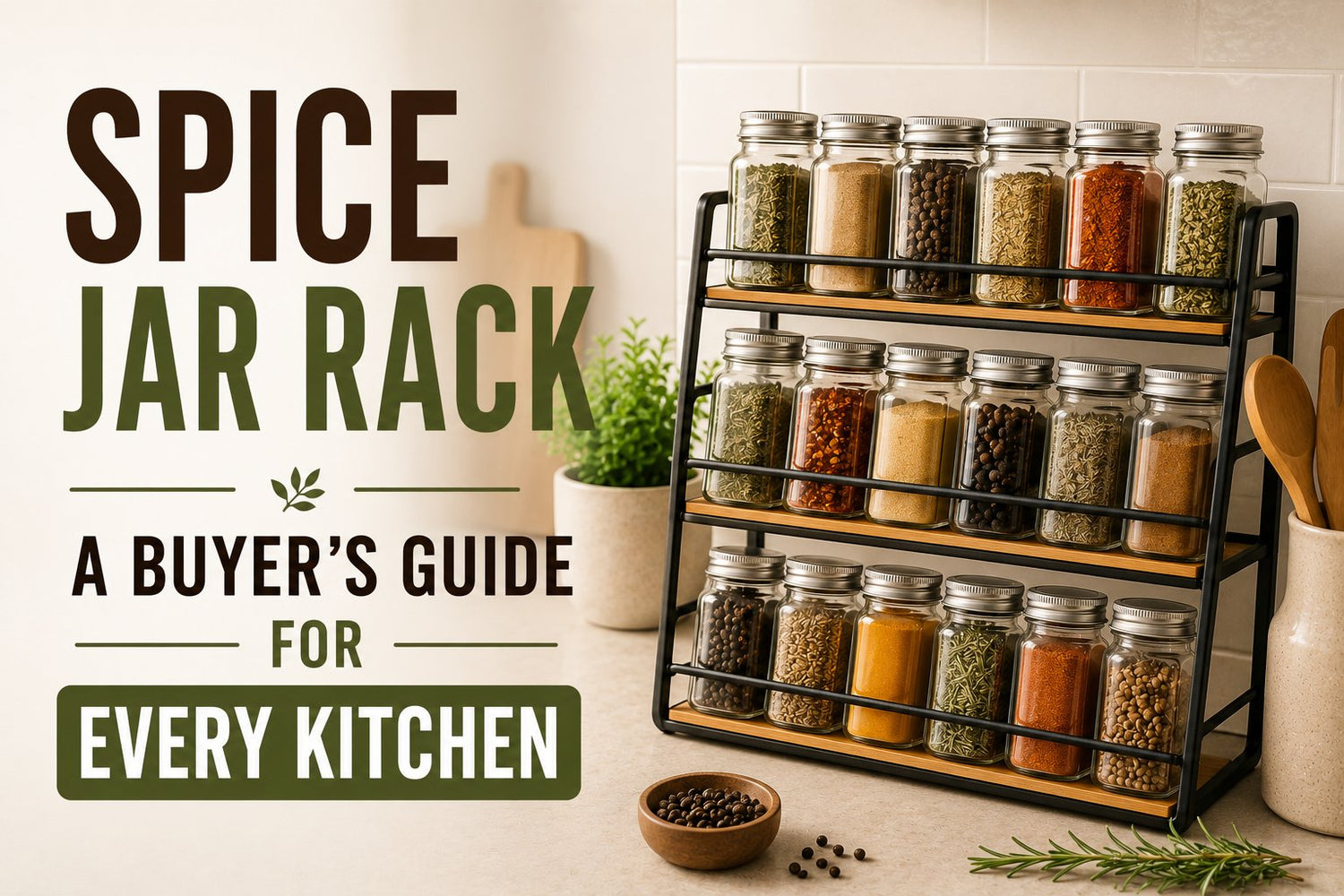
You are cooking in a small apartment kitchen, the oil is already hot, and the cumin you need is stuck behind a row of mismatched jars that barely fit the shelf. That kind of setup slows dinner down fast. It also causes the same two problems I see in real homes all the time. People buy duplicates because they cannot see what they own, and they keep old spices too long because nothing is easy to reach.
A spice jar rack solves that by turning a crowded cabinet, narrow drawer, or awkward wall strip into usable storage. The right one keeps labels visible, stops jars from tipping, and fits the space you have instead of the space a product photo pretends you have.
That matters even more in rentals, older flats, and compact city kitchens. Cabinets in older housing stock are often shallow, uneven, or interrupted by hinges, pipes, and thick face frames. Humid kitchens create another problem. Cardboard packs soften, metal racks can rust if the finish is poor, and adhesive mounts often fail when they are installed near kettles, hobs, or unventilated exterior walls.
Good spice storage should work with those conditions, not fight them.
If you are trying to get better use out of a cramped kitchen, start with a rack that matches your cabinet depth, jar size, and installation limits. If the spice area is only one part of a bigger reset, this guide on how to organise pantry shelves helps you build a storage system that stays practical in daily use.
Table of Contents
- Finding Calm in Kitchen Chaos
- Choosing Your Ideal Spice Rack Type
- Materials Matter Durability and Style
- Sizing and Jar Compatibility Guide
- Installation and Placement for Homes and Rentals
- Creating Your Spice Organisation System
- Your Final Spice Rack Decision Checklist
Finding Calm in Kitchen Chaos
Dinner is halfway done, the onions are in the pan, and the spice cabinet turns into a delay. Paprika is hiding behind a half-used cinnamon jar. The cumin tips forward when you reach in. A duplicate oregano appears because the first one got buried weeks ago. In small kitchens, that kind of mess costs time fast.
I see this constantly in compact flats, older rentals, and galley kitchens where every shelf is either too deep, too shallow, or interrupted by odd hinges and uneven cabinet walls. A good spice jar rack brings order by making every jar visible, stable, and easy to return to the same spot. That matters even more in older housing stock, where cabinet depths and shelf heights often do not match standard organisers sold online.
The goal is simple. Reduce friction.
A rack earns its place when it saves motions during cooking. If you have to lift one row to reach another, read labels at a bad angle, or keep straightening jars that slide after every door slam, the setup will not hold. People do not abandon spice systems because they dislike organising. They abandon systems that add small annoyances every day.
This clutter rarely stays limited to spices. Once one shelf becomes a catch-all, nearby storage usually follows. If the rest of your kitchen has the same problem, this guide on how to organize pantry shelves without wasting space helps fix the larger pattern.
The category keeps growing because kitchen storage is solving a real use problem, not just a visual one. As noted earlier, market reporting shows steady growth in spice storage products, which matches what shows up in actual kitchens. Cooks want faster access, fewer duplicate purchases, and cabinets that stay usable in daily life.
In practice, the payoff usually shows up in three places:
- You cook with less interruption. The right jar is visible on the first reach.
- You waste less. Older jars get used before they expire at the back of a shelf.
- You keep the area cleaner. A defined storage spot stops loose bottles from spreading into the rest of the cabinet.
Renters and small-space cooks need to be stricter here than homeowners with oversized kitchens. Counter space is limited. Many landlords do not allow drilling. Some flats trap steam, which can turn labels soft, make wood swell, and leave metal racks spotting if they sit too close to the hob or kettle. The best spice jar rack is the one that fits your cabinet as it exists, handles the moisture in the room, and works with your cooking habits instead of against them.
That is the difference between a rack that looks neat for a week and one that still works six months later.
Choosing Your Ideal Spice Rack Type
The right rack type depends less on style and more on where your dead space is. In one kitchen, the unused side of the fridge is the answer. In another, it's a shallow top drawer. In another, it's a strip of wall near the cooker that can hold a fixed rack.

What each rack type does well
Wall-mounted racks suit cooks who want visibility. You can scan labels quickly, and they free up drawers and counters. They're useful in narrow kitchens where vertical storage matters. The trade-off is installation. In rentals, that can be a deal-breaker unless your lease is flexible.
Drawer inserts create the cleanest look. They hide visual clutter and keep jars stable if the insert fits properly. They work best when you already have a drawer that isn't doing a more important job. If your kitchen is short on drawers, sacrificing one for spices can feel expensive.
Countertop revolving racks are practical for people who cook constantly and want spices within arm's reach. They require no installation and can move with you. Their weakness is obvious. They take up counter space, and in small kitchens that's often the most valuable real estate.
Magnetic racks are especially useful in rentals and compact kitchens. They make use of the fridge side or another metal surface and can be repositioned without drilling. One example is the Magnet Shelf Rack for Refrigerator - Kitchen Organizer, which includes a stable tray for seasoning bottles, a middle hook position for paper towel storage, and a bottom wooden rail for towels or kitchen tools. That kind of multi-use format makes sense when every surface has to earn its keep.
If you're trying to decide between drawer storage and visible storage, these kitchen drawer organisers help frame the trade-off clearly.
Practical rule: Don't choose a rack type based on how it looks empty. Choose it based on how easy it is to return a jar with one hand while you're cooking.
Spice Jar Rack Types At a Glance
| Rack Type | Best For | Pros | Cons |
|---|---|---|---|
| Wall-mounted | Homeowners, serious cooks, unused wall space | Frees counters, keeps jars visible, uses vertical space well | Requires installation, can look messy if labels don't match |
| Drawer insert | Minimalist kitchens, hidden storage | Clean appearance, jars stay contained, easy to group by type | Uses drawer space, lower access angle can be awkward |
| Countertop revolving rack | Frequent cooks, portable setups | No installation, easy to move, quick reach during cooking | Takes counter space, capacity can be limited |
| Magnetic rack | Renters, compact urban kitchens, fridge-side storage | Damage-free placement, flexible positioning, fast access | Needs a metal surface, not ideal for every jar shape |
Materials Matter Durability and Style
A spice rack usually fails slowly, not all at once. In a small rental kitchen, that matters more because the rack often ends up above the kettle, beside the hob, or inside an older cabinet that already runs warm and damp. Material choice decides whether the rack stays straight and easy to clean, or starts bowing, swelling, and leaving you with jars that wobble every time you reach for them.
What holds up in daily use
The right material depends on two things. How heavy your jars are, and what the kitchen air is like day after day.
Glass jars put steady weight on a rack, especially if you buy spices in matching sets or decant into larger containers. A cheap shelf may look fine empty and still start sagging after a few months of normal use. I see this often in compact flats where people try to maximize every inch and end up storing more on a rack than the material can handle comfortably.
Here is how the common options perform in real kitchens:
- Wood: Looks warmer than metal or plastic and suits open shelving well. Solid wood holds up better than thin MDF or poorly finished bamboo. In humid kitchens, unsealed wood can swell, stain, or develop rough edges that catch labels.
- Stainless steel: Handles heat, steam, and oil residue well. It wipes clean fast and makes sense near cookers, kettles, or toaster stations. Lower-grade finishes can still show fingerprints or surface rust if the coating is poor.
- Plastic or acrylic: Useful for renters because it is light and usually easy to reposition. Thick acrylic can work well in drawers or inside cabinets. Thin plastic tends to flex, crack at screw points, or yellow over time, especially near sunlit windows.
- Composite materials: Some engineered boards are stable enough for pantry use. Budget versions are usually the first to warp in older homes where cabinets are slightly uneven or the room gets damp after cooking.
If you store spices in glass, it helps to think about the full setup, not just the rack. This guide to glass food storage containers and their pros and cons explains the same trade-offs around weight, breakage, and cleaning.
A rack that flexes even slightly will keep getting worse. Jars start leaning, labels rub, and the whole setup becomes harder to use with one hand.
Style should follow kitchen conditions
Good-looking storage still has to survive real use. In older apartments and rentals, cabinets are often shallower, walls are not perfectly square, and ventilation is mediocre. Those details change what material makes sense.
Wood works well in a dry pantry or on open shelving away from steam. It is usually the better-looking option, but it asks more from the room. If the rack will live near a hob, sink, or kettle, sealed metal is usually the lower-maintenance choice. It stays stable, cleans up quickly, and does not absorb cooking residue.
Plastic has a place too. For inside awkward cabinets, under-shelf add-ons, or temporary renter-friendly setups, a well-made plastic rack can be the practical answer. The mistake is choosing the cheapest version available, then loading it with heavy glass jars in a warm cabinet. That is where cracks, shelf dip, and sticky surfaces show up first.
A spice rack should match the kitchen you have. In a dry family kitchen, wood can look great and last. In a humid flat with tight clearance and older cabinets, stainless steel or thick acrylic usually gives fewer problems and a longer service life.
Sizing and Jar Compatibility Guide
Most spice rack returns happen for one reason. The buyer measured the cabinet opening, but not the inside obstacles, shelf lip, jar width, or real usable height. A rack can be technically smaller than the space and still not fit properly.

Measure the space first
Start with the exact area where the rack will live. Not the whole cabinet. Not the advertised cabinet width. The actual usable zone.
Check these points in order:
- Depth: Measure from the front edge to the back obstruction. Hinges, rails, and shelf lips matter.
- Width: Measure side to side in more than one spot if the cabinet is old.
- Height: Measure vertical clearance, especially if jars need to stand upright or tilt.
- Door swing or drawer travel: Make sure the rack won't block normal opening.
For compact kitchens, especially in urban California apartments, cabinet depths often average 11–12 inches, and a usable rack should accommodate jars with a maximum diameter of 2.75 inches and allow 5.5 inches of vertical clearance to fit standard commercial containers safely. Those details matter most in shallow cabinets where every fraction affects reach and fit.
A good companion step is reviewing common food storage container sizes, because once people start organising spices, they usually begin standardising nearby pantry storage too.
Then measure the jars
This is the part shoppers skip. Don't assume your current spice bottles are “standard”. Some are short and wide. Others are narrow but unexpectedly tall because of their lids.
Use a simple checklist:
- Diameter first: If the jar is too wide, angled tiers and drawer slots won't work.
- Height with lid on: Don't measure the glass body only.
- Base shape: Rounded or flared bases can make drawer inserts unstable.
- Quantity: Count how many jars need daily access versus backup storage.
Bring your five most-used jars into the decision. If those fit comfortably, the rest of the system usually follows.
If you're buying for a rental kitchen, leave a little tolerance rather than choosing a rack that only works at exact dimensions. Tight fits look efficient on paper and become irritating in practice.
Installation and Placement for Homes and Rentals
Installation changes the whole buying decision. A rack that works beautifully in a homeowner's remodel can be a terrible choice in a rented flat with uneven cabinetry, strict wall rules, and cupboards that haven't been square in decades.
What works in owner-occupied kitchens
If you own the space and plan to stay, fixed installation gives you the most stable result. Screwed-in wall racks, built-in drawer inserts, and cabinet-door systems usually feel better over time because they don't shift. They also let you design around your cooking flow rather than around reversibility.
Permanent installs are worth it when:
- You've measured carefully: Built-ins punish guesswork.
- You use spices constantly: Daily use justifies a more customized setup.
- Your cabinets are consistent: Modern kitchens accept fitted organisers more easily.
That said, even owners shouldn't force pull-out systems into cabinets that vary in depth or have awkward interior hardware.
What renters should avoid
In California, 55% of households are renters, and older kitchens often create a specific problem. According to Sacramento Remodel's discussion of hidden spice racks and older cabinetry issues, pull-out racks commonly fail in pre-1980s cabinets with depth variations exceeding 1.5 inches. That's exactly why a rack can look right in the listing and still jam, scrape, or sit crooked once installed.
For renters, I'd avoid any spice jar rack that depends on perfect cabinet geometry unless you've checked every interior surface yourself. Older cupboards are rarely as uniform as generic buying guides assume.
Better renter-friendly options usually include:
- Magnetic storage: Good for fridge sides and easy to remove.
- Adhesive-mounted shelves: Useful on smooth, clean surfaces, but only when the weight load is realistic.
- Free-standing drawer or shelf inserts: Best when they don't need screws and can move with you.
- Over-door organisers: Helpful when interior cabinet space is crowded, especially if you already use over-the-door pantry organisation elsewhere.
Renters need reversibility, but they also need tolerance. A slightly forgiving storage solution beats a “perfect fit” product that only works in a perfectly square cabinet.
Humidity adds another layer. In coastal kitchens, avoid unfinished wood if the rack sits near a cooker or sink. In older rentals, that combination of uneven cabinets and moisture causes far more frustration than style-focused guides admit.
Creating Your Spice Organisation System
A rack solves access. A system solves the chaos that returns two weeks later.

The simplest improvement is consistency. Matching jars help, but matching logic matters more. If cumin is next to curry powder one week, then buried behind nutmeg the next, the rack is only half doing its job.
Choose an organising logic you'll actually keep up
There are three systems that work well in real kitchens.
Alphabetical works for people who want fast retrieval and don't cook in distinct “zones” or cuisines. It's efficient, especially in larger collections, but it can separate spices that are often used together.
By cuisine or category suits cooks who work in patterns. Baking spices together. Indian staples together. Everyday savoury spices in one section. This is usually the most intuitive setup for active cooks.
By frequency of use is the easiest to maintain. The spices you reach for daily stay closest. Seasonal or occasional ones move higher, lower, or further back.
A practical setup often blends these approaches:
- Front row: Salt-adjacent everyday cooking spices
- Middle zone: Most-used cuisine groups
- Back-up area: Refills, baking extras, and infrequent blends
If a system takes too much thinking, nobody keeps it up. The best organisation method is the one that survives a busy week.
Placement matters just as much as grouping. For small kitchens, keeping the spice rack within easy reach of the primary cook zone, around 34–36 inches high, helps reduce extra steps and awkward reaching, as noted in this video discussion of efficient spice placement in compact kitchens.
Place the rack where cooking happens
Don't place spices where there's only empty space. Place them where your hand naturally goes during cooking. That's often near the hob, beside the prep area, or on the least disruptive side of the fridge.
Labels help most when they're visible from your normal angle, not just when standing directly in front of the rack. Top labels work well in drawers. Front labels work better on shelves and wall racks.
For a quick visual walkthrough of organised spice storage in action, this video is useful:
One final habit keeps the system from sliding backwards. Keep refills separate from daily-use jars. Backup stock belongs in a bin or pantry box, not mixed into the main spice jar rack.
Your Final Spice Rack Decision Checklist
A good buying decision usually comes down to a short list of honest checks. Not what looks best online. Not what fits a trend. What fits your kitchen, your jars, and your tolerance for installation.
Five checks before you buy

Run through these before you commit:
- Rack type fit: Does the format suit your actual kitchen layout? A countertop carousel might be easy, but it won't help if your worktop is already crowded.
- Measured space: Have you checked the actual usable dimensions and not just the advertised cabinet size?
- Jar compatibility: Do your current jars fit the shelf spacing, slot width, or tier depth comfortably?
- Material match: Is the material suitable for your kitchen's conditions, especially if heat or humidity are an issue?
- Access and cleaning: Can you grab jars quickly, wipe the rack down easily, and return things without fuss?
Then ask one final practical question. Will this still work after a long week of normal cooking? That's the standard that matters. The right spice jar rack makes daily cooking smoother without asking for constant tidying, re-adjusting, or careful handling.
For homeowners, that may mean a fixed rack sized precisely to a cabinet run. For renters, it often means choosing flexibility over a custom fit. For short-term rental hosts or property managers, standardising jar size and choosing forgiving rack formats usually saves more hassle than trying to optimise every unit individually.
A tidy spice setup isn't about perfection. It's about removing one recurring source of friction from the kitchen.
If you're comparing practical kitchen organisation tools and want guidance that focuses on fit, usability, and real-life setup, GrifGlo offers decision-friendly recommendations across pantry, drawer, fridge, and storage categories so you can choose with more confidence and less guesswork.


Laisser un commentaire
Ce site est protégé par hCaptcha, et la Politique de confidentialité et les Conditions de service de hCaptcha s’appliquent.