

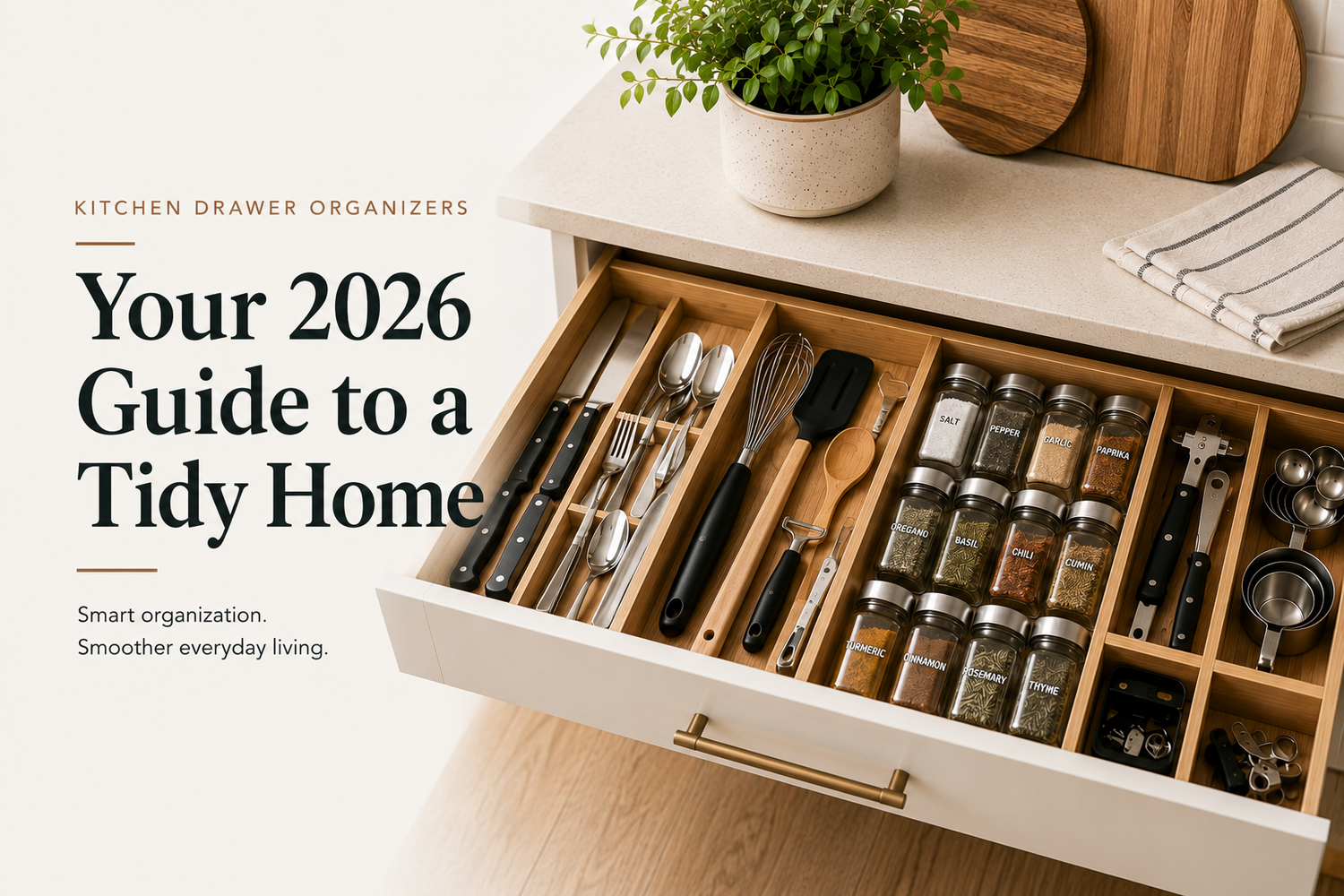
You open the drawer for a wooden spoon and get a whisk caught in the handle of a can opener. Measuring spoons have slipped under a spatula, the peeler is somehow sideways, and the drawer barely shuts. That kind of mess isn't just annoying. It slows down every small kitchen task and turns one of the hardest-working parts of the room into a catch-all.
A good drawer system fixes more than appearance. It gives each tool a clear home, keeps daily-use items close at hand, and makes reset easy after cooking. That's why kitchen drawer organizers have become part of a much larger storage shift. The global kitchen storage organization market is projected at USD 160.13 billion in 2026 and USD 221.89 billion by 2033, while the global drawer organizer market is projected to grow from USD 4.2 billion in 2024 to USD 7.1 billion by 2033, according to Coherent Market Insights on kitchen storage organization market projections.
Table of Contents
- From Chaos to Calm Introducing Kitchen Drawer Organization
- Choosing Your System Organizer Types and Materials
- How to Measure and Select the Perfect Fit
- Drawer Layout Strategies for Utensils Spices and More
- Installation Tips and Long-Term Maintenance
- Buying Considerations for Homeowners Renters and Businesses
- Conclusion Your Path to a Permanently Organized Kitchen
-
Frequently Asked Questions
- Do kitchen drawer organizers stay organised long term
- Is bamboo better than plastic
- Should I organise before or after I declutter
- What's the biggest measuring mistake
- Are expandable organisers enough for most kitchens
- How do I stop utensils from sliding into each other
- Can I use drawer organisers in rental kitchens
- How often should I reset an organised drawer
From Chaos to Calm Introducing Kitchen Drawer Organization
You open the top drawer to grab a peeler before dinner, and the utensil you need is trapped under takeout packets, measuring spoons, and two tools no one has used in months. That kind of mess is frustrating, but it is also predictable. Drawers become chaotic when they are asked to do too many jobs at once.
A functional drawer starts with three principles. Zoning, use-frequency, and system-matching. Zoning gives each category a clear home. Use-frequency decides what earns the easiest-to-reach space. System-matching means the organizer has to suit the items and the way the kitchen is used, not just the drawer dimensions.
I see the same failure point in busy family kitchens, compact flats, and turnover-ready rentals. The drawer that feels chaotic contains a mix of categories with no physical boundaries. Daily tools belong near the prep area. Loose pieces need containment. Low-use items should move out of prime space. Once those decisions are made, the drawer starts supporting the kitchen instead of fighting it.
Practical rule: A drawer should answer one question clearly. Cutlery drawer, cooking tools drawer, baking drawer, spice drawer. If the answer is “a bit of everything,” the system will drift back into clutter.
This shift in thinking is important because drawer organisation works best as an operating system, not a one-time tidy-up. A tray can make a drawer look better for a week. A clear zone plan keeps it usable for months. The same logic applies across the kitchen. If you are also sorting pantry overflow or food prep storage, it helps to choose food storage containers that match how you cook and store leftovers, rather than buying sets that look coordinated but solve the wrong problem.
The drawer has to support the task
A neat drawer can still be inefficient. If tongs live near the coffee station or measuring spoons are buried behind bag clips, the layout is still wrong.
Good organization reduces friction. You reach once, find the item, use it, and return it to the same spot without thinking. That is what turns a cleaned-out drawer into a system that lasts.
Choosing Your System Organizer Types and Materials

Start with structure, not style
Shoppers often look at material first because it's the most visible feature. A better approach is to reverse that. Start with the format of the organizer, because structure determines whether the drawer will keep working after a busy week.
Fixed trays work well for stable categories. Cutlery is the obvious example. Forks stay forks, table knives stay table knives, and you don't need to reconfigure anything. The downside is rigidity. If one compartment is too narrow for serving spoons or too shallow for bulkier tools, you're stuck.
Expandable trays suit drawers that need some flexibility. They're useful when the drawer width is awkward or when the item mix changes a little over time. They're less ideal when you need highly specific compartment sizes, because expansion solves width better than category precision.
Modular bins are the most adaptable. They're often the best answer for tool drawers, snack drawers, and mixed utility drawers because you can combine small and medium containers around what you own. The trade-off is that poorly chosen modules create dead zones around the edges.
Dividers and custom partitions work best when the contents are long, irregular, or likely to slide. They help with spatulas, whisks, peelers, and food clips because they create lanes instead of generic piles.
A useful adjacent example is the Magnet Shelf Rack for Refrigerator - Kitchen Organizer, which is described as a refrigerator side hanging magnet shelf with a stable tray for seasoning bottles, magazines, and plastic wrap, a middle hook position for paper towel storage, and a bottom wooden rail for towels or kitchen tools. It isn't a drawer insert, but it reflects the same principle. Match the storage format to the items and access pattern, not just to the look.
For related decision-making on adjacent kitchen storage systems, GrifGlo also publishes practical buying guides such as this one on choosing food storage containers.
Material changes the daily experience
Material affects cleaning, grip, noise, and how forgiving the organizer feels in real use.
| Material | Pros | Cons | Best For |
|---|---|---|---|
| Wood | Warm look, sturdy feel, often suits traditional cabinetry | Can show stains, needs gentler care | Homeowners matching cabinetry or built-in style |
| Bamboo | Clean appearance, lighter visual feel, natural finish | Can dry out or mark if soaked or neglected | Everyday kitchens that want a natural look |
| Plastic | Easy to wipe, practical for spills, common in modular formats | Can look less integrated with cabinetry | Busy family kitchens, rentals, utility drawers |
| Metal | Durable structure, useful in some divider formats | Can rattle, may feel harsh for delicate items | Utility storage, less common for cutlery comfort |
The best material is the one you'll maintain without resentment. A beautiful insert that you avoid cleaning becomes clutter with compartments.
What usually works best in real kitchens is a simple match between drawer type and maintenance tolerance. Plastic and bamboo tend to win for most households because they're easy to live with. Wood looks excellent when the kitchen supports it. Metal has its place, but not every drawer benefits from a harder, noisier surface.
How to Measure and Select the Perfect Fit
Start with the empty drawer, not the product listing.

A lot of returns happen because people measure the outside of the drawer front or guess based on cabinet size. Organizers fit the internal cavity, and that's where the surprises are. Slide hardware, screws, sidewalls, and narrow back corners all matter.
Measure the drawer you actually have
The key technical rule is to measure length, width, and height at the narrowest points. Most organizers are designed for standard drawer heights of about 2.5 to 3 inches and are often produced in 3-inch increments for modularity, as explained in Lela Burris's guide to measuring drawers. That modular sizing helps reduce dead space, but only if your measurements are accurate.
Use this sequence:
- Empty the drawer fully. Don't measure around contents.
- Measure inside width from inner wall to inner wall.
- Measure inside depth from the back interior wall to the inside of the drawer front.
- Measure interior height from the drawer base to the point where the drawer still closes freely.
- Check the narrowest spots. Look for slide hardware, screw heads, clips, or bowed sides.
- Leave a little tolerance. A too-tight insert becomes a daily annoyance.
Later, if you're organising pantry items as well, this guide on airtight vs stackable vs modular pantry storage containers helps with the same fit-first thinking.
This short video gives a visual sense of the measuring process:
Choose fit before features
Shoppers often get distracted by expandable wings, angled slots, or nice finishes. Those details matter less than whether the organiser clears the drawer sides and allows the drawer to close without rubbing.
A simple way to avoid mistakes is to sort the contents before you buy. Cutlery needs shallow, narrow compartments. Long utensils need length more than width. Small loose items need containment so they don't migrate. When you know the item group, it's easier to choose the right tray depth and divider pattern.
Buy for the hardest item in the drawer, not the easiest one. A tray that holds forks beautifully but crushes your serving spoon is the wrong tray.
Even nearby support tools affect how smoothly the system works. For example, a kitchen reset station may include a bin such as the HOME AESTHETICS HA-5138 Swing Garbage Bin 15L, described as a 15 litre plastic trash can for kitchens, offices, or bathrooms, made of resistant and durable plastic. That doesn't go inside the drawer, but it helps during setup because editing and discarding are part of getting the drawer fit right in the first place.
Drawer Layout Strategies for Utensils Spices and More

An organizer is only the container. The lasting part is the layout. The best kitchen drawer organizers support how you cook, where you stand, and what you reach for every day.
Cutlery and everyday tools
The cutlery drawer should be the easiest one in the kitchen. Keep it close to the dishwasher or dining area if that supports unloading, or close to the prep zone if that's how your kitchen flows. Standard categories work well here because they're stable and easy to maintain.
For a tool drawer, the layout changes. Many systems fail here because the contents aren't uniform. Thin tools slip under larger ones, handles overlap, and every opening of the drawer reshuffles the pile.
High-performance organizers are built to separate items by shape and use frequency. OXO's expandable kitchen tool organizer is one example of that logic, using an oversized bay for long tools, adjustable dividers, and a small storage cup for accessories. The reason this works is practical. Mixed-item drawers fail when thin items slide under larger ones, creating friction and wasted motion, while adjustable partitions reduce movement and keep categories stable, as shown on OXO's expandable kitchen tool drawer organizer page.
For many households, this zoning works:
- Closest reach zone for spatulas, tongs, wooden spoons, and measuring spoons.
- Secondary zone for peelers, can openers, graters, and scissors.
- Back corner or side compartment for bag clips, corn holders, or other small accessories.
- Elsewhere entirely for seasonal gadgets and duplicate tools.
If you're refreshing flatware and trying to align drawer layout with what you use each day, this guide to a cutlery set in Canada can help you decide what deserves prime drawer space.
Spices and the so-called junk drawer
A spice drawer works when labels are easy to scan and jars don't roll. If the drawer is shallow, use a low-profile insert or angled arrangement. If it's deeper, don't just stack jars. You'll lose visibility and buy duplicates because you can't see what's already there.
The junk drawer needs a stricter hand than any other drawer. I don't try to eliminate it in most homes. I redefine it. It becomes a household utility drawer with hard boundaries.
A good utility drawer usually contains:
- Paper items like stamps, sticky notes, and a pen.
- Small tools such as scissors or a mini screwdriver.
- Battery or key zone only if there's a container stopping drift.
- No kitchen spillover from spare utensils, takeaway packets, or random cords.
A junk drawer becomes manageable the moment every small item has a container that's smaller than the drawer itself.
That's the core principle behind durable drawer organisation. Don't organise by product category alone. Organise by movement. What do you reach for first, what tends to tangle, what slides, and what should live somewhere else entirely.
Installation Tips and Long-Term Maintenance
A clean install matters because even a well-chosen organizer can become irritating if it shifts every time the drawer opens.
Make the insert stay put
The first step is simple. Clean the drawer base before adding anything. Crumbs and dust create tiny high points that make trays rock or drift.
Then decide whether the organizer should sit loose or be lightly anchored by friction. In many kitchens, a thin non-slip liner underneath the insert solves most movement without making cleaning difficult. If you're using modular bins, fill the footprint so the pieces brace one another instead of floating around the drawer.
A few practical fixes work well:
- Use a liner under light trays if the drawer interior is slick.
- Fill edge gaps intentionally with a narrow bin or divider so modules don't travel.
- Avoid overloading one side of the drawer with heavy metal tools.
- Test the close several times before finalising placement.
Clean for the material you chose
Plastic organisers are usually the lowest-maintenance option. Take them out, shake out debris, wipe with mild soap and water, dry fully, and return them.
Wood and bamboo need a lighter touch. Don't leave them wet, and don't soak them. Wipe, dry promptly, and keep spills from sitting in corners. That's especially important in drawers near the sink or prep area.
Regular resets prevent the slow return of chaos:
- Weekly quick check for crumbs and misplaced items.
- Monthly edit to remove objects that wandered in from elsewhere.
- Seasonal review to relocate tools you no longer use often.
For the same maintenance mindset with nearby kitchen systems, this guide on how to clean food storage containers is useful because the principle is identical. Easy-to-clean systems get maintained. Fussy systems get ignored.
Buying Considerations for Homeowners Renters and Businesses

The right choice depends less on trend and more on who has to live with the system.
What matters most by use case
Homeowners usually benefit from a longer-view approach. If the cabinetry is staying, it makes sense to choose organisers that suit the drawer dimensions well, look consistent with the kitchen, and hold up through years of use. Bamboo, wood, or well-fitted modular systems often make sense here.
Renters need portability. Drawers in a future home won't match the current ones, so rigid custom inserts can become expensive leftovers. Expandable trays and modular bins are usually the safer buy because they adapt, move easily, and don't require any permanent changes.
Businesses, property managers, and short-term rentals need standardisation more than personality. The ideal setup is easy to clean, hard to misuse, and simple for the next person to understand. Plastic organisers often work well because they wipe down quickly and can be repeated across units.
In shared or turnover-heavy kitchens, the best system is the one a new user can understand in seconds.
Where standardisation helps
For managed properties, repeatable layouts reduce confusion. Put cutlery in the same drawer across units. Keep utensils in the same type of compartment. Avoid clever custom arrangements that only make sense to the person who installed them.
That logic applies to nearby storage too. If you're thinking about a broader kitchen reset, these ideas on pantry storage racks pair well with drawer organisation because both depend on visibility, containment, and repeatable placement.
A homeowner can afford a more personalised layout. A renter should optimise for flexibility. A business should optimise for clarity. Those are different goals, and the organiser should match them.
Conclusion Your Path to a Permanently Organized Kitchen
A tidy drawer isn't the result of buying a nicer tray. It comes from making a few good decisions in the right order. Assign the drawer a clear job. Measure the inside carefully. Choose a structure that suits the contents. Then lay items out by frequency and function so the drawer can recover quickly after real use.
That's why some kitchen drawer organizers last while others fail within a month. The successful models match the way the kitchen operates. They don't just divide space; they support habits.
This also lines up with broader buying behaviour in North America. The U.S. kitchen organizer market was valued at USD 20.29 billion in 2023 and is projected to reach USD 23.59 billion by 2029, with the drawers, upper and lower cabinet organizers segment identified as the fastest-growing, according to Business Wire's summary of the U.S. kitchen organisers market report. For Canadian households and property managers, that matters because drawer organisation has moved into the category of core kitchen function.
If your drawers are frustrating you now, start with one. Pick the worst one. Empty it, sort it, measure it, and give it a proper layout. One well-organised drawer often changes how you approach the rest of the kitchen, because you can feel the difference every single day.
Frequently Asked Questions
Do kitchen drawer organizers stay organised long term
They can, if the setup matches the drawer's real job. A utensil drawer that holds only daily-use tools usually stays tidy. A mixed drawer stuffed with scissors, batteries, takeout menus, and random gadgets usually falls apart fast. Long-term success depends on zoning, use-frequency, and compartments that fit the items instead of fighting them.
Is bamboo better than plastic
Neither material wins in every kitchen. Bamboo has a warmer look and often suits drawers that are opened often or visible in styled spaces. Plastic is easier to wipe clean and usually holds up better in busy family kitchens, rentals, and utility drawers. Pick the material that fits your maintenance habits, not just your aesthetic.
Should I organise before or after I declutter
Declutter first. Otherwise, you build a drawer around duplicates, low-use tools, and items that should live somewhere else. I see this often. People buy a tray, fill every slot, and only later realise half the contents did not deserve prime drawer space.
What's the biggest measuring mistake
Measuring the drawer front instead of the usable interior is a common one. The other mistake is missing obstructions such as side hardware, curved corners, or drawer slides that reduce width. Measure the inside base, the narrowest point, and the height clearance so the organiser fits and the drawer closes properly.
Are expandable organisers enough for most kitchens
For many standard drawers, yes. They are useful for forks, spoons, spatulas, and other categories that change a little over time. Expandable organizers are weaker in drawers with odd dimensions, bulky tools, or lots of small loose items. In those cases, modular bins or custom dividers usually hold the layout better.
How do I stop utensils from sliding into each other
Use defined lanes. Long tools need lengthwise compartments, and small pieces need their own contained section. One big open tray invites overlap, noise, and drift. A drawer liner can also help reduce movement if the organiser shifts during daily use.
Can I use drawer organisers in rental kitchens
Yes, and rentals often benefit the most because drawer storage is usually basic. Choose modular, removable pieces that can adapt to a new kitchen later. Skip anything permanent unless the landlord approves it or you know you will stay for years.
How often should I reset an organised drawer
A quick weekly straighten is enough for most kitchens. Then do a deeper reset every few months to remove items that have migrated in or stopped earning space. If a drawer gets messy within days, that usually points to a bad layout, poor zoning, or a drawer trying to do too many jobs.
If you're comparing kitchen drawer organizers and related storage tools, GrifGlo is one place to browse decision-focused guides across kitchen, pantry, fridge, and home organisation categories. It's built to help shoppers narrow options by fit, use case, and everyday practicality rather than sorting through an overwhelming catalogue.


Leave a comment
This site is protected by hCaptcha and the hCaptcha Privacy Policy and Terms of Service apply.