

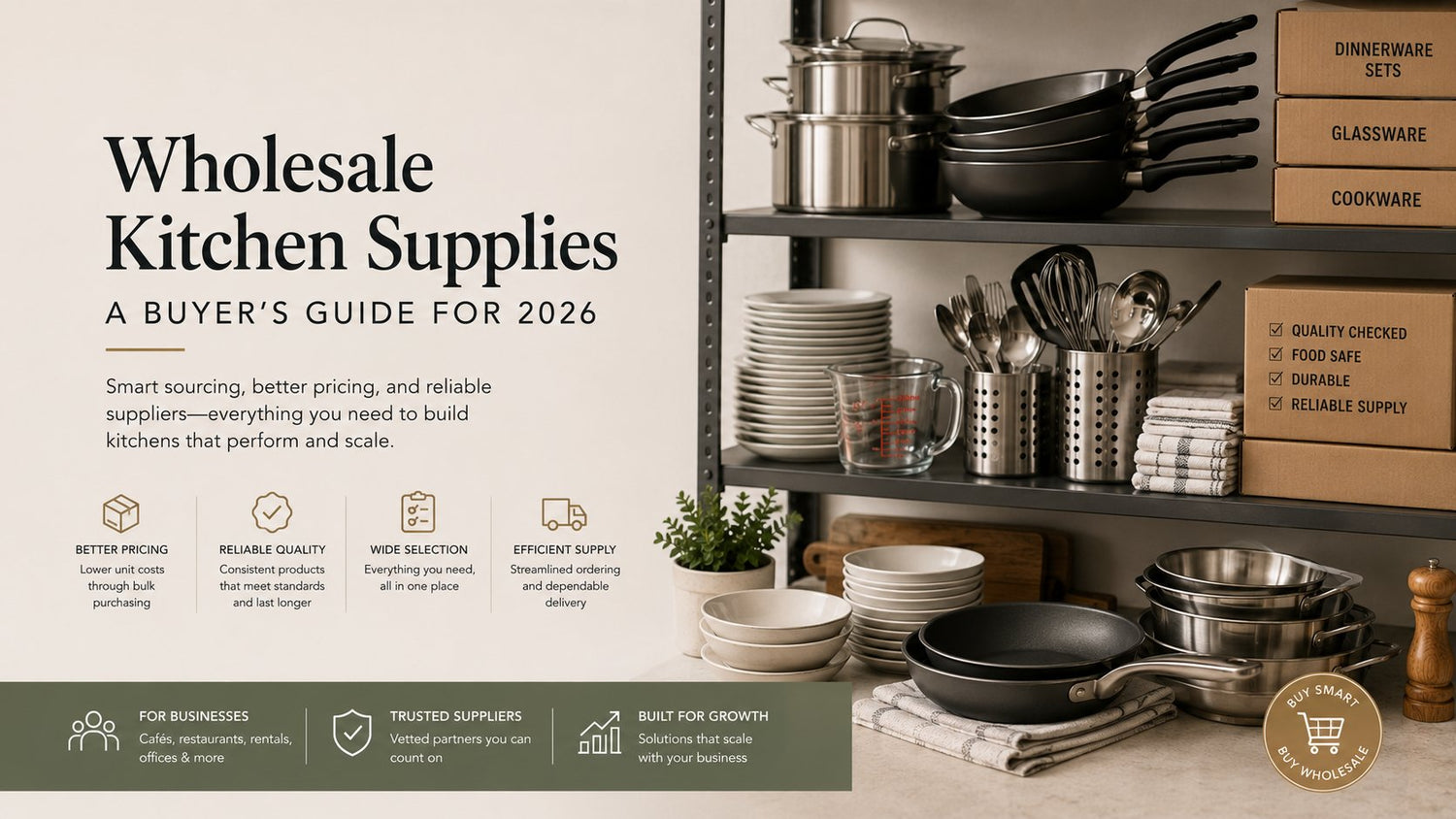
If you're outfitting a holiday rental, a small café kitchen, an office break room, or even a busy household, the same problem shows up fast. Retail pricing looks manageable when you're buying one frying pan or a single set of utensils. It gets painful when you're buying twenty, replacing damaged pieces, or trying to standardise across multiple kitchens.
That's where most buyers make the wrong move. They keep shopping like consumers when they need to start buying like operators. Wholesale kitchen supplies aren't just about larger cartons. They're about repeatability, cleaner specifications, fewer mismatched items, better replenishment, and a purchasing process that doesn't fall apart every time stock runs low.
The opportunity is large enough that it's worth treating this seriously. The global kitchenware market was valued at USD 73.26 billion in 2025 and is projected to reach USD 123.33 billion by 2033, with a 6.8% CAGR projection according to Grand View Research's kitchenware market analysis. For buyers, that matters because a growing market usually means more supplier choice, more product overlap, and more room to negotiate if you know how to buy properly.
Table of Contents
- Beyond Retail Why Wholesale Kitchen Supplies Matter
- Decoding Your Supplier Options
- Strategic Categories for Bulk Purchasing
- Mastering Pricing MOQs and Negotiation
- Ensuring Quality and Compliance Standards
- Building Your Reliable Sourcing Workflow
- Conclusion From Sourcing to Strategic System
Beyond Retail Why Wholesale Kitchen Supplies Matter
A property manager usually notices the problem after the second or third unit setup. One kitchen has black nylon utensils, another has mixed stainless and silicone, a third has retail-brand cookware that looked fine online but wears out quickly. Reordering becomes a scavenger hunt. Costs creep up, replacements don't match, and staff waste time comparing listings that should already be standard.
Wholesale fixes that when it's done properly. You move from one-off buying to a procurement model with set specifications, approved substitutes, reorder points, and supplier relationships that can handle repeat demand. That matters just as much for a large household as it does for a hospitality team.

Wholesale means operational control
Most people hear “wholesale” and think “buying a lot of the same thing”. That's only part of it. In practice, wholesale kitchen supplies let you control four things retail buying rarely handles well:
- Consistency: The same pan, utensil set, storage bin, and cleaning tool can be ordered again without restarting the search.
- Planning: You can build par levels for fast-moving items instead of reacting after something breaks.
- Suitability: You choose products for the use case, not for shelf appeal.
- Admin time: Fewer suppliers and repeatable product lists cut the back-and-forth.
A household can use the same logic. If you're reorganising a pantry, replacing worn utensils, and standardising food storage, it helps to think in systems rather than single items. A practical example is using consistent storage dimensions and shelving layouts, which is the same mindset behind pantry storage racks for organised kitchen systems.
Practical rule: If you expect to reorder an item, treat the first purchase like a sourcing decision, not a shopping decision.
Growth in demand changes how buyers should act
The kitchen category is no longer a niche add-on. It spans households, restaurants, office kitchens, rentals, and institutional setups. Buyers who stay in retail mode often overpay for items that should have been standardised early.
The better approach is simple. Pick the right supplier channel, choose only the categories worth bulk purchasing, set your quality floor, and build a repeatable ordering workflow. That's how wholesale kitchen supplies start saving money without creating new problems in storage, compliance, or replenishment.
Decoding Your Supplier Options
Not every supplier serves the same kind of buyer. A café opening its first location, a landlord equipping short-term rentals, and a household building a long-term kitchen setup shouldn't all buy through the same channel. Most sourcing mistakes happen before anyone compares prices. They start with choosing the wrong supplier type.

The four channels most buyers actually use
Distributors are the default starting point for many small businesses and property managers. They hold stock from multiple brands, offer mixed-category purchasing, and usually make reordering easier. You'll often pay more than direct factory pricing, but you gain flexibility and lower operational friction.
Manufacturers work well when volume is high and specifications are stable. If you need the same utensil kit, storage container, or cookware line across many units, factory buying can make sense. The trade-off is that manufacturers usually expect firmer commitments, longer planning windows, and less tolerance for small test orders.
Liquidation and surplus sellers can be useful for non-critical categories or opportunistic buys. They're rarely ideal for standardisation. If a buyer depends on those channels for core tools, matching replacements later becomes difficult.
B2B marketplaces sit in the middle. They give you breadth, faster quote gathering, and access to a range of sellers. They also require more vetting because product presentation can look polished even when supplier depth is weak.
Use distributors when you need reliability, manufacturers when volume is predictable, liquidation only when substitution won't hurt operations, and marketplaces when you're still mapping the field.
A simple example of a low-complexity item is the LUCIANO Salt and Pepper Stainless Steel Set - 80973. It's a straightforward stainless steel shaker set designed for salt, pepper, sugar, spices, or cinnamon, with each shaker holding up to 100ml. Items like this are easy to source through distributors or marketplaces because the functional requirements are clear and the product doesn't usually require custom specification.
Wholesale Supplier Types Compared
| Supplier Type | Best For | Pros | Cons |
|---|---|---|---|
| Distributor | Small businesses, offices, property managers | Mixed categories, easier reorders, simpler account management | Higher pricing than factory-direct in many cases |
| Manufacturer | Larger repeat programmes, standardised kits | Better control over specs, stronger pricing at volume | Higher commitment, longer lead times, less flexibility |
| Liquidation or surplus | One-off buys, backup stock, low-risk accessories | Can help on cost, useful for non-core items | Inconsistent supply, poor standardisation |
| B2B marketplace | Buyers comparing multiple sellers quickly | Broad selection, faster quote collection | More supplier vetting required, variable listing quality |
What works for different buyers
For households, the smartest route is often a distributor or curated marketplace seller with clear product data. Households rarely need factory quantities.
For property managers, a hybrid model works better. Use a distributor for replenishment and a manufacturer only for the handful of items you know you'll standardise across every unit.
For small businesses, the answer depends on consumption. If an item turns over steadily and the specification won't change, direct buying becomes more attractive. If demand is uneven, flexibility usually beats headline price.
Strategic Categories for Bulk Purchasing
The mistake I see often is buying everything in bulk just because a supplier offers a wholesale catalogue. That ties up cash, fills storage space, and leaves you with cartons of items nobody needed in the first place. Bulk buying works best when the item is either consumed steadily, replaced regularly, or benefits from standardisation across locations.
The volume in this category is real. In 2024, over 7.1 billion kitchen utensil units were sold globally, with the household sector demanding over 4.2 billion units and commercial food establishments purchasing over 1.9 billion utensil units, according to Market Growth Reports on the kitchen utensil market. That scale tells you something useful. Utensils, storage, and basic kitchen tools are not edge purchases. They're core repeat-buy categories.

Buy in bulk where standardisation matters
Start with utensils and small tools. Tongs, ladles, spatulas, peelers, measuring spoons, and prep bowls disappear, bend, or get mixed between locations. These are ideal bulk categories because the use rate is predictable and replacement is routine.
Then look at cookware with hard use cycles. Pots, pans, sheet trays, and mixing bowls make sense to standardise if you run rentals, offices, or commercial kitchens. Matching sizes help with storage, training, and replacement.
Disposables and cleaning-adjacent supplies are usually strong wholesale buys for business users. Gloves, liners, cloths, and similar operational items are easier to forecast than aspirational gadgets.
Organisation products are often undervalued. Standard bins, shelf risers, labels, and storage containers reduce overbuying because people can see what they have. For households and rentals, choosing food storage containers by use case and fit is more useful than chasing random container sets that don't stack well.
Where bulk buying often goes wrong
Some categories look tempting but don't repay the commitment.
- Trend-driven gadgets: If the item solves a novelty problem, demand usually isn't stable enough to justify volume buying.
- Appliances with variable plug, power, or warranty needs: Standardise only after you've confirmed the same model works in every setting.
- Decorative kitchen accessories: They can drift out of use fast, especially across mixed property styles.
- Highly personal household tools: Knife preferences, mug sizes, and serving pieces often create more exceptions than efficiencies.
Buy bulk for repetition, not optimism.
A practical purchasing list usually starts with high-touch, high-replacement items first. Once those are stable, move into storage systems and then into more specialised accessories. That sequence keeps your wholesale kitchen supplies programme useful instead of bloated.
Mastering Pricing MOQs and Negotiation
Most buyers don't lose money because they missed some secret wholesale trick. They lose money because they don't understand how suppliers build pricing. If you know how MOQ, packaging, and repeat volume interact, negotiations get much simpler.
In the Canadian wholesale market, MOQs for kitchen gadgets typically start at 500 to 1,000 units, and tiered pricing can reduce per-unit costs by 30% to 50% at higher volumes. That drop happens because larger orders spread setup costs across more units. There's no mystery in it. The factory or supplier has fixed work to do whether you order a little or a lot.
How MOQ changes the conversation
MOQ means Minimum Order Quantity. It's the point where the supplier can produce, pack, and ship profitably under their model. Buyers often treat MOQ as a wall. It's better to treat it as a negotiation topic.
If you're below MOQ, you still have options:
- Ask for a stock item instead of a custom item. Suppliers are more flexible when they aren't changing tooling, packaging, or branding.
- Combine variants carefully. Some suppliers will accept mixed colours or sizes within one production run if the core product is identical.
- Use a trial order path. A buyer can test fit and quality through a smaller first buy, then commit to the larger repeat programme.
- Consolidate internal demand. A property manager with multiple units or an office group with several sites can aggregate orders.
A lot of buyers focus only on the ticket price and forget the whole basket. If the supplier can hold consistent stock, ship on schedule, and keep the same specification, the operational savings can outweigh a slightly higher unit rate.
For buyers building kitchen-adjacent programmes, the same thinking applies to barware, service pieces, and accessory kits. It helps to compare items by how often they're replaced and how standardised they need to be, much like home bar essentials selected for repeat use and easy replenishment.
What to negotiate besides unit price
A better negotiation usually sounds like a purchasing manager, not a bargain hunter.
- Payment terms: Ask what improves with recurring orders, not just with the first one.
- Pack configuration: Carton sizes affect storage and breakage risk.
- Substitution rules: Get written agreement on what happens if the original item is unavailable.
- Lead time commitments: A slightly higher price may be worth it if the supplier can replenish consistently.
- Sample crediting: If you're testing product before a larger order, ask whether sample cost can be applied to the final purchase.
Buyers get better deals when they give suppliers something useful in return. Forecasts, repeat volume, simpler specifications, and prompt approvals all matter.
The buyers who do this well don't chase the lowest quoted number on every line. They build a pricing structure they can sustainably operate under month after month.
Ensuring Quality and Compliance Standards
Cheap kitchen supplies create expensive problems. Handles loosen, coatings fail, utensils warp, and stainless that looked acceptable in a product photo starts spotting or rusting under real use. In hospitality, rentals, and office kitchens, that doesn't stay a product issue for long. It becomes a maintenance issue, a hygiene issue, and eventually a reputation issue.
This is why material specification matters more than marketing language. “Heavy-duty” and “commercial style” don't tell you much. Actual composition does.

Material quality shows up in replacement cycles
In the Canadian wholesale market, 304 food-grade stainless steel (18/8) is the premier material for commercial cookware. Its 18% to 20% chromium content forms a passive oxide layer that helps prevent rust, and it outperforms lower-grade steel by 40% in pitting resistance, reducing replacement frequency by up to 30% in high-volume hospitality settings.
That matters in practical terms. If you're buying ladles, prep bowls, shakers, trays, or cookware for repeated washing and steady use, better stainless usually costs more up front but causes fewer service headaches. Lower-grade metal can still have a place in light-duty settings, but buyers should choose it knowingly, not accidentally.
The cheapest compliant-looking item is often the most expensive item after six months of actual use.
For food-contact categories, buyers should also ask what testing or certifications the supplier can provide. Even when you're not dealing with a formal commercial kitchen, it's worth buying as if safety and durability will be audited later. That mindset prevents a lot of avoidable replacement.
A household buyer can apply the same logic to storage and prep items. Material choice affects staining, odour retention, and cleaning effort, especially when comparing options like glass and lower-grade alternatives. That's why glass food storage container trade-offs in everyday kitchen use are worth reviewing before locking in a standard.
A short verification checklist
Before approving a supplier for wholesale kitchen supplies, check the following:
- Material declaration: Ask what the item is made from, not what it looks like.
- Food-contact suitability: Confirm the intended use is documented for the category.
- Finish quality: Rough welds, sharp seams, and thin edges usually signal broader quality shortcuts.
- Replacement consistency: Ask whether the same specification will still be available on the next order.
- Sample inspection: Always handle at least one unit before committing to scale, especially for items with moving parts or frequent washing exposure.
Quality control isn't paperwork for its own sake. It protects the workflow you're trying to build.
Building Your Reliable Sourcing Workflow
A good wholesale programme isn't a list of suppliers saved in a browser folder. It's a workflow. If the process depends on memory, a favourite rep, or one staff member who knows where everything came from, it won't scale.
That matters more now because supply risk is still uneven. From May 2025 to April 2026, California port delays added 15% to 20% to lead times for imported kitchenware, and 42% of small businesses reported stockouts. In that environment, reliable West Coast distributors or US-made options can help buyers secure 2-week versus 8-week delivery times. The practical lesson is simple. Source for continuity, not just unit cost.
A workflow that scales across buyer types
The workflow should be simple enough for a household and structured enough for a hospitality team. I'd build it in this order:
- Define the use case Separate household, rental, office, and commercial kitchen needs. A utensil that survives occasional home use may fail quickly in a high-turnover property.
- Create a standard item list Build a shortlist by category. Include the exact item name, material, dimensions if relevant, approved substitute, and who signs off changes.
- Request samples before committing Product pages don't tell you enough about grip comfort, seam quality, lid fit, stacking behaviour, or cleaning ease.
- Approve only replenishable items A product can be excellent and still be a bad sourcing choice if the supplier can't keep it available.
- Set reorder triggers Don't wait until a unit is missing cookware or a break room runs out of essentials. Set a simple threshold for each key item.
- Store the decisions centrally This can be a spreadsheet, purchasing system, or shared operations document. What matters is that someone else can use it tomorrow without calling you.
For kitchens that also need tighter storage discipline, the same system works better when products have a designated place and inventory is visible. The logic behind organising a pantry with bins and zones for repeatable restocking applies directly to back-of-house and multi-unit setups.
How to reduce supply risk before it hurts operations
A resilient sourcing workflow needs backups. Not many. Just enough.
- Primary supplier: The one you expect to use most often.
- Secondary supplier: Approved for core replacements if the primary slips.
- Domestic or regional fallback: Useful when imported lines stall.
- Substitution rules: Written guidance on what can change and what can't.
This is also where curated sourcing platforms can be useful. GrifGlo organises home, kitchen, and organisation categories into decision-friendly groupings and supports business and bulk purchasing for offices, rental properties, and hospitality teams. That kind of setup can shorten the comparison stage for buyers who want clearer criteria rather than a massive undifferentiated catalogue.
A reliable workflow doesn't remove all supply problems. It stops every supply problem from becoming an operational emergency.
One final point matters for modern buyers. Sustainability claims should be screened the same way as quality claims. If a supplier offers compostable, bamboo, recycled, or lower-waste options, ask for clear product information and fit-for-use detail before adding them to your approved list. Eco-friendly sourcing only works when the item is also durable enough, available enough, and practical enough for the environment you're running.
Conclusion From Sourcing to Strategic System
The value of wholesale kitchen supplies isn't just lower unit cost. It's control. When buyers move from retail habits to procurement habits, kitchens become easier to equip, replenish, and standardise.
That shift changes a lot of day-to-day problems. Supplier choice becomes deliberate instead of reactive. Bulk buying becomes selective instead of indiscriminate. MOQ discussions stop feeling opaque. Quality checks become part of the process, not an afterthought after something fails in service.
The strongest buyers don't treat sourcing as a hunt for deals. They treat it as a system with clear specs, approved channels, backup options, and reorder discipline. That applies whether you're managing a few household upgrades, fitting out several rental units, or maintaining kitchen supplies for a small business.
There's also a practical mindset behind all of this. Buy core items in volume when usage is predictable. Be strict about materials and replenishment. Keep records anyone on the team can follow. Leave trend products and awkward one-offs out of the standard catalogue unless there's a clear reason to include them.
Done well, wholesale kitchen supplies become less about cartons and more about reliability. That's when procurement starts helping operations instead of interrupting them.
If you're building a repeatable kitchen sourcing system for a home, rental property, office, or hospitality setup, GrifGlo is a practical place to start. It helps buyers compare essentials across kitchen, organisation, and home categories with clearer guidance, while also supporting structured bulk purchasing through reliable channels.

Laisser un commentaire
Ce site est protégé par hCaptcha, et la Politique de confidentialité et les Conditions de service de hCaptcha s’appliquent.