

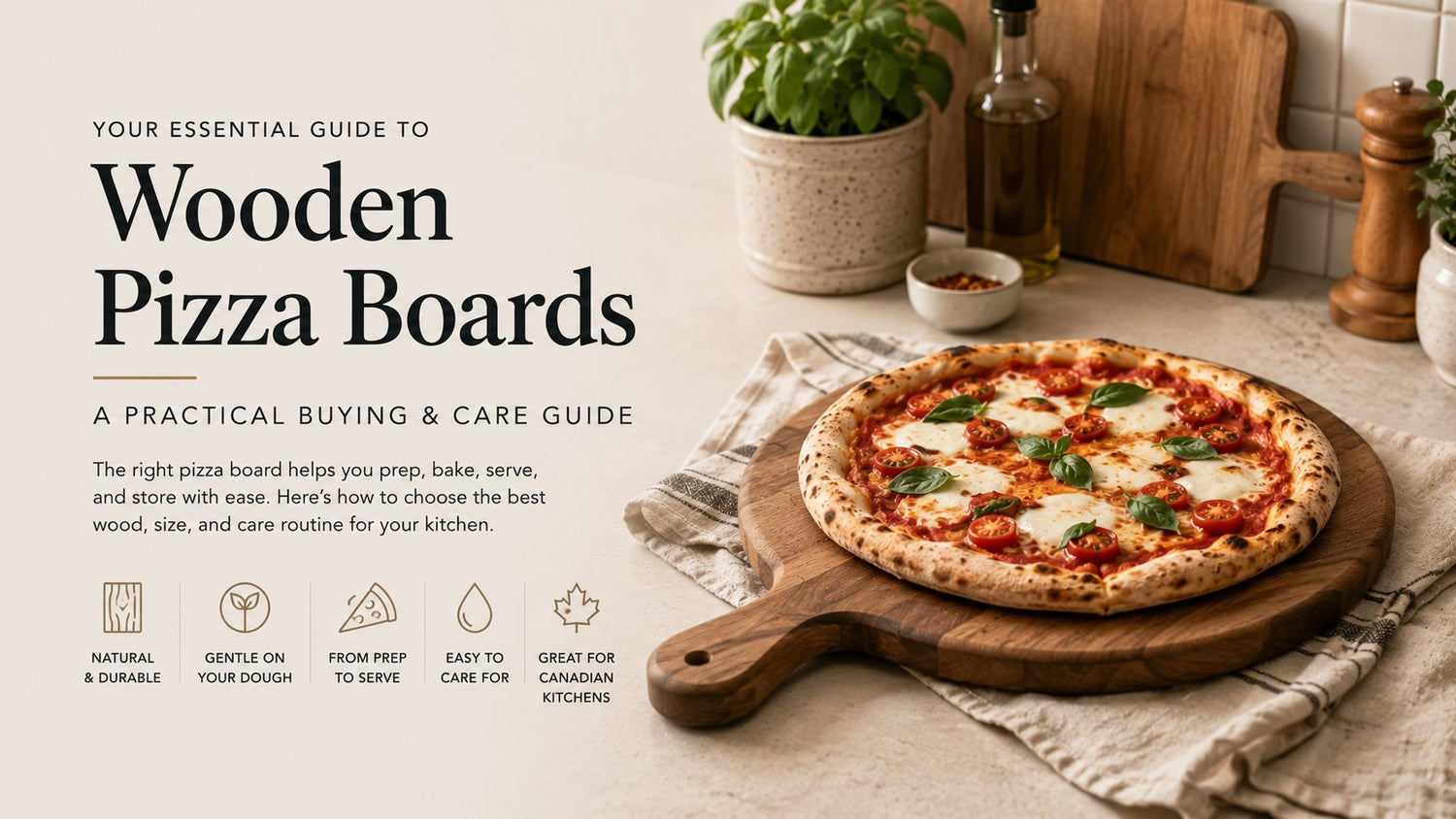
You've stretched the dough, added the toppings, and now the awkward part starts. The pizza sticks to the tray, the crust folds on the transfer, or the board you bought looks good on the counter but feels clumsy in a real kitchen. That's usually the moment people realise a pizza board isn't just a serving prop. It's a working tool.
For Canadian home cooks and small operators, that tool has to do more than look rustic. It needs to fit a modest oven, store neatly in a condo kitchen, stay flat through seasonal humidity changes, and clean up without becoming a maintenance headache. It also helps if it can move from prep to serving without making dinner feel like a balancing act.
A good wooden pizza board solves several small problems at once. It helps raw dough release more cleanly, gives your hands some protection from heat during serving, and turns a hot pizza into something you can carry and cut with a bit of confidence. If your kitchen is short on space, it can also double as a prep board or platter, which matters more than many product listings admit. If you're already reworking your kitchen setup, this kind of multi-use thinking also applies to the pantry, especially if you've been refining how to organise your pantry with bins and zones.
Table of Contents
- Your Essential Guide to Wooden Pizza Boards
- Why Wood Is Your Pizza's Best Friend
- Decoding the Wood Grain and Species
- Finding the Perfect Fit Size and Thickness
- The Art of Maintenance Cleaning and Oiling
- Weighing Alternatives to Wooden Boards
- Choosing with Confidence for Your Kitchen
Your Essential Guide to Wooden Pizza Boards
Wooden pizza boards sit in a useful middle ground between cookware and servingware. They're practical enough for regular weeknight use, but they also bring some of the feel of a proper pizzeria setup into an ordinary kitchen. That matters because pizza is one of those foods where the transfer step can ruin good work fast.
A wooden board or peel gives raw dough a friendlier launch surface than many people expect. It also gives finished pizza a stable place to rest, slice, and serve. In small homes, that double duty is often the difference between a tool that earns its shelf space and one that gets shoved behind the toaster.
Canadian buyers have a few extra considerations. Urban kitchens often have tighter storage, condo ovens can feel cramped, and swings in indoor humidity can be rough on neglected wood. Choosing well means paying attention to size, thickness, wood type, and maintenance, not just the shape of the handle.
Practical rule: Buy for the kitchen you have, not the fantasy pizza station you wish you had.
The strongest boards aren't always the biggest, and the prettiest ones aren't always the easiest to live with. A board that fits your oven, your sink, and your storage habits will get used. That's the one worth owning.
Why Wood Is Your Pizza's Best Friend
Friday night, the dough is stretched, the toppings are on, and the only part left is the transfer. That is where a wooden pizza board earns its keep. It gives raw dough a more forgiving surface to sit on, and it feels steadier in the hand while you line up the launch.

What wood does better than metal
Raw dough sticks for two main reasons. Moisture builds under it, or the cook hesitates during the slide. Wood helps on both fronts. A lightly floured wooden board holds just enough surface texture to keep the dough settled while you build, but it still releases well when the board is tipped and the pizza is given a confident shake.
Metal peels have their place. They are thin, fast, and excellent for turning or retrieving a baked pizza. For launching an uncooked pie, though, many home cooks find wood less twitchy. The board feels warmer, less slick, and easier to control in that two-second window between counter and stone.
Heat matters too. Wood does not pull heat through the handle the way metal can. At the table, that makes a wooden board more comfortable for serving and slicing. In a Canadian home, where one board often has to prep, serve, and store neatly in a condo kitchen, that versatility is worth paying for.
A good pizza board makes the transfer feel routine. That is the standard.
Wood also gives you a wider margin for error with common home oven sizes. Many Canadian ranges and wall ovens feel cramped once a stone or steel is inside, so a board that is a bit lighter and easier to angle can save a pizza that would otherwise catch on the oven frame. In practice, that matters more than showroom looks.
That same practicality is why some cooks keep wood for pizza and a separate board for wet prep or dishwasher-safe daily chopping. For comparison, the Combekk Recycled Paper Cutting Board 20x30 cm is listed at 73 and marked in_stock. It is made from 100% recycled paper and designed for knife work, which makes it useful as a contrast. It fills a different role than a wooden pizza board built for launching and serving.
Why professionals still reach for wood
Wooden peels have stayed in working kitchens for a simple reason. They solve a real handling problem. Bakers, pizzeria staff, and serious home cooks keep using them because raw pizza behaves better on wood than on many harder, colder surfaces.
Food-safe hardwood boards are also accepted for kitchen use when they are cleaned, dried, and maintained properly. That point matters more than romantic ideas about old-world tools. A neglected wooden board can warp, dry out, or pick up odours. A well-made one that is kept clean and lightly oiled works for years.
There is a trade-off. A thick serving board can be excellent on the table and annoying at the oven. If the edge is too blunt, the board is too heavy, or the face is too wide for a compact oven opening, the launch gets clumsy fast. For many Canadian buyers, especially in smaller urban kitchens, the best wooden pizza board is the one that fits the oven, fits the cabinet, and does not make pizza night harder than it needs to be.
Decoding the Wood Grain and Species
A wooden pizza board can feel right in the hand or awkward from the first use. Grain construction and wood species decide a lot of that. They affect weight, knife marks, moisture movement, and how the board fits into a real Canadian kitchen where storage is often tight and oven space is limited.

End grain and edge grain in plain terms
End-grain boards show the ends of the wood fibres. Knife edges tend to leave less obvious scoring because the fibres part and settle back. That makes end grain appealing if the board will spend as much time on the table and under a pizza wheel as it does near the oven. The trade-off is plain. End-grain boards are usually thicker, heavier, and pricier.
Edge-grain boards show the long side of each wood strip. They are often lighter, simpler to handle, and easier to store upright in a narrow cabinet or beside a fridge. For many home cooks, especially in condos or older urban kitchens, that matters more than a premium look.
Here is the practical split:
- End grain suits buyers who want a serving board that can handle frequent slicing and still age gracefully.
- Edge grain suits buyers who want a lighter board that is easier to carry, wash, and put away.
- For launching pizza, lower weight and a manageable profile usually matter more than visual drama.
I usually steer people toward edge grain unless they know they want a heavier presentation board. A board that lives on the counter can be beautiful. A board that has to come out of a tight drawer on a busy weeknight has to be easy first.
Species that make sense for pizza boards
Hardwood choice changes the feel of the board more than many product pages admit. Maple, beech, acacia, birch, and cherry can all work, but they do not work the same way.
Maple is the safe bet for good reason. It is hard, fine-grained, and widely used for food-contact boards. It wears evenly, does not shout for attention, and fits kitchens that need one board to do several jobs.
Beech has a similar practical appeal. It tends to be stable, straightforward, and less showy than acacia. Many buyers who care more about function than display end up happy with beech.
Acacia is popular because it looks rich on a product page and on the table. It also varies more from piece to piece, both in colour and density. That can be fine for serving, but some acacia boards end up heavier than expected, which matters if you are lifting a hot pizza in a small space.
Birch appears less often, but it has a sensible place. It is durable, usually lighter in appearance, and can suit people who want a cleaner, simpler look without going too soft.
Cherry brings warmth and a smoother visual character. It is often chosen for serving-focused boards rather than boards that will see hard daily cutting.
A quick rule helps here. Pick species by use, not by colour. The same way food storage container sizes affect how well a kitchen stays organized, board dimensions and wood choice need to match the routine, the oven, and the storage space you have.
Food safety guidance for wood cutting boards generally supports well-finished hardwoods that are kept clean, dried promptly, and maintained with oil. That matters more than marketing claims about one species being perfect for everyone. In real use, the best wood is the one that stays flat, feels comfortable, and does not turn basic pizza night into a juggling act.
If a board feels heavy and awkward when it is empty, it will not improve with a hot 14-inch pizza on top.
Common Woods for Pizza Boards Compared
| Wood Type | Hardness (Janka) | Grain Characteristics | Best For |
|---|---|---|---|
| Maple | Qualitatively hard and durable | Fine, even grain | Everyday prep, serving, frequent use |
| Beech | Qualitatively hard and stable | Tight, consistent grain | Practical work boards, simple maintenance |
| Acacia | Qualitatively hard with varied density | Bold, visible grain | Multi-use serving and prep boards |
| Birch | Qualitatively durable | Smooth, subtle grain | Heat-exposed workflows, artisan use |
| Cherry | Qualitatively softer than some other hardwoods | Warm colour, smoother visual character | Serving-focused boards, lighter-duty cutting |
Finding the Perfect Fit Size and Thickness
Most buyers spend too much time on wood species and not enough time on dimensions. In everyday use, size and thickness decide whether a board feels helpful or awkward.

A Canadian survey in 2025 found that 68% of renters prioritise multi-use kitchen tools, yet most wooden pizza board marketing doesn't explain board size against common oven dimensions or standard 12 to 14 inch supermarket pizza sizes, according to this summary of the sizing gap. That disconnect is exactly why people end up with boards that don't fit their routine.
Match the board to the pizza you actually make
Start with the pizza, not the board.
If you mostly bake frozen or take-home pizzas in the common 12 to 14 inch range, you don't need an oversized showpiece. You need enough border around the crust to carry it safely, plus a shape that turns comfortably in your kitchen. In many condo kitchens, a compact round or a moderate rectangular board is easier to wash, store, and grab quickly.
Use this practical filter:
- Mostly 12-inch pizzas: choose a board with enough margin to carry and slice without crowding the crust.
- Mostly 14-inch pizzas: move up, but only if your oven door, counter depth, and storage all allow it.
- Outdoor oven users: a larger board can make sense, because the workflow usually gives you more room.
- Apartment kitchens: favour a board that can also act as a serving platter or prep surface.
Before buying, measure three things: your oven opening, the clear landing space on your counter, and the cabinet or vertical slot where the board will live. If storage is tight, this kind of pre-measuring is no different from choosing food storage container sizes. Fit comes first.
Thickness matters more than most listings suggest
A thin board can feel handy in the hand but disappoint over time. Wood boards used around heat need enough body to stay flat. A thickness of 0.5 inches or more provides the thermal mass needed to better resist warping, based on the same wood-performance note cited earlier in the article.
That doesn't mean thicker is always better. A very thick serving board can become cumbersome fast, especially if it has a long handle and you're carrying a loaded pizza through a narrow kitchen path. The sweet spot is usually thick enough to stay stable, but not so heavy that you avoid using it.
A good check is simple. Hold a loaded cutting board or sheet pan from your kitchen with one hand. If that already feels tiring, don't buy a pizza board that exceeds that feel just because the photos look beautiful.
The Art of Maintenance Cleaning and Oiling
Friday night, the pizza is out, and the board goes from hot serving piece to cleanup job in a few minutes. That's the moment that decides whether a wooden pizza board stays flat for years or starts to cup, roughen, and split before the next hockey season.

Wood rewards a steady routine. It does poorly with two things. Long exposure to water and long stretches of neglect. In many Canadian homes, especially condos with tighter kitchens and less airflow, boards often get tucked beside the fridge or slid into a narrow cabinet while still slightly damp. That habit causes more trouble than normal washing ever will.
A simple cleaning routine that works
Clean the board soon after use, while flour and cheese are still easy to remove. Scrape first. Wash second. Dry right away.
Canadian food-safety guidance for wooden food-contact surfaces recommends checking for cracks, washing thoroughly with hot, soapy water, and drying well so moisture does not linger in the wood. That same approach works in a home kitchen and in a small café.
A practical routine looks like this:
- Remove loose debris: Use a bench scraper, dough scraper, or dry cloth.
- Wash briefly: Hot, soapy water is enough for normal use.
- Dry both faces: Towel-dry the front, back, and edge.
- Air-dry upright: Stand it on edge so both sides release moisture evenly.
- Store with breathing room: Avoid pressing it tight against damp trays or dishcloths.
If you already follow good habits for cleaning food storage containers without trapping odours or residue, the same principle applies here. Clean promptly, dry thoroughly, and don't leave food residue sitting overnight.
One simple rule helps. Water is not the enemy. Trapped moisture is.
How to oil without overthinking it
Oiling keeps the fibres from drying out and taking on moisture unevenly. It works like moisturizer for skin. The board should feel nourished, not slick.
Use a food-safe mineral oil or a board cream made for kitchen wood. Apply a light coat to a clean, fully dry board, spread it with a cloth, let it soak in, and wipe off what the wood does not absorb. More oil does not mean better protection. Excess just sits on the surface and feels greasy.
Wood movement is normal. The USDA Forest Products Laboratory notes that wood shrinks and swells as its moisture content changes, especially across the grain, which is why boards that dry unevenly are more likely to warp or crack over time. Regular oiling helps slow moisture swings. It does not make the board waterproof, but it does make daily use much more forgiving.
This short video shows the general motion and pacing clearly:
Signs a board needs oil:
- Dull surface: The wood looks dry or chalky.
- Raised grain: The board feels slightly fuzzy after washing.
- Patchy colour: Areas near the rim or handle look drier than the centre.
- Fast absorption: A few drops of water soak in quickly instead of sitting briefly on the surface.
In a heated Canadian home in winter, many boards need oil more often than owners expect. Dry indoor air pulls moisture out of wood fast. In summer, the issue often flips, especially in older homes or busy kitchens with less ventilation.
When a board needs more than soap and water
A rough surface can usually be fixed. Light sanding with the grain will smooth small knife marks, flour burn, and raised fibres. Wipe away the dust, then oil the board again before putting it back into service.
Deep cracks are different. Once a split opens enough to catch debris or moisture, the board becomes harder to clean properly and less pleasant to use. For a serving board, you might tolerate cosmetic wear. For a working pizza board that sees dough, sauce, and slicing, hygiene and stability matter more than sentiment.
Check the board on a flat counter now and then. If it rocks, the shape has changed enough to affect slicing, serving, and storage. In a small urban kitchen, where boards often double as prep space and need to slide into a narrow slot afterward, that matters quickly. A board you have to baby every time you put it away is a board you will stop reaching for.
Weighing Alternatives to Wooden Boards
Wood isn't the only option, and it isn't the right answer for every job. The best setup often depends on whether you care most about launching raw dough, retrieving a baked pizza, easy cleaning, or compact storage.
When metal earns its place
Metal peels are thin. That's their biggest strength. When a pizza is already baked and you need to slide under it cleanly, a thin metal edge behaves more like a giant spatula than a board.
The downside comes earlier in the process. Raw dough tends to be less forgiving on metal, especially if your flouring is inconsistent or you pause too long before the launch. Metal also transfers heat quickly, which can make it less pleasant for serving.
For many cooks, the practical split is simple. Wood for launching and serving. Metal for retrieval.
Where composite boards fit
Composite and paper-based alternatives can be useful when cleaning convenience matters more than tradition. They often suit buyers who want a prep or serving board that feels lower-maintenance than wood.
That's where a product such as the larger Combekk recycled paper board can make sense as a separate utility item, not as a stand-in for a classic wooden launch peel. The use case is different. One is about oven workflow and tactile control. The other is about prep convenience and easy cleanup.
A quick comparison helps:
- Wooden boards: Better feel for raw dough, better insulation, more maintenance.
- Metal peels: Better for retrieval, thinner edge, less forgiving with raw dough.
- Composite boards: Easier cleaning, often less character in hand, different serving feel.
If you're comparing materials in a broader kitchen-organising sense, the logic isn't far off from weighing glass vs plastic food storage containers. No material wins every category. The right one depends on the job.
The wrong board isn't always poor quality. Often, it's just assigned to the wrong task.
Choosing with Confidence for Your Kitchen
The right wooden pizza board is the one that matches your space, your pizza habits, and your willingness to maintain it.
If you cook for a family and have room to store a larger board, a durable hardwood board with sensible thickness is usually the steady choice. It should feel planted on the counter and comfortable enough to carry from oven to table without strain.
If you rent or live in a smaller urban kitchen, prioritise footprint and double duty. A board that handles pizza night but also works as a serving platter or prep surface will earn its keep. Slimmer storage, moderate size, and manageable weight matter more than a dramatic slab of wood.
If you run a small hospitality operation or cook at volume, think in terms of routine. Choose a board that staff can clean properly, inspect easily, and handle fast. A beautiful board that slows down service or develops maintenance issues isn't a practical asset.
One last filter helps. Ask yourself where the board will live on an ordinary Tuesday. If you don't have a clear answer, it's probably too big or too specialised. If you do, and the board also matches the pizzas you make, you're on the right track. For broader kitchen fit and storage planning around everyday tools, guides like pantry storage racks can help keep the rest of the space as functional as pizza night.
GrifGlo helps shoppers compare practical home and kitchen essentials with clear sizing, use-case guidance, and decision-friendly product context. If you're narrowing down wooden pizza boards, prep tools, or other everyday kitchen gear, GrifGlo is one place to organise the options before you buy.

Laisser un commentaire
Ce site est protégé par hCaptcha, et la Politique de confidentialité et les Conditions de service de hCaptcha s’appliquent.