

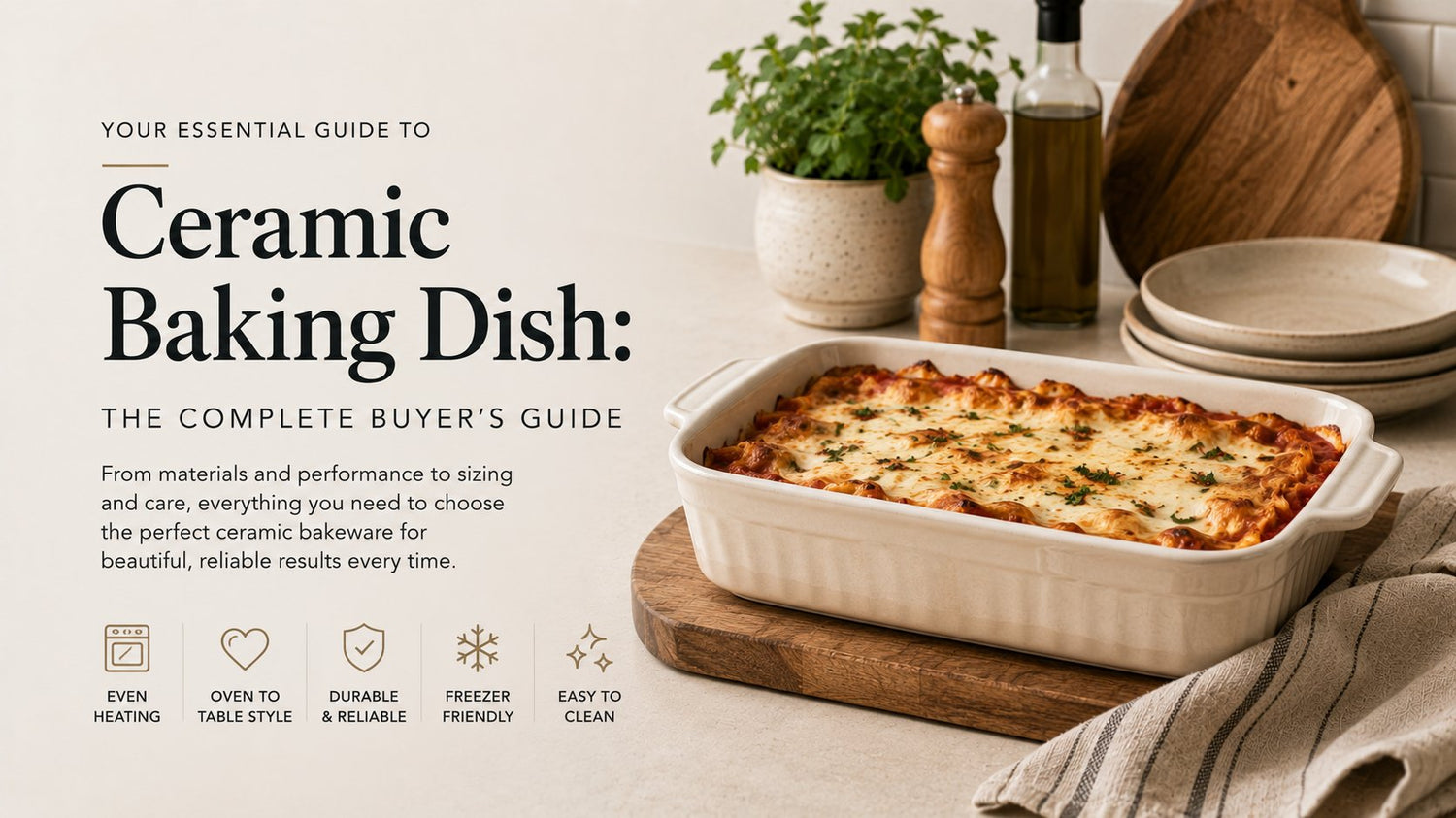
You're probably here because one dish keeps letting you down. The lasagna bubbles at the edges but stays cool in the middle. The baked oatmeal dries out at the corners. Or you're trying to buy once, buy properly, and stop second-guessing whether the dish that works for a family dinner will also hold up in a rental kitchen or a small hospitality setup.
That's where a ceramic baking dish earns its place. It isn't just about looks, although ceramic does move neatly from oven to table. It's about steadier heat, better control for casseroles and baked pasta, and a style of cookware that suits both everyday households and people outfitting several kitchens at once.
Table of Contents
- Your Essential Guide to Ceramic Bakeware
- The Enduring Appeal of Ceramic Bakeware
- Ceramic vs The Competition A Material Showdown
- Mastering Heat Ceramic Performance Explained
- Finding Your Fit Sizing and Capacity Guide
- A Smart Buyer's Guide to Reliable Bakeware
- Care and Maintenance for a Lifetime of Bakes
Your Essential Guide to Ceramic Bakeware
A good baking dish fixes a very ordinary problem. You want dinner to cook evenly, hold its warmth on the table, and clean up without a wrestling match in the sink. For many home cooks, ceramic is the piece that solves all three.
That matters because home baking and roasting are part of daily life for a lot of households. Statistics Canada reported that 68% of households engaged in daily baking or roasting activities in 2023, as noted in DataHorizzon Research's market summary. When people use bakeware often, the wrong material gets annoying fast.
Ceramic tends to suit dishes that need patience rather than aggression. Think lasagna, gratins, bread puddings, cobblers, enchiladas, and make-ahead casseroles. It's also a sensible choice if you want one piece that works for a household kitchen today and still makes sense later if you move, batch-cook more often, or start organising supplies for a rental or guest suite.
Practical rule: If the food should cook gently and stay hot after serving, ceramic is usually the safer bet than a thin metal pan.
If you're also trying to make the rest of the kitchen work better around that dish, organised shelving helps more than people expect. A simple system for ingredients, lids, and pans keeps everyday cooking smoother, especially in smaller homes. GrifGlo's guide to pantry storage racks is useful if your bakeware competes for space with dry goods and appliances.
The Enduring Appeal of Ceramic Bakeware
Ceramic bakeware has lasted because it solves a basic cooking problem well. Food rarely cooks nicely when heat hits it too hard or too unevenly. Ceramic softens that process.
Why ceramic still feels current
Ceramic isn't a trend piece. It has a long cooking history, and that history matters because it tells you what the material is naturally good at. According to the background provided on cookware and bakeware history, ceramics' role as baking vessels traces to pre-contact First Nations communities in Canada using clay dishes for slow-baking over fires, a method that mirrors how many people use the oven now. The same source also notes that a 2024 Canadian Kitchenware Association report found 72% of Ontario households own ceramic baking dishes, with even heat distribution and table appeal named as reasons.
That combination explains ceramic's staying power. It cooks gently, and it looks at home on the table.
Think of ceramic like a heat battery
The easiest way to understand ceramic is to stop thinking of it as a simple container. Think of it as a heat battery.
A metal pan grabs heat fast, a bit like turning on a bright flashlight. You get quick response, but you also get hot spots. Ceramic behaves more like a brick hearth. It warms gradually, stores that warmth, and then releases it in a steadier way. That makes a visible difference in foods where you want the centre and edges to move toward doneness together.
For a custard, that means less risk of a tough outside and undercooked middle. For a baked pasta, it means the sauce has more chance to simmer rather than split. For a fruit crumble, it helps the filling cook through before the topping gets too dark.
Ceramic rewards foods that benefit from calm, even heat rather than sharp bursts of intensity.
Why people keep reaching for it
Some tools stay in the cupboard because they're specialised. A ceramic baking dish usually doesn't. It becomes the pan for Sunday baked French toast, weeknight enchiladas, reheated leftovers, and the dessert you bring to a gathering.
A few reasons stand out:
- Evener cooking: Ceramic's natural heat behaviour favours casseroles, gratins, and other layered dishes.
- Oven-to-table use: The dish often looks presentable enough to serve from directly.
- Food compatibility: Ceramic is a comfortable choice for acidic bakes like tomato sauces and fruit desserts.
- Daily practicality: One dish can cover prep, bake, serve, and often storage once cooled.
For households, that means fewer specialised pans. For small businesses and hosts, it means easier standardisation. The same material that helps a family dinner feel more predictable also helps a guest kitchen feel more dependable.
Ceramic vs The Competition A Material Showdown
A ceramic baking dish isn't automatically the right answer for every recipe. The useful question is simpler. What job do you need the dish to do?

Bakeware Material Comparison
| Material | Heat Retention | Heat Conduction | Best For | Key Considerations |
|---|---|---|---|---|
| Ceramic | High | Slower, gentler | Casseroles, baked pasta, cobblers, custards | Longer preheat, can crack with sudden temperature change |
| Glass | Moderate to high | Gentle | Bakes where you want to see browning on the sides | Needs care with temperature shifts |
| Metal | Lower retention | Fast | Roasting, crisp edges, quick browning | Can create hot spots, some metals react with acidic foods |
| Silicone | Low to moderate | Soft, less direct | Flexible unmoulding, some desserts | Less structure, usually not ideal for classic casseroles |
Ceramic versus metal
Metal is the sprinter. Ceramic is the distance runner.
If you want deep browning, fast response, or a tray that heats up quickly for roasted vegetables, metal does that well. If you want a lasagna to bake evenly through multiple layers, ceramic is often easier to control. The difference shows up most clearly in moisture-rich dishes. Metal can push the outside ahead of the centre. Ceramic gives the middle more time to catch up.
That's why many cooks keep both. Metal handles speed and colour. Ceramic handles steadiness.
For acidic dishes, ceramic also feels less fussy. Tomato sauces, berry bakes, and lemony casseroles all sit comfortably in it.
Ceramic versus glass
Glass and ceramic often get grouped together because they're both common for casseroles and desserts. In real kitchens, they overlap, but they don't behave exactly the same.
Glass lets you see what's happening around the edges, which some cooks love for baked puddings or fruit crisps. Ceramic usually feels a bit more forgiving in presentation and table use. It also has that classic substantial feel that many people prefer when serving.
Where readers often get stuck is storage and cleanup after baking. If you use heavier dishes regularly, a dedicated drying setup helps prevent awkward stacking near the sink. Something like the HOME AESTHETICS HA-4403 Dishrack 2 Tier With Rubbermaid fits naturally into that routine because its 2-tier space-saving design, built-in drainboard system, cutlery and glass holders, and durable steel frame support bulkier kitchen items without forcing them to crowd the counter.
Ceramic versus silicone
Silicone is handy, but it plays a different role. It's useful when flexibility matters, such as unmoulding certain bakes. It doesn't give the same sturdy, oven-to-table presence as ceramic, and it's usually not the first choice for a bubbling family-size casserole or a dish that guests will serve from directly.
The fit-for-purpose view
For households, choose by recipe pattern. If you bake saucy, layered, or make-ahead meals, ceramic deserves a permanent spot. If you mostly roast, sear, and chase crisp edges, metal may be your first reach.
For hosts and small operators, reliability matters even more than versatility on paper. Standardising on ceramic can make sense when you want guests or staff to use one intuitive dish for bakes, reheats, and table service. If you're also comparing broader storage materials for leftovers and prep, GrifGlo's guide to glass vs plastic food storage containers helps clarify where ceramic fits in the wider kitchen system.
Mastering Heat Ceramic Performance Explained
The biggest misunderstanding about a ceramic baking dish is that “slower” means “worse”. In baking, slower can be exactly what you want.

What slow heating actually does
According to Mariano's guide to baking dishes, ceramic materials absorb and distribute heat more slowly than metal but maintain stable temperatures longer once hot. The same source notes this makes ceramic especially useful for delicate baked foods like casseroles and custards because it helps prevent hot spots. The trade-off is practical and simple: cooking can take 5-10% longer than in metal pans.
That sounds minor until you see it in action. A metal pan can race ahead at the edges. Ceramic tends to narrow the gap between the edge and the centre. So while dinner may need a bit more time, the result is often more even.
How that changes your cooking
Three kitchen habits make ceramic work better:
- Preheat properly: Ceramic rewards a fully heated oven. If the oven is still climbing, the dish's slower response can stretch cooking unpredictably.
- Use it for gentle bakes: Custards, gratins, bread puddings, stuffed pasta bakes, and baked oatmeal all benefit from steadier heat.
- Let carryover warmth help you: Ceramic stays warm after it leaves the oven, which is useful for serving and for dishes that set as they rest.
A ceramic dish doesn't rush. If your recipe needs patience, that's a strength, not a flaw.
Safe heat use without cracked dishes
Ceramic is durable, but it hates shock. The easiest analogy is ice on a winter windscreen and very hot water. Sudden change creates stress.
Use these rules:
- Oven: Yes, that's its home.
- Microwave: Often yes, if the specific dish says it's microwave safe.
- Broiler: Use caution. Intense top heat can be too abrupt for some dishes and glazes.
- Stovetop: No. A ceramic baking dish isn't built for direct burner contact.
And the most important habit of all:
- Avoid thermal shock: Don't move a cold dish straight into very high heat if the maker warns against it, and don't place a hot dish onto a cold wet surface or run cold water into it right away.
When ceramic is the smart choice
If you're baking something delicate, layered, creamy, or acidic, ceramic gives you a wider margin for error than a thin metal pan. If you're chasing speed above all else, use metal instead.
That is the true lesson of ceramic performance. It is not the fastest tool in the kitchen. It is one of the steadiest.
Finding Your Fit Sizing and Capacity Guide
Size is where many people buy the wrong ceramic baking dish. They focus on colour, shape, or handles, then discover the dish doesn't match the way they cook.

A simple rule helps. Match the dish to your most common cooking pattern, not your biggest holiday meal.
What the common sizes are good at
A rectangular 9x13-inch dish is the classic workhorse. It suits lasagna, enchiladas, baked pasta, larger cobblers, breakfast casseroles, and batch-cooked mains. Verified product data for ceramic bakeware notes that 9x13-inch dishes typically range from 4.3 to 5.3 quarts, which helps explain why they're so useful for family meals and make-ahead cooking.
An 8x8-inch dish is the better pick for smaller households, side dishes, brownies, baked dips, and scaled-down casseroles. It feels less wasteful when you're not feeding a crowd.
Round and oval dishes are often more specialised. They work well for pies, gratins, and table service, but many kitchens still benefit most from starting with one square and one rectangular piece.
If you cook once and eat twice, a rectangular dish usually earns its shelf space first.
Home kitchens and shared kitchens need different logic
Market demand reflects that broader use. The North American ceramic baking dishes market was valued at USD 3.5 billion in 2023, and the home use segment accounts for 70% of the market, according to the source assigned to this article's opening section. That same market view also notes growing demand from hospitality and rental properties, which changes how sizing decisions work.
For a home kitchen, ask:
- Do you cook for one or two most nights? Start smaller.
- Do you batch-cook weekends? Choose the larger rectangle first.
- Do you want oven-to-table serving? Pick a shape that fits your dining routine, not just your oven.
For small businesses, hosts, and property managers, the checklist shifts:
- Standardise shapes: Fewer sizes make replacement easier.
- Choose stack-friendly forms: Straighter sides and similar footprints simplify storage.
- Prioritise versatility: A dish that handles pasta bakes, reheats, desserts, and breakfast casseroles reduces the need for multiple specialised pieces.
- Think about carrying weight: Staff and guests tend to handle medium-size dishes more confidently than oversized ones.
A useful parallel is food storage. The right container size saves space, avoids waste, and makes repeated use simpler. GrifGlo's guide to food storage container sizes applies that same fit-for-purpose thinking to another everyday kitchen category.
A sensible buying pattern
If you're building from scratch, one practical pairing covers a lot of ground: one larger rectangular dish and one smaller square dish. That setup works for most households and gives small operators a clean starting point for standardising kitchens without overbuying.
A Smart Buyer's Guide to Reliable Bakeware
A ceramic baking dish can look excellent on the shelf and still be the wrong buy. Reliability starts with the details you don't notice at first glance.

Start with safety and heat rating
The clearest quality signals are material safety and temperature tolerance. According to the verified product information from DafuCeramic's porcelain baking dish listing, high-quality ceramic dishes are explicitly manufactured to be lead-free and cadmium-free. The same source says standard dishes typically handle 450-500°F, while premium enamel-coated porcelain can reach 650°F.
That doesn't mean everyone needs the highest rating. It means the rating should match your cooking habits. If you mainly bake casseroles and fruit desserts, standard tolerance may be enough. If you want more flexibility for hotter oven use and longer-term durability, premium porcelain may justify the step up.
What to inspect before buying
Look at the dish like a tool, not décor.
- Glaze quality: The surface should look even, smooth, and free from visible cracks or rough patches.
- Handles: Integrated handles matter more than people realise when the dish is full and hot.
- Weight: Heavier pieces often feel steadier and less flimsy in daily use.
- Shape: Straightforward shapes are easier to stack, store, line, and clean.
- Use labels: Check whether the dish is approved for microwave, freezer, dishwasher, or oven use according to the maker.
For buyers who also want everyday ceramic outside the oven, GrifGlo lists options such as the Ceramic Food Storage & Lunch Box category in its broader kitchen organisation approach. The platform's guide on how to choose food storage containers is useful when you're comparing material quality, lids, and routine use across more than one kitchen task.
What makes a dish worth paying for
A cheap dish can become expensive if it chips, crazes, or feels unreliable every time you pull it from the oven. A better way to judge value is to ask how often the piece will be used and by whom.
For a household, that might mean one dependable rectangular dish used several times a week. For a host or small business, it might mean choosing a model that different people can use with confidence and replace consistently if needed.
Here's a quick visual explainer before the final checklist:
The shortlist that usually works
If you want a practical buying filter, keep it tight:
- Confirm lead-free and cadmium-free language
- Check the temperature rating
- Inspect the glaze
- Lift it by the handles
- Choose the size that fits your normal routine
Buy the dish you'll use every week, not the one that only makes sense on holidays.
Care and Maintenance for a Lifetime of Bakes
Ceramic lasts well when you treat the glaze kindly. Most damage happens after cooking, not during it.

Let the dish cool before washing. That one habit does more than any fancy cleaner because it reduces the chance of thermal shock. Once it's warm or cool, soak stuck-on food with warm water and mild soap rather than attacking it straight away.
Cleaning without harming the surface
Use a soft sponge or cloth for most residue. For stubborn baked-on spots, a paste of baking soda and water can help. If needed, let the dish soak longer and loosen food gently with a non-metal utensil.
Avoid steel wool and harsh abrasive pads. They can scratch the glaze, and once the surface is compromised, the dish becomes harder to clean and less pleasant to use.
Storage habits that prevent chips
Storage is where many otherwise good dishes get damaged. If you stack ceramic pieces, place a cloth, paper towel, or soft liner between them. That reduces rubbing and edge knocks.
For households, this keeps favourite dishes looking presentable. For rental properties or shared kitchens, it also makes breakage less likely when different people unpack and restack items.
A simple cleaning and storage routine keeps ceramic useful for years. If you're building better habits across the rest of the kitchen too, GrifGlo's guide on how to clean food storage containers follows the same practical approach: protect the material first, then remove the mess.
A well-chosen ceramic baking dish can simplify weeknight cooking, make oven-to-table serving easier, and help households, hosts, and small operators buy with more confidence. GrifGlo publishes decision-friendly guides for home, kitchen, organisation, and bulk purchasing, so you can compare practical options, spot reliability signals, and build a setup that fits real routines.

Laisser un commentaire
Ce site est protégé par hCaptcha, et la Politique de confidentialité et les Conditions de service de hCaptcha s’appliquent.