

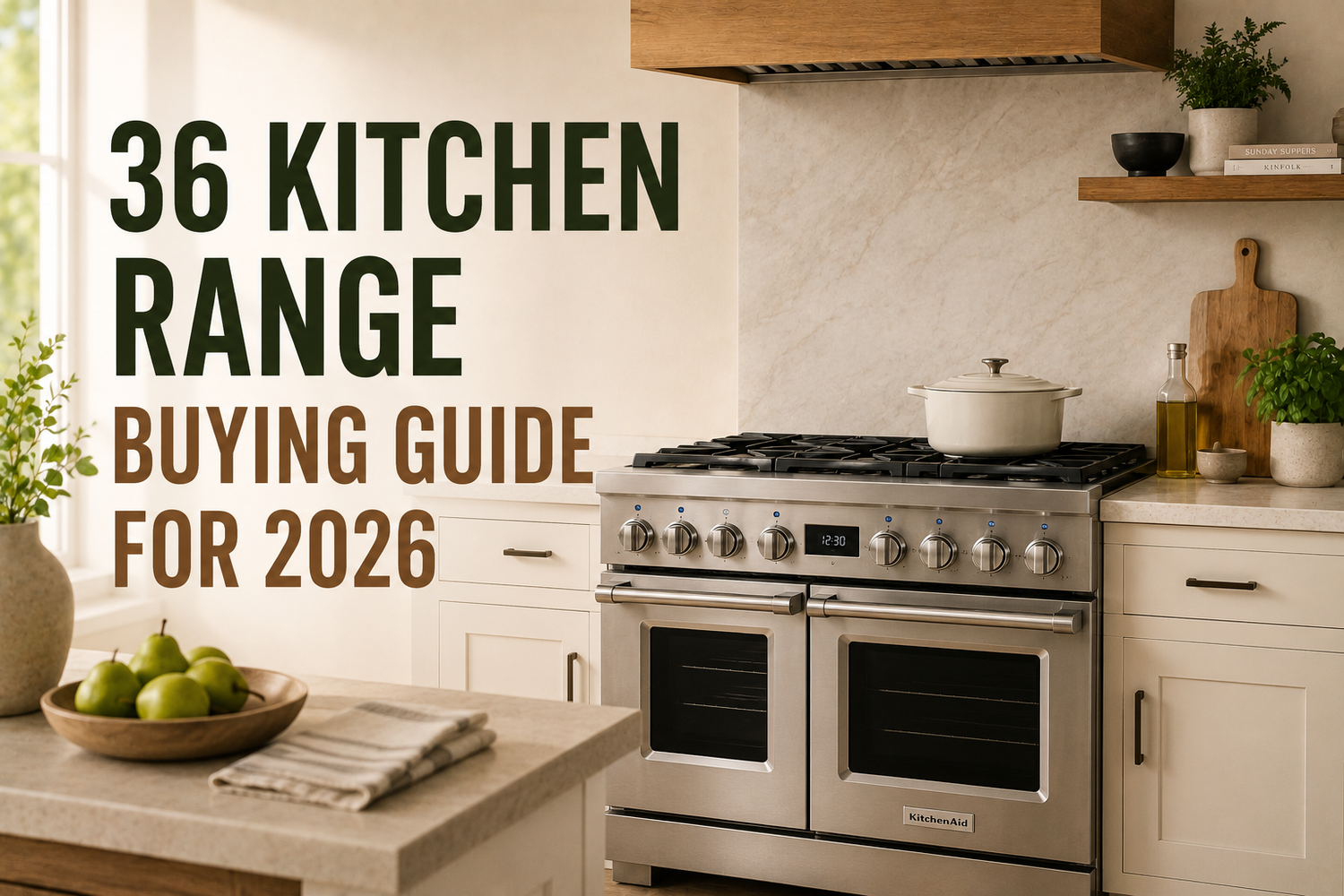
You're standing in a kitchen that's doing too much with too little. One pan is fighting for space next to another, the oven feels tight when you try to roast a full tray, and you're wondering whether a 36 kitchen range is a real upgrade or just a wider version of the stove you already have. In California, that question gets more serious fast, because appliance choices sit inside a high-cost housing market, older kitchen layouts, and ventilation rules that can make or break the install.
A 36-inch range is usually not about luxury for its own sake. It's about whether the kitchen can support better cooking flow, a wider oven cavity, stronger burner output, and the venting that keeps all of that usable day after day. In a state where more than one-third of homes were built before 1970 and the median sale price for an existing single-family home reached $869,500 in June 2026 (California housing and remodel context), the range decision becomes part of the whole kitchen system, not just a purchase at the appliance aisle.
Table of Contents
- Why a 36 Kitchen Range Changes the Way You Cook
- What Counts as a 36 Kitchen Range Today
- Gas, Electric, Dual-Fuel, and Induction Compared
- Measuring Your Kitchen Before You Measure the Range
- Venting and Hood Sizing for a 36 Kitchen Range
- Matching Features to Your Cooking Habits
- Price, Weight, and Long-Term Ownership
- Your 36 Kitchen Range Decision Checklist
Why a 36 Kitchen Range Changes the Way You Cook
A homeowner usually feels the difference the first time dinner gets busy. One pot is simmering, another pan needs a quick sear, and the oven is already occupied with a sheet pan. On a standard setup, that starts to feel cramped. On a 36 kitchen range, the extra width gives each task its own space, so the cook isn't constantly shuffling handles, moving pans, or working around hot spots.
More room changes the rhythm, not just the footprint
The practical gain is workflow. Independent appliance guidance notes that 36-inch models commonly provide 5 to 6 burners and larger oven cavities than 30-inch units, which is why this size is often chosen for family-scale meal prep and more serious home cooking (36-inch model guidance). That extra burner real estate matters when you're running sauce, vegetables, pasta water, and protein at the same time. It also matters if you want a visual centerpiece that signals a more finished kitchen for resale.
People often underestimate the category. They see inches, but what they're really buying is cooking capacity and fewer compromises during a busy meal. A compact slow cooker like the Hamilton Beach Oval Slow Cooker 4QT, 33140VCR serves a very different job, one or two people and a simple set-and-forget routine. A 36-inch range is the opposite end of that logic, built for simultaneous cooking and a broader oven workflow.
Practical rule: if your biggest pain point is burner crowding or oven crowding, the width change matters. If your pain point is install feasibility, the width is only one part of the decision.
A useful way to think about it is this, the range becomes the centre of a cooking zone rather than just a hot box under the counter. That is why the category keeps showing up in higher-value kitchen upgrades, especially in homes where the existing layout has to be preserved.
What Counts as a 36 Kitchen Range Today
A 36 kitchen range is more than a wider version of a 30-inch appliance. It is a different kitchen-system choice, because the cooktop, oven, vent hood, cabinet opening, and delivery path all need to work together. In California homes, that matters even more, since older housing stock often means tighter hallways, narrower doorways, and remodels that have to fit into an existing footprint.

The category sits between residential and commercial
Most 36-inch ranges sit in a premium residential category with pro-style cues, not true commercial equipment. Product specifications show that 36-inch electric and gas models commonly carry 6 burners and oven capacities around 5.1 to 6.3 cubic feet, with outputs ranging from about 18,200 watts on electric units to roughly 130,000 BTU total on some gas configurations (range cooker market and product specs). That is enough capacity for family cooking, entertaining, and larger roasting jobs without crossing into a full commercial buildout.
That middle position is why the category also needs to be judged as a system. A range with stronger burners can demand a stronger hood, because capture depends on more than width alone. If the hood cannot pull smoke and heat far enough out of the cooking plume, the extra power just spreads the mess faster. For a buyer, the useful question is not only whether the range fits the opening, but whether the entire cooking zone can handle the output safely and comfortably.
Why the size feels different in daily use
Burner spacing is where the difference becomes obvious. Four burners can cover everyday cooking, but five or six burners give you room to run sauce, vegetables, pasta water, and protein at the same time without crowding pan handles. Oven cavity size changes the experience in the same way, because larger cavities give baking sheets, roasting pans, and holiday trays more clearance around the sides.
That extra air space matters. It helps hot air move around food instead of getting trapped against the pan or the oven wall, which is why a bigger cavity often feels easier to use even before you fill it. A 36-inch model also tends to feel more forgiving when you are loading awkward cookware or cooking multiple dishes at once.
The install path matters just as much as the cutout. A range can look straightforward on paper, then get stuck at the front door, in a narrow hallway, or at a tight kitchen turn. If you are comparing a slide-in range layout with a standard drop-in or freestanding setup, the details of trim, clearance, and cabinet edges shape the final fit as much as the nominal width does.
Gas, Electric, Dual-Fuel, and Induction Compared
A 36-inch range is a kitchen-systems choice, not just a width choice. The fuel type changes how heat arrives, how the oven behaves, how much electrical support the installation needs, and how hard the ventilation system has to work. In a California home, that matters even more because older housing stock, tighter cabinet runs, and mixed utility setups often shape the final decision as much as the cooktop itself.
What each configuration feels like in daily use
Gas gives immediate visual feedback. You turn the knob, the flame changes, and the burner reacts at once. Premium 36-inch gas ranges can carry 22,000 BTU front burners and a 116,000 BTU total cooktop rating (premium 36-inch gas range specs). That profile fits cooks who want strong searing, quick adjustments, and a burner layout that feels easy to read at a glance.
Dual-fuel combines a gas cooktop with an electric oven. The cooktop side behaves like gas, while the oven side behaves more like an electric baking chamber, which many buyers prefer for steadier roasting and baking. Product specifications for 36-inch dual-fuel pro ranges show 18,000 BTU burners, a 4.9 cu. ft. oven, and 240/208V, 30A power requirements (dual-fuel pro range specs). That mix often suits households that cook on the range and bake in the oven often enough to care about oven consistency.
Electric is the straightforward answer when gas service is absent or not practical. Larger 36-inch electric models can reach 18,200 watts in product specs (range cooker market and product specs). For buyers comparing operating habits rather than showroom labels, a clear overview of gas or electric cooktop costs helps frame the utility discussion without turning it into a brand debate.
Induction belongs in the same conversation because it uses the 36-inch format to deliver fast response with a cooler cooking surface. It behaves differently from gas and electric resistive tops, but for a buyer who wants rapid control and a cleaner top to wipe down, it can be the most direct fit. If oven space matters more than flame cooking, a reference like electric stove with double oven is useful for comparing how electric formats handle baking capacity.
Snapshot comparison
| Configuration | Typical Cooktop Output | Oven Capacity | Best For |
|---|---|---|---|
| Gas | Up to 116,000 BTU total on premium models | Varies by model | High-heat searing and visible flame control |
| Dual-fuel | 18,000 BTU burner class | 4.9 cu. ft. | Better baking plus strong cooktop response |
| Electric | Up to 18,200 watts | Around 5.1 to 6.3 cu. ft. across the category | Homes without gas and buyers wanting simpler planning |
| Induction | Not expressed in BTU, uses zone-based electrical control | Varies by model | Fast response, cooler cooktop, precision simmering |
A useful way to read the table is to separate cooktop behavior from oven behavior. Gas and induction change the feel at the burners, while dual-fuel changes the oven experience more than the cooktop experience. Electric can suit households that want a wide cooking surface with fewer gas-planning constraints, but the installation still needs the right electrical capacity and cabinet planning to make the appliance work as intended.
Measuring Your Kitchen Before You Measure the Range
A 36-inch purchase goes wrong most often when someone measures only the cabinet opening and skips the path that gets the range into the kitchen. The cutout matters, but so do the doorway, hallway, gas line, electrical access, and the floor route from the entrance to the installation spot. California guidance stresses checking cabinet width, depth, and height, along with the route through hallways and doorways, because the appliance still has to fit through the house before it can fit into the cabinet opening (range measuring guidance).

Measure the whole path, not just the opening
Start at the cabinet cutout, then work back toward the front door. A range that fits the opening can still stop at a tight hallway turn or a narrow doorway, and that problem shows up before installation begins. Buyers often miss that because a 36-inch model feels like a simple wider swap, when the key question is whether the home can receive it cleanly.
The utility check comes next. A 36-inch professional gas range in the California market commonly needs a 120V, 60Hz, 20A electrical connection even when the cooktop itself uses gas, because ignition, controls, and auxiliary features still need power (36-inch gas range electrical requirements). That means the essential planning question is not just whether gas is present, but whether gas and electrical access are both in the right place before the cabinetry is locked in.
Practical rule: if the gas stub, outlet location, or cabinet dimensions are uncertain, pause the order. Cabinets can be adjusted around an appliance. A missing utility connection can stop the project.
The size of the range also needs to line up with the rest of the kitchen, not just the opening in front of it. A larger cooktop often belongs in a layout that can support the surrounding landing space, ventilation, and fridge placement, which is why planning a kitchen layout in 2026 is useful when you are mapping the whole room instead of treating the range as a standalone purchase. If refrigeration is part of the same upgrade, 36-inch fridge sizing helps show why appliance widths have to work together, not one by one.
Venting and Hood Sizing for a 36 Kitchen Range
A wider cooktop doesn't just take up more counter line, it creates a wider thermal plume. That plume carries heat, grease, steam, and cooking particles upward, so hood performance matters as much as burner count. In California, where indoor air quality is a daily concern, that makes venting one of the most important parts of the decision.

Why width alone doesn't solve capture
General guidance says a 36-inch pro-style range often needs ventilation sized around total BTU output divided by 100, which frequently pushes hood needs into the 600+ CFM range (36-inch hood sizing guidance). The same guidance recommends a ducted hood wider than the range and mounted 24 to 30 inches above the cooktop. That's the starting point, not the finish line.
The important detail is capture geometry. A hood can be wide enough on paper and still miss the plume if it sits too high or lacks overlap. That's why a 36-inch cooktop can disappoint buyers who upgrade the range but keep an undersized or poorly placed hood. The extra burner space becomes wasted potential if smoke and steam drift into the room instead of into the duct.
A hood that overlaps the cooktop and moves enough air will usually outperform a bigger hood that sits too high or moves too little air.
This is also where people get tripped up by the idea that more burners automatically means more cooking power in a usable sense. The true win comes when the range and hood are sized together. If you're planning the hood itself, how to install a range hood is a useful reference for the installation side of the equation.
A quick way to think about the airflow target
If the range has strong burners, the hood has to clear the output without turning the kitchen into a smoke trap. That doesn't mean every 36-inch range needs the same hood, but it does mean the hood should be chosen after the cooktop, not before it. If you love searing, wok cooking, or multi-pan weeknight cooking, venting is not a finishing touch. It's part of the purchase.
Matching Features to Your Cooking Habits
The right 36 kitchen range is the one that fits how you cook, not the one with the longest spec sheet. A household that reheats leftovers and puts together one-pan dinners has different needs from a family that hosts on weekends or a property manager standardising appliances across multiple units. The 36-inch format can serve all three, but the features worth paying for should match the way the kitchen gets used.

Start with the cook, then move to the household
A home chef usually cares most about burner density and oven response. Six burners, a quick-heating oven, and strong output make it easier to run a full meal without waiting for one pan to clear before the next one starts. If the kitchen serves a family first, a griddle, double-oven layout, or self-cleaning convenience can matter more than chasing the highest burner rating.
The California context matters too. Many homes were built before 1970, and replacing an appliance often has to work within the existing cabinet line, the opening in the wall, and the expectations of a market where remodeling often happens inside older housing stock (California housing and remodel context). A 36-inch range may look like a simple upgrade on paper, but in practice it has to fit the space, the utility hookups, and the way the home presents to buyers or guests.
For anyone choosing cooking tools at the same time, best cookware for gas stoves is a useful companion. Cookware quality changes how much of the burner output reaches the pan, so a strong range can still feel uneven if the pots and pans are warped or mismatched.
Who benefits from simpler builds
Property managers and short-term rental hosts often need durability, standardisation, and fewer service surprises. In that setting, a straightforward configuration can be the smarter choice because it stands up to repeated use without adding features guests are unlikely to notice or use. A host staging luxury properties may still want the visual presence of a 36-inch unit, even if the actual cooking demand stays fairly modest.
Decision shortcut: buy for the way the kitchen gets used on ordinary Tuesdays, not the one time you host a holiday dinner.
That filter keeps the upgrade grounded. You do not need every feature. You need the set of features that fits the cooking pattern that shows up most often.
Price, Weight, and Long-Term Ownership
A 36-inch range is a commitment, not a casual swap. These units often weigh 385 to 410 lb., and that changes delivery planning, floor support, and anti-tip anchoring. The weight matters before the box ever reaches the kitchen, because installers need a clear route through hallways and doorways, plus a floor that can handle the load without complaint.
That weight is also why a 36-inch range behaves more like a kitchen system than a single appliance. A slim spec sheet can hide the actual job, which includes the cabinet opening, the path into the home, the utility hookups, and the structure beneath the floor. In older California housing stock, those details often matter more than the headline width.
Premium features change the ownership equation too. Higher output burners, dual-fuel construction, and advanced ovens can improve cooking performance, but they also add more parts to clean, check, and eventually service. Burner grates, heavy surfaces, and oven components need regular care, and a range built for frequent use will ask more of the owner than a simpler model used for occasional meals.
Service access matters after the showroom visit is over. A range with good parts availability and clear support is easier to keep in working order, while a model with limited support can become harder to justify even if it still looks right in the room. Warranty terms tell part of that story, but long-term ownership also depends on whether common repairs are realistic once the first years of use pass.
A smart buyer looks past the display kitchen and asks a practical question, will this range still be easy to live with after delivery day, cleaning day, and the first repair call?
Your 36 Kitchen Range Decision Checklist
A 36-inch range looks like a single appliance on the showroom floor, but the purchase only works when the whole kitchen system lines up. The box, the route into the home, the fuel, the vent, and the floor beneath it all need to agree.
Use this before you order, and use it again before delivery day.
- Cabinet opening: confirm the width, depth, and height so the range fits the cutout without forcing the cabinetry.
- Doorway and hallway route: make sure the appliance can reach the kitchen, especially in homes with tight turns, narrow halls, or older trim.
- Fuel type: gas, electric, dual-fuel, or induction.
- Electrical service: verify the outlet and circuit match the model.
- Venting: choose a hood that can capture the cooktop plume, not just cover the opening above it.
- Burner layout: decide whether five or six burners fits your cooking style.
- Oven capacity: check whether the cavity matches your baking and roasting habits.
- Weight and install support: plan for delivery, anchoring, and floor considerations.
- Total cost: include venting, utility work, and any cabinet changes.
The measurement part deserves extra care. Appliance guidance for the range itself, and for the route into the kitchen, puts real weight on hallway and doorway checks because 36-inch units are substantial in size and weight, especially in older California housing stock where passages can be tight. If the path is off by even a little, the install can stall before the appliance ever reaches the cabinet opening.
The hood choice deserves the same attention. A 36-inch cooktop throws heat, grease, and steam outward in a broad plume, so capture matters more than just matching the width of the range. A hood that is too weak, or mounted without enough thought to cabinet depth and ceiling height, can leave you with smoke drifting past the front burners instead of being pulled up and away.
If you're unsure about the install path, stop and measure again. The biggest failures are usually not cooking failures. They're ventilation that can't keep up and an install path that was never verified.
If you want a cleaner way to compare range options, cookware needs, and kitchen-fit decisions without sifting through unrelated product pages, visit GrifGlo. GrifGlo organizes home and kitchen purchases around real-world use, so you can line up the range, hood, and cookware choices before you commit. That makes a 36-inch upgrade easier to plan and a lot harder to get wrong.



Leave a comment
This site is protected by hCaptcha and the hCaptcha Privacy Policy and Terms of Service apply.