

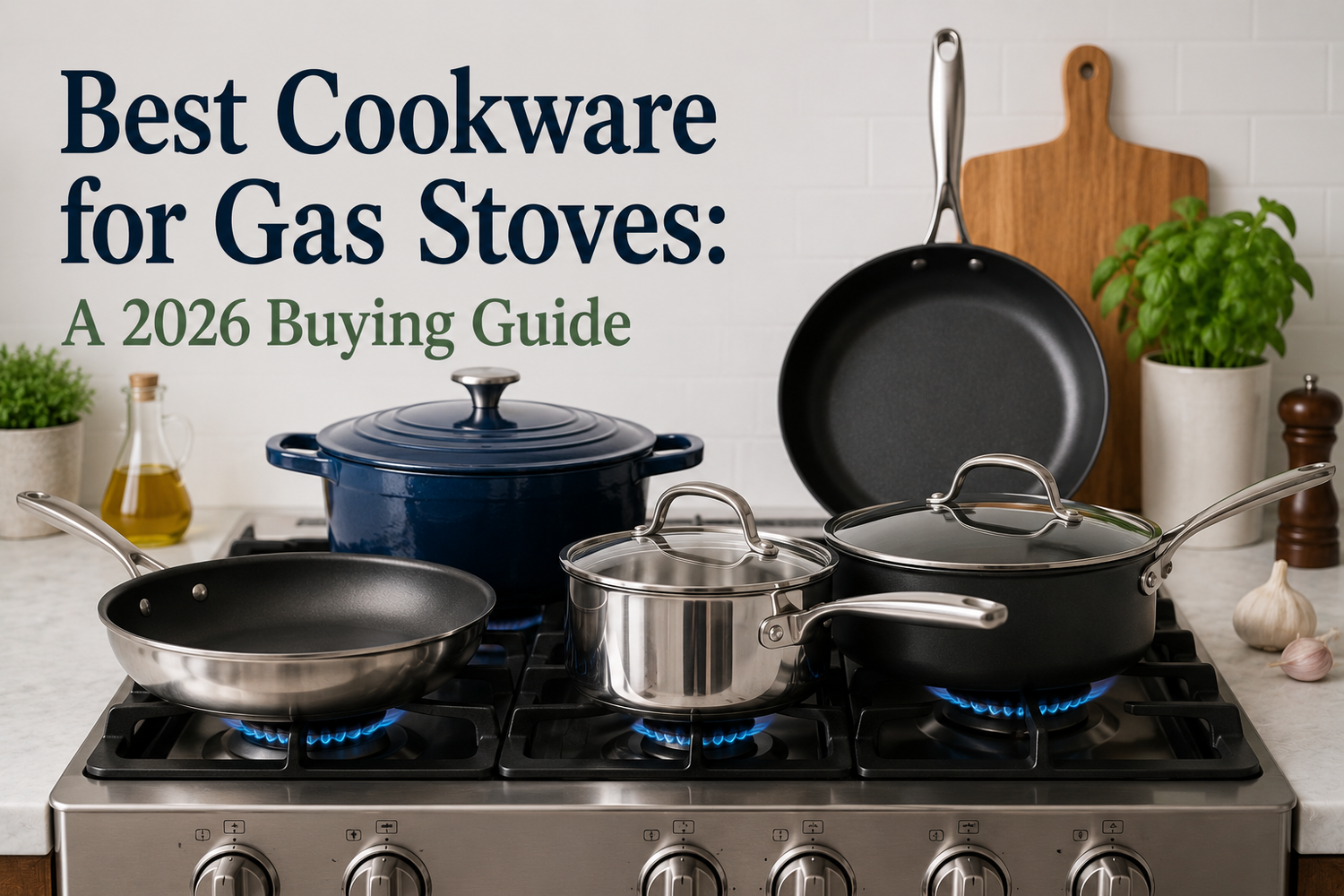
You're probably here because your current pan is doing at least one annoying thing on a gas stove. It scorches in the centre while the outer ring stays pale. It rocks on the grate instead of sitting flat. Or it looked fine in the shop, then started showing heat stains, rough hotspots, or a slight warp after a few weeks of normal use.
That usually isn't a cooking-skill problem. It's a cookware construction problem.
Gas is fast, flexible, and excellent for control, but it also exposes cookware to a very specific kind of heat: concentrated flame, quick temperature shifts, and direct contact around the base and lower sidewalls. That's why the best cookware for gas stoves isn't just about choosing a popular material. It's about choosing a pan that can handle how real residential gas burners behave, especially the moderate-BTU burners found in most homes.
Table of Contents
- Your Guide to Choosing the Right Cookware
- How Gas Stoves Challenge Your Cookware
- Evaluating Cookware Materials for Gas Cooking
- Pro Picks Versus Smart Buys for Your Kitchen
- Matching Pan Shape and Size to Your Cooking Style
- Maintenance and Safety on a Gas Stove
- Final Checklist and Frequently Asked Questions
Your Guide to Choosing the Right Cookware
Shoppers often consider cookware material alone. Stainless steel, cast iron, copper, non-stick. That's a start, but it misses the detail that matters most on a gas range: how the pan behaves over a live flame in an everyday kitchen.
One of the clearest gaps in typical buying advice is that it rarely connects cookware choice to burner output, flame spread, or the difference between entry-level residential gas ranges and more powerful setups, as noted in this discussion of cookware choices for real home gas stoves. That's why buyers often end up with cookware that sounds right on paper but feels frustrating in use.
A better way to choose is to filter every option through three simple questions:
- Will it stay flat and stable over time?
- Will it spread heat beyond the exact footprint of the flame?
- Will it suit what you cook most often?
If the answer to any of those is no, the pan won't feel like a good investment for long.
Practical rule: On a gas stove, the pan's construction matters at least as much as the material printed on the box.
For a first serious setup, keep the goal modest and sensible. You don't need a full wall of matching cookware. You need a few dependable pieces that can sear, simmer, sauté, and boil without fighting you. If you're still building out the rest of your kitchen, a simple kitchen essentials list for everyday cooking helps keep the purchase focused.
The rest comes down to understanding what gas heat does to a pan.
How Gas Stoves Challenge Your Cookware
Gas heat looks even from a distance, but it doesn't hit cookware evenly. A flame behaves more like a spotlight than a floodlight. It concentrates energy in a smaller area, and that matters a lot when the burner is narrower than the pan base.

Hot spots start at the centre
On many home gas stoves, the strongest heat lands near the middle of the pan bottom, or in a ring pattern that doesn't fully cover the cooking surface. If the cookware can't move that heat sideways, food browns too fast in one zone and lags in another. That's why pancakes end up dark in the centre and underdone near the edge, and why delicate sauces can catch in one patch even while the rest is still thin.
Lateral heat spreading is important. Fully clad cookware moves heat up and across the sidewalls, not just across a thick base. That gives the flame less opportunity to create one overheated centre zone.
Thin pans struggle with fast heat changes
Gas is responsive. Turn the knob and the flame changes immediately. That's useful for cooking, but it's tough on flimsy cookware. Thin metal expands and contracts quickly, and repeated heat shocks can pull a base out of flat.
Consumer Reports notes in its cookware buying guide that 3-ply or higher stainless steel is less likely to warp than thinner cookware. The same guidance also supports fully clad 3-ply or 5-ply stainless steel for gas stoves because the bonded layers through the sidewalls improve heat spreading and reduce hot spots under a flame.
If a pan can't tolerate quick heat changes, gas will expose that weakness fast.
Flame affects more than the base
A gas burner doesn't just heat the bottom. Flame can creep around the lower sidewalls, darken exterior finishes, and overheat exposed handle joints if the pan is undersized for the burner. That's one reason decorative coatings often age badly on gas, even when the cooking surface still works.
A good gas-stove pan usually has:
- A flat base that sits securely on grates
- Enough mass to resist warping
- Sidewall construction that helps move heat
- Handles and finishes that can live with open-flame cooking
These details sound technical, but they show up in very ordinary meals. Fried eggs. Weeknight pasta sauce. A quick chicken sauté. The pan either works with the burner, or it keeps reminding you that it doesn't.
Evaluating Cookware Materials for Gas Cooking
Material matters, but on gas, construction plus material is the answer. A well-built stainless steel pan can outperform a cheaper version made from the same metal, and a heavy cast-iron skillet behaves very differently from a lightweight non-stick pan even when both fit the same burner.

In Canada, gas and dual-fuel cooking remain common. Approximately 68% of Canadian households utilize gas or dual-fuel cooking ranges, and the market has long favoured stainless steel, copper, and cast iron for that reason. The same Canadian industry data also notes that 92% of professional Canadian chefs in gas-equipped kitchens prefer 3-ply or higher stainless steel because it handles rapid temperature changes without warping.
Fully clad stainless steel
If you want one answer that fits most homes, this is it. Fully clad stainless steel is the most balanced option for gas because it combines durability, non-reactivity, and better heat movement than thin stainless or disc-bottom pans.
It's especially strong for:
- sautéing onions without one burnt patch
- searing meat, then deglazing
- simmering tomato sauces
- moving between hob and oven
What works: a flat, heavy pan with 3-ply or 5-ply construction.
What doesn't: very light stainless with only a base plate. Those pans often heat unevenly when the flame doesn't fully match the pan diameter.
Copper
Copper is the responsive specialist. It reacts quickly when you raise or lower the flame, which makes it excellent for sauces, sugar work, and tasks where precision matters.
The trade-off is upkeep and cost. Copper also needs proper lining because raw copper is reactive. For many home cooks, it's a brilliant niche piece rather than the core of a set.
Kitchen reality: If you mostly cook eggs, pasta, vegetables, and weeknight proteins, fully clad stainless usually earns its keep more often than copper.
Cast iron
Cast iron shines when you want heat retention. Once hot, it stays hot. That's useful for deep browning, oven finishing, and foods that benefit from steady stored heat.
Its limits show up in daily convenience. It's heavy, slower to respond when you reduce heat, and less pleasant for quick pan work. On moderate home burners, it can also take time to heat through properly.
Use cast iron when you want:
- strong crust on meat
- cornbread or skillet baking
- high-heat roasting
- long heat retention at the table
Reach for something else when you're making a quick pan sauce or doing delicate temperature changes.
Hard-anodized aluminum
This is the lightweight workhorse. Hard-anodized aluminum heats quickly and is easier to handle than cast iron. On gas, that can be a real advantage for home cooks who want speed and lower weight without going to premium copper.
The issue is variation. Some hard-anodized pans are excellent. Others are thin, especially in lower-priced lines, and that's where hot spots and base distortion can creep in. It's worth checking thickness, handle attachment, and whether the base stays flat on a grate.
Traditional non-stick and ceramic-coated pans
These can still have a place, but they're not the long-term hero piece for most gas setups. Gas flame can be rough on coatings, especially if the flame licks up the sidewalls or the pan is routinely overheated.
That doesn't mean you need to avoid non-stick entirely. It means you should treat it as a specialised tool for lower-heat tasks rather than the backbone of your kitchen. If you're comparing coating types more closely, this guide to non-stick cookware options and trade-offs is useful background.
A small side note on tools: if you're building a practical stainless-based setup, something like the HAUTE CUISINE Stainless Steel Garlic Press - 80710-HC fits the same logic. It has a durable stainless steel build, comfort grip handles, and quick cleanup, which suits cooks who prefer straightforward, hard-wearing kitchen tools.
Here's a simple scorecard for gas-stove use:
| Material | Best use on gas | Main strength | Main compromise |
|---|---|---|---|
| Fully clad stainless steel | Everyday cooking | Balanced heat control and durability | Higher upfront cost |
| Copper | Precision tasks | Fast response | Expensive and higher maintenance |
| Cast iron | Searing and retention | Holds heat very well | Heavy and slower to adjust |
| Hard-anodized aluminum | Fast everyday use | Light and responsive | Quality varies a lot |
| Non-stick or ceramic-coated | Gentle, lower-heat cooking | Easy release | Coatings wear faster under flame |
For a visual walkthrough of construction differences, this video gives useful context before you buy.
Pro Picks Versus Smart Buys for Your Kitchen
A pro-grade pan and a smart-budget pan don't always differ in the ways shoppers expect. The biggest gap usually isn't branding. It's construction quality where gas heat is least forgiving.

Where it pays to spend more
Spend more on the pan that does the hardest jobs most often. For most kitchens, that's the skillet or sauté pan. This piece sees high heat, quick preheating, deglazing, repeated washing, and the most noticeable hot-spot problems if construction is poor.
A stronger buy usually includes:
- Clad construction rather than a thin body with a base disc
- A flat, weighty base that stays stable on grates
- Secure handle attachment that feels solid when the pan is full
- Enough thickness to resist thermal shock from fast burner changes
Canadian cookware standards started pushing the market in this direction decades ago. A government standard introduced in 1995 required cookware used on gas ranges to maintain structural integrity under rapid thermal stress, and by 2010, 88% of new cookware sets sold in the CA region were designed specifically for gas compatibility, including flat, stable bases to reduce wobble.
Where you can save without regretting it
Not every piece needs premium construction. A stockpot, for example, is usually heating liquid. That's a more forgiving job than browning fish or managing a pan sauce. You can often buy more modestly there without suffering much in day-to-day results.
Good places to save:
- larger stockpots used mostly for boiling
- backup saucepans for simple reheating
- lower-heat egg pans that you replace more often
Poor places to cut corners:
- your main frying pan
- your everyday saucepan for grains, sauces, and reheating
- anything that already feels unstable on the grate in the shop
Buy one pan you'll rely on for years. Save on the pieces that do gentler work.
The practical buying split
A sensible home setup often mixes one or two serious pans with a few less expensive support pieces. That gives you durability where flame stress is highest and keeps the overall purchase reasonable.
If you're choosing between a larger set and a better skillet, choose the better skillet.
Matching Pan Shape and Size to Your Cooking Style
The best cookware for gas stoves also has to fit the way you cook. A pan can be made from the right material and still be the wrong tool if the shape fights the burner or the food.
The everyday trio
Start with three forms that cover most real kitchens.
A skillet or frying pan handles browning, eggs, reheating leftovers, and fast meals. On gas, this is the pan where even heat spread matters most because the food sits directly across the cooking surface.
A saucepan is for grains, soups, oatmeal, beans, and small-batch sauces. Straight sides help with volume and evaporation control, but if you make cream sauces or anything that needs whisking into the corners, a saucier often behaves better because there are fewer tight edges for food to catch on.
A stockpot or Dutch oven takes care of pasta, soups, braises, and larger batches. If you cook stews, bread, or one-pot meals regularly, it's worth understanding what a Dutch oven is used for in everyday cooking, because it may replace several single-purpose pieces.
Match the burner to the base
On gas, pan size isn't just about capacity. It's about how the flame meets the bottom of the pan. If the burner is too small for the pan, the middle gets most of the heat and the outer area lags. If the burner is too large, flame can curl up the sides and overheat handles or exterior finishes.
A few practical habits help:
- Use your largest burner for your main skillet. That reduces centre-heavy heating.
- Keep smaller saucepans on smaller burners. They heat more efficiently and stay easier to control.
- Don't buy oversized pans for a compact stove. A wide pan that overhangs the burner pattern often cooks worse than a slightly smaller, better-matched one.
Shape affects stirring and scorching
Many guides on this topic are too generic. On a moderate residential gas stove, edge shape matters because the flame heats the lower sidewalls as well as the base.
For example:
- Saucier pans are excellent for risotto, custard, and pan sauces because the curved interior makes stirring easier and reduces food collecting in corners.
- Straight-sided sauté pans are better when you want surface area plus depth, such as browning chicken pieces and finishing with liquid.
- Woks only perform properly if your stove and the wok shape match. A flat-bottom wok can work on a home gas range. A traditional round-bottom version usually won't without the right support.
The right size and shape make a moderate burner feel more capable. The wrong one makes even expensive cookware feel awkward.
Maintenance and Safety on a Gas Stove
Good cookware lasts longer on gas when you manage flame, heat-up speed, and cleaning habits. Most damage comes from routine misuse, not dramatic accidents.

Daily habits that prevent damage
Preheat with a bit more patience than you think you need. A cold pan over aggressive flame is one of the fastest ways to stress the base. Medium heat for a little longer is usually better than blasting high heat from the start.
Keep the flame under the base. If it's climbing the sidewalls, you're wasting heat and punishing the pan finish, handle, and rim.
Check flatness occasionally. Set the pan on a cool, level surface or on your grate. If it rocks, spins, or no longer sits evenly, performance will suffer even before the damage looks dramatic.
Check this often: A stable pan is safer and cooks better. If it wobbles, don't ignore it.
Cleaning and finish care
Stainless steel will often show discolouration from high heat. That's normal on gas and not usually a sign of failure. It matters more whether the base remains flat and the cooking surface remains smooth.
For coated pans, avoid overheating and don't let empty cookware sit over flame. Gas gives fast control, but it also gives you enough heat to shorten the life of coatings quickly if you're careless.
For cast iron and carbon steel, keep seasoning maintained and dry thoroughly after washing. If cast iron is part of your lineup, this guide on cast-iron cookware care and routine maintenance covers the core habits.
Safety details worth checking before you buy
Not all handles behave the same over gas. Metal handles can get hot fast, especially if they're short or positioned low over the burner. Glass lids can be useful, but they need careful handling if exposed to abrupt temperature changes or direct flame contact near the rim.
Look for:
- Secure handles with no looseness
- Stable bases that sit confidently on your grates
- Oven-safe construction if you finish dishes in the oven
- Finishes you don't mind aging, because gas is honest and visible
The less delicate the exterior, the easier the cookware is to live with.
Final Checklist and Frequently Asked Questions
Quick answers buyers usually need
Can I use my existing non-stick pans on a gas stove?
Usually yes, if the flame stays under the base and you keep the heat moderate. They're just not the strongest long-term choice for repeated high-heat gas cooking.
Is stainless steel too sticky for everyday use?
Not once you learn heat and oil timing. A properly preheated clad stainless pan becomes much easier to use than many first-time buyers expect.
Do I need cast iron if I already have stainless steel?
Not necessarily. Cast iron is useful for heat retention and crust, but many home cooks can cover most meals with clad stainless and one specialised pan.
Are glass lids safe on gas?
Often yes, but they need sensible use. Avoid letting flame wrap around the sides, and don't shock a hot lid with sudden temperature change.
Buying checklist you can actually use
Bring this list into the shop or keep it open while browsing:
- Base stability: Does the pan sit flat without rocking?
- Construction: Is it fully clad, or only reinforced at the base?
- Weight: Does it feel substantial enough to resist warping without being annoying to lift?
- Burner fit: Does the base size match the burners you use most?
- Handle comfort: Can you grip it securely when the pan is full?
- Kitchen fit: Will it also work if you move to another hob type later?
- Cleaning reality: Are you willing to maintain seasoning or polish finishes if required?
- Use case: Are you buying this for searing, simmering, eggs, sauces, or boiling?
- Lid choice: Do you need one, and will it tolerate your normal cooking habits?
- Set discipline: Are you choosing pieces you'll use weekly, not just a larger box?
If part of your setup includes baking and oven-to-table cooking, it also helps to think about complementary pieces such as a ceramic baking dish for casseroles and roasting.
The short version is simple. For most households, the best cookware for gas stoves is a small, well-chosen group of pans with flat bases, durable construction, and shapes that match the way you cook. Start there and you'll avoid most expensive mistakes.
If you're narrowing down practical kitchen gear and want decision-friendly guidance instead of endless scrolling, GrifGlo organises cookware and home essentials around real use cases, comparisons, and buying criteria so you can choose what fits your kitchen with more confidence.

Leave a comment
This site is protected by hCaptcha and the hCaptcha Privacy Policy and Terms of Service apply.