


You're halfway through dinner prep, the tea towel has disappeared, and your recipe card is somewhere under the chopping board. An apron with pockets sounds like the obvious fix, until you bend to open the oven and a loaded pocket catches on the handle.
The right apron keeps useful items accessible without turning your clothing into a tool bag. Start with what you carry, where you need to reach it, and how you'll wash the apron. Pocket count comes last.
Table of Contents
- Apron Types and Pocket Placement
- Fabric and Durability for Daily Kitchen Use
- Sizing and Fit for Your Body and Kitchen
- Care, Repair and When to Retire Your Apron
- Home, Workplace and Bulk Buying Costs
- Pick Your Apron with Pockets in Four Checks
Apron Types and Pocket Placement
| Apron type | Pocket layout | Best for | Watch for |
|---|---|---|---|
| Bib apron with hip patch pockets | Two patch pockets at hip height | Everyday home cooking | Oversized pockets can catch on counters |
| Full-length bistro apron | Three or four front pockets | Hosting and restaurant service | More fabric to wear, and extra compartments to tidy |
| Half waist apron | One wide kangaroo pocket | Quick prep and baking | Little upper-body coverage |
| Cross-back apron | Multi-pocket panel | Artists, baristas and crafters | Straps need adjusting to stay put |
| Bib apron with side pocket | Zippered side pocket | Workshops and garden tasks | Zip hardware can scratch surfaces |
| Chef apron with towel loop | Pocket panel plus towel loop | Professional kitchens | Extra features may not justify the price |
These are layouts to compare, not guaranteed specifications for every apron carrying the same name. A bistro apron may have a simple divided panel, while another has deeper compartments. Check the actual product photographs and pocket dimensions rather than buying by style name alone.
Pocket position matters more than pocket count. A roomy compartment is inconvenient if your hand can't enter it while you're standing at the counter. It's worse if the pocket sits directly across your hip crease, where its contents press into you whenever you crouch.
The Canadian Centre for Occupational Health and Safety food-service guide treats clothing and personal protective equipment as workplace safety considerations. Apply that distinction when shopping: an apron's storage layout and its protective coverage are separate decisions.
Match the contents to the opening
Use this starting arrangement, then adjust it to your actual movements:
- Upper chest pockets: Suitable for a capped pen, folded order notes or a thermometer in its protective sleeve. Check that nothing tips out when you lean forward.
- Hip patch pockets: Useful for a dry cloth, recipe card or clean tasting spoon kept in a sleeve. Avoid loading them until the corners stand away from your body.
- Side zip pockets: Practical for a small tape measure during garden or workshop tasks. Cool tongs belong there only if the compartment securely contains them, handle-up, without projecting into your path.
- Wide front panels: Convenient for hosting supplies such as cloth napkins and a notepad. Dividers help stop small items from sliding beneath larger ones.
- Towel loops: Useful only when the hanging towel stays clear of doors, handles and heat. A loop isn't permission to trail fabric beside the hob.
Keep liquids, hot objects, glass and exposed knives out of every pocket. Loose cutlery belongs at the workstation rather than somewhere it can fall towards a burner.
More storage helps only when you can move normally with it loaded.
Check the loaded apron, not just the photograph
Put your intended nonhazardous contents into the pockets before deciding. Walk past a counter, turn sideways and crouch as though reaching a low cupboard. If a pocket catches, try a smaller opening or a position closer to the front of your body.
Inspect the upper pocket corners for bartacks, the dense reinforcing stitches that secure stress points. Look for even stitching and fabric that lies flat rather than puckering around the attachment. For workplace purchasing, wash a sample and repeat the movement test before ordering the batch.
Cooking equipment is the leading cause of home fires and injuries identified in CAL FIRE's cooking-safety guidance. Treat pockets as storage, never as protection from hot grease or a reason to bring hanging fabric near flames.
Before choosing a style, answer these questions: What will I carry? How much coverage do I need? How often will it be laundered? A half apron suits floury hands and quick preparation, but it won't cover a shirt during sauce-making.
Fabric and Durability for Daily Kitchen Use
| Fabric | Weight to check on the product listing | Durability | Care note |
|---|---|---|---|
| Cotton canvas | Look for the actual fabric weight, not simply “heavy-duty” | Holds pocket shape well | Wash at the permitted temperature; allow for shrinkage |
| Denim | Check whether it's light, flexible denim or stiff workwear cloth | Durable, but potentially heavy | Wash cold, inside out; colour can fade |
| Linen | Choose by opacity and drape as well as listed weight | Good for lighter use; softens with wear | Creases readily; air dry |
| Cotton-polyester blend | Confirm the weight and fibre proportions | Resists wrinkles; construction still matters | Use lower drying heat |
| Waxed or coated cotton | Ask for the base-fabric weight and coating details | Wipes clean; folds can stiffen or wear | Usually requires spot cleaning |
Fabric names don't establish fabric weight. Canvas can be supple or board-like, and denim can feel comfortable in the hand yet become tiring once you fill the pockets. Without a product-specific weight, don't assume that similar-looking aprons use equivalent cloth.
For most home cooks, cotton canvas is a sensible starting point because a firm weave supports pocket openings without excessive sagging. Denim suits someone who prioritises abrasion resistance and doesn't mind extra bulk. Linen makes sense in a warm kitchen when comfort matters more than a crisp, structured appearance.
Balance cleaning convenience against construction
Cotton-polyester blends suit buyers who dislike ironing, but use the listed care temperature rather than treating the synthetic content as permission for hot drying. Waxed and coated fabrics offer a different compromise: wiping away surface mess can be convenient, but a spot-clean-only apron is awkward when flour and food collect inside the pockets.
A compact countertop appliance illustrates why the whole working area matters, not just the apron fabric.
Choose tightly woven, low-pile cloth rather than fuzzy pocket trim for cooking. That's a sensible screening preference, not proof that a particular apron is flame-resistant.
Under Health Canada's textile flammability guidance, plain-surface textiles must achieve a flame-spread time greater than 3.5 seconds, while raised-surface textiles that ignite or fuse at the base must exceed 4 seconds. These are laboratory compliance thresholds, not safe exposure times for someone wearing an apron.
Ask about the finished construction
Pockets introduce folds, seams and additional layers. For food-service purchasing, request compliance evidence relevant to the finished textile construction rather than accepting a fibre-content label as sufficient documentation.
Ask the supplier where the apron was made and what they can document about their production arrangements.
Sizing and Fit for Your Body and Kitchen
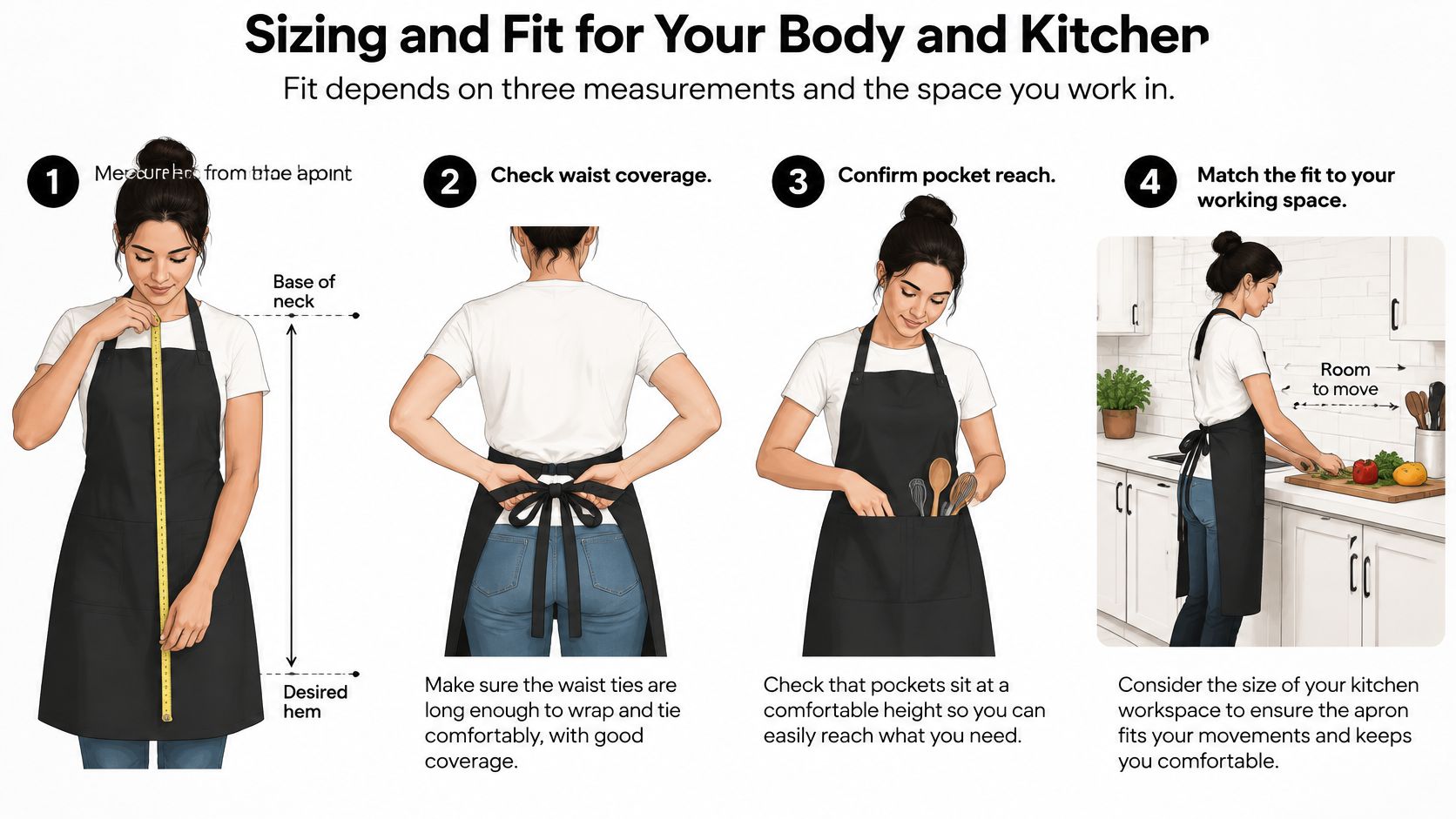
- Measure the intended length. Run a tape measure from the base of your neck down to your preferred hem. Around the knee is a useful starting point for everyday coverage; a longer bistro apron should still allow an unrestricted stride.
- Measure over cooking clothes. Take your waist measurement while wearing the clothes you'll use underneath. A winter jumper changes the fit, especially when you wrap ties around to the front.
- Check the adjustment system. Confirm that the neck strap can place the bib where you want it without pulling against your neck. On a cross-back design, check how tightening the ties changes both the chest coverage and pocket height.
- Confirm usable tie length. The ties should fasten securely without bunching the apron into a thick knot. If you prefer a front bow, don't assume ties shown fastened behind the model will reach comfortably around you.
Use the measuring routine below to compare the garment with both your body and your workspace.
Test the fit in working positions
An apron that looks tidy when you stand still can bunch when you move. Bend towards a low shelf, reach towards an upper cupboard and turn as though transferring a chopping board to the sink. The bib shouldn't pull sharply, and the waist shouldn't ride up over the pocket openings.
Check pocket access with your usual hand, too. If retrieving a notepad requires lifting the apron or twisting your wrist around the opening, the layout isn't right for you, even if the overall size fits.
Fit test: You should be able to forget about the apron while moving, not keep adjusting it between tasks.
Leave room for doors and narrow walkways
In a crowded rental kitchen, test the hem against the oven and dishwasher doors when they're open. A shorter apron can be easier to manage, provided it still covers the clothing you want to protect. Avoid solving excess length by repeatedly folding the waist, which can shift the pockets into an awkward position.
For a visual fitting reference, use the video alongside your own measurements.
For staff orders, compare the garment's stated length, width and tie arrangement with the people who'll wear it. A label such as universal size doesn't replace a usable size chart. Let staff try a sample over their work clothes before committing to a standard style.
Care, Repair and When to Retire Your Apron
Empty every pocket before washing. Turn the pocket lining or opening out far enough to remove crumbs, flour and forgotten paper, then turn the apron inside out. Fasten adjustable hardware so it doesn't strike the drum or catch other laundry.
Work liquid laundry detergent gently into greasy marks before washing, testing an inconspicuous area first. Our guide to removing stains from clothes can help you choose a treatment for the actual stain rather than scrubbing the whole apron aggressively. Avoid hot drying while an oily mark remains.
For machine-washable canvas, use warm rather than hot water only when the care label permits it. Coatings, trim and dyed fabrics may require cooler washing or spot cleaning. Open the pockets during drying and make sure the inner corners are fully dry before putting the apron away.
Repair the attachment before it tears
A loose pocket corner is often repairable while the surrounding fabric is sound. Use a needle suited to the cloth, matching sewing thread and a small fabric patch if the attachment area has weakened.
- Secure loose stitching: Trim dangling thread and restitch along the existing seam through sound fabric.
- Reinforce the corner: Add a short, dense line of stitches across the stressed attachment point. Don't repeatedly stitch into cloth that's already splitting.
- Support a weak area: Place a backing patch behind it, then sew through the reinforced area rather than relying on the frayed edge.
- Test gently: Reload the pocket with its normal contents and check that the repair lies flat.
There's no honest universal repair-time or lifespan promise. A cleanly detached seam is a different job from torn fabric beneath a loaded pocket.
Retire for failure, not appearance
A stubborn tomato stain doesn't automatically make an apron unusable. Replace or retire it when the neck adjustment won't hold, a critical seam has no sound fabric left for repair, or repeated folding has worn the cloth thin.
Before disposal, consider whether replacement ties or a new patch pocket would restore function. Remove hardware only if the receiving collection programme asks for it; don't assume mixed fibres can be separated at home.
Check whether your local textile collection accepts worn aprons. Donate a clean, usable apron if a local organisation accepts it.
A higher purchase price isn't an environmental credential. Accessible seams, replaceable ties and a repairable pocket are more useful evidence.
A straightforward cotton or linen design may be easier to maintain than a laminated, heavily decorated apron. Choose it for repairability, not an unsupported promise that every natural-fibre garment will be accepted for recycling.
Home, Workplace and Bulk Buying Costs
| Apron option | Listed price | Pack | Source note |
|---|---|---|---|
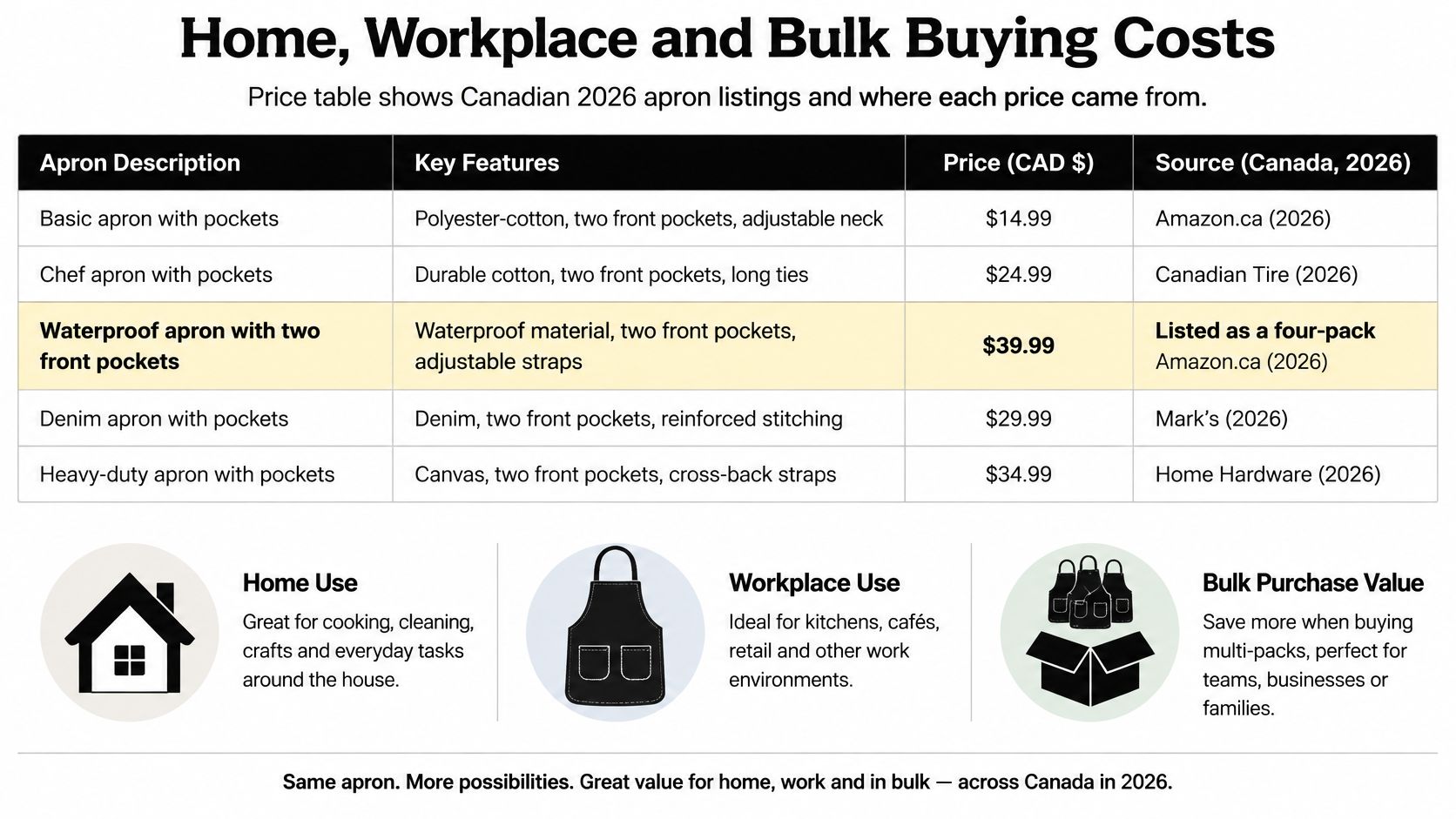
| Waterproof apron with two front pockets | CA$22.99 | Four-pack | Amazon Canada listing, 2026 |
| Artist's apron with multiple pockets | CA$22.99 | Single apron | DeSerres listing, 2026; released February 2025 |
| Cross-back canvas chef apron with multiple pockets | CA$31.97 | Single apron | Amazon Canada listing, 2026; first available July 30, 2024 |
| Full-length bistro apron with pocket panel | Obtain a current quote | Confirm with seller | No reliable listing available for comparison |
The multipack works out to about CA$5.75 per apron, calculated from the Amazon Canada price and pack size in the table. That's a useful entry-price benchmark, not evidence that its coating, stitching or wash life matches the more expensive options.
The comparison below puts the listed options into a purchase-planning format.
Compare cost against actual wash life
Cost per usable wash cycle equals purchase cost divided by completed wash-and-use cycles before replacement. Add repair and laundering expenses if you're comparing workplace options with different cleaning requirements.
The important word is actual. None of these listings establishes a comparable wash-life result, so don't turn price differences into durability claims. Keep a simple replacement record showing why an apron failed: tie damage, coating deterioration, pocket tearing or unacceptable shrinkage.
A cheap apron that remains comfortable and functional can be good value. A heavier apron isn't automatically better value if staff avoid wearing it.
Buy differently for home and shared use
For a home cook, spend first on a comfortable garment and suitable cloth. Paying for extra compartments makes little sense when you'll leave them empty. A lighter apron can be perfectly adequate for occasional baking or meal preparation.
For a café, office pantry or cleaning team, consistency matters more. Request the following in writing before approving a batch:
- Garment specifications: Fabric composition, listed weight, dimensions and adjustment arrangement.
- Pocket layout: Opening sizes, compartment positions and reinforcement details.
- Cleaning requirements: Permitted wash and drying methods, including restrictions on coatings.
- Replacement consistency: Whether a later order can match the approved sample.
Keep clean spares available while used aprons are being laundered. Our wholesale kitchen supplies guide offers a broader starting point for organising shared-kitchen purchases.
Treat the table as a listing snapshot, not a live quotation. Check the current price, delivery charges, pack quantity and return conditions at checkout, especially when a product page offers several styles under the same listing.
Pick Your Apron with Pockets in Four Checks
- Match storage to the task. Make a short list of what needs to travel with you. If you're comparing aprons online, measure those objects and ask for pocket dimensions when the listing doesn't provide them. Reject layouts that require you to carry awkward items just because there's space.
- Confirm what you're buying. Look for a clear fabric description, product-specific weight and useful construction photographs. For a food-service team, include finished-construction compliance documentation in the purchasing requirements. Attractive close-ups aren't a substitute for specifications.
- Verify the working fit. Compare your measurements with the garment chart, then try the apron in the positions your kitchen demands. An easy return matters when you can't assess the garment in person. Keep packaging until you're satisfied with the fit.
- Plan ownership beyond delivery. Read the cleaning instructions before ordering. Decide whether you're willing to spot-clean a coating or manage adjustable hardware, and look for seams you could realistically repair. The best choice fits your maintenance routine as well as your body.
Choose for the kitchen you actually have
For renters, prioritise an apron that stays within your working space. If the kitchen has a narrow aisle and low cupboards, a manageable hem and uncomplicated straps are more useful than a dramatic full-length silhouette. Choose lighter cloth if you tend to remove heavier garments halfway through cooking.
For hosts, separate preparation from service. A bistro apron can keep napkins and a notepad accessible while leaving the upper body uncovered, but that makes it a different choice from a bib apron worn for messy cooking. Don't pay for kitchen-level coverage if the main task is carrying plates and checking the table.
Keep the specification simple
When several people need the same style, our product standardisation guide can help turn preferences into a repeatable purchasing specification. Record the approved fit, material and layout rather than relying on a product name that may cover several versions.
Before paying, check the current listed price, size chart and return policy. Save the specification with the order so you can compare what arrives with what you selected. A useful apron with pockets should make an ordinary cooking session less fiddly, not introduce another piece of equipment you have to manage.
GrifGlo offers practical comparisons and sizing guidance to help you choose essentials around real routines. Visit GrifGlo to explore our Kitchen collection, including Cookware, Knives & Sharpening, Kitchen Appliances, Racks & Holders, Food Storage, Cutting Boards and Kitchen Tools & Gadgets, and organise your workspace around what you use most.



Leave a comment
This site is protected by hCaptcha and the hCaptcha Privacy Policy and Terms of Service apply.